
Chapter 20 of 25 · Lessons for the Young Economist by Robert P. Murphy
LESSON 20 The Economics of Drug Prohibition
In this lesson you will learn:
- The definition of drug prohibition.
- Why drug prohibition fosters corruption and gang violence.
- Why drug prohibition reduces product safety.
Drug Prohibition
Drug prohibition refers to the severe penalties that governments often impose on the consumption and especially the production and sale of certain drugs. Drug prohibition is qualitatively different from U.S. state and local government’s current use of sin taxes—very high sales taxes—to discourage people from buying liquor and cigarettes. In the modern American regime of drug prohibition, the possession and especially commercial distribution of drugs such as cocaine and heroin are outright crimes, punishable not only by huge fines but also lengthy prison terms.
As the title states clearly, in this lesson we are going to examine the economics of drug prohibition. Using the tools we have developed in this book, we will be able to understand why drug prohibition leads to a familiar pattern of results. In contrast, someone ignorant of economics would be at a loss to explain the pattern. Instead the results of drug prohibition would appear as random occurrences, having nothing to do with the government policies.
We should stress at the outset that economic analysis by itself cannot judge whether drug prohibition is a good or a bad policy. Ultimately citizens and policy makers must incorporate their value judgments before deciding whether it is good or bad for the government to, say, punish convicted cocaine dealers with 25-year prison sentences. However, in order for citizens and policy makers to make informed decisions, they must understand the full consequences of drug prohibition.
When it comes to illicit drugs, the question is not: “Would it be better to live in a society with or without cocaine?” That particular question is not relevant, because the government is powerless to stamp out cocaine use completely. Rather, the crucial question is this: “Would it be better to live in a society with or without extreme penalties for cocaine use?” In order to imagine what society would be like in one condition versus the other, it is important to learn what economic analysis says about the effects of drug prohibition. Remember that there is a difference between saying something is immoral versus saying it should be illegal. If someone argues that cheating on one’s wife shouldn’t carry a jail term, that person isn’t thereby condoning adultery.
One final caveat before we plunge into the analysis: In the rest of this lesson we will be focusing on the (usually neglected) negative consequences of drug prohibition. We are doing this because the positive consequences of drug prohibition are obvious and visible: Many people believe that the use of certain drugs is personally and socially destructive, and so they conclude that government policies which strongly discourage this behavior are (other things being equal) beneficial. The analysis below is designed to show the ways in which other things are not equal when the government engages in drug prohibition. The benefits of reduced and/or stigmatized drug use must be contrasted with the harms of police corruption, gang warfare, and deaths from overdoses—things which most people would also deem personally and socially destructive.1
Drug Prohibition Corrupts Government Officials
In this context, corruption refers to government officials who do not execute their legal duties because they are secretly being paid by members of the drug trade whom they are supposedly combating. Most Americans are aware of the widespread corruption in the Mexican and Colombian governments, but many Americans would be shocked to learn that there is a (less severe) problem of corruption plaguing U.S. courts and police departments.
The straightforward explanation for the connection between drug prohibition and corruption is that prohibition leads to huge monetary profits in the drug industry, giving drug producers the ability (and of course the motive) to pay enormous bribes to government officials. Simple economic analysis will illustrate why.
Typically, governments try to stamp out the drug trade by inflicting much heavier penalties on suppliers rather than consumers. This emphasis is due to two main reasons: (1) If the goal is to limit total drug consumption, it is a better use of limited police resources to knock out one major supplier rather than the potentially thousands of customers who rely on him, and (2) the public doesn’t mind harsh penalties on professional drug dealers, but would balk at draconian punishments of casual consumers. These two factors explain why governments typically enact much higher penalties for those who are obviously drug dealers, as opposed to those who are caught with only a smaller quantity of the contraband, intended for personal use.
In addition to the higher official penalties on drug producers versus consumers, we must also consider that the likelihood of actually being arrested is much higher for a professional drug dealer, than for a casual customer.2 After all, the professional drug dealer—especially the larger the operation—must deal with many other members of his industry, be they higher-level suppliers or lower-level retailers. For example, one member of the drug trade might run an operation where he buys cocaine from Colombian “wholesalers,” hires Mexican truck drivers to smuggle it across the U.S. border, and then sells fractions of what gets through to the heads of regional drug gangs in California. If Colombian, Mexican, or U.S. anti-drug forces should penetrate any portion of this extensive operation, the particular dealer would be vulnerable to arrest. His entire workday involves the habitual violation of anti-drug laws. In contrast, the casual customer is really only at risk when he needs to purchase more product, and he only interacts with other “small fish” such as a neighborhood dealer. There is much less chance of his life being ruined by government punishment for his involvement in the drug industry.
Police Corruption: It’s Not Just a Problem for Mexico
The following excerpts from a 2008 news article about an FBI sting in the Chicago area illustrate the connection between drug enforcement and police corruption:
Seventeen people—including 15 south suburban police officers—have been charged in a federal probe of allegations that officers provided armed security for large-scale drug deals. The officers apparently thought they were protecting high-rolling drug dealers. It turned out they were actually FBI agents.
All 17 were charged Tuesday with conspiracy to possess and distribute kilogram quantities of cocaine and/or heroin in eight separate criminal complaints unsealed following arrests early Tuesday, according to a release from the U.S. Attorney’s office.
Ten sheriff’s correctional officers—sworn personnel that worked the jails and lockups—have been charged with criminal conspiracy. The Feds say the sheriff’s officers along with four police officers from Harvey and one Chicago cop were caught in an FBI sting.
“An undercover FBI agent was able to deal with not one, not two, but 15 different law enforcement officers who sold out their badge in a greed [sic] for money to help drug dealers do their business,” said U.S. Attorney Patrick Fitzgerald.
Prosecutors say the officers took up to $4,000 in payoffs to act as lookouts and protection when what they thought were big drug deals were going down.
Seven of the eight complaints were supported by a single, 61-page FBI affidavit that outlines an undercover investigation that involved such activity as police officers protecting a high-stakes poker game, protecting transportation of large amounts of cash and two law officers actually selling powder cocaine, in addition to the routine activity of providing security for purported narcotics trasactions, the release said.
According to a release, a six-passenger, twin propeller engine aircraft flew on May 13 into west suburban DuPage Airport where three men awaited its arrival. Two of them... accompanied someone whom they believed brokered large-scale drug transactions but, in fact, was an undercover FBI agent, the release said. They boarded the aircraft, operated by two other undercover agents, and began counting packages of what was purported to be at least 80 kilograms of cocaine inside four duffel bags.
[The two Cook County correctional officers] and the undercover agent removed the duffels from the plane and took them through the airport lobby to the trunk of the agent’s car in the parking lot, the affidavit alleges. [The two officers], in a separate car, followed the agent to a nearby parking lot, where the agent parked and got into the officers’ vehicle. Together, the trio watched as yet another undercover agent arrived, removed the duffels and drove away. The FBI agent posing as the drug broker then paid [the officers] $4,000 each—allegedly their most profitable payday in the corrupt relationship they began with the undercover agent at least a year earlier.
Of the 17 defendants, 10 are Cook County Sheriff’s correctional officers, four are Harvey police officers and one is a Chicago police officer. They allegedly accepted between $400 and $4,000 each on one or more occasions to serve as lookouts and be ready to intervene if real police or rival drug dealers attempted to interfere with transfers of cocaine and heroin, according to the affidavit.
“Ideally, it should be hard to find one corrupt police officer and it should never be easy to find 15 who allegedly used their guns and badges to protect people they believed were dealing drugs instead of arresting them,” U.S. Atty. Patrick Fitzgerald said in the release. “And the involvement of some in off-loading and delivering what they thought were large shipments of drugs flown in by plane is particularly shocking.”
Source: CBS 2, “15 Cops Charged in FBI Sting, Drug Dealing Probe,” December 2, 2008 at http://cbs2chicago.com/local/harvey.police.raid.2.877798.html.
Because of these disparities in the effective penalties facing drug producers versus consumers, the supply of illegal drugs falls much more than the demand, relative to an initially unregulated market. This pushes up the new equilibrium price of illegal drugs, meaning that the monetary “markup”—the difference between the monetary expenses to produce the product, versus the actual payment that the end users give in exchange—becomes quite high. The following diagram illustrates the hypothetical unregulated, versus prohibited, market for cocaine.
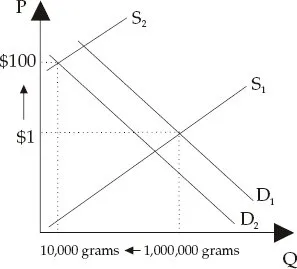
Market for Cocaine
In the previous diagram, we see that the unregulated market price of cocaine is initially $1 per gram. At that price, producers want to sell 1 million grams of cocaine, and consumers want to buy 1 million grams.
After the imposition of strict drug laws, the supply and demand curves for cocaine both shift to the left. That is, for a given dollar-price of a gram of cocaine, producers are willing to offer much less than before (since they now risk going to jail), and consumers are not willing to buy as many grams either. However, the quantitative shift is much greater on the supply side than the demand side. That is why the new (prohibition) equilibrium has a market price of $100 per gram, where producers want to supply 10,000 grams and consumers want to buy the same amount.
A crucial point is that the monetary profit will remain high, even years after the drug prohibition has gone into effect. The supply curve in the diagram above shifted to the left because of the non-monetary risks associated with remaining in the cocaine business. The higher price paid by customers will therefore not translate into higher prices paid to the farmers in Colombia who harvest coca. No, the huge markup must remain, in order to make it worthwhile (in the eyes of some) to remain cocaine producers even in the face of significant penalties.
In the new equilibrium, it’s not true to say that “it’s now more attractive than before to become a cocaine dealer.” People choose occupations based on many factors, only one of which is how much money they will typically earn. It’s more accurate to say that because of the new government penalties (and presumably the corresponding social stigma), the “salaries” of drug dealers had to skyrocket in order to compensate for the new downsides of the profession. This principle is not unique to illegal drugs—coal miners and taxi drivers (who are often robbed) receive an implicit form of hazard pay as well. The difference is that with illegal drug dealers, the hazard comes not from nature or muggers, but the government judicial system.
The Significance of “Victimless Crimes”
It is important to note that the scope for government corruption due to drug prohibition is much larger than for more traditional crimes such as homicide and robbery. Indeed in the United States, to talk of a “dirty cop” is almost synonymous with one who takes drug money; no one would think that the term might refer to a police officer who is regularly paid off by contract hit men so that they can murder with impunity 6 days a week. Yet criminal gangs do routinely pay off police and other government officials in order to run major drug operations with official (though of course discreet) protection.
To understand this disparity we need to reflect on the common remark that illegal drug transactions are “victimless crimes.” Naturally the supporters of drug laws would reject this phrase as an inaccurate cliche, since children are certainly victims if their father loses his job and becomes abusive due to addiction. But there is a definite sense in which the production and consumption of drugs is qualitatively less victimizing than traditional crimes such as homicide, rape, and robbery. The difference is that in a “victimless crime”—which in the United States includes not only drug transactions but activities such as gambling and prostitution—all parties to the transaction are voluntary participants. This feature has two major implications, both of which help explain the connection between drug prohibition and corruption.
First, there is the simple fact that police officers, judges, and other government officials won’t feel as bad “looking the other way” for someone who supplies desired products to willingly paying customers, as they would for ignoring their official responsibilities to prevent nonconsensual crimes against person or property.
Second, the drug trade is after all a business. There are many millions of people in the United States who willingly spend their money on illegal drugs on a regular basis. According to the Office of National Drug Control Policy, a 2007 survey showed 6% of young adults reported using cocaine within the previous year, and 2% had used cocaine within the past month.3 There is quite simply much more money in the drug business, than in the hit man or even bank robbery “businesses.” Because it is victimless in the important sense defined above, the drug trade can be much more easily kept quiet than crimes with explicit victims who would call the police—and might get someone who wasn’t on the criminals’ payroll—or, failing that, could go to the media and complain.
We mention these differences to deal with a standard defense of drug prohibition which says, “Well if we should legalize drugs because of corruption, why not legalize murder too?” As we have shown above, the scope for corruption due to drug prohibition is far larger than for traditional crimes, and the difference stems from the “victimless” nature of drug crimes. This difference by itself doesn’t prove that drugs should be legalized, but it does show a problem of drug prohibition that is not nearly as rampant with other crimes.
Corruption as Cause and Consequence
Most people abhor systemic government corruption because it breaks down traditional respect for the law and makes citizens more likely to commit crime. However in the context of drug prohibition there is a much more specific dynamic at work. Government corruption is both a consequence and a cause of illegal drug trafficking.
Here’s how the feedback cycle works: We have already seen that drug prohibition typically raises the market price of (newly illegal) drugs, because the supply curve shifts left far more than the demand curve. This skyrocketing price allows entrepreneurs to earn millions of dollars annually, giving them the wherewithal to bribe government officials who otherwise could arrest them. This is the sense in which corruption is a consequence of illegal drug trafficking.
However, it’s also true that corruption is a necessary component of illegal drug trafficking, and in that sense is a cause of it. In truly oppressive regimes—such as Afghanistan under Taliban rule—the drug trade can be snuffed out by the government. If the penalties were high enough and consistently enforced, then supply and demand could be reduced so much that the new equilibrium quantity of, say, cocaine production and consumption would be zero. Yet in practice this rarely happens, because the government itself can’t police its own employees, when they might be offered literally hundreds of thousands of dollars per year to shirk their official duties.
Widespread corruption allows drug criminals to escape the huge official punishments that the law books require, and thus the supply curve for illegal drugs does not shift as much as it would in the absence of corruption. To put it succinctly, under drug prohibition in relatively free societies, the supply curve shifts left until the new market-clearing price is high enough for the remaining producers to afford adding narcotics officers and judges to their payrolls.
Drug Prohibition Fosters Violence
Everyone knows that the illegal drug trade is plagued by excessive violence, often in the form of gang warfare. Worse still, innocent bystanders are often killed as collateral damage from turf battles between rival drug dealers. The casual observer might conclude that drugs such as cocaine and heroin are intrinsically bad, and go hand-in-hand with violence. Yet this explanation is wrong. Both economic theory and American history demonstrate that drug prohibition causes violence, not drugs per se.
Alcohol Prohibition in the United States
The historical evidence is clear enough in the case of alcohol Prohibition. From 1920 to 1933, under the Eighteenth Amendment to the Constitution,4 the sale, manufacture, and transportation of alcohol (for purposes of consumption) was illegal in the United States. Yet despite the official illegality, alcohol was still produced and distributed by bootleggers, and drinkers could still gather socially at speakeasies.
Although Prohibition didn’t eliminate alcohol use, it did place the industry under the control of organized crime. During the Prohibition period—often called the “Noble Experiment”—mobsters such as Al Capone (based in Chicago) derived significant revenues from the illicit alcohol trade, money that they used to bribe government officials and hire “soldiers” and other henchmen for their criminal networks.
For our purposes, the important feature of alcohol Prohibition was that the alcohol trade could be as violent as the heroin or cocaine trade is today. The infamous St. Valentine’s Day Massacre was a 1929 gangland hit in which Al Capone arranged for the murder of seven members of rival Bugs Moran’s operation. Historians cite various motivations for the slayings, but all agree that Capone and Moran were enemies due in part to rivalry in the bootleg market.
If you have seen movies or read true crime accounts dealing with Prohibition-era gangsters, these historical events are familiar and do not cause any puzzlement. Yet on the surface it should be shocking that rival entrepreneurs would try to kill each other over alcohol. Can you imagine turning on the television tomorrow and learning that the distributors of Budweiser had ordered a hit on the distributors of Heineken? That would be inconceivable.
Alcohol is no longer controlled by organized criminals, but instead by legitimate businessmen and women. Now that alcohol is legal, its producers try to gain market share by improving the product quality or cutting its price. It wouldn’t even occur to them to use violence to gain more customers.
On the other hand, what activities do we see in the hands of criminal organizations? They include drugs such as heroin and cocaine, prostitution, gambling, and loan sharking.5 In short, all areas that are still (unlike alcohol since the repeal of Prohibition) either prohibited or heavily regulated by the government.
The historical episode of alcohol Prohibition provides very compelling evidence that the violence we currently associate with illegal drugs is due to government’s prohibition, not to the nature of the products themselves. In the remainder of this section we’ll explain this undeniable connection using economic reasoning.
Drug Prohibition Raises the Marginal Benefits of Violence
We have already seen how prohibition raises the monetary earnings of drug dealers. Among its other consequences, this increase in price translates into a much greater benefit from boosting sales and controlling a greater share of the retail market.
In a regular, legal market, competition tends to drive down the price until the monetary returns are comparable to that of other projects. Because there is usually such a small “markup” from the production expenses compared to the retail price, most legitimate business owners don’t see significant increases in their monetary profits by “stealing” a few customers away from their competitors.
In contrast, a cocaine dealer sees an enormous increase in his total monetary earnings if he can add a handful of regular users to his customer base. This is because the expenses in his business are largely fixed, meaning they are the same whether he sells 10 grams of cocaine per day or 100 grams. And note that this feature is greatly amplified by prohibition itself, because when cocaine distribution is illegal, the primary “business expenses” are mental ones, namely the risks of going to prison or being killed by a rival dealer.
Because it makes individual customers so much more lucrative, drug prohibition increases the benefits (on the margin) from using violence to intimidate or actually kill competitors. This is one of the major explanations for why prohibited industries tend to be rife with violence, whereas legitimate businesspeople almost never resort to violence as a means of competing.
In a typical treatment of the economics of drug prohibition, the writer will often explain that producers in prohibited industries cannot rely on police protection and contract enforcement, and so must resort to private violence to protect their merchandise. Explanations of this sort often cast the drug industry as one suffering from “government neglect,” and into this anarchy violent gangsters flow.
Such explanations have things backward. There are plenty of commercial relations in everyday life that are not protected by government courts. Using eBay, Amazon, and other mechanisms, Americans spend billions of dollars per year buying items—often of high value—from perfect strangers who might live across the country. In principle someone could file a lawsuit in the event of fraud, but in practice these transactions are largely “self-policing” through the private-sector hosts and the sometimes elaborate system of reputation that they develop.6
It is completely inverted to view prohibited industries as suffering from a lack of police and judicial oversight. On the contrary it is precisely these industries that receive the most government attention! It is simply not true that the police ignore drug dealers, even in inner city projects. If it were true, then the market price of drugs in these areas would fall to (nearly) the monetary production costs, and young teenagers would find being a drug dealer to be no more lucrative than becoming a paper boy. The police are not viewed as friendly servants of the public in certain drug-ridden neighborhoods, but they definitely enforce drug laws, if only sporadically—that’s why the market price stays high, allowing drug dealers to buy fancy cars and expensive jewelry.
It is true that given the prevalence of violent drug dealers, anyone with the temerity to enter the industry and try to earn significant amounts of money must himself become heavily armed and gain a reputation for ruthlessness, because he can’t look to the police for protection. But again, this observation is surely only incidental. It doesn’t explain why the drug industry is rife with violence in the first place. The average dry cleaner doesn’t worry about a rival from across town spraying his shop with machine gun fire, and his confidence in this regard is not simply that he could call government detectives who would find and punish the drive-by shooters after the fact.
No, the real reason that dry cleaners don’t compete using violence is that it wouldn’t be worth it. In contrast, drug prohibition makes it “worth it” for cocaine producers to kill each other.
Drug Prohibition Lowers the Marginal Costs of Violence
Another aspect to the connection between violence and drug prohibition is that on the margin, prohibition lowers the cost of an individual violent act. Consider this: Part of the reason that a major Budweiser distributor wouldn’t take out a contract on the life of his Heineken rival is that such a move would completely transform his own life. As a legitimate businessman, he could travel in respectable social circles, and assuming he had paid his taxes properly, he would be under no threat of going to jail for the rest of his life. In this situation, committing the heinous crime of paying to have someone murdered would be incredibly risky.
In contrast, the head of a cocaine distribution network has already committed more than enough crimes to go to jail for life if he should ever fall out of the good graces of the police on his payroll, or become the target of higher-level government officials whom he cannot bribe. Because he must associate with other habitual lawbreakers, he does not worry nearly as much that violent acts will ruin his social standing in respectable circles—he forfeited that option when he decided to become a large-scale drug dealer.
Another important consideration is that the illegal drug dealer must develop a network of relationships with criminals, allowing him to much more easily recruit “soldiers” or arrange for professional hit men to carry out violent attacks on his rivals. In contrast, the legitimate businessperson would probably have no idea how to have someone murdered with little chance of being caught; it’s not as if he would trust the top hit when searching Google for “contract killer.”
Finally, the nature of the black market makes violence a much more practical option. If cocaine and other drugs could be sold legally, then retail shops could operate safely even in the toughest of neighborhoods using security measures such as bulletproof partitions separating customers from employees. In contrast, with drug prohibition the “employees” of drug operations often operate on the streets, making it less costly for their competitors to attempt to wipe them out.
The Feedback Loop of Violence
As with corruption, there is a dynamic at work in which violence begets violence in the (prohibited) drug trade. By discussing the changing benefits and costs of engaging in violence, we may have made it seem as if the same people would sell drugs with or without drug prohibition, and that it was the change in government policy that transformed mild-mannered executives into ruthless crime bosses.
Obviously this is not the real story. In practice what happens is that drug prohibition chases away honest and nonviolent people from the industry. As more and more of them leave, the supply of (illegal) drugs shrinks further and further, driving up the price. Yet this creates an opportunity for new entrepreneurs to enter the market. They are not necessarily the best businessmen, conventionally defined; they probably couldn’t compete in a normal market and rise to the top. Yet what they are good at is outwitting and outmuscling their competitors, and at corrupting government officials. In the prohibited drug industry, these are indispensable skills. People who in other walks of life would have been unemployable suddenly have an opportunity to use their “talents” to earn millions of dollars.
Because the prohibited drug trade attracts violent individuals who think of immediate payoffs and disregard long-term consequences, it should come as no surprise that over many years, prohibition fosters a subculture of gang warfare.
Violence From the Consumer
Thus far we have focused on the violence coming from producers in the drug trade. But it is also worth noting that violence from drug consumers will also tend to rise because of prohibition, simply because of the huge price increase. When there are addicts willing to do just about anything to get their next fix, citizens should think twice before recommending government policies that make cocaine up to 1,000 times more expensive than it would otherwise be.
Drug Prohibition Reduces Product Safety
Yet another unintended consequence of drug prohibition is the increase in injury or death from product impurities or consumer mistakes. For example, in 1920—the year alcohol Prohibition was introduced in the United States—the national death toll from liquor poisoning was 1,064. Five years later, deaths from liquor poisoning had quadrupled to 4,154. Such results led Will Rogers to quip that “governments used to murder by the bullet only. Now it’s by the quart.”7
The economic explanation for this pattern is straightforward. Under prohibition, relative amateurs make the product, often in their homes (depending on the drug). This makes quality control difficult and reduces product purity. Another problem is that illegal drugs are typically transported in generic packaging. There is nothing like a sealed bottle with “Tylenol” stamped on it to vouch for the safety of the contents and to clearly explain the proper dosage. Because of the difficulty in building up name-brand recognition, the truly safe (illegal) drug producers cannot capture as much of the market as they would without prohibition. Consumers consequently have to take their chances and hope that what they buy won’t end up killing them.
Another factor to explain the rise in overdoses is that the consumers of illegal drugs tend to seek out more potent forms to get their fix. In order to minimize the number of illegal purchases, as well as to make concealment easier, a drinker during Prohibition might switch to whiskey rather than beer. This effect also operates—and probably much more heavily—on the production side. For example, someone growing marijuana in his closet only has so much space to work with. He will tend to grow those strains that have the highest potency and hence the highest market price per weight. For an analogy, if the government decided to prohibit the sale and consumption of shrimp, the proportion of “jumbo” to normal-sized shrimp would probably increase in the black market, compared to their proportions in a legal market where retailers could store their shrimp in large refrigerators.
Unintended Consequences of Alcohol Prohibition
Irving Fisher was a famous University of Chicago economist who was a very strong supporter of alcohol Prohibition. Yet Fisher himself reported: “I am credibly informed that a very conservative reckoning would set the poisonous effects of bootleg beverages as compared with medicinal liquors at ten to one; that is, it requires only a tenth as much bootleg liquor as of preprohibition liquor to produce a given degree of drunkenness. The reason, of course, is that bootleg liquor is so concentrated and almost invariably contains other and more deadly poisons than mere ethyl alcohol.”
–Irving Fisher, quoted in Mark Thornton, “Alcohol Prohibition Was a Failure,” Cato Institute Policy Analysis No. 157, July 17, 1991
Lesson Recap...
- There is an important distinction between activities that are immoral and those that are illegal. In the case of illicit drugs, it is a coherent position to support legalization while personally condemning drug use. (Someone could think infidelity shouldn’t carry a jail term, without thereby condoning adultery.)
- Prohibition raises the market price of the drugs, leading to huge monetary (accounting) profits. Because the illegal drug trade is so lucrative, and because it is a “victimless crime,” prohibition leads to police corruption.
- Drug prohibition raises the marginal benefits and reduces the marginal costs to drug dealers of using violence against their competitors. In addition, the incentives of prohibition lead producers and consumers to shift to “harder” drugs, which leads to more overdoses and other health problems.
NEW TERMS
Drug prohibition: Severe penalties that the government imposes on the consumption and especially the production and sale of certain drugs.
Sin taxes: High sales taxes on goods such as cigarettes and liquor that are imposed not merely to raise revenue, but also to encourage people to reduce their purchases of these dubious items.
Corruption: In the context of the drug trade, the failure of police and other government officials to execute their duties, either because they are accepting bribes from drug dealers or because they themselves are trafficking in prohibited substances. In some cases police officers have simply robbed drug dealers (of cash) at gunpoint, knowing that they had no recourse.
Hazard pay: The higher earnings necessary to attract workers into an industry that is more dangerous than others.
Loan sharking: The practice of lending money at high interest rates and using illegal methods to obtain repayment.
Usury laws: Price ceilings on interest rates.
Fixed costs: Monetary expenses that do not increase when a business expands output. For example, a barber shop’s monthly water bill will be roughly the same whether it provides 1 haircut or 100 haircuts per day, and so this is a fixed cost.
STUDY QUESTIONS
- What role does economic science play in the analysis of drug prohibition?
- In what sense do cocaine dealers (under drug prohibition) earn hazard pay?
- *What is the connection between corruption and a “victimless crime” such as cocaine distribution?
- How does drug prohibition raise the marginal benefits of using violence for drug dealers?
- How might drug prohibition contribute to fatal overdoses?
Lessons for the Young Economist
Read the whole book online · Book details
This work is published under a Creative Commons licence. You may copy, share, and re-host it with attribution.