
Chapter 21 of 25 · Lessons for the Young Economist by Robert P. Murphy
LESSON 21 Inflation
In this lesson you will learn:
- The difference between monetary inflation and price inflation.
- How government intervention makes prices rise.
- The harmful effects of price inflation.
Money Inflation versus Price Inflation
People use the term inflation all the time, and yet they don’t always agree on what the term means. Historically the term inflation referred to an increase in the amount of money in the economy.1 However, over the course of the 20th century the term gradually came to signify the general increase in prices of goods and services in the economy. To avoid confusion, in this chapter we will use the more specific terms monetary inflation and price inflation.
The Old Switcheroo
The word ‘inflation’ originally applied solely to the quantity of money It meant that the volume of money was inflated, blown up, overextended. It is not mere pedantry to insist that the word should be used only in its original meaning. To use it to mean ‘a rise in prices’ is to deflect attention away from the real cause of inflation and the real cure for it.
–Henry Hazlitt, What You Should Know About Inflation (New York: D. Van Nostrand, 1965), p. 2
The two phenomena—a rising stock of money2 and a general rise in prices—typically go hand in hand. In fact, after documenting the very tight historical correlations—across the centuries and across the world—the economist Milton Friedman famously summarized his research by declaring, “Inflation is always and everywhere a monetary phenomenon.”
What Friedman was saying is that whenever and wherever he had found long-term and rapid price rises in his research, he also found a rapidly increasing stock of money. People often blame price inflation on greedy companies, aggressive labor unions, or a government running up its debt. But what Friedman had established was that historically, lasting price inflation could only happen if the amount of money in the economy grew as well.
In the next section we will go over the basic economics of price inflation, in order to make sense of the correlations Friedman (and others) have found between (a) growth in the money stock and (b) growth in the prices of most goods and services. We should stress that there is not a precise one-to-one connection between money and prices. For example, if the amount of money goes up by 10 percent in one year, we can’t automatically assume that the prices of all (or even most) goods and services will rise by a comparable amount. We are making the weaker claim that across history and across countries, whenever there has been a period of long-term price rises, there has also been long-term expansions in the amount of money in that economy.
The following chart shows the relationship between money and prices in the United States over a 50-year period:
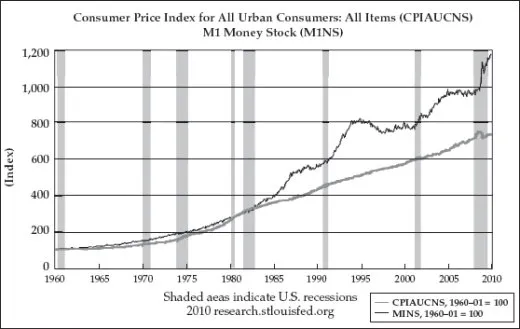
In the chart above, CPI (the gray line) refers to the Consumer Price Index which is a standard index used to gauge movements in prices. The CPI takes an average of the prices of typical items in the United States that consumers purchase (such as food, gasoline, etc.) in order to come up with a rough comparison between “the price level” in different years. The black line in the chart is M1, which is a particular measurement of the money supply that includes actual paper currency as well as the total amount of checking account balances held by everyone in the United States.
The units of the vertical axis of the chart are an index, set to 100 for the first point on the chart, namely the values of CPI and Ml on January 1960. The chart shows that for the first 24 years (from 1960 through 1984) CPI and Ml grew at similar proportions. The money stock grew a bit more quickly—it had doubled from its initial 1960 value by the end of 1975, whereas prices hadn’t doubled until early 1977—but the connection seems quite strong between the two series.
Notice in particular that the rapid price inflation of the late 1970s was matched with a comparable increase in the money stock. To be specific, from January 1975 through January 1980, CPI rose 49%, while Ml rose 40%. To make sure you understand what these numbers mean, we are saying that in general, something that cost $10 in early 1975 would cost about $15 just five years later, for an average yearly rate of price inflation of more than 8% for five years in a row.3
Now picture an economist who was an expert on the history of U.S. money (as measured by Ml) and prices in the year 1983. At that point, going all the way back to 1960, he would have believed there was a very tight connection between Ml and CPI. Sure, sometimes one series would rise faster than the other, but the different growth rates tended to balance out so that after 23 years had passed, the two series had increased by almost the exact same proportion. Someone who thought economics was all about careful measurements and statistical correlations might think he had discovered the economic equivalent of the charge on an electron.
However, the chart shows what happened. Since the mid-1980s, the stock of money—at least as gauged by the particular measure Ml—has risen far more quickly (in percentage terms) than prices, at least as gauged by the CPI. And of course, the connection between the two series utterly breaks during the financial crisis of 2008, when Ml shot up sharply while CPI declined.
We are discussing the chart above to make sure you understand the lessons and limitations of the empirical work on monetary and price inflation. Throughout history whenever there has been significant price inflation—especially hyperinflation when prices rise at inconceivable rates, such as one million percent (or more!) per year—we always find that the money stock rises significantly during the same period.
Yet as the chart on page 327 shows only too well, there is not a mechanical rule connecting prices with the stock of money. Everything in the economy ultimately occurs because of individual human actions which are guided by people’s subjective values and beliefs. If people’s values and beliefs about certain things remain roughly constant over a period of years, then statisticians might discover apparent “laws” connecting various measures of economic activity. Yet those laws can be shattered in an instant when the actual human beings change their preferences or their beliefs about the future.
In an introductory book such as this, we will not try to explain the exact patterns in the chart above. However, in the next section you will learn how basic economic tools can be applied to money and prices, which will at least provide the framework for a fuller understanding.
How Governments Make Prices Rise
In Lesson 7 we laid out the general explanation of money in a pure market economy. We saw that the same principles of economics applied to goods such as gold and silver when they became money, i.e., widely accepted media of exchange.
You will probably not be surprised to learn that historically, government rulers did not leave the “money market” alone. Instead governments throughout the ages have systematically debased the currency—meaning they reduced the market value of each unit of money—while enriching themselves.
For example, the Caesars of ancient Rome would engage in the following process: They would take the gold coins that were paid as tax tribute, and would melt them down. Then they would add in some baser metal, and have their mints produce more coins than the original number, and yet keep the official markings of the coin the same. Over time, this process ensured that the “gold” coins that were used in commerce actually had progressively smaller amounts of actual gold in them.4 Merchants became aware of this and would adjust their prices accordingly, so that what used to cost “one gold coin” would eventually cost several “gold coins.”
The point of this procedure, of course, was that at least initially—before the merchants realized the full extent of the debasement—the Roman government could afford to buy more things than without debasing the currency. For example, if the government originally collected 1,000 gold coins in taxes, without resorting to debasement they could afford to buy... 1,000 gold coins’ worth of goods. But through the trick described above, if the government took the original coins and transformed them into 1,100 coins that superficially appeared to be the same as the original batch, then obviously the government could obtain more goods and services from producers in the community.
Once the merchants began to catch on to this scam, an arms race of sorts developed. The merchants could raise their prices expecting further debasement, but there was nothing to stop the Roman government from accelerating the pace of the metal dilution. The inevitable result was that prices in the Roman Empire grew quite rapidly.
The Rise of Fiat Money
As you probably realize, governments around the world gradually moved away from monetary systems anchored on precious metals. Today all major economies are based on fiat money which refers to government-sponsored money that is not “backed up” by any goods from the market. For example, in the United States the official money is the U.S. dollar. The U.S. government and the central bank, the Federal Reserve, strictly control the number of green pieces of paper of varying denominations and (to a lesser extent) the total deposits in all checking accounts that are measured in U.S. dollars. But there is nothing to “guarantee” the value of the dollar.
The U.S. dollar is simply the U.S. dollar. The dollar doesn’t entitle the holder to anything else—it’s not a legally binding contract or a claim on the U.S. government in any way. If you walk up to the U.S. Treasury or a Federal Reserve Bank, hand in a $20 bill, and say, “Now what do I get?” they will tell you, “Either two tens, four fives, or twenty singles. Which do you want?”
This is a very strange arrangement when you think about it. People are willing to work grueling hours in a hot factory, rob banks, and even kill each other, all in order to get their hands on more of these green pieces of paper that are intrinsically useless. That is, even a $100 bill by itself isn’t good for very much besides being a bookmark—and even then, a very germy bookmark at that. So on the surface, it’s extremely odd that these little pieces of green paper are some of the most coveted things on the planet.
Of course, the reason workers are willing to give up their leisure for dollars, and that merchants are willing to sell their goods for dollars, is simply that... they expect other people will do the same in the future. In other words, the reason a man will spend 40 hours a week taking orders from a guy he can’t stand, is that he will get a pile of dollars in exchange for these services. Then, he thinks other people will take orders from him because of his stockpile. He’ll walk into a building and people will snap to attention, cleaning off a table just for him, and then bring him all sorts of delicious food and tasty beverages. One person will prostrate herself so much as to introduce herself by name and say she will be serving the man. The man will say, “Bring me some eggs,” and lo and behold, the people in the building will obey him. Possession of the green pieces of paper enables him to be the boss, and for the same reason that he himself took orders from the loudmouth at his own job.
Clearly whoever is in charge of creating these green pieces of paper has a very nifty operation. It’s extremely easy for the U.S. government to print up more dollars; the cost is just a few pennies to buy the paper and ink necessary, and the government can print bills with more zeroes on them to achieve any amount of new money at a negligible expense. This is an awesome amount of power to be vested in the hands of a single group, and it’s interesting to see how things came to this.
Although modern economies are all based on fiat money, it was not always so. In Lesson 7 we learned how market commodities (such as gold and silver) could emerge spontaneously from an initial barter economy and eventually become money. In such a situation, it’s true that part of the reason people would work hard for an ounce of gold was simply that others would work hard for that same ounce of gold in the future. But beyond that, gold, silver, and other commodity monies were in themselves actual goods in the market that people subjectively valued even before they had achieved their status as money. In a pure market economy, there is no single agency in charge of “the money”. No, various people could own gold mines, for example, and thus the total amount of money in the economy was determined in the open market through supply and demand, in the same way that the total amount of bicycles isn’t set by a government agency.
Historically, governments took over control of the money by first issuing paper currency that was linked to gold and/or silver. For example, from 1834 through 1933 (with very minor exceptions), Americans knew that $20.67 in U.S. currency would entitle them to one ounce of gold. This wasn’t merely a prediction or a hope on their part; the government was legally obligated to hand over physical gold to people who presented it with paper dollars. Thus the paper dollars themselves weren’t the true money, but rather were certificates that entitled the holder to get the real money, namely gold.5
In 1933 after his inauguration in the depths of the Great Depression, President Franklin D. Roosevelt formally ended the government’s promise to redeem dollars for gold. For the next several decades, other governments (and their central banks) could still hand in U.S. dollars for gold, but Richard Nixon closed even this avenue by officially severing the dollar from gold in 1971. From that point onward, the U.S. dollar has been a true fiat money, backed up by nothing. Because at that point all of the other major currencies were themselves tied to the U.S. dollar, it meant that the entire world economy was now subject to fiat monies.
In terms of the basic economics, the significance of a fiat versus a commodity money is that it’s so much easier to increase the amount of fiat money in the economy. Large and rapid price inflation would be extremely unlikely for example, if everyone used actual gold as the money good, for the practical reason that it is difficult to dig up more gold. On the other hand, with fiat money governments have the ability to increase the amount of money a millionfold in very short order—indeed, they can do it with a few presses of a button with modern electronic banking. All of the historical examples of hyperinflation—where a money was destroyed because it lost its value so quickly—occurred because governments fell into a vicious cycle where prices kept rising, and so governments kept printing more and more money to pay their bills.
Standard debates over proper “monetary policy” overlook this rather important feature of our world since 1971: The people in charge of their country’s respective currencies literally have the power to destroy them overnight. Of course this doesn’t happen in practice because government officials presumably have no interest in wrecking their own economies (though you might not know it from their decisions). But most people would not give one or a handful of people the ability to, say, wipe out a country’s entire collection of books, or the complete contents of its hard drives, simply by pressing a few buttons. Yet this is the current state of our world with respect to perhaps the single most important good: money.
The Price of Money Set By Supply and Demand
Whether we have a commodity money such as gold, or a fiat money such as today’s U.S. dollar, its market price is set by supply and demand. Of course with a commodity money, the market supply consists of the individual supplies of all the different producers in the private sector. In contrast, with modern fiat money, governments (or their designated agencies) determine the quantities of dollars, euros, pesos, and so forth.6 Despite this difference, the same tools of supply and demand can explain the price of ounces of gold as well as the price of rectangular green portraits of Benjamin Franklin.
The one major hitch in using supply and demand analysis in this lesson is that the “price” of money behaves in the opposite way of how you are used to thinking about other prices. For example, suppose we are analyzing the car market for a certain city. With the original supply and demand, imagine the equilibrium price is $20,000 and the equilibrium quantity is 1,000 cars. Then there is a new dealership that opens up, so that the supply curve for cars shifts to the right. In the new equilibrium, the price has dropped to $15,000 and the quantity of cars has doubled to 2,000 vehicles. This is all basic review.
Now what happens if we analyze this same market, but from the point of view of the money? After all, even fiat money is an economic good, so we should be able to use our tools of analysis. The problem here is when we want to mark the “price” of dollars. In terms of the car market, we could say that initially, the price of a $1 bill was 1/20,000th of a car, but that after the new dealership opened up, the price of a $1 bill increased to 1/15,000th of a car.
So we see that the movement in the price of money was in the opposite direction of the price of the cars. In other words, if it takes fewer dollar bills to buy a car, that’s the same thing as saying it takes more of a car to buy a dollar bill. That language might strike you as strange at first, but essentially the car dealer is selling cars in order to buy U.S. dollars. His customers are on the other side of the transaction; they are selling dollars in order to buy cars.
If dollar bills and cars were the only goods in the economy, we would be done. However, the whole point of having money is that it stands on one side of every transaction involving many thousands of different types of goods. So it’s not really true to say that the price of money is 1/20,000th or 1/15,000th of a car. We also have to think about how many dollar bills exchange for packs of gum, gallons of gasoline, hours of carpentry, and so on.
For example, suppose that a gumball originally costs 25 cents, but then the price doubles to 50 cents for one gumball. An equivalent expression would be to say that the price of a $1 bill was originally 4 gumballs and then fell in half to 2 gumballs. This is a crucial point: When the price (measured in dollars) of a regular good or service goes up, that is the same thing as saying the market value of the dollar goes down. When the “price of money” falls, it means that the dollar-prices of other goods are going up.
In the real world, prices of various goods and services do not all rise to the same degree, and in fact some prices rise while other prices fall. That’s why it’s very controversial to even define what we mean by “the price of money”. Economists have devised various “baskets” of goods to provide a rough idea, of which the Consumer Price Index (CPI) is one such measure. For our purposes, the important point is that you understand that rising prices (measured in money) are the same thing as a falling value or “purchasing power” of money.
Once we understand the connection between regular prices and the “price” of money, it’s easy to see what causes price inflation: anything that causes the price of money to go down. Using our standard tools, that means there can be two causes for a general rise in the prices of goods and services in the economy: (1) The supply of money has increased, and/or (2) the demand for money has fallen.
With this insight, we can return to some of the points mentioned earlier in this lesson. For example, the complete collapse of some currencies—where the purchasing power or price of the money fell to virtually zero very quickly—happened when the respective governments began creating incredible amounts of new currency (i.e., the supply increased). Once this process began, the public became doubtful about the currency’s ability to buy goods and services in the future, and so they didn’t want to hold it; hence the demand for the currency began falling. The process snowballed until the price of the currency was virtually zero, meaning that units of it (such as the German mark) could fetch nothing in the marketplace.
On the other hand, we can also explain what happened in the United States in the mid-1980s. As the graph earlier in this lesson illustrated, the stock of money (as measured by the statistic Ml) grew very quickly even though prices (as measured by the CPI) did not rise nearly as much. In other words, from the mid-1980s onward the U.S. saw a large increase in the quantity of money but a much smaller fall in its price. The broad explanation of this pattern is simple: The supply of dollars increased but so did the demand. The specific reasons for the increase in demand—which probably include the strong U.S. economy, and the success in bringing down price inflation rates from the dangerous levels of the late 1970s—are beyond the scope of our discussion. The important point is that you cannot look at the number of dollar bills and mechanically calculate what will happen to prices, because the market value of money is set by supply and demand.
The Danger of Government Price Inflation
Price inflation is not the sole product of government intervention. Even in a pure market economy using gold, a huge influx of gold (from newly discovered mines or from newly discovered foreign lands) can cause the prices of most goods and services (measured in gold ounces) to rise. In theory, if the medieval alchemists had been successful and figured out a way to turn lead into gold, then the market price of gold would have fallen until the returns to alchemists were the same as in other industries. In other words (depending on the exact alchemic process) the price of gold would probably fall until it was close to the price of lead. In this fanciful scenario, people in a pure market economy would probably switch to another form of money, for the same reason that historically people never used lead as a commodity money.7
In practice, however, the great threat to price stability has come not from market-based commodity money, but from government-controlled money, and in particular fiat money.8 For example, when the U.S. dollar was firmly linked to gold at $20.67 an ounce the purchasing power of the dollar was fairly constant over long stretches of time. It might fall during a war and rise during an economic crisis, but generally speaking dollars could buy the same amount of goods in one year as they would have in previous decades. During arguably the most prosperous decade in U.S. history for example, the CPI was virtually flat from 1922 through 1929. American shoppers did not see significant movements in the prices of milk, eggs, and meat throughout this period, even though the economy was booming.
This is no longer the case. Especially since Richard Nixon “closed the gold window” in 1971 and formally severed the dollar’s tie to gold, there has been a steady and virtually uninterrupted fall in the purchasing power of the dollar. In other words, prices of goods and services in the U.S. have constantly risen as the economy moved away from a commodity money (gold) and toward a fiat money. Nowadays young people must tolerate their parents and grandparents’ boring discussions of how cheap things were “when I was growing up.” What these young people—and possibly even their parents and grandparents—don’t realize is that this steady erosion of the dollar is not a fact of nature. It is the result of the government’s intervention into the economy, through its monopolization of the money stock and its decision to continually pump new dollars into the economy.
Besides generating boring stories from grandpa, the harm of persistent price inflation is that it partially defeats the purpose of using money in the first place. Remember that the great contribution of having a money is that it helps people make plans and coordinate their activities in the market. Entrepreneurs can tell if they’re running a successful business by adding up the money prices of the inputs they buy, and comparing this grand total to the sum of the money prices of the things they sell to their customers. Workers can make an informed decision about whether to take a new job across the country, by looking at the typical prices of important goods (such as food and housing) in the new area compared to the typical prices in their current location, and do the same for the salary differences in the two locations. Retired couples who are planning a luxurious European vacation can avoid starving twenty years later by consulting with a financial planner to make sure they’ve set aside enough investments to support them later on. Having a sound money—meaning a money for which the value doesn’t bounce around erratically and doesn’t lose its purchasing power over time—makes all of these activities much more orderly. Having an unsound fiat money is (usually) still better than nothing, but in the extreme governments can render their monies so useless that the public literally abandons the currency and adopts other items as media of exchange.
One of the official duties of the Federal Reserve—the government-established central bank of the United States—is to maintain price stability. Since the Federal Reserve’s founding in 1913, the U.S. dollar has lost about 95% of its purchasing power. To see it another way, things that cost $1 in the market in 1913 cost about $22 today. But beyond this sustained drop in the “price” of the U.S. dollar (compared to most goods and services), is the fact that the drop has been incredibly volatile. Prices rose very quickly during World War I, then they collapsed in 1920 and 1921, then were steady again through the 1920s, then collapsed again during the early years of the Great Depression. Since the end of World War II, U.S. prices have risen steadily, but the pace of the increase has been irregular. In particular, prices rose very quickly at the end of the 1970s, before slowing to much lower growth rates in the 1980s.
Currently (2010), U.S. investors are divided in their forecasts about future price inflation. Some expect a collapse in prices, comparable to the early period of the Great Depression. Others expect a surge in prices, comparable to (though not as extreme as) the recent case of Zimbabwe.9 Because of this uncertainty over a very important aspect of the future—namely the purchasing power of the U.S. dollar—Americans and indeed people all over the world are distracted from building their businesses, playing with their kids, and watching kung fu movies because they have to do research on Federal Reserve meetings and constantly tinker with their financial portfolios to include more gold or more bonds. All of this activity makes sense at an individual level, given the poor track record of the Federal Reserve in its official mission of price stability. But in terms of the whole economic system, it is very wasteful. In a pure market economy with a sound money, people could focus on the more important things in life (such as kung fu movies).
Price Inflation Contained Through Proper Forecasts?
Some people pooh pooh the harmful effects of price inflation. They will concede that if the rising prices took everyone by surprise, then there would be a problem. But by this point, some would argue, everybody knows that the U.S. dollar (and other fiat currencies) will shed their purchasing power over time. When businesses borrow money, and older workers decide on retirement, they take this phenomenon into account. What’s more, in modern economies sophisticated financial instruments allow investors to protect themselves against price inflation through various means. In short, people in the mixed economy aren’t sitting ducks when the government intervenes in the supply of money. They respond and protect themselves using other aspects of the market economy.
This is all true, but notice that we could say the same thing if the government randomly injected people with viruses or set their houses on fire. People wouldn’t sit still and passively accept the new reality; instead they would take active countermeasures (vaccines, more smoke alarms, etc.) and would buy more financial protection through medical and fire insurance policies. But it would be nonsense to say that these defensive measures completely neutralized the harmful effects of our hypothetical government virus-injectors and arsonists.
The same principle applies to government price inflation. It’s true that the harm can be mitigated through the market’s defensive reactions. But the society still ends up poorer compared to the situation where the government left money to the private sector.
No matter what, government monetary inflation must distort the economy relative to the pure market outcome. This is because the government and central bank invariably use the new money to buy things, whether tangible goods (like tanks and bombers during a war) or financial assets (like a mortgage-backed security in the wake of the 2008 financial panic).
We have already seen in Lesson 18 that government distorts the economy when it takes resources out of the control of private hands and places them under the discretion of government officials. This harmful process necessarily occurs whenever the government creates new money i.e., engages in monetary inflation.
No matter what the public does in response, it cannot prevent the government from siphoning away actual goods and assets (barrels of oil, corporate bonds, etc.) when the government controls the printing press. Under a fiat money system, the government’s newly printed $100 bills are legal tender just as much as the money already in the wallets and purses of average citizens. For this reason, even if a particular episode of monetary inflation doesn’t lead to immediate price inflation,10 the government intervention still distorts the economy relative to the pure market outcome.
Lesson Recap...
- Monetary inflation refers to the expansion of money; in our economy the term refers to an increase in the total number of dollars. Price inflation refers to a general increase in the prices of goods and services, as measured in units of money.
- Government intervention leads to systematic inflation. All major governments have used various means to force their people to stop using market-based commodity monies (such as gold and silver) and to instead use paper fiat currencies. It is much easier to expand the amount of fiat money, versus digging up more gold and silver.
- Large-scale and persistent price inflation can devastate an economy. When money’s purchasing power erodes quickly and erratically, it limits the benefits of having a money in the first place and pushes society back towards a situation of barter. Without a sound currency, people have less incentive to save and make long-term investment decisions.
NEW TERMS
Inflation: A term that originally referred to monetary inflation, but nowadays tends to refer to price inflation.
Monetary inflation: An expansion in the total amount of money in the economy
Price inflation: A general increase in the prices of goods and services, quoted in units money Price inflation is the same thing as a fall in the purchasing power of money
Stock of money: The total amount of money in the economy at a particular time.
Consumer Price Index (CPI): The Bureau of Labor Statistics’ gauge of the “price level” affecting regular households. The CPI is an average (weighted by their relative importance) of the prices of gasoline, food, and other common items.
M1: A popular measure of the total amount of money in an economy. Ml includes the actual currency held by the public (in their wallets, purses, and cashiers’ drawers) but also the total amount of checking account balances. (Because of the fractional reserve banking system, Ml is larger than the number of dollars printed on green pieces of paper. If everyone tried to withdraw his or her checking account from the banks at the same time, there wouldn’t be enough currency to go around. This is why Ml indicates more total money than just the amount of paper currency.)
Hyperinflation: Very severe inflation. There is no precise boundary between inflation and hyperinflation, but in a hyperinflation people begin buying anything at all in order to unload their money holdings which are losing value by the hour.
Debasement: Government policies that weaken the money. When coins were valued because of their precious metal content, debasement meant melting the coins and re-minting them with baser (less valuable) metals added to the mixture. Under fiat money, debasement involves the rapid creation of new money, which reduces the value of a single unit of money.
Fiat money: Paper money that is not “backed” by anything. The only reason people accept fiat money in trade, is that they expect it to have purchasing power in the future.
Federal Reserve: The central bank of the United States, founded in 1913. The “Fed” is responsible for U.S. monetary policy, and has the dual mandate of providing stable economic growth (which implies full employment) and low price inflation.
STUDY QUESTIONS
- What are the two meanings of the term inflation?
- Is there a strict connection between money growth and price increases?
- Why do workers sell their labor hours in exchange for intrinsically useless pieces of fiat money?
- If the stock of money increases, what happens to the “price of money,” other things equal? What does this imply for the prices of goods and services?
- What is the harm of government price inflation?
Lessons for the Young Economist
Read the whole book online · Book details
This work is published under a Creative Commons licence. You may copy, share, and re-host it with attribution.