
Chapter 155 of 178 · Mises: The Last Knight of Liberalism by Jörg Guido Hülsmann
Grey Eminence and Itinerant Scholar
The success of Human Action was not the only instance of Mises's influence on the libertarian movement and on the American Right in general. Another factor was, ironically, his relative isolation among academic economists. By the late 1940s, Mises was already the odd man out in both his methods of research and his political orientation. Then Human Action put him in the spotlight, and suddenly his authority weighed heavily in the decision-making of the few but substantial funds that had been created to support free-market scholarship.
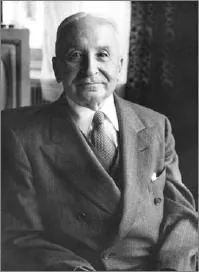
Mises in their New York apartment in the 1950s
Thirty years of social science research funding through the Rockefeller Foundation and others who pursued an explicit “scientistic” orientation had left their mark on the state of economics and other disciplines. The money from Rockefeller, Ford, Carnegie, and others was channeled into the universities through the Social Science Research Council, a 1923 Rockefeller creation. To the exterior world, the Council represented seven major social science societies, but in fact it was a self-perpetuating body. In January 1954, Karl E. Ettinger, a private research consultant, commented on the role of the Council in a letter to F.A. Hayek. Quoting extensively from R.B. Fosdick's History of the Rockefeller Foundation, he concluded:
there seems to be strong evidence that the emergence of an orthodoxy of quantitative sociology has been greatly influenced by the magnetism of money and the control of available funds by a foundation bureaucracy that knew what it wanted and favored the imitation of the methods of natural scientists by social scientists.89
Only a small number of private individuals and institutions still supported social philosophers of the old type. Mises knew them all, and Human Action had given a great boost to his authority. The Volker Fund had been funding him since 1945. But after the publication of his treatise, the Fund began supporting lectures and extended seminars for Mises, and it even started funding his students. Thus from 1955 to 1969, the Volker Fund sponsored a one-year fellowship in political economy at NYU's Graduate School of Business Administration. Mises nominated the recipient.90 For some time, he also controlled an annual budget of $12,500 at NYU.91 And other institutions started doing the same thing, for example, the Earhart Foundation undertook travel expenditures and student scholarships, the National Association of Manufacturers organized and paid for seminars, and Howard Pew and others subsidized The Freeman. For several years, funding Mises and his projects was almost a matter of course. His judgment on persons and projects was often final.92
This sudden concentration of resources on Mises reflected more than the respect owed to the man—it was also the sign of an important problem in the free-market movement: by the early 1950s, substantial money was available for scholarship, but there were not many libertarian scholars of Mises's stature. The situation was quite bleak, as Lawrence Fertig stated in a letter:
Take the faculty of Columbia University. Aside from Dr. George Stigler and Dr. Leo Wolman, I doubt if there is another member on the entire economics faculty who presents the free-market, liberal point of view. At Yale, out of thirty members of the economics faculty, until recently just two—Professor Henry Fairchild and one other—represented the old liberal point of view. The Harvard faculty is dominated by men like Professor Seymour Harris, Alvin Hansen, Sweezy and others like them, who range all the way from Keynesians to outright Socialists. This faculty [NYU] is definitely under the major influence of Keynesians and collectivists, although there are a few eminent men, like John D. Williams and Sumner Slichter, who have not gone entirely that way. The same is true of smaller colleges, such as Williams, Amherst, etc. The New School for Social Research doesn't have a single libertarian on its faculty. Sarah Lawrence College probably couldn't produce a single one either.93
The men on Fertig's short list of libertarians were less original than Mises, less radical, and less outspoken in their support of laissez-faire capitalism—a fact that was obvious to all parties involved. Mises himself considered many of them to be moderate interventionists, an opinion that his financial backers had learned to respect. He occasionally recommended textbooks written by these other men, for example, Fairchild and Shelly's Understanding Our Free Economy, and Van Sickle and Rogge's Introduction to Economics. But the most he could say of these books was that the interventionism advocated within them was less radical than that promoted in all the other textbooks, which he believed were “totally flawed from a theoretical point of view (Marx, Keynes, econometrics) and had a radical interventionist, if not outright socialist orientation.”94
In short, there was no substitute for Ludwig von Mises, and this fact would have unfortunate consequences for American libertarianism in the following decades.
Mises: The Last Knight of Liberalism
Read the whole book online · Book details
Free to read online and to download from this archive.