
Chapter 156 of 178 · Mises: The Last Knight of Liberalism by Jörg Guido Hülsmann
New York Circles
Mises's activities in New York centered on his NYU seminar. By the early to mid-1950s, four major groups attended the NYU seminar.
First, there was a group of NYU students who took the seminar for credit. The great majority of them were thoroughly uninterested in scientific questions of economic analysis. Yet there were exceptions. One early student who cooperated more closely with Mises was Hugh P. King, who from 1951 to 1953 was his assistant and later became a business counselor.95 Then there was Morton Cobrin, who in 1952 wrote a 300-page master's thesis that condensed some of the main ideas of Human Action in more accessible language. Cobrin then attended Mises's seminar on “Government Control and the Profit System.”96 But there were also more important exceptions. At least three regular NYU students would eventually become important Misesians who, each in his own way, took up where their teacher had left off: Hans Sennholz, Israel Kirzner, and George Reisman.97
Hans Sennholz, who had translated Böhm-Bawerk, received his American Ph.D. under Mises in 1954 and published his dissertation in early 1955 under the title How Can Europe Survive? With Mises's support, Sennholz had received a $3,000 Earhart research grant for the academic year 1953–1954, when the fellowship program started.98 Mises praised him as outstanding in his “professional ability, pedagogic talent and personal character.”99
In contrast to Sennholz, young Israel Kirzner had not known anything about Mises before attending his seminar. He was not even a student of economics, but an accounting major who had to take one economics seminar to fulfill his requirements. Since he knew nothing of economics, he decided to attend the classes of the most published economics professor at NYU. Starting in September 1954, Kirzner attended Mises's seminar for many years, acting eventually as a (Volker-sponsored) tutor for the younger students. He switched from accounting to economics and studied under Mises to obtain his Ph.D., which he received in 1957 with The Economic Point of View. Kirzner eventually became a professor of economics at NYU, a famous theoretician of entrepreneurship with numerous book publications, and retired in 2002.100
Israel Kirzner
The third important Misesian from the ranks of Mises's regular students was George Reisman, who got a Ph.D. under Mises in 1963 for a theoretical study of interest rates with the title: The Theory of Aggregate Profit and the Average Rate of Profit. His lifelong research project was the creation of a great synthesis between classical economics, Austrian economics, and Ayn Rand's “objectivist” social philosophy. As a result of these endeavours, he eventually published his magnum opus, Capitalism (1996). He is now an emeritus professor at Pepperdine University in California.
The second group at the seminar was composed of professionals and businessmen. This group included personal friends of Mises's, such as Henry Hazlitt, Lawrence Fertig, and George Koether. But there were also men such as Doctor Richard Fruin, a commander in the U.S. Navy, who had come to know Mises through his publications and who seized the opportunity to attend the seminar sessions from the end of 1954 to the end of 1961.
The third group came from FEE. It included Foundation staff and students who had been introduced to Austrian economics through FEE. The staunchest attendees were Bettina Bien and Percy Greaves, who would form the core of the seminar until its very end.
The fourth group was a spin-off of the FEE crowd. It was composed of radical young free-marketeers around Murray Rothbard, including Ralph Raico, George Reisman, Leonard Liggio, and Robert Hessen. They called themselves the Circle Bastiat.
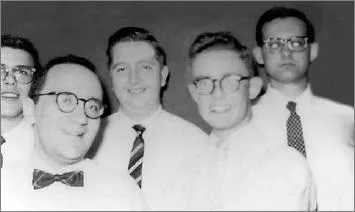
The Circle Bastiat: left to right, Ralph Raico, Murray Rothbard, George Reisman, Leonard Liggio, and Robert Hessen
When Rand's novel Atlas Shrugged appeared in 1957, it had a deep impact on the Circle Bastiat, and also impressed Mises and other senior members of his seminar.101 Rothbard read the novel that fall and discussed it endlessly with Reisman. They also had continuing discussions on the question of whether capital accumulation implied a declining interest rate. For Reisman, these discussions were the point of departure for a lifelong research program.102
By all standards, the seminar was of very high quality. In its first ten years, it featured Mises at the peak of his teaching career. One participant who had attended the sessions from the very start in 1945 wrote a thank-you note in 1952, stating that he had been especially impressed by two facts:
First, it has attracted a serious-minded group of individuals whose varied occupational and professional interests serve to stimulate a fruitful discussion; secondly, unlike most seminars, each succeeding year of attendance builds upon the intellectual acquisitions of the past one without leaving any impression that the student is repeating a previous course.103
What makes the seminar especially important for the later dissemination of Mises's ideas is that it brought together a group of excellent students for whom Human Action was the starting point for further intellectual work. No previous group of his students had had this privilege, and it had a noticeable effect on their further intellectual development and on the schools they created. It is revealing to contrast the cases of Sennholz and Rothbard with the case of Fritz Machlup, who had been Mises's star student in the 1920s and early 30s. All three men were high-caliber intellectuals, but only the former two became genuine Misesians. A possible difference lay in the existence of the treatise.
As he had done with his students in Vienna and Geneva, Mises inspired his American students to apply rigorous deductive reasoning to the analysis of politically relevant subjects. But they did more: they followed the logic to its politically radical conclusions. Murray Rothbard in his youthful exuberance once boasted that his forthcoming defense of the market economy “will be far more right-wing than Mises because of its grounding in ‘welfare economics,’ which theory I have basically set forth in my Festschrift article.”104 It is unthinkable that one of Mises's Vienna students would have boasted that he was more libertarian than his professor—the Vienna students thought Mises tended to exaggerate the case for the market economy.
But Rothbard was merely an extreme case of the entire species of Misesian students in the post-Human Action period. Their favorite sport was to find statist arguments and premises in Mises's works. They relished in “unveiling” his socialism and had a good laugh when Rothbard called the old master “a member of the non-Communist left.”105
This new radicalism radiated beyond Mises's NYU seminar. Inspired by Human Action, several authors set out to defend liberty, property, and capitalism as absolute principles of social order. The best known case is Ayn Rand, who shocked the political correctness of her day with a proud, assertive defense of individualism and capitalism that announced itself right in the titles of her books. Works such as Capitalism—The Unknown Ideal and The Virtue of Selfishness were inspired by Human Action, an intellectual debt that she graciously acknowledged. Yet Rand's case was no exception. In September 1955, Mises received a massive manuscript with the title “The Capitalist Manifesto.” The author, a certain Joe Abrahamson, asked him for comments.106 It was the work of an enthusiastic amateur but it showed where ever more of his readers were headed.
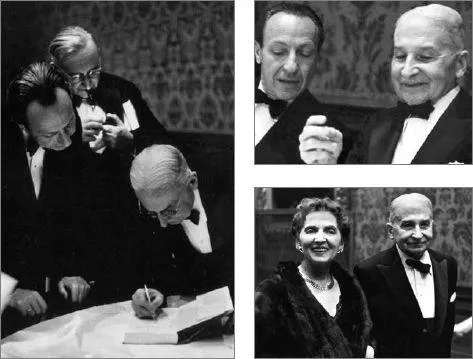
The high point of these glorious years was the publication of a Festschrift for Mises on the occasion of the fiftieth anniversary of the doctorate that Mises had earned at the University of Vienna in 1906. Mises received the book at a celebration on March 7, 1956 in Manhattan. Hans and Mary Sennholz organized the event.107 Roughly a year before the celebration, they had invited contributions from seminar members such as Hazlitt, Rothbard, and Sennholz, and from various other intellectuals who had in some way been close to Mises.108
ON FREEDOM AND FREE ENTERPRISE ESSAYS IN HONOR OF LUDWIG VON MISES
Edited by Mary Sennholz
on the occasion of the 50th anniversary of Mises's doctorate, February 20, 1956
PART 1: GRATO ANIMO BENEFICIIQUE MEMORES
1. The Intransigence of Ludwig von Mises, Jacques Rueff, France
2. On Reading von Mises, William E. Rappard, Switzerland
3. Two of Ludwig von Mises' Most Important Works, Henry Hazlitt, U.S.A.
PART 2: ON THE NATURE OF MAN AND GOVERNMENT
4. Order vs. Organization, Bertrand de jouvenel, France
5. On Democracy, Hans F. Sennholz, U.S.A.
6. The Road to Totalitarianism, Henry Hazlitt, U.S.A.
7. The Greatest Economic Charity, F.A. Harper, U.S.A.
PART 3: ON SCIENTIFIC METHOD
8. The Place of Economics among the Sciences, Wilhelm Röpke, Switzerland
9. On Methodology in Economics, Faustino Ballvé, Mexico
10. Some Considerations on Economics Laws, Carlo Antoni, Italy
11. Averages and Aggregates in Economics, Louis M. Spadaro, U.S.A.
12. The Inferiority Complex of the Social Sciences, Fritz Machlup, U.S.A.
PART 4: THE ECONOMICS OF FREE ENTERPRISE
13. The Market Economy and the Distribution of Wealth, L.M. Lachmann, South Africa
14. Unearned Riches, Leonard E. Read, U.S.A.
15. The Yield from Money Held, William H. Hutt, South Africa
16. The Accelerator and Say's Law, William H. Peterson, U.S.A.
17. Toward a Reconstruction of Utility and Welfare Economics, Murray N. Rothbard
PART 5: THE HAMPERED MARKET ECONOMY
18. Progressive Taxation Reconsidered, F.A. Hayek, U.S.A.
19. Is Further Intervention a Cure for Prior Intervention?, Percy L. Greaves, Jr., U.S.A.
PART 6: ON SOCIALISM
20. French Socialism, Louis Baudin, France
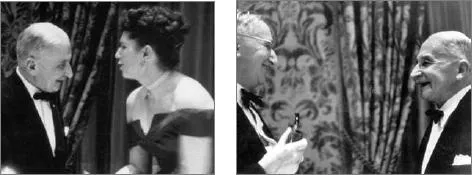
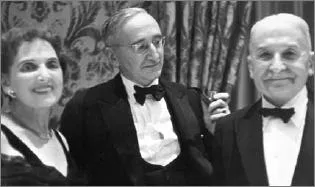 On the occasion of the 50th anniversary of Mises's doctorate. Top with Mary Sennholz and Hayek; left, with Margit and Hayek, bottom left, autographing the Festschrift volume with Machlup and Hayek, bottom right, with Machlup and with Margit
The Sennholzes took pains to avoid any closer involvement of Mises's former students and colleagues from Vienna, whose political orientation was considerably less liberal than that of the NYU seminar. Among the twenty contributors, only three— Röpke, Machlup, and Hayek—had been friends with Mises in Vienna. Thus the Festschrift became a faithful reflection of the change of Mises's intellectual environment. It was to be a celebration of the intellectual case for human liberty and the free market, and of the man who had done so much to develop this case. The title made it clear: On Freedom and Free Enterprise.109
Mises: The Last Knight of Liberalism
Read the whole book online · Book details
Free to read online and to download from this archive.