
Chapter 24 of 68 · Money, Bank Credit, and Economic Cycles by Jesus Huerta de Soto
2 THE EFFECT ON THE PRODUCTIVE STRUCTURE OF AN INCREASE IN CREDIT FINANCED UNDER A PRIOR INCREASE IN VOLUNTARY SAVING THE THREE DIFFERENT MANIFESTATIONS OF THE PROCESS OF VOLUNTARY SAVING
In this section we will examine what happens within the structure of production when, for whatever reason, economic agents reduce their rate of time preference; that is, when they decide to increase their saving or supply of present goods. This can take place in any of the following ways:
First, capitalists of the different stages in the productive structure may decide, beginning at a certain point, to modify the proportion in which they had been reinvesting the gross income derived from their productive activity. In other words, nothing guarantees the continuity, from one period to the next, of the ratio in which the capitalists of one productive stage spend the income they receive from that stage on the purchase of capital goods from earlier stages and on labor and natural resources. Capitalists may very possibly decide to increase their supply of present goods. That is, they may decide to reinvest a greater percentage of the income they receive per period, acquiring capital goods and services as well as original means of production (labor and natural resources). In that case, in the short run, their accounting profit margin will decrease, which is equivalent to a downward trend in the market interest rate. The profit margin falls as a result of an increase in monetary costs in relation to income. The capitalists are willing to temporarily accept this drop in accounting profits, since they expect to generate in this way, in a more or less distant future, total profits larger than those they would have earned had they not modified their behavior.41 Given that the market in which present goods are exchanged for future goods encompasses society's entire structure of productive stages, such increases in saving and their manifestation in new investments are often the most important in society.
Second, owners of the original means of production (workers and owners of natural resources) may decide not to consume, as in the past, the entire sum of their social net income (which in Chart V-1 was 70 m.u.). They may instead decide to reduce their consumption beginning at a certain point and to invest the m.u. they no longer spend on final consumer goods and services, in the productive stages they decide to launch directly as capitalists (a category which includes members of cooperatives). Though this procedure takes place in the market, the resulting savings are not normally very substantial in real life.
Third, it could occur that both the owners of the original means of production (workers and the owners of natural resources) as well as capitalists (to the extent they receive net income in the form of accounting profits or market interest) decide beginning at a certain point not to consume their entire net income, but to loan a portion of it to capitalists of the different stages in the production process, enabling them to broaden their activities by purchasing more capital goods from prior stages and more natural resources, and by hiring more labor. This third procedure is carried out through the credit market, which, despite being the most visible and conspicuous in real economic life, is of secondary importance and plays a subsidiary role in relation to the more general market in which present goods are exchanged for future goods through self-financing or capitalists’ direct reinvestment of present goods in their productive stages (the first and second procedures of saving-investment mentioned above). Though this system of saving is important, it is usually secondary to the first two procedures for increasing saving we described above. Nevertheless a very strong connection exists between the flows of saving and investment of both procedures, and in fact both sectors of the “time market”—the general sector of the productive structure and the particular sector of the credit market—behave as if they were communicating vessels.
ACCOUNT RECORDS OF SAVINGS CHANNELLED INTO LOANS
From an economic standpoint, all three of these procedures for increasing saving invariably entail the following: an increase in the supply of present goods held by savers, who transfer these present goods to the owners of original resources and material means of production (capital goods) from previous productive stages. For instance, if we follow the accounting example from chapter 4, which involves the third procedure described above, the following journal entries result:
The saver who loans his resources in the form of present goods records this entry in his journal:

This entry is clearly the accounting record of the fact that the saver offers 1,000,000 m.u. of present goods, which he relinquishes. In doing so he loses the complete availability of the goods and transfers it to a third person; for instance, the entrepreneur of a certain productive stage. The entrepreneur receives the m.u. as a loan, which he records in his journal via the following entry:

The entrepreneur who receives these present goods uses them to acquire: (1) capital goods from prior productive stages; (2) labor services; (3) natural resources. Through this third procedure, savers who do not wish to involve themselves directly in the activity of any of the productive stages can save and invest through the credit market by entering into a loan contract. Although this method is indirect, it ultimately produces a result identical to that of the first two procedures for voluntarily increasing saving.
THE ISSUE OF CONSUMER LOANS
It could be argued that sometimes loans are not granted to entrepreneurs of productive stages, to enable them to lengthen their production processes through investment, but are instead granted to consumers who purchase final goods. First, we must note that the very nature of the initial two saving procedures described above precludes the use of the saved resources for consumption. It is only possible to conceive of a consumer loan in the credit market, which as we know plays a subsidiary role and is secondary to the total market where present goods are offered and purchased in exchange for future goods. Second, in most cases consumer loans are granted to finance the purchase of durable consumer goods, which as we saw in previous sections,42are ultimately comparable to capital goods maintained over a number of consecutive stages of production, while the durable consumer good's capacity to provide services to its owner lasts. Under these circumstances, by far the most common, the economic effects of consumer loans, with respect to encouraging investment and lengthening productive stages, are identical to and indistinguishable from the effects of any increase in savings directly invested in the capital goods of any stage in the productive structure. Therefore only a hypothetical consumer loan allocated for financing a household's current expenditure on non-durable consumer goods would have the effect of immediately and directly increasing final current consumption. Nonetheless despite the fact that relatively little credit is allotted to final current consumption, the existence of such consumer loans in the market indicates a certain latent consumer demand for them. Given the connection between all sectors of the market of present and future goods, once this residual demand for loans for current consumption is satisfied, most real resources saved are freed to be invested in the productive stages furthest from consumption.
THE EFFECTS OF VOLUNTARY SAVING ON THE PRODUCTIVE STRUCTURE
We will now explain how the price system and the coordinating role of entrepreneurs in a free market spontaneously channel decreases in the social rate of time preference and the resulting increases in saving into modifications of society's structure of productive stages, making this structure more complex and lasting, and in the long run, appreciably more productive. In short we will explain one of the most significant coordinating processes which exist in all economies. Unfortunately, as a result of monetarist and Keynesian economic theories (which we will examine critically in chapter 7), for at least two generations of economists the majority of economics textbooks and study programs have almost completely ignored this process. Consequently most of today's economists are unfamiliar with the functioning of one of the most important processes of coordination present in all market economies.43
For analytical purposes we will begin by considering an extreme situation which nevertheless will be of great assistance in graphically illustrating and better understanding the processes involved. We will suppose that economic agents suddenly decide to save 25 percent of their net income. Our starting point will be the clear, numerical example of the last section, in which we assumed net income was equal to 100 m.u., which corresponded to the original means of production and the interest capitalists received, and which was spent entirely on consumer goods. We will now suppose that, as a result of a fall in time preference, economic agents decide to relinquish 25 percent (i.e., one-fourth) of their consumption and to save the corresponding resources, offering this excess of present goods to potential demanders of them. Three effects simultaneously follow from this increase in voluntary saving. Given their great importance, we will now consider them separately.44
FIRST: THE EFFECT PRODUCED BY THE NEW DISPARITY IN PROFITS BETWEEN THE DIFFERENT PRODUCTIVE STAGES
If there is an increase in social saving of one-fourth of net income, clearly the total monetary demand for consumer goods will decrease by the same proportion. Chart V-2 illustrates the effect this has on the final stage, that of consumption, and on the accounting profits of companies devoted to that stage.
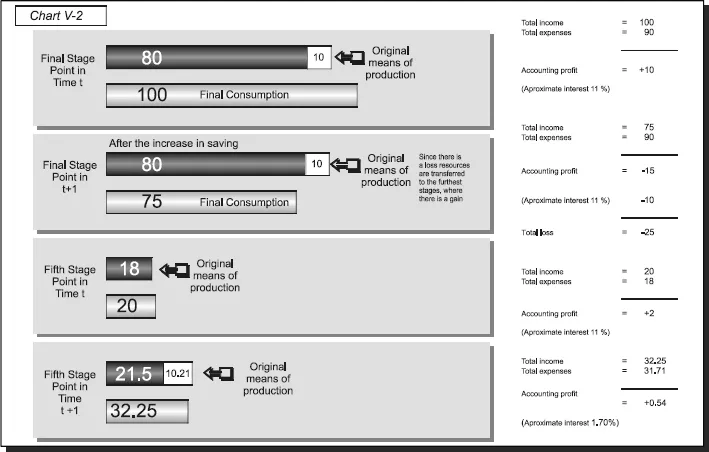
Chart V-2 shows that before the increase in saving, 100 m.u. of net income were spent on final consumer goods produced by companies which first incurred expenses totaling 90 m.u. Of this amount, 80 m.u. corresponded to the purchase of capital goods from the stage immediately preceding, and 10 m.u. were paid for original means of production hired or purchased in the last stage (labor and natural resources). This determined an accounting profit of 10 m.u., roughly equal to an interest rate of 11 percent, which as we saw in the last section, was the market rate of interest which accounting profits of all productive stages, both those closest to and those furthest from final consumption, tended to match.
If we suppose there is an increase in saving equal to 25 percent of net income, the situation in the final stage (consumption) is reflected in Chart V-2 at point t+1. Immediately following the rise in saving, we see that the monetary demand for final consumer goods decreases from 100 to 75 m.u. in each time period. Nevertheless a reduction in expenditures does not immediately accompany this fall in cash income which businesses devoted to the final stage of production experience. On the contrary, in their account books these companies record unchanged expenditures of 90 m.u. Just as in the previous case, 80 m.u. of this amount is spent on capital goods from the preceding stage (machinery, suppliers, intermediate products, etc.) and 10 m.u. are paid to the owners of the original means of production (workers and the owners of natural resources). As a result of this increase in saving, companies devoted to the final stage (consumption) suffer an accounting loss of 15 m.u. This sum becomes 25 m.u. when we consider the opportunity cost derived from the fact that the entrepreneurs not only experience the above accounting loss, but also fail to earn the 10 m.u. which capital invested in other productive stages generates as interest. Therefore we could conclude that all increases in saving cause considerable relative losses to or decreases in the accounting profits of the companies which operate closest to final consumption.
However let us now remember that the sector of consumption constitutes only a relatively small part of society's total productive structure and that the sum of the m.u. spent on final consumption makes up only a fraction of the value of the gross national output, which encompasses all stages of the production process. Therefore the fact that accounting losses occur in the final stage does not immediately affect the stages prior to consumption, in which a positive difference continues to exist between income and expenditures, a difference similar to the one which preceded the increase in saving. Only after a prolonged period of time will the depressive effect which the rise in saving exerts upon the final stage (that of consumer goods) begin to be felt in the stages closest to it, and this negative influence will increasingly weaken as we “climb” to productive stages relatively more distant from final consumption. At any rate the accounting profits of the stages furthest from consumption will tend to remain constant, as shown in Chart V-2, stage five, point in time t. Here we observe that activity in this stage continues to yield an accounting profit of 11 percent, the result of a total income of 20 m.u. and total expenses of 18 m.u. Hence the increase in saving clearly gives rise to a great disparity between the accounting profits received by companies devoted to the first stage, that of consumer goods, and those earned by companies operating in the stages furthest from final consumption (in our example, the fifth stage in the productive structure). In the consumer goods sector an accounting loss follows from the upsurge in saving, while the industries of the fifth stage, which are further from consumption, continue to enjoy profits roughly equal to 11 percent of the capital invested.
This disparity in profits acts as a warning sign and an incentive for entrepreneurs to restrict their investments in the stages close to consumption and to channel these resources into other stages which still offer relatively higher profits and which are, given the circumstances, the stages furthest from final consumption. Therefore entrepreneurs will tend to transfer a portion of their demand for productive resources, in the form of capital goods and primary factors of production, from the final stage (consumption) and those closest to it, to the stages furthest from consumption, where they discover they can still obtain comparatively much higher profits. The increased investment or demand for more productive resources in the stages furthest from consumption produces the effect shown in Chart V-2 for stage five, point in time t+1. Indeed entrepreneurs from the fifth stage increase their investment in original factors and productive resources from 18 m.u. to 31.71 m.u., a figure nearly double their initial outlay. (Of this amount 21.5 m.u. are spent on the productive services of capital goods and 10.21 m.u. are spent on labor services and natural resources).45 This leads to a rise in the production of goods in the fifth stage, which in monetary terms, increases from 20 m.u. to 32.35 m.u., resulting in an accounting profit of 0.54 m.u. Although in terms of percentage this amount is lower than former profits (1.70 percent as opposed to the 11 percent earned previously), it is comparatively a much higher profit than that which the industries producing final consumer goods obtain (industries which, as we saw, are sustaining absolute losses of 15 m.u.).
Consequently growth in saving gives rise to a disparity between the rates of profit in the different stages of the productive structure. This leads entrepreneurs to reduce immediate production of consumer goods and to increase production in the stages furthest from consumption. A temporary lengthening of production processes tends to ensue, lasting until the new social rate of time preference or interest rate, in the form of differentials between accounting income and expenditures in each stage, now appreciably lower as a result of the substantial increase in saving, spreads uniformly, throughout the entire productive structure.
The entrepreneurs of the fifth stage have been able to increase their supply of present goods from 18 m.u. at point t to 31.71 m.u. at point t+1. This has been possible due to greater social saving, or a greater supply of present goods in society. The entrepreneurs finance this larger investment in part through the increase in their own saving, i.e., by investing a portion of the money which in the past they earned as interest and spent on consumption, and in part through new saving they receive from the credit market in the form of loans fully backed by a prior rise in voluntary saving. In other words, the increase in investment in the fifth stage materializes by any of the three procedures described in the last section.
Moreover the increase one might expect to observe in the prices of the factors of production (capital goods, labor and natural resources) as a result of the greater demand for them in the fifth stage does not necessarily occur (with the possible exception of very specific means of production). In fact each increase in the demand for productive resources in the stages furthest from consumption is mostly or even completely neutralized or offset by a parallel increase in the supply of these inputs which takes place as they are gradually freed from the stages closest to consumption, where entrepreneurs are incurring considerable accounting losses and are consequently obliged to restrict their investment expenditure on these factors. Thus for entrepreneurial coordination to exist between the stages in the productive structure of a society which is immersed in a process of increased saving and economic growth, it is particularly important that the corresponding factor markets, especially the markets for original means of production (labor and natural resources), be very flexible and permit at a minimum economic and social cost the gradual transfer of these factors from certain stages of production to others.
Finally the drop in investment in the consumer goods sector, which tends to stem from accounting losses generated by the increase in voluntary saving, normally accounts for a certain slowdown in the arrival of new consumer goods to the market (regardless of the increase in the stock of them). This slowdown lasts until the rise in the complexity and number of stages in the production process unquestionably improves productivity, which in turn brings a significantly larger quantity of consumer goods to the market. One might expect the temporary reduction in the supply of consumer goods to push up their price, other things being equal. However this rise in prices does not materialize, precisely because from the outset the decrease in supply is more than compensated for by the parallel fall in the demand for consumer goods, a result of the prior increase in voluntary saving.
To sum up, the increase in voluntary saving is invested in the productive structure, either through direct investments or through loans granted to the entrepreneurs of the productive stages relatively distant from consumption. These loans are backed by real voluntary saving and lead to an increase in the monetary demand for original means of production and capital goods used in such stages. As we saw at the beginning of this chapter, production processes tend to be more productive the more stages distant from consumption they contain, and the more complex these stages are. Therefore this more capitalintensive structure will eventually bring about a considerable increase in the final production of consumer goods, once the newly-initiated processes come to an end. Hence growth in saving and the free exercise of entrepreneurship are the necessary conditions for and the motor which drives all processes of economic growth and development.
SECOND: THE EFFECT OF THE DECREASE IN THE INTEREST RATE ON THE MARKET PRICE OF CAPITAL GOODS
The increase in voluntary saving, i.e., in the supply of present goods, gives rise, other things being equal, to a decrease in the market rate of interest. As we know, this interest rate tends to manifest itself as the accounting difference between income and expenses in the different productive stages and is also visible in the interest rate at which loans are granted in the credit market. It is important to note that the fall in the interest rate caused by all rises in voluntary saving greatly affects the value of capital goods, especially all of those used in the stages furthest from final consumption, goods which, relatively speaking, have a long life and make a large contribution to the production process.
Let us consider a capital good with a long life, such as a building owned by a company, an industrial plant, a ship or airplane used for transport, a blast furnace, a computer or high-tech communications device, etc., which has been produced and performs its services in different stages of the productive structure, all of which are relatively distant from consumption. The market value of this capital good tends to equal the value of its expected future flow of rents, discounted by the interest rate. An inverse relationship exists between the present (discounted) value and the interest rate. By way of illustration, a decrease in the interest rate from 11 to 5 percent, brought about by an increase in saving, causes the present value of a capital good with a very long life to more than double (the present value of a perpetual unitary rent at 11 percent interest is equal to 1/0.11 = 9.09; and the present value of a perpetual rent at 5 percent interest is equal to 1/0.05 = 20). If the capital good lasts, for example, twenty years, a drop in the interest rate from 11 to 5 percent produces an increase of 56 percent in the market or capitalized value of the good.46
Therefore if people begin to value present goods less in relative terms, then the market price of capital goods and durable consumer goods will tend to increase. Moreover it will tend to increase in proportion to the duration of a good; i.e., to the number of productive stages in which it is used and to the distance of these stages from consumption. Capital goods already in use will undergo a significant rise in price as a result of the drop in the interest rate and will be produced in greater quantities, bringing about a horizontal widening of the capital goods structure (that is, an increase in the production of pre-existing capital goods). At the same time, the fall in the interest rate will reveal that many production processes or capital goods which until then were not considered profitable begin to be so, and consequently entrepreneurs will start to introduce them. In fact in the past entrepreneurs refrained from adopting many technological innovations and new projects because they expected the cost involved to be higher than the resulting market value (which tends to equal the value of the estimated future rent of each capital good, discounted by the interest rate). However when the interest rate falls, the market value of projects for lengthening the productive structure through new, more modern stages further from consumption begins to rise and may even come to exceed the cost of production, rendering these projects worthwhile. Hence the second effect of a decrease in the interest rate caused by an increase in voluntary saving is the deepening of the investment goods structure, in the form of a vertical lengthening involving new stages of capital goods increasingly distant from consumption.47
Both the widening and deepening of the capital goods structure follow from the role of entrepreneurs and their collective capacity for creativity and coordination. They are able to recognize an opportunity and a potential profit margin when a difference arises between the market price of capital goods (determined by the present value of their expected future rent, which increases appreciably when the interest rate falls) and the cost necessary to produce them (a cost which remains constant or may even decrease, given the greater market supply of original means of production coming from the stage of final consumption, which initially shrank when saving increased).
Thus this second effect also entails a lengthening of the capital goods structure, just as we saw with the first effect.
Fluctuations in the value of capital goods, which arise from variations in saving and the interest rate, also tend to spread to the securities which represent these goods, and thus to the stock markets where they are traded. Hence an increase in voluntary saving, which leads to a drop in the interest rate, will further boost the price of stocks of companies which operate in the capital goods stages furthest from consumption, and in general, the price of all securities representing capital goods. Only securities which represent the property of the companies closest to consumption will undergo a temporary, relative decline in price, as a result of the immediate, negative impact of the decrease in the demand for consumer goods that is generated by the upsurge in saving. Therefore it is clear that, contrary to popular opinion, and in the absence of other monetary distortions we have not yet touched on, the stock market does not necessarily reflect mainly companies’ profits. In fact, in relative terms with the capital invested, the accounting profits earned by the companies of the different stages tend to match the interest rate. Thus an environment of high saving and low relative profits (i.e., with a low interest rate) constitutes the setting for the greatest growth in the market value of securities representing capital goods. Moreover the further the capital goods are from final consumption, the higher the market price of the corresponding securities.48 In contrast, growth in relative accounting profits throughout the productive structure, and thus in the market rate of interest, other things being equal, will manifest itself in a drop in the value of securities and a consequent fall in their market value. This theoretical explanation sheds light on many general stock-market reactions which ordinary people and many “experts” in finance and economics fail to understand, since they simply apply the naive theory that the stock market must merely reflect, automatically and faithfully, the level of accounting profits earned by all companies participating in the production process, without considering the stages in which the profits are earned nor the evolution of the social time preference (interest rates).
THIRD: THE RICARDO EFFECT
All increases in voluntary saving exert a particularly important, immediate effect on the level of real wages. Chart V-2 shows how the monetary demand for consumer goods falls by one-fourth (from 100 m.u. to 75 m.u.), due to the rise in saving. Hence it is easy to understand why increases in saving are generally followed by decreases in the prices of final consumer goods.49 If, as generally occurs, the wages or rents of the original factor labor are initially held constant in nominal terms, a decline in the prices of final consumer goods will be followed by a rise in the real wages of workers employed in all stages of the productive structure. With the same money income in nominal terms, workers will be able to acquire a greater quantity and quality of final consumer goods and services at consumer goods’ new, more reduced prices.
This increase in real wages, which arises from the growth in voluntary saving, means that, relatively speaking, it is in the interest of entrepreneurs of all stages in the production process to replace labor with capital goods. To put it another way, via an increase in real wages, the rise in voluntary saving sets a trend throughout the economic system toward longer and more capital-intensive productive stages. In other words, entrepreneurs now find it more attractive to use, relatively speaking, more capital goods than labor. This constitutes a third powerful, additional effect tending toward the lengthening of the stages in the productive structure. It adds to and overlaps the other two effects mentioned previously.
The first to explicitly refer to this third effect was David Ricardo. He did so in his book, On the Principles of Political Economy and Taxation, the first edition of which was published in 1817. Here Ricardo concludes that
[e]very rise of wages, therefore, or, which is the same thing, every fall of profits, would lower the relative value of those commodities which were produced with a capital of a durable nature, and would proportionally elevate those which were produced with capital more perishable. A fall of wages would have precisely the contrary effect.50
In the well-known appendix “On Machinery,” which was added in the third edition, published in 1821, Ricardo concludes that “[m]achinery and labour are in constant competition, and the former can frequently not be employed until labour rises.”51
The same idea was later recovered by F.A. Hayek, who, beginning in 1939, applied it extensively in his writings on business cycles. Here we will for the first time use it, integrated with the prior two effects, to explain the consequences an upsurge in voluntary saving has on the productive structure and to detract from theories on the so-called “paradox of thrift” and the supposedly negative influence of saving on effective demand. Hayek offers a very concise explanation of the “Ricardo Effect” when he states that
[w]ith high real wages and a low rate of profit investment will take highly capitalistic forms: entrepreneurs will try to meet the high costs of labour by introducing very labour-saving machinery—the kind of machinery which it will be profitable to use only at a very low rate of profit and interest.52
Hence the “Ricardo Effect” is a third microeconomic explanation for the behavior of entrepreneurs, who react to an upsurge in voluntary saving by boosting their demand for capital goods and by investing in new stages further from final consumption.
It is important to remember that all increases in voluntary saving and investment initially bring about a decline in the production of new consumer goods and services with respect to the short-term maximum which could be achieved if inputs were not diverted from the stages closest to final consumption. This decline performs the function of freeing productive factors necessary to lengthen the stages of capital goods furthest from consumption.53 Furthermore the consumer goods and services left unsold as a result of the rise in voluntary saving play a role remarkably similar to that of the accumulated berries in our Robinson Crusoe example. The berries permitted Crusoe to sustain himself for the number of days required to produce his capital equipment (the wooden stick); during this time period he was not able to devote himself to picking berries “by hand.” In a modern economy, consumer goods and services which remain unsold when saving increases fulfill the important function of making it possible for the different economic agents (workers, owners of natural resources and capitalists) to sustain themselves during the time periods that follow. During these periods the recently-initiated lengthening of the productive structure causes an inevitable slowdown in the arrival of new consumer goods and services to the market. This “slowdown” lasts until the completion of all of the new, more capital-intensive processes that have been started. If it were not for the consumer goods and services that remain unsold due to saving, the temporary drop in the supply of new consumer goods would trigger a substantial rise in the relative price of these goods and considerable difficulties in the provision of them.54
CONCLUSION: THE EMERGENCE OF A NEW, MORE CAPITAL-INTENSIVE PRODUCTIVE STRUCTURE
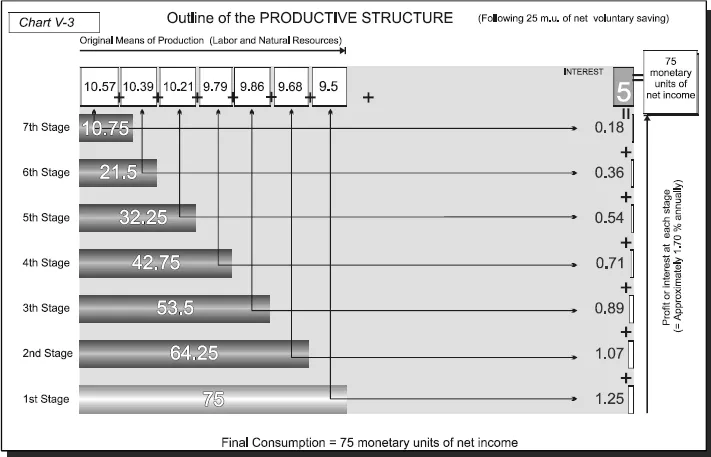
The three effects we have just examined are provoked by the entrepreneurial process of seeking profit, and the combination of the three tends to result in a new, narrower and more elongated structure of capital goods stages. Moreover the differential between income and costs at each stage, i.e., the accounting profit or interest rate, tends to even out at a lower level over all stages of the new productive structure (as naturally corresponds to a larger volume of saving and a lower social rate of time preference). Therefore the shape of the productive structure comes to closely resemble that reflected in Chart V-3.
Chart V-3 reveals that final consumption has fallen to 75 m.u. This reduction has also affected the value of the product of the second stage (the previous stage closest to consumption), which has dropped from 80 m.u. in Chart V-1 to 64.25 m.u. in Chart V-3. A similar decrease occurs in the third stage (from 60 m.u. to 53.5 m.u.), though this time the reduction is proportionally smaller. However beginning in the fourth stage (and upward, each stage further from consumption than the one before it), the demand in monetary terms grows. The increase is gradual at first. In the fourth stage, the figures rise from 40 m.u. to 42.75 m.u. It then becomes proportionally much more substantial in the fifth stage, where the value of the product grows from 20 m.u. to 32.25 m.u., as we saw in Chart V-2. Furthermore two new stages, stages six and seven, appear in the area furthest from consumption. These stages did not exist before.
After all necessary adjustments have been made, the rate of profit for the different stages tends to even out at a significantly lower level than that reflected in Chart V-1. This phenomenon derives from the fact that the upsurge in voluntary saving generates a much lower market rate of interest, and the rate of accounting profit for each stage (in our example, approximately 1.70 percent annually) approaches this figure. The net income received by the owners of the original means of production (workers and owners of natural resources) and by the capitalists of each stage, according to the net interest rate or differential, amounts to 75 m.u., which coincides with the monetary income spent on consumer goods and services. It is important to point out that even if only 75 m.u. are spent on consumer goods and services, i.e., 25 units less than in Chart V-1, once all new production processes are completed, the production of new final consumer goods and services will increase substantially in real terms. This is because production processes tend to become more productive as they become more roundabout and capital-intensive. Moreover a larger quantity, in real terms, of produced consumer goods and services can only be sold for a lower total number of m.u. (in our example, 75). Therefore there is a dramatic decline in the unit price of new consumer goods and services reaching the market, and correspondingly the income received by owners of the original means of production (specifically, workers’ wages and hence, their living standard) undergoes a sharp increase in real terms.
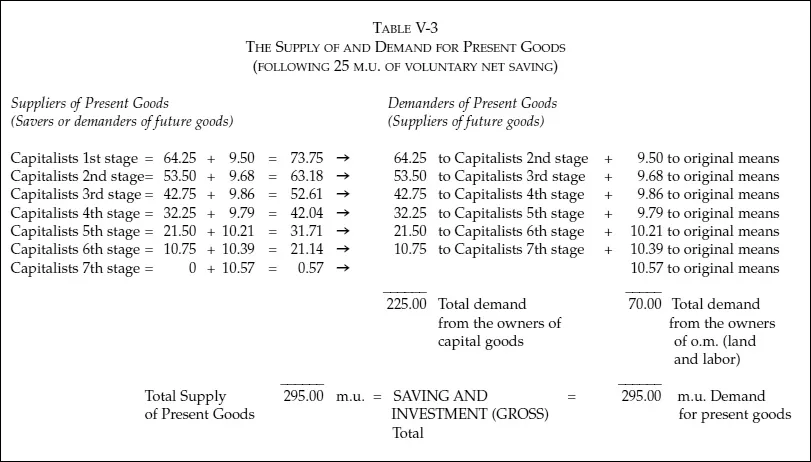
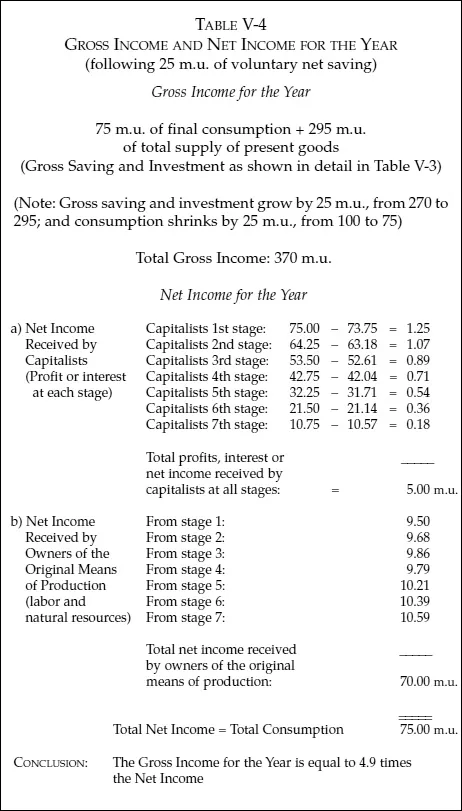
Tables V-3 and V-4 reflect both the supply of and the demand for present goods, as well as the composition of the gross national output for the year, after all adjustments provoked by the increase in voluntary saving. We see that the supply of and demand for present goods rests at 295 m.u., i.e., 25 m.u. more than in Table V-1. This is because gross saving and investment have grown by precisely the 25 m.u. of additional net saving voluntarily carried out. However as Table V-4 shows, the gross national output for the year remains unaltered at 370 m.u., of which 75 m.u. correspond to the demand for final consumer goods, and 295 m.u. to the total supply of present goods. In other words, even though the gross national output is identical in monetary terms to its value in the last example, it is now distributed in a radically different manner: over a narrower and more elongated productive structure (that is, a more capital-intensive one with more stages).
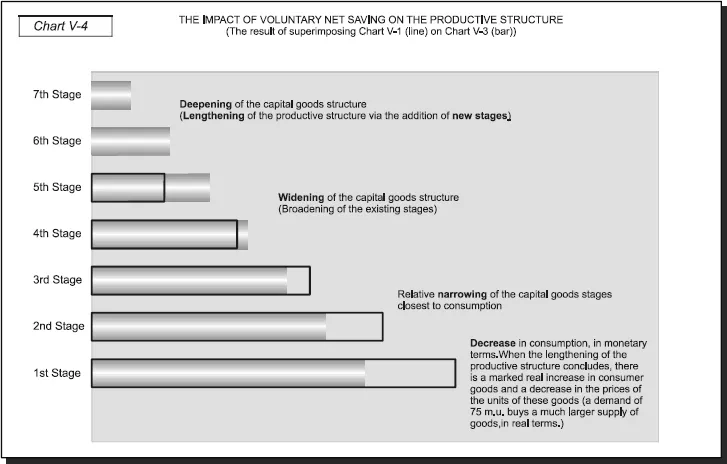
The distinct distribution of the same gross national output (in monetary terms) in each of the two productive structures is more apparent in Chart V-4.
Chart V-4 is simply the result of superimposing Chart V-1 (line) on Chart V-3 (bar), and it shows the impact on the productive structure of the 25 m.u. growth in voluntary net saving. Hence we see that the voluntary increase in saving provokes the following effects:
- First: a deepening of the capital goods structure. This outcome manifests itself as a vertical “lengthening” of the productive structure via the addition of new stages (in our example, stages six and seven, which did not exist before).
- Second: a widening of the capital goods structure, embodied in a broadening of the existing stages (as in stages four and five).
- Third: a relative narrowing of the capital goods stages closest to consumption.
- Fourth: In the final stage, the stage of consumer goods and services, the jump in voluntary saving invariably generates an initial drop in consumption (in monetary terms). However the lengthening of the productive structure is followed by a substantial real increase (in terms of quantity and quality) in the production of consumer goods and services. Given that the monetary demand for these goods is invariably reduced, and given that these two effects (the drop in consumption and the upsurge in the production of consumer goods) exert similar influences, the increase in production gives rise to a sharp drop in the market prices of consumer goods. Ultimately this drop in prices makes it possible for a significant real rise in wages to occur, along with a general increase in all real income received by owners of the original means of production.55
In short, in our example there has been no drop in the money supply (and therefore no external deflation, strictly-speaking), nor has the demand for money risen. So if we assume both of these factors remain constant, then the general fall in the price of consumer goods and services arises exclusively from the upsurge in saving and the increase in productivity, itself a consequence of the more capital-intensive productive structure. Moreover this brings about marked growth in wages (in real terms), which, though their nominal value remains the same or even diminishes somewhat, permit the earner to acquire an increasing quantity of consumer goods and services of higher and higher quality: the decline in the price of these goods is proportionally much sharper than the possible decline in wages. In brief this is the healthiest, most sustained process of economic growth and development imaginable. In other words, it involves the fewest economic and social maladjustments, tensions, and conflicts and historically has taken place on various occasions, as the most reliable studies have shown.56
THE THEORETICAL SOLUTION TO THE “PARADOX OF THRIFT”57
Our analysis also allows us to solve the problems posed by the supposed dilemma of the paradox of thrift or saving. This “paradox” rests on the concept that, though saving by individuals is positive in the sense that it allows them to augment their income, socially speaking, when the aggregate demand for consumer goods diminishes, the decrease eventually exerts a negative effect on investment and production.58 In contrast we have presented the theoretical arguments which demonstrate that this interpretation, based on the old myth of underconsumption, is faulty. Indeed, even assuming that gross national output in monetary terms remains constant, we have shown how society grows and develops through an increase in real wages, even when the monetary demand for consumer goods declines. We have also demonstrated how, in the absence of state intervention and increases in the money supply, an immensely powerful market force, driven by entrepreneurs’ search for profit, leads to the lengthening of and growing complexity in the productive structure. In short, despite the initial relative decrease in the demand for consumer goods which stems from growth in saving, the productivity of the economic system is boosted, as is the final production of consumer goods and services, and real wages.59
THE CASE OF AN ECONOMY IN REGRESSION
Our reasoning up to this point can be reversed, with appropriate changes, to explain the effects of a hypothetical decrease in society's voluntary saving. Let us begin by supposing that the productive structure closely resembles that reflected in Chart V-3. If society as a whole decides to save less, the result will be an increase, of for instance 25 m.u., in the monetary demand for consumer goods and services. Therefore the monetary demand will rise from 75 m.u. to 100 m.u., and the industries and companies of the stages closest to consumption will tend to grow dramatically, which will drive up their accounting profits. Though these events may appear to provoke the effects of a consumer boom, in the long run they will lead to a “flattening” of the productive structure, since productive resources will be withdrawn from the stages furthest from consumption and transferred to those closest to it. In fact the increased accounting profits of the stages close to final consumption will, relatively speaking, discourage production in the most distant stages, which will tend to bring about a reduction in investment in these stages. Moreover the drop in saving will push up the market rate of interest and diminish the corresponding present value of durable capital goods, deterring investment in them. Finally a reverse “Ricardo Effect” will exert its influence: growth in the prices of consumer goods and services will be accompanied by an immediate decline in real wages and in the rents of the other original factors, which will encourage capitalists to replace capital equipment with labor, now relatively cheaper.
The combined result of all these influences is a flattening of the productive structure, which comes to resemble that described in Chart V-1, which, although it reflects a greater demand for consumer goods and services in monetary terms, shows there has been a generalized impoverishment of society in real terms. In fact the less capital-intensive productive structure will result in the arrival of fewer consumer goods and services to the final stage, which nevertheless undergoes a considerable rise in monetary demand. Hence there is a decrease in the production of consumer goods and services, along with a substantial increase in their price, a consequence of the two previous effects combined. The result is the generalized impoverishment of society, especially of workers, whose wages shrink in real terms, since, while in monetary terms they may remain constant or even increase, such a rise never reaches the level of growth undergone by monetary prices of consumer goods and services.
According to John Hicks, Giovanni Boccaccio, in an interesting passage in the Introduction to Decameron, written around the year 1360, was the first to describe, in rather precise terms, a process very similar to the one we have just analyzed when he related the impact the Great Plague of the fourteenth century had on the people of Florence. In fact the epidemic caused people to anticipate a drastic reduction in life expectancy, and thus entrepreneurs and workers, instead of saving and “lengthening” the stages in their production process by working their lands and tending their livestock, devoted themselves to increasing their present consumption.60 After Boccaccio, the first economist to seriously consider the effects of a decline in saving and the resulting economic setback was Böhm-Bawerk in his book, Capital and Interest,61 where he explains in detail that a general decision by individuals to consume more and save less triggers a phenomenon of capital consumption, which ultimately lowers productive capacity and the production of consumer goods and services, giving rise to the generalized impoverishment of society.62
Money, Bank Credit, and Economic Cycles
Read the whole book online · Book details
Free to read online and to download from this archive.