
Chapter 25 of 68 · Money, Bank Credit, and Economic Cycles by Jesus Huerta de Soto
3. The Effects of Bank Credit Expansion Unbacked by an Increase in Saving: The Austrian Theory or Circulation Credit Theory of the Business Cycle
In this section we will examine the effects banks exert on the productive structure when they create loans unbacked by a prior increase in voluntary saving. These circumstances differ radically from those we studied in the last section, where loans were fully backed by a corresponding rise in voluntary saving. In accordance with the credit expansion process triggered by fractional-reserve banking (a process we examined in detail in chapter 4), a bank's creation of credit would result in an accounting entry which, in its simplest form, would resemble this one:
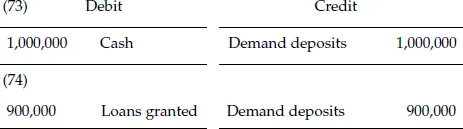
These book entries, which are identical to numbers (17) and (18) in chapter 4, record in a simplified and concise fashion the unquestionable fact that the bank is able to generate from nothing new m.u. in the form of deposits or fiduciary media which are granted to the public as loans or credit even when the public has not first decided to increase saving.63 We will now consider the effects this important event has on social processes of coordination and economic interaction.
THE EFFECTS OF CREDIT EXPANSION ON THE PRODUCTIVE STRUCTURE
The creation of money by the banking system in the form of loans has some real effects on the economy's productive structure, and it is necessary to clearly distinguish between these effects and those we studied in the last section with respect to loans backed by saving. More specifically, the generation of loans ex nihilo (i.e., in the absence of an increase in saving) raises the supply of credit to the economy, especially to the different capital goods stages in the productive structure. From this standpoint, the increased supply of loans which results from bank credit expansion will initially exert an effect very similar to that produced by the flow of new loans from saving which we analyzed in detail in the last section: it will tend to cause a widening and lengthening of the stages in the productive structure.
The “widening” of the different stages is easy to understand, since basically the loans are granted for the production processes which constitute each of the stages. Credit extended to finance durable consumer goods also leads to a widening and lengthening of the productive structure, because (as we have seen) durable consumer goods are economically comparable to capital goods throughout the period during which they are fit to render their services. Therefore even in the case of consumer loans (to finance durable consumer goods), the greater influx of loans will tend to increase both the quantity and quality of such goods.
The “lengthening” of the productive structure derives from the fact that the only way banks can introduce into the economy the new money they create from nothing and grant as loans is by temporarily and artificially reducing the interest rate in the credit market and by easing the rest of the economic and contractual conditions they insist on when granting loans to their customers. This lowering of the interest rate in the credit market does not necessarily manifest itself as a decrease in absolute terms. Instead a decrease in relative terms, i.e., in relation to the interest rate which would have predominated in the market in the absence of credit expansion, is sufficient.64 Hence the reduction is even compatible with an increase in the interest rate in nominal terms, if the rate climbs less than it would have in an environment without credit expansion (for instance, if credit expansion coincides with a generalized drop in the purchasing power of money). Likewise such a reduction is compatible with a decline in the interest rate, if the rate falls even more than it would have had there been no credit expansion (for example, in a process in which, in contrast, the purchasing power of money is growing). Therefore this lowering of the interest rate is a fact accounted for by theory, and one it will be necessary to interpret historically while considering the circumstances particular to each case.
The relative reduction credit expansion causes in the interest rate boosts the present value of capital goods, since the flow of rents they are expected to produce increases in value when discounted using a lower market rate of interest. In addition, the lowering of the interest rate gives the appearance of profitability to investment projects which until that point were not profitable, giving rise to new stages further from consumption, i.e., stages which are more capital-intensive. The process through which these stages come into existence closely resembles the one involved when society's voluntary saving actually increases. Nevertheless we must emphasize that although the initial effects may be very similar to those which, as we saw, follow an upsurge in voluntary saving, in this case the productive stages are lengthened and widened65 only as a consequence of the easier credit terms banks offer at relatively lower interest rates yet without any previous growth in voluntary saving. As we know, a sustainable lengthening of the productive structure is only possible if the necessary prior saving has taken place in the form of a drop in the final demand for consumer goods. This drop permits the different productive agents to sustain themselves using the unsold consumer goods and services while the new processes introduced reach completion and their more productive result begins to reach the market in the form of consumer goods.66
In short, entrepreneurs decide to launch new investment projects, widening and lengthening the capital goods stages in the productive structure; that is, they act as if society's saving had increased, when in fact such an event has not occurred. In the case of an upsurge in voluntary saving, which we examined in the last section, the individual behavior of the different economic agents tended to become compatible, and thus the real resources that were saved and not consumed made the preservation and lengthening of the productive structure possible. Now the fact that entrepreneurs respond to credit expansion by behaving as if saving had increased triggers a process of maladjustment or discoordination in the behavior of the different economic agents. Indeed entrepreneurs rush to invest and to widen and lengthen the real productive structure even though economic agents have not decided to augment their saving by the volume necessary to finance the new investments. In a nutshell, this is a typical example of an inducement to mass entrepreneurial error in economic calculation or estimation regarding the outcome of the different courses of action entrepreneurs adopt. This error in economic calculation stems from the fact that one of the basic indicators entrepreneurs refer to before acting, the interest rate (along with the attractiveness of terms offered in the credit market), is temporarily manipulated and artificially lowered by banks through a process of credit expansion.67 In the words of Ludwig von Mises,
But now the drop in interest falsifies the businessman's calculation. Although the amount of capital goods available did not increase, the calculation employs figures which would be utilizable only if such an increase had taken place. The result of such calculations is therefore misleading. They make some projects appear profitable and realizable which a correct calculation, based on an interest rate not manipulated by credit expansion, would have shown as unrealizable. Entrepreneurs embark upon the execution of such projects. Business activities are stimulated. A boom begins.68
At first the discoordination expresses itself in the emergence of a period of exaggerated and disproportionate optimism, which stems from the fact that economic agents feel able to expand the productive structure without at the same time having to make the sacrifice of reducing their consumption to generate savings. In the last section the lengthening of the productive structure was shown to be made possible precisely by the prior sacrifice required by all increases in saving. Now we see that entrepreneurs hasten to widen and lengthen the stages in production processes when no such prior saving has taken place. The discoordination could not be more obvious nor the initial excess of optimism more justified, since it seems possible to introduce longer production processes without any sacrifice or previous accumulation of capital. In short a mass error is committed by entrepreneurs, who adopt production processes they consider profitable, but which are not. This error feeds a generalized optimism founded on the belief that it is possible to widen and lengthen the stages in production processes without anyone's having to save. Intertemporal discoordination increasingly mounts: entrepreneurs invest as if social saving were constantly growing; consumers continue to consume at a steady (or even increased) pace and do not worry about stepping up their saving.69
To illustrate the initial effect credit expansion exerts on the real productive structure, we will follow the system used in the last section to present several graphs and tables which reflect the impact of credit expansion on the productive structure. A word of caution is necessary, however: it is practically impossible to represent in this way the complex effects produced in the market when credit expansion triggers the generalized process of discoordination we are describing. Therefore it is important to exercise great care in interpreting the following tables and charts, which should only be valued insofar as they illustrate and facilitate understanding of the fundamental economic argument. It is nearly impossible to reflect with charts anything other than strictly static situations, since charts invariably conceal the dynamic processes which take place between situations. Nonetheless the tables and graphs we propose to represent the stages in the productive structure may well help illustrate the essential theoretical argument and greatly facilitate an understanding of it.70
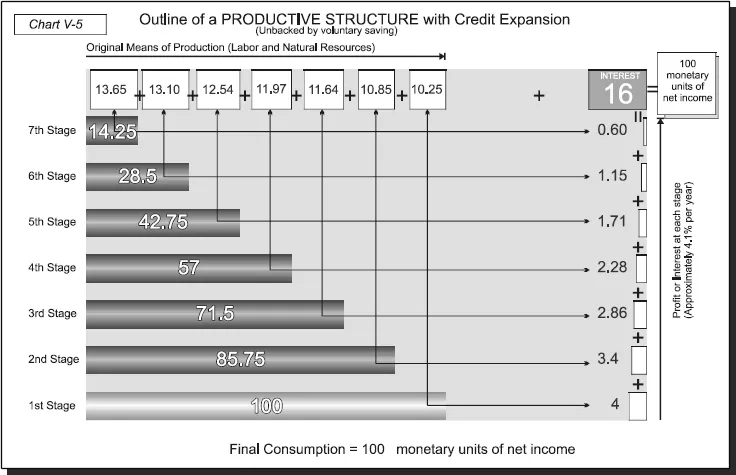
Chart V-5 provides a simplified illustration of the effect exerted on the structure of productive stages by credit expansion brought about by the banking system without the necessary increase in social saving. When we compare it with Chart V-1 of this chapter, we see that final consumption remains unchanged at 100 m.u., in keeping with our supposition that no growth in net saving has taken place. However new money is created (deposits or fiduciary media) and enters the system through credit expansion and the relative reduction in the interest rate (along with the typical easing of the contractual conditions and the requirements for obtaining a loan) necessary to persuade economic agents to take out the newly-created loans. Therefore the rate of profit in the different productive stages, which as we know tends to coincide with the interest rate obtained at each stage by advancing present goods in exchange for future goods, now drops from the 11 percent shown in Chart V-1 to slightly over 4 percent yearly. Moreover the new loans allow the entrepreneurs of each productive stage to pay more for the corresponding original means of production, as well as for the capital goods from earlier stages which they obtain for their own productive processes.
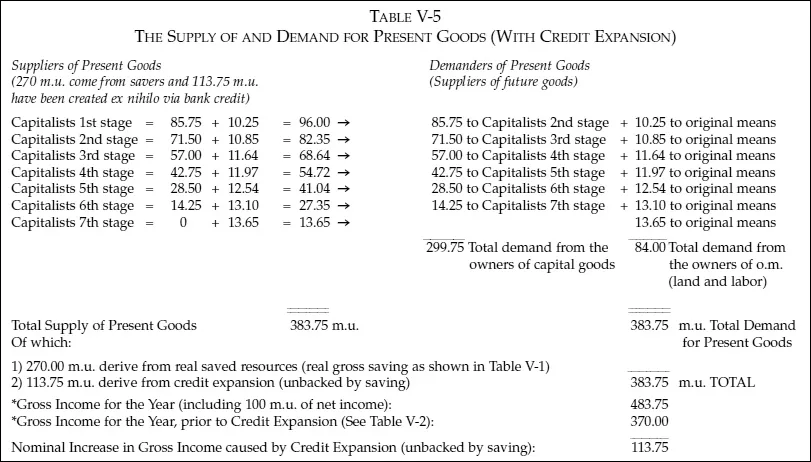
Table V-5 reflects the supply of and demand for present goods following bank credit expansion unbacked by saving. We see that the supply of present goods increases from the 270 m.u. shown in Table V-1 to slightly over 380 m.u., which are in turn composed of the 270 m.u. from the example in the last section (m.u. originating from real saved resources) plus slightly over 113 m.u. which banks have created through credit expansion without the backing of any saving. Thus credit expansion has the effect of artificially raising the supply of present goods, which are demanded at lower interest rates by owners of the original means of production and by capitalists of the earlier stages further from consumption. Furthermore Table V-5 reveals that the gross income for the year is over 483 m.u., 113 units more than the gross income for the year prior to credit expansion. (See Table V-2.)
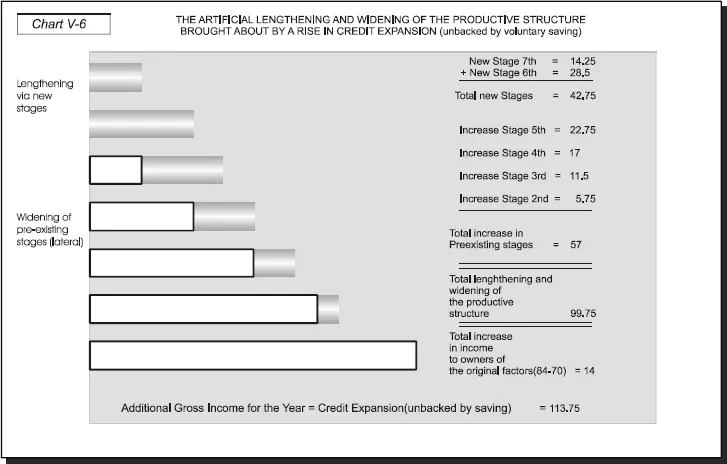
Chart V-6 offers a simplified representation of the effect of credit expansion (i.e., unbacked by a prior rise in voluntary saving) on the productive structure. In our example, this effect expresses itself in the lengthening of the productive structure via the appearance of two new stages, six and seven. Prior to the expansion of credit these stages did not exist, and they are the furthest from final consumption. In addition the preexisting productive stages (two through five) are widened. The sum of the m.u. which represent the monetary demand embodied in each new widening or lengthening of productive stages, and which on the chart is reflected by the shaded areas, amounts to 113.75 m.u., the exact rise in gross monetary income for the year, an increase which stems exclusively from the creation of new money through credit expansion brought about by banks.
Let us not be deceived by Chart V-5: the new structure of productive stages it illustrates rests on generalized intertemporal discoordination, in turn the result of the mass entrepreneurial error provoked by the introduction of a large volume of new loans which are granted at artificially reduced interest rates, without the backing of real prior saving. This anomalous state of discoordination cannot be maintained, and the next section will include a detailed explanation of the reaction credit expansion inevitably sets off in the market. In other words, from the standpoint of pure microeconomic theory, we will examine the factors that will cause the reversal of the “macroeconomic” discoordination we have revealed.
Hence we will study the reasons the intertemporal discoordination process, initially set in motion by credit expansion, will completely reverse. Any attack on the social process, be it intervention, systematic coercion, manipulation of essential indicators (such as the price of present goods in terms of future goods, or the market rate of interest), or the granting of privileges against traditional legal principles, spontaneously triggers certain processes of social interaction which, as they are driven precisely by entrepreneurship and its capacity to coordinate, tend to halt and rectify errors and discoordination. Great credit goes to Ludwig von Mises for being the first to reveal, in 1912, that credit expansion gives rise to booms and optimism which sooner or later invariably subside. In his own words:
The increased productive activity that sets in when the banks start the policy of granting loans at less than the natural rate of interest at first causes the prices of production goods to rise while the prices of consumption goods, although they rise also, do so only in a moderate degree, namely, only insofar as they are raised by the rise in wages. Thus the tendency toward a fall in the rate of interest on loans that originates in the policy of the banks is at first strengthened. But soon a countermovement sets in: the prices of consumption goods rise, those of production goods fall. That is, the rate of interest on loans rises again, it again approaches the natural rate.71
As we will have the opportunity to study later, prior to Mises various scholars of the School of Salamanca (Saravia de la Calle for instance) and others of the nineteenth century, mainly intellectuals of the Currency School (Henry Thornton, Condy Raguet, Geyer, etc.), sensed that booms provoked by credit expansion ultimately and spontaneously reversed, causing economic crises. Nonetheless Mises was the first to correctly formulate and explain, from the standpoint of economic theory, the reasons this is necessarily so. Despite Mises's momentous initial contribution, a completely formulated analysis of the different economic effects which comprise the market's reaction to credit expansion first became available with the writings of Mises's most brilliant student, F.A. Hayek.72 In the next section we will examine these effects in detail.73
THE MARKET'S SPONTANEOUS REACTION TO CREDIT EXPANSION
We will now consider the microeconomic factors which will halt the process of exaggerated optimism and unsustainable economic expansion that follows the granting of bank loans unbacked by a previous increase in voluntary saving. In this way we will be fully able to take typically macroeconomic phenomena (economic crises, depression, and unemployment) back to their fundamental microeconomic roots. We will now study, one by one, the six microeconomic causes of the reversal of the boom that credit expansion invariably triggers:
1. The rise in the price of the original means of production.
The first temporary effect of credit expansion is an increase in the relative price of the original means of production (labor and natural resources). This rise in price stems from two separate causes which reinforce each other. On the one hand, capitalists from the different stages in the production process show a greater monetary demand for original resources, and this growth in demand is made possible by the new loans the banking system grants. On the other hand, with respect to supply, we must keep in mind that when credit expansion takes place without the backing of a prior increase in saving, no original means of production are freed from the stages closest to consumption, as occurred in the process we studied earlier, which was initiated by a real upsurge in voluntary saving. Therefore the rise in the demand for original means of production in the stages furthest from consumption and the absence of an accompanying boost in supply inevitably result in a gradual increase in the market price of the factors of production. Ultimately this increase tends to accelerate due to competition among the entrepreneurs of the different stages in the production process. The desire of these entrepreneurs to attract original resources to their projects makes them willing to pay higher and higher prices for these resources, prices they are able to offer because they have just received new liquidity from the banks in the form of loans the banks have created from nothing. This rise in the relative price of the original factors of production begins to push the cost of the newly launched investment projects above the amount originally budgeted. Nevertheless this effect alone is still not sufficient to end the wave of optimism, and entrepreneurs, who continue to feel safe and supported by the banks, usually go ahead with their investment projects without a second thought.74
2. The subsequent rise in the price of consumer goods.
Sooner or later the price of consumer goods begins to gradually climb, while the price of services offered by the original factors of production starts to mount at a slower pace (in other words, it begins to fall in relative terms). The combination of the following three factors accounts for this phenomenon:
- First, growth in the monetary income of the owners of the original factors of production. Indeed if, as we are supposing, economic agents’ rate of time preference remains stable, and therefore they continue to save the same proportion of their income, the monetary demand for consumer goods increases as a result of the increase in monetary income received by the owners of the original factors of production. Nonetheless this effect would only explain a similar rise in the price of consumer goods if it were not for the fact that it combines with effects (b) and (c).
- Second, a slowdown in the production of new consumer goods and services in the short- and medium-term, a consequence of the lengthening of production processes and the greater demand for original means of production in the stages furthest from final consumption. This decline in the speed at which new consumer goods arrive at the final stage in the production process derives from the fact that original factors of production are withdrawn from the stages closest to consumption, causing a relative shortage of these factors in those stages. This shortage affects the immediate production and delivery of final consumer goods and services. Furthermore as the capital theory outlined at the beginning of the chapter explains, the generalized lengthening of production processes and the incorporation into them of a greater number of stages further from consumption invariably leads to a short-term decrease in the rate at which new consumer goods are produced. This slowdown lasts the length of time necessary for newly initiated investment processes to reach completion. It is clear that the longer production processes are, i.e., the more stages they contain, the more productive they tend to be. However it is also clear that until new investment processes conclude, they will not allow a larger quantity of consumer goods to reach the final stage. Hence the growth in income experienced by the owners of the original factors of production, and thus the increase in monetary demand for consumer goods, combined with the short-term slowdown in the arrival of new consumer goods to the market, accounts for the fact that the price of consumer goods and services eventually climbs more than proportionally; that is, faster than the increase in monetary income experienced by the owners of the original means of production.
- Third, the rise in monetary demand for consumer goods which is triggered by artificial entrepreneurial profits that result from the credit expansion process. Banks’ creation of loans ultimately entails an increase in the money supply and a rise in the price of the factors of production and of consumer goods. These increases eventually distort entrepreneurs’ estimates of their profits and losses. In fact entrepreneurs tend to calculate their costs in terms of the historical cost and purchasing power of m.u. prior to the inflationary process. However they compute their earnings based on income comprised of m.u. with less purchasing power. All of this leads to considerable and purely fictitious profits, the appearance of which creates an illusion of entrepreneurial prosperity and explains why businessmen begin to spend profits that have not actually been produced, which further increases the pressure of the monetary demand for final consumer goods.75
It is important to underline the effect of the more-than-proportional rise in the price of consumer goods with respect to the rise in the price of original factors of production. Theoretically this is the phenomenon which has most escaped the notice of many scholars. As they have not fully comprehended capital theory, the analyses of these theorists have not accounted for the fact that when more productive resources are devoted to processes further from consumption, processes which begin to yield results only after a prolonged period of time, there is a reduction in the speed at which new consumer goods arrive at the last stage in the production process. Moreover this is one of the most significant distinguishing features of the case we are now considering (in which the lengthening of production processes is financed with loans the banks create ex nihilo) with respect to the process initiated by an upsurge in voluntary saving (which by definition produced an increase in the stock of consumer goods that remained unsold and which sustained the owners of the original factors of production while new processes of production could be completed). When there is no prior growth in saving, and therefore consumer goods and services are not freed to support society during the lengthening of the productive stages and the transfer of original factors from the stages closest to consumption to those furthest from it, the relative price of consumer goods inevitably tends to rise.76
3. The substantial relative increase in the accounting profits of the companies from the stages closest to final consumption.
The price of consumer goods escalates faster than the price of original factors of production, and this results in relative growth in the accounting profits of the companies from the stages closest to consumption with respect to the accounting profits of companies who operate in the stages furthest from consumption. Indeed the relative price of the goods and services sold in the stages closest to consumption increases very rapidly, while costs, though they also rise, do not rise as fast. Consequently accounting profits, or the differential between income and costs, mount in the final stages. In contrast, in the stages furthest from consumption the price of the intermediate goods produced at each stage does not show a major change, while the cost of the original factors of production employed at each stage climbs continuously, due to the greater monetary demand for these factors, which in turn originates directly from credit expansion. Hence companies operating in the stages furthest from consumption tend to bring in less profit, an accounting result of a rise in costs more rapid than the corresponding increase in income. These two factors produce the following combined effect: it gradually becomes evident throughout the productive structure that the accounting profits generated in the stages closest to consumption are higher in relative terms than the accounting profits earned in the stages furthest from it. This prompts entrepreneurs to rethink their investments and even to doubt their soundness. It compels them to again consider the need to reverse their initial investment of resources by withdrawing them from more capital-intensive projects which have barely gotten off the ground and returning them to the stages closest to consumption.77
4. The “Ricardo Effect.”
In addition, the more-than-proportional rise in the price of consumer goods with respect to the increase in original-factor income begins to drive down (in relative terms) the real income of these factors, particularly wages. This real reduction in wages provokes the “Ricardo Effect,” which we have covered in detail, but which now exerts an impact contrary to the one it exerted in our last example, where real growth took place in voluntary saving. In the case of voluntary saving, the temporary decrease in the demand for consumer goods brought about a real increase in wages, which tended to give rise to the substitution of machines for labor and therefore to lengthen the productive stages, distancing them from consumption and making them more capital-intensive. However now the effect is just the opposite: the more-than-proportional growth in the price of consumer goods with respect to the rise in factor income drives this income, particularly wages, down in real terms, providing entrepreneurs with a powerful financial incentive to substitute labor for machinery or capital equipment, in keeping with the “Ricardo Effect.” This results in a relative drop in the demand for the capital goods and intermediate products of the stages furthest from consumption, which in turn further aggravates the underlying problem of the fall in accounting profits (even losses) which begins to be perceived in the stages furthest from consumption.78
In short, here the “Ricardo Effect” exerts an impact contrary to the one it exerted when there was an upsurge in voluntary saving.79 Then we saw that an increase in saving brought about a short-term decrease in the demand for consumer goods and in their price, and thus a boost in real wages which encouraged the substitution of machinery for workers, growth in the demand for capital goods and a lengthening of productive stages. Now we see that the relative rise in the price of consumer goods causes a drop in real wages, motivating entrepreneurs to substitute labor for machinery, which lessens the demand for capital goods and further reduces the profits of companies operating in the stages furthest from consumption.80
5. The increase in the loan rate of interest. Rates even exceed pre-credit-expansion levels.
The last temporary effect consists of an escalation in interest rates in the credit market. This rise occurs sooner or later, when the pace of credit expansion unbacked by real saving stops accelerating. When this happens the interest rate will tend to return to the relatively higher levels which prevailed prior to the beginning of credit expansion. In fact if, for instance, the interest rate is around 10 percent before credit expansion begins and the new loans the banking system creates ex nihilo are placed in the productive sectors via a reduction in the interest rate (for example, to 4 percent) and an easing of the rest of the “peripheral” requirements for the granting of loans (contractual guarantees, etc.), it is clear than when credit expansion comes to a halt, if, as we are supposing, no increase in voluntary saving takes place, interest rates will climb to their previous level (in our example, they will rise from 4 to 10 percent). They will even exceed their pre-credit-expansion level (i.e., they will rise above the originary rate of 10 percent) as a result of the combined effect of the following two phenomena:
- Other things being equal, credit expansion and the increase in the money supply which it involves will tend to drive up the price of consumer goods, i.e., to reduce the purchasing power of the monetary unit. Consequently if lenders wish to charge the same interest rates in real terms, they will have to add (to the interest rate which prevails prior to the beginning of the credit expansion process) a component for “inflation,” or in other words, for the expected drop in the purchasing power of the monetary unit.81
- There is another powerful reason interest rates climb to and even exceed their prior level: entrepreneurs who have embarked upon the lengthening of production processes despite the rise in interest rates will, to the extent that they have already committed substantial resources to new investment projects, be willing to pay very high interest rates, provided they are supplied with the funds necessary to complete the projects they have mistakenly launched. This is an important aspect which went completely unnoticed until Hayek studied it in detail in 1937.82 Hayek demonstrated that the process of investment in capital goods generates an autonomous demand for subsequent capital goods, precisely ones which are complementary to those already produced. Furthermore this phenomenon will last as long as the belief that the production processes can be completed. Thus entrepreneurs will rush to demand new loans regardless of their cost, before being forced to admit their failure and altogether abandon investment projects in which they have allocated very important resources and with respect to which they have jeopardized their prestige. As a result, the growth in the interest rate which takes place in the credit market at the end of the boom is not only due to monetary phenomena, as Hayek had previously thought, but also to real factors that affect the demand for new loans.83 In short, entrepreneurs, determined to complete the new more capital-intensive stages they have begun and which they begin to see threatened, turn to banks and demand additional loans, offering a higher and higher interest rate for them. Thus they start a “fight to the death” to obtain additional financing.84
6. The appearance of accounting losses in companies operating in the stages relatively more distant from consumption: the inevitable advent of the crisis.
The above five factors provoke the following combined effect: sooner or later companies which operate in the stages relatively more distant from consumption begin to incur heavy accounting losses. These accounting losses, when compared with the relative profits generated in the stages closest to consumption, finally reveal beyond all doubt the serious entrepreneurial errors committed and the urgent need to correct them by paralyzing and then liquidating the investment projects mistakenly launched, withdrawing productive resources from the stages furthest from consumption and transferring them back to those closest to it.
In a nutshell, entrepreneurs begin to realize a massive readjustment in the productive structure is necessary. Through this “restructuring” in which they withdraw from the projects they began in the stages of capital goods industries and which they were unable to successfully complete, they transfer what is left of their resources to the industries closest to consumption. It has now become obvious that certain investment projects are unprofitable, and entrepreneurs must liquidate these and make a massive transfer of the corresponding productive resources, particularly labor, to the stages closest to consumption. Crisis and economic recession have hit, essentially due to a lack of real saved resources with which to complete investment projects which, as has become apparent, were too ambitious. The crisis is brought to a head by excessive investment (“overinvestment”) in the stages furthest from consumption, i.e., in capital goods industries (computer software and hardware, high-tech communications devices, blast furnaces, shipyards, construction, etc.), and in all other stages with a widened capital goods structure. It also erupts due to a parallel relative shortage in investment in the industries closest to consumption. The combined effect of the two errors is generalized malinvestment of productive resources; that is, investment of a style, quality, quantity, and geographic and entrepreneurial distribution typical of a situation in which much more voluntary saving has taken place. In short, entrepreneurs have invested an inappropriate amount in an inadequate manner in the wrong places in the productive structure because they were under the impression, deceived as they were by bank credit expansion, that social saving would be much greater. Economic agents have devoted themselves to lengthening the most capital-intensive stages in the hope that once the new investment processes have, with time, reached completion, the final flow of consumer goods and services will increase significantly. However the process by which the productive structure is lengthened requires a very prolonged period of time. Until this time has passed, society cannot profit from the corresponding rise in the production of consumer goods and services. Yet economic agents are not willing to wait until the end of that more prolonged period of time. Instead they express their preferences through their actions and demand the consumer goods and services now, i.e., much sooner than would be possible were the lengthening of the productive structure to be completed.85
Society's savings can be either wisely or foolishly invested. Credit expansion brought about by the banking system ex nihilo encourages entrepreneurs to act as if social saving had increased substantially, precisely by the amount the bank has created in the form of new loans or fiduciary media. The microeconomic processes examined above invariably and spontaneously bring to light the error committed. This error derives from the fact that for a prolonged period of time economic agents believed available savings to be much more considerable than they actually were. This situation is very similar to the one in which our Robinson Crusoe from section 1 would find himself if, having saved a basket of berries large enough to permit him to spend a maximum of five days producing a capital good without having to devote himself to the collection of more berries, through an error in calculation86 were to believe that this amount of savings would allow him to undertake the construction of his cabin. After five days spent just digging the foundations and gathering materials, he would have consumed all of his berries and would therefore be unable to complete his illusory investment project. Mises likens the general error committed to the one a builder would make if he were to misjudge the amount of materials available to him and use them all up laying the foundations of a building, which he would then be forced to leave unfinished.87 As Hayek puts it, we are thus dealing with a crisis of overconsumption, or in other words, insufficient saving. It has become obvious that saving is inadequate to permit the completion of the more capital-intensive investments made by mistake. The situation would resemble that of the imaginary inhabitants of an island who, having undertaken the construction of an enormous machine capable of completely satisfying their needs, had exhausted all of their savings and capital before finishing it and had been left with no other choice but to temporarily abandon the project and return all of their energy to the daily search for food at a mere subsistence level, i.e., without the assistance of any capital equipment.88 In our society such a shortage of savings leads to the following: many factories are closed, particularly in the stages furthest from consumption, numerous investment projects launched in error are paralyzed, and many workers are laid off. Furthermore pessimism spreads throughout society, and the notion that an inexplicable economic crisis has erupted, shortly after people had begun to believe that the boom and optimism, far from reaching their peak, would last indefinitely, demoralizes even the most persistently high-spirited.89
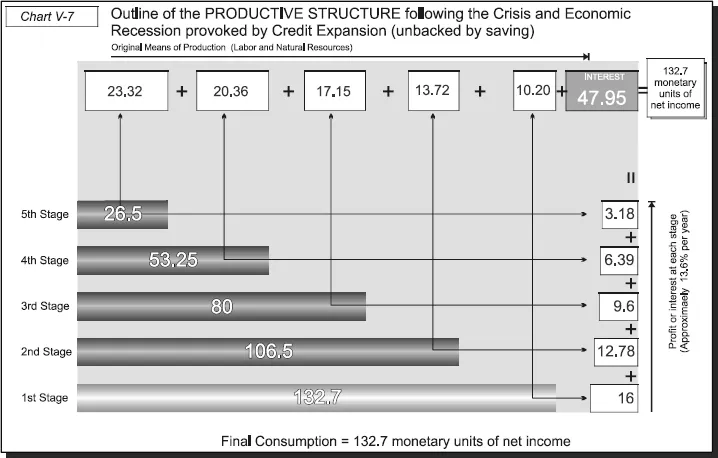
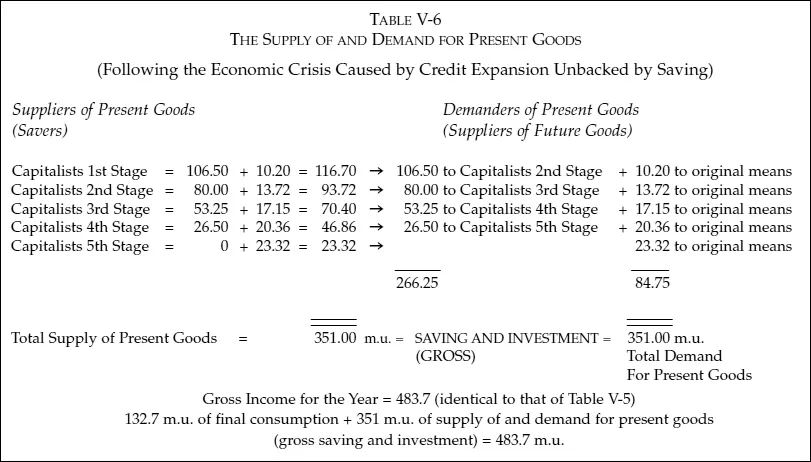
Chart V-7 reflects the state of the productive structure once the crisis and economic recession provoked by credit expansion (i.e., unbacked by a prior increase in voluntary saving) have become evident and the necessary readjustments have been made. As the chart makes clear, the new productive structure is flatter and contains only five stages, since the two stages furthest from consumption have disappeared. As Charts V-5 and V-6 show, initially credit expansion, in error, permitted entrepreneurs to embark on these stages. Furthermore Table V-6 demonstrates that although the gross income for the year is identical to that reflected in Table V-5 (483.7 m.u.), the distribution of the portion allocated to the direct demand for final consumer goods and services and to the demand for intermediate goods has varied in favor of the former. In fact now there are 132 m.u. of monetary demand for consumer goods, an amount one-third larger than the 100 units of monetary demand which appeared in the example shown in Chart V-5 and Table V-5. Meanwhile the overall monetary demand for intermediate goods has diminished from 383 to 351 units. In short there is a “flatter” structure which is less capital-intensive and therefore leads to the production of fewer consumer goods and services, yet these goods and services are the object of greater monetary demand, all of which gives rise to a strong jump in the price of consumer goods and services and the generalized impoverishment of society. This is revealed in the fall, in real terms, in the price of the different original factors of production. Though the nominal value of the monetary income received by their owners has mounted substantially, the even more rapid increase in the price of consumer goods places the owners of these factors at a considerable disadvantage in real terms. Moreover the interest rate, or rate of accounting profit approached at each stage, has risen above 13.5 percent, i.e., to a level which even exceeds that of the interest in the credit market prior to credit expansion (11 percent per year). This higher rate reflects a premium to compensate for the drop in the purchasing power of money; the keener competition among the different entrepreneurs, who desperately wish to obtain new loans; and the increase in the components of risk and entrepreneurial uncertainty which influences the interest rate whenever pessimism and economic distrust are rampant.
We must emphasize that the productive structure which remains following the necessary readjustment, and which Chart V-7 illustrates, cannot continue to match the structure that existed prior to credit expansion. This is due to the fact that circumstances have changed significantly. Heavy inevitable losses of specific capital goods have been incurred to the extent that society's scarce resources have been channeled into investments that cannot be restructured and therefore are devoid of economic value. This gives rise to general impoverishment of society, a state which manifests itself as a decline in capital equipment per capita, resulting in a decrease in the productivity of labor, and consequently, a further reduction in real wages. Furthermore there has been a shift in the distribution of income among the different factors of production, as well as a realignment of all the investment processes which, though initiated in error, are still of some use and economic value. All of these new circumstances make the productive structure qualitatively very different from and quantitatively much flatter and poorer than the one that existed before banks brought about credit expansion.90
In summary, we have described the microeconomic basis for the spontaneous market reaction which consistently tends to follow credit expansion. This reaction gives rise to the consecutive cycles of boom and recession which have regularly affected western economies for nearly two centuries (and even much longer, as we saw in chapter 2). We have also demonstrated that there is no theoretical possibility that banks' increase in loans, if not backed by a corresponding prior rise in voluntary saving, will permit society to reduce the necessary sacrifices all processes of economic growth require, and foster and accelerate sustainable growth in the absence of a voluntary decision made by citizens to sacrifice and save.91 Given that these are highly significant conclusions, in the next section we will analyze their implications for the banking sector, particularly, the manner in which they explain that this sector cannot operate independently (i.e., without a central bank) while maintaining a fractional reserve. Thus we will conclude the theoretical analysis we set out to produce in chapter 3: to demonstrate on the basis of economic theory that it is impossible for the banking system to insure itself against suspensions of payments and bankruptcy via a fractional-reserve requirement, since the supposed insurance (the fractional-reserve requirement) is precisely what triggers a process of credit expansion, boom, crisis and economic recession which invariably has a detrimental effect on banks’ solvency and ability to pay.
Money, Bank Credit, and Economic Cycles
Read the whole book online · Book details
Free to read online and to download from this archive.