
Chapter 20 of 68 · Money, Bank Credit, and Economic Cycles by Jesus Huerta de Soto
7. The Parallels Between the Creation of Deposits and the Issuance of Unbacked Banknotes
The economic analysis of the issuance of unbacked banknotes, an operation which emerged long after the discovery of fractional-reserve banking, is not one of the main purposes of this book.39 However it could be useful at this point to consider in some detail the accounting and legal aspects of the issuance of unbacked banknotes, since as we will demonstrate, its effects are identical to those produced by banks' creation of loans and deposits from nothing.
Let us imagine that banking is just beginning to emerge, and banks act as true depositaries of money as stipulated in an irregular deposit contract. As long as the general legal principles we studied in chapters 1 through 3 are upheld, banks will accept monetary units (usually gold or any other type of commodity money) and keep them in their vaults, and in return they will give depositors deposit certificates, receipts or banknotes for the entire sum deposited. A bank which correctly honors its commitments will make the following entry in its journal:
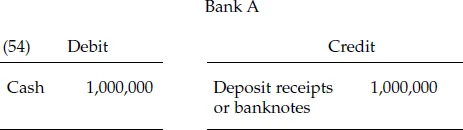
If the bank fulfills its commitments for a lengthy period of time and people completely trust it, it is certain that the public will gradually begin to use the banknotes (or the deposit slips or receipts the bank issues in exchange for monetary units deposited) as if they were the units of commodity money themselves, thus converting the banknotes into monetary units (perfect money substitutes, to use Mises's terminology). Given that money is a present good people need and use only as a medium of exchange and not for their own consumption, if depositors trust the bank, their use of banknotes as money could be prolonged indefinitely (they would not need to go to the bank and withdraw the monetary units they originally deposited). When this situation arises, bankers may start to feel tempted to issue deposit receipts for an amount exceeding the sum of monetary units actually deposited.
Clearly if bankers succumb to this temptation, they violate universal legal principles and commit not only the crime of counterfeiting (by issuing a false receipt unbacked by a corresponding deposit), but the crime of fraud as well, by presenting as a means of payment a document that in reality lacks all backing.40 Nevertheless, if people place enough trust in the bank and the banker knows from experience that a reserve ratio, c, of 0.1 will permit him to honor his commitments under ordinary circumstances, he will be able to issue up to nine times more in new false deposit receipts or banknotes. His corresponding journal entry will appear as follows:
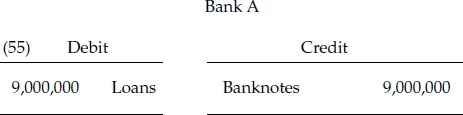
We have assumed the bank uses the counterfeit bills to grant loans, but it could use them for any purpose, for example to purchase any other asset (like lavish buildings) or simply to pay day-to-day expenses. If the bank uses the bills to grant loans, its balance sheet will appear as follows:
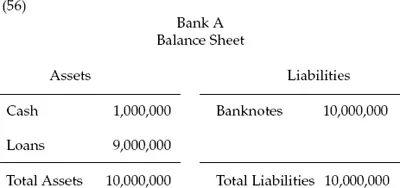
If people trust the bank, borrowers will agree to receive their loans in bills, which will circulate as if they were money. Under these conditions the banker may even believe, with good reason, that no one will ever return these bills to the bank to withdraw the original money deposited. The moment the banker decides this is the case, his judgment may manifest itself as an accounting entry identifying the 9,000,000 false bills put into circulation by the bank as part of the year's profit, which the banker may freely appropriate. The following journal entries will be made:
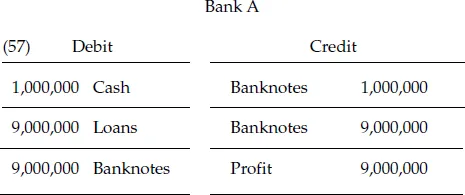
These accounting entries reflect the fact that the banker is sure he will never have to return the sum of the bills, since his bills circulate as money. The bank's balance sheet will look like this:
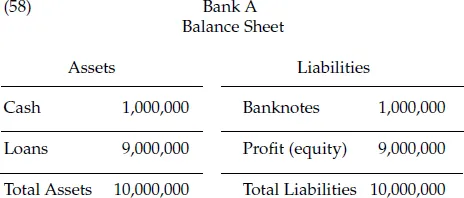
From this balance sheet we can conclude that once the banknotes have acquired the nature of monetary units, no one will ever return them to the bank to withdraw the money deposited, since the bills circulate freely and are considered money themselves. Only 1,000,000 of the banknotes issued are recorded in the Liabilities column, because 10 percent is sufficient to comply with ordinary requests for conversion. Hence this balance sheet amounts to an acknowledgment of the fraud the bank commits when it issues bills for an amount exceeding the sum of money deposited. Bankers have never thus recorded in their account books the issuance of unbacked banknotes, as it would fully reveal the fraud they commit. By their deceitful actions they harm third parties, whose money drops in value due to the increase in the money supply, not to mention economic crises and recessions, an effect we will consider later. Nonetheless this last balance sheet is clearly more honest, in the sense that at least it demonstrates the banker's maneuver and the fact that the issuance of unbacked bills constitutes an endless source of financing which permits bankers to appropriate a very large volume of wealth.
The reader will surely have noticed that records (54) through (55) are identical to ones we studied with respect to deposits. In fact the nature of banknotes is identical to that of secondary deposits and both produce the same economic effects. They actually represent the same operation and result in identical accounting records.
Both activities generate considerable assets for banks, who gradually take this wealth from all economic agents in the market through a process the agents cannot understand or identify, one which leads to small decreases in the purchasing power of the monetary units all use in society. Credit expansion is backed by the creation of new deposits or bills, and since these are considered money in themselves, from the subjective point of view of the public, they will never be withdrawn under normal conditions. In this way banks appropriate a large volume of wealth, which from an accounting standpoint they guarantee with deposits or bills that permit them to disguise the fact that economically speaking they are the only beneficiaries who completely take advantage de facto of these assets. Thus they have found a perennial source of financing which will probably not be demanded from them, a “loan” they will never have to return (which is ultimately the same as a “gift”). From an economic point of view, bankers and other related economic agents are the ones who take advantage of these extraordinary circumstances. They possess the enormous power to create money, and they use this power continually to expand their assets, open new offices, hire new employees, etc. Furthermore they have managed to keep their activities relatively hidden from most of the public, including economists, by backing their created loans with liability accounts (deposit accounts or banknote accounts) that do not coincide with their actual equity. In short, bankers have discovered their Philosopher's Stone (much like the one sought-after in the Middle Ages), which enables them to create new monetary units from nothing, and thus to generate hidden wealth, harming and deceiving third parties in the process. In account books depositors are formally recognized as the owners of such wealth, but in practice it does not belong to anyone (however, economically speaking, it belongs to the bankers themselves). As we mentioned before, the recognition of this fact is fundamental to our arguments in the last chapter, where we propose a plan for reforming the banking system. The wealth banks have gradually accumulated can and must be returned to the citizens. Through a process of privatization, it should become available for different uses of great importance to society (for example, to help pay off the national debt, or make a transition to a private Social Security system based on investment).
The parallels between the issuance of unbacked banknotes and credit expansion backed by secondary deposits created ex nihilo are now evident. Indeed all of the arguments offered in the preceding pages hold true for banknotes as well as for demand deposits. With that in mind, let us briefly consider a few entries. For example, when loans are granted against the issuance of banknotes:
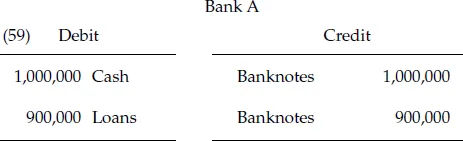
In this case the bank grants loans from nothing by simply issuing “false” bills and giving them to borrowers. In the worst of cases, if these borrowers return the bills to the bank to withdraw units of commodity money from the vault, the bank's balance sheet will look like this:
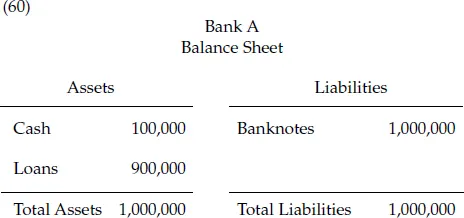
If we suppose that the borrowers pay this money to other people, who eventually take it to another bank, for instance Bank B, which also issues banknotes without backing, Bank B would make the following journal entries:
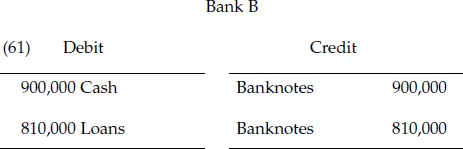
Bank B's balance sheet would appear as follows:
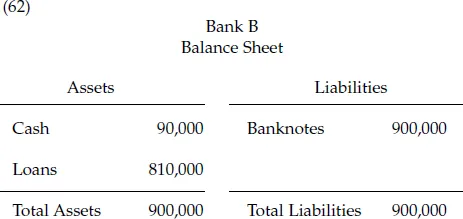
The process continues in this manner and spreads throughout the system. If we suppose that the reserve ratio, c, for banknotes is equal to 0.1 and k = 0, we know the system will be able to create from nothing:

monetary units in the form of bills unbacked by original money (gold or any other type of commodity money).
We would have obtained the same result in the case of a monopolistic bank, one that enjoys the trust and business of everyone, with a reserve ratio, c, of 0.1 and a k of 1. In this case the credit expansion, x, would be equal to:
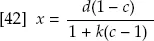
and when k = 1, x equals:  banknotes created ex nihilo.
If we suppose that all the banks issue bills simultaneously and receive new original monetary units at the same rate, then by maintaining its cash reserves unaltered, a single bank will be able to generate banknotes equal to:

This is the same formula we applied to deposits. The following entries will be made:
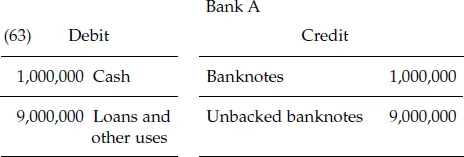
We could also reproduce all of the accounting entries for the more general case in which k > 0 (in our previous example k = 0.2). If c = 0.1, then for each 1,000,000 m.u. a bank receives, it will be able to create from nothing new banknotes for a sum equal to:
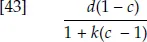
That is, the bank will have the capacity to create 1,097,560 m.u. in the form of unbacked bills. One by one we could duplicate for banknotes all of the results we obtained for bank deposits, which shows that there is no economic difference between the issuance of unbacked bills and the ex nihilo expansion of bank-credit backed by deposits generated from nothing. The only substantial difference is of a legal nature, since according to universal legal principles, the issuance of unbacked bills implies counterfeiting and the crime of fraud, while the monetary bank-deposit contract only involves misappropriation.
Nonetheless there are some differences regarding the way the operation is carried out. Banknotes take the form of bearer bonds and each has a particular face value, allowing the notes to be transferred from one person to another without it being necessary for the bank to make any accounting entry in its books (and as a result the cost of bank transactions decreases). In contrast deposits offer customers the advantage of being able to write an exact figure on a check without needing to hand over a specific number of bills of a set value. However the fact that the banker must follow the transactions conducted and record them in his books constitutes a disadvantage.
Still, apart from these legal differences and differences in form, from an economic standpoint the two operations are essentially identical and produce the same effects. As we will see later, however, when the theory of money was first being developed, theorists only recognized the immorality of the creation of unbacked banknotes and the serious harm it causes. They did not initially realize nor respond to the fact that the expansive creation of loans backed by deposits generated from nothing has exactly the same effects. This explains why the Peel Act of July 19, 1844, the foundation of all modern banking systems, prohibited the issuance of unbacked bills yet failed miserably to achieve its objectives of monetary stability and an adequate definition and defense of citizens' property rights with respect to banking. Its failure was due to legislators' inability to comprehend that bank deposits with a fractional reserve have exactly the same nature and economic effects as unbacked banknotes. As a result, the Act did not outlaw fractional-reserve banking and allowed the age-old practice of “issuing” unbacked (secondary) deposits to continue. In reality secondary deposits predated the fiduciary issue of banknotes, but because the former proved much more complex, only the latter was (very belatedly) prohibited. The monetary bank-deposit contract with a fractional reserve is still legal today, even though it has exactly the same economic nature and produces the same damaging effects as the issuance of unbacked banknotes prohibited in 1844 by the Peel Act.41
Money, Bank Credit, and Economic Cycles
Read the whole book online · Book details
Free to read online and to download from this archive.