
Chapter 21 of 68 · Money, Bank Credit, and Economic Cycles by Jesus Huerta de Soto
8. The Credit Tightening Process
One of the central problems posed by the process of credit expansion and ex nihilo deposit creation, and thus by the bank deposit contract involving a fractional reserve, is that just as this process inevitably unleashes forces that reverse the effects of credit expansion on the real economy, it also looses forces which lead to a parallel process of credit tightening or contraction. Ceteris paribus, any of the following events serve to establish that such a process has been set in motion: (a) a decrease in original deposits; (b) an increase in the desire of the public to hold monetary units outside the banking system (i.e., an increase in f); (c) a rise in banks' “prudence,” leading them to boost their reserve ratio, c, in order to be able to comply with the higher average number of possible withdrawal requests; (d) a sudden rise in loan repayment not offset by an increase in loans granted; and (e) an escalation in the number of borrowers unable to return their loans, i.e., many more defaulters.
First, it is clear that if a certain sum in original deposits is withdrawn from a bank (for instance, the 1,000,000 m.u. deposited in past illustrations), all created loans and deposits such as we referred to in preceding examples would disappear in a chain reaction, resulting in fewer loans and deposits. If we suppose that c = 0.1 and k = f = 0, then the decrease in loans and deposits would equal 9,000,000 m.u., implying a significant drop in the money supply, which would fall to one-tenth of its prior sum. The result is severe deflation, or a decline in the amount of money in circulation, leading to a reduction in the prices of goods and services, which, in the short and medium term, further aggravates the recession ultimately caused in the market by all processes of credit expansion.
Second, a desire of the public to keep more money outside the banking system produces the same effects. It provokes an increase in f and a decline in banks' capacity for credit expansion, which in turn brings about a recession and a monetary squeeze.
Third, a decision by banks to be more “prudent” and to increase their reserve ratio leads to a contraction as well.
Fourth, the repayment of loans produces equally deflationary effects (when enough new loans are not granted to at least offset the ones returned). Let us consider this possibility in greater detail. We will begin by imagining a bank with c = 0.1, k = 0 and f = 0, whose borrowers pay back their loans. The accounting entries and balance sheet prepared when the loans are granted are as follows:
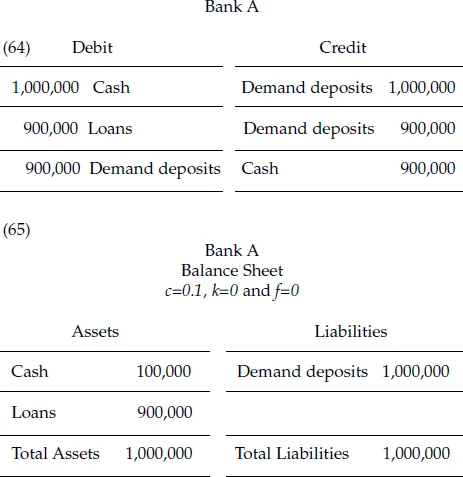
In previous examples we observed the creation through the banking system of new loans and deposits for the sum of 9,000,000 m.u. In this instance, when borrowers return the loans the last two accounting entries are canceled as follows:
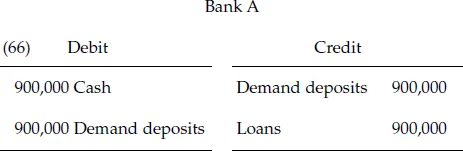
The balance sheet of Bank A now looks like this:
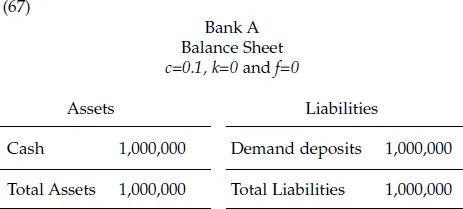
Economically speaking, this means that from the point of view of an individual bank, there has been a 900,000 m.u. decrease in the money supply, which has gone from 1,900,000 m.u. at the time the loans were given (1,000,000 in deposits and 900,000 in money handed over to the borrowers) to 1,000,000 m.u., the only money left once the loans are repaid. Therefore from the standpoint of an isolated bank the money supply clearly contracts.
Given that all banks expand credit and receive original deposits simultaneously, we already know each bank is able to maintain its cash reserves constant and grant loans for a multiple of its reserves. Hence the balance sheet of any bank, Bank A for instance, would appear as follows:
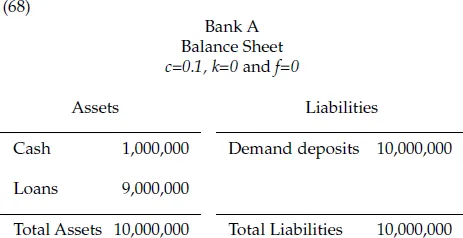
If all the bank's borrowers return their loans paying with checks, the bank's balance sheet will look like this:
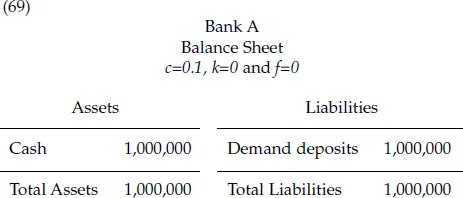
This balance sheet clearly reflects the 9,000,000 m.u. reduction in the money supply or tightening of credit. An identical decline would result from the simultaneous repayment of loans in isolated banks, as in entries (66) and (67), through a process identical to the inverse of the one shown in Table IV-2.
Fifth, if the loans lose their value due to the failure of the economic activity for which they were employed, the corresponding bank must record this fact as a loss, as shown here:
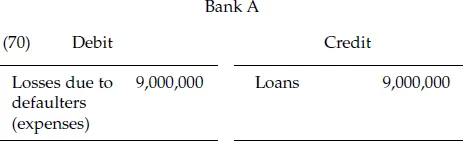
The bank's balance sheet would then look like this:
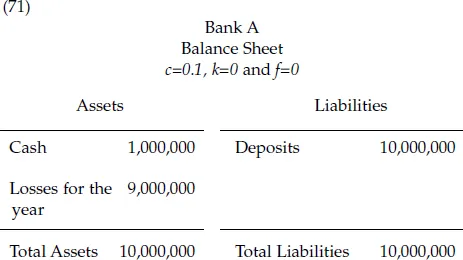
If we compare this balance sheet with (69), we see the bank holds the same amount in cash reserves in each instance, yet a very significant difference exists: in (71) the Liabilities column reflects 10,000,000 m.u. in deposits, as opposed to 1,000,000 m.u. in (69). In other words, the bank has technically failed. Nevertheless as long as depositors continue to trust it, no decrease in the money supply will take place. In fact, since no one will claim the 9,000,000 m.u. of secondary deposits the bankers created from nothing, they may even consider this amount part of the year's profits, a sum to compensate for the 9,000,000 m.u. lost to defaulters, leaving the balance sheet as it appears in (69).42 However in terms of deflation this situation is obviously even more dangerous than that following the repayment of a loan: before arriving at this situation, banks will heavily restrict new loans (they will be much more rigorous in their criteria for granting them), accelerating the deflationary process; and if the measures they take do not prove sufficient to avoid defaulters and the risk of failure, they will be one step away from losing the confidence of their depositors, who may force them to suspend payments and/or declare bankruptcy, and in this case even the 1,000,000 m.u. originally deposited in cash would be withdrawn, threatening the existence of the entire banking system.
Under ordinary conditions the contraction or deflation we are describing does not occur, because when a customer of one bank returns a loan, the sum is compensated for by another loan granted by another bank; in fact even within the same bank the attempt is always made to replace the repaid loan with a new one. In addition under normal circumstances the bank may consider payment arrears just one more operating cost. The crucial problem posed by credit tightening (as we will examine in the following chapters) consists of the fact that the very process of credit expansion based on a fractional reserve inevitably triggers the granting of loans unsupported by voluntary saving, resulting in a process of intertemporal discoordination, which in turn stems from the distorted information the banking system imparts to businessmen who receive loans generated ex nihilo by the system. Hence businessmen rush out to launch investment projects as if society's real saving had increased, when in fact this has not happened. The result is artificial economic expansion or a “boom,” which by processes we will later study in detail, inevitably provokes an adjustment in the form of a crisis and economic recession. This sums up the negative effects exerted on the real economy by the financial practice of expanding credit through the issuance of fiduciary media (deposits).
The crisis and economic recession reveal that a highly significant number of investment projects financed under new loans created by banks are not profitable because they do not correspond to the true desires of consumers. Therefore many investment processes fail, which ultimately has a profound effect on the banking system. The harmful consequences are evidenced by a widespread repayment of loans by many demoralized businessmen assessing their losses and liquidating unsound investment projects (thus provoking deflation and the tightening of credit); they are also demonstrated by an alarming and atypical rise in payment arrears on loans (adversely affecting the banks' solvency). Just as the money supply was expanded according to the bank multiplier, artificial economic expansion fostered by the ex nihilo creation of loans eventually triggers an endogenous recession, which in the form of a widespread repayment of loans and an increase in arrears, reduces the money supply substantially. Therefore the fractional-reserve banking system generates an extremely elastic money supply, which “stretches” with ease but then must contract just as effortlessly, producing the corresponding effects on economic activity, which is repeatedly buffeted by successive stages of boom and recession. “Manic-depressive” economic activity, with all of its heavy, painful social costs, is undoubtedly the most severe, damaging effect the current banking system (based on a fractional reserve, in violation of universal legal principles) has on society.
In short, bank customers' economic difficulties, one of the inevitable consequences of all credit expansion, render many loans irrecoverable, accelerating even more the credit tightening process (the inverse of the expansion process). In fact, as in our accounting example, the bank may completely fail as a result, in which case the bills and deposits issued by it (which we know are economically equivalent) will lose all value, further aggravating the monetary squeeze (instead of the 9,000,000 m.u. decrease in the money supply caused by the return of a loan, here the money supply would drop by 10,000,000 m.u.; that is, including the 1,000,000 m.u. in primary deposits held by the bank). Furthermore, one bank's solvency problems are enough to sow panic among the customers of all other banks, leading them to suspend payments one by one, with tragic economic and financial consequences.
Moreover we must point out that, even if the public continues to trust banks (despite their insolvency), and even if a central bank created ad hoc for such situations provides all the liquidity necessary to assure depositors their deposits are fully protected, the inability to recover loans initiates a process of credit tightening that is spontaneously set off when loans are repaid and cannot be replaced by new ones at the same rate. This phenomenon is typical of periods of recession. When customers default on their loans, banks become more cautious about granting more. Hence the natural reluctance of the demoralized public to request loans is reinforced by banks' greater prudence and rigor when it comes to giving them. In addition, as bankers see their profitability fall along with the value of their assets as a result of irrecoverable loans, they will attempt to be more careful, and other things being equal, to increase their cash on hand by raising their reserve ratio, which will have an even greater tightening effect. Finally business failures and frustration arising from the inability to honor commitments to banks will contribute even more to the demoralization of economic agents and to their determination to avoid new investment projects financed with bank loans. In fact many businessmen eventually realize they allowed themselves to be carried away by unjustified optimism in the phases of expansion, largely due to the excessively generous credit terms bankers initially offered, and the businessmen correctly attribute their errors in judgment to these easy terms.43 As a result they resolve not to commit the same errors again. (Whether or not their attempt at rectification is successful and in the future the businessmen remember their unpleasant experiences during the stage of recession is a different issue we will confront later.)
In conclusion, we have seen that the fractional-reserve banking system can contract and drastically reduce the money supply just as easily as it expands credit and increases the money supply. In other words, the system generates an elastic and extremely fragile stock of money which is subject to great convulsions that are very difficult, if not impossible, to mitigate or stop. This monetary and banking system contrasts with inelastic systems (for example, the one that combines the classic gold standard with a 100-percent reserve requirement), which do not permit disproportionate expansion of the money supply (the worldwide production of gold has been growing in recent centuries at the rate of 1 to 2 percent per year). Moreover they offer the following advantage: due to the fact that these systems are inelastic (gold is indestructible and throughout history the world has accumulated a very inflexible stock of it), they do not permit any abrupt decline, nor (logically) any credit or monetary squeezes which exert debilitating effects on the economy, as opposed to the current situation for which the existing banking system is responsible.44
Money, Bank Credit, and Economic Cycles
Read the whole book online · Book details
Free to read online and to download from this archive.