
Chapter 6 of 9 · Right-Wing Collectivism: The Other Threat to Liberty by Jeffrey A. Tucker
III. The History Policy Science Kills
The climate-change debate has many people wondering whether we should really turn over public policy—which deals with fundamental matters of human freedom—to a state-appointed scientific establishment. Must moral imperatives give way to the judgment of technical experts in the natural sciences? Should we trust their authority? Their power?
There is a real history here to consult. The integration of government policy and scientific establishments has reinforced bad science and yielded ghastly policies.
There’s no better case study than the use of eugenics: the science, so called, of breeding a better race of human beings. It was popular in the Progressive Era and following, and it heavily informed US government policy. Back then, the scientific consensus was all in for public policy founded on high claims of perfect knowledge based on expert research. There was a cultural atmosphere of panic (“race suicide!”) and a clamor for the experts to put together a plan to deal with it. That plan included segregation, sterilization, and labor-market exclusion of the “unfit.”
Ironically, climatology had something to do with it. Harvard professor Robert DeCourcy Ward (1867–1931) is credited with holding the first chair of climatology in the United States. He was a consummate member of the academic establishment. He was editor of the American Meteorological Journal, president of the Association of American Geographers, and a member of both the American Academy of Arts and Sciences and the Royal Meteorological Society of London.
He also had an avocation. He was a founder of the American Restriction League. It was one of the first organizations to advocate reversing the traditional American policy of free immigration and replacing it with a “scientific” approach rooted in Darwinian evolutionary theory and the policy of eugenics. Centered in Boston, the league eventually expanded to New York, Chicago, and San Francisco. Its science inspired a dramatic change in US policy over labor law, marriage policy, city planning, and, its greatest achievements, the 1921 Emergency Quota Act and the 1924 Immigration Act. These were the first-ever legislated limits on the number of immigrants who could come to the United States.
Nothing Left to Chance
“Darwin and his followers laid the foundation of the science of eugenics,” Ward alleged in his manifesto published in the North American Review in July 1910. “They have shown us the methods and possibilities of the product of new species of plants and animals…. In fact, artificial selection has been applied to almost every living thing with which man has close relations except man himself.”
“Why,” Ward demanded, “should the breeding of man, the most important animal of all, alone be left to chance?”
By “chance,” of course, he meant choice.
“Chance” is how the scientific establishment of the Progressive Era regarded the free society. Freedom was considered to be unplanned, anarchic, chaotic, and potentially deadly for the race. To the Progressives, freedom needed to be replaced by a planned society administered by experts in their fields. It would be another 100 years before climatologists themselves became part of the policy-planning apparatus of the state, so Professor Ward busied himself in racial science and the advocacy of immigration restrictions.
Ward explained that the United States had a “remarkably favorable opportunity for practising eugenic principles.” And there was a desperate need to do so, because “already we have no hundreds of thousands, but millions of Italians and Slavs and Jews whose blood is going into the new American race.” This trend could cause Anglo-Saxon America to “disappear.” Without eugenic policy, the “new American race” will not be a “better, stronger, more intelligent race” but rather a “weak and possibly degenerate mongrel.”
Citing a report from the New York Immigration Commission, Ward was particularly worried about mixing American Anglo-Saxon blood with “long-headed Sicilians and those of the round-headed east European Hebrews.”
Keep Them Out
“We certainly ought to begin at once to segregate, far more than we now do, all our native and foreign-born population which is unfit for parenthood,” Ward wrote. “They must be prevented from breeding.”
But even more effective, Ward wrote, would be strict quotas on immigration. While “our surgeons are doing a wonderful work,” he wrote, they can’t keep up in filtering out people with physical and mental disabilities pouring into the country and diluting the racial stock of Americans, turning us into “degenerate mongrels.”
Such were the policies dictated by eugenic science, which, far from being seen as quackery from the fringe, was in the mainstream of academic opinion. President Woodrow Wilson, America’s first professorial president, embraced eugenic policy. So did Supreme Court Justice Oliver Wendell Holmes Jr., who, in upholding Virginia’s sterilization law, wrote, “Three generations of imbeciles are enough.”
Looking through the literature of the era, I am struck by the near absence of dissenting voices on the topic. Popular books advocating eugenics and white supremacy, such as The Passing of the Great Race by Madison Grant, became immediate bestsellers. The opinions in these books—which are not for the faint of heart—were expressed long before the Nazis discredited such policies. They reflect the thinking of an entire generation, and are much more frank than one would expect to read now.
It’s crucial to understand that all these opinions were not just about pushing racism as an aesthetic or personal preference. Eugenics was about politics: using the state to plan the population. It should not be surprising, then, that the entire anti-immigration movement was steeped in eugenics ideology. Indeed, the more I look into this history, the less I am able to separate the anti-immigrant movement of the Progressive Era from white supremacy in its rawest form.
Shortly after Ward’s article appeared, the climatologist called on his friends to influence legislation. Restriction League president Prescott Hall and Charles Davenport of the Eugenics Record Office began the effort to pass a new law with specific eugenic intent. It sought to limit the immigration of southern Italians and Jews in particular. And immigration from Eastern Europe, Italy, and Asia did indeed plummet.
The Politics of Eugenics
Immigration wasn’t the only policy affected by eugenic ideology. Edwin Black’s War Against the Weak: Eugenics and America’s Campaign to Create a Master Race (2003, 2012) documents how eugenics was central to Progressive Era politics. An entire generation of academics, politicians, and philanthropists used bad science to plot the extermination of undesirables. Laws requiring sterilization claimed 60,000 victims. Given the attitudes of the time, it’s surprising that the carnage in the United States was so low. Europe, however, was not as fortunate.
Eugenics became part of the standard curriculum in biology, with William Castle’s 1916 Genetics and Eugenics commonly used for over 15 years, with four iterative editions.
Literature and the arts were not immune. John Carey’s The Intellectuals and the Masses: Pride and Prejudice Among the Literary Intelligentsia, 1880–1939 (2005) shows how the eugenics mania affected the entire modernist literary movement of the United Kingdom, with such famed minds as T.S. Eliot and D.H. Lawrence getting wrapped up in it.
Economics Gets In on the Act
Remarkably, even economists fell under the sway of eugenic pseudoscience. Thomas Leonard’s explosively brilliant Illiberal Reformers: Race, Eugenics, and American Economics in the Progressive Era (2016) documents in excruciating detail how eugenic ideology corrupted the entire economics profession in the first two decades of the 20th century. Across the board, in the books and articles of the profession, you find all the usual concerns about race suicide, the poisoning of the national bloodstream by inferiors, and the desperate need for state planning to breed people the way ranchers breed animals. Here we find the template for the first-ever large-scale implementation of scientific social and economic policy.
Students of the history of economic thought will recognize the names of these advocates: Richard T. Ely, John R. Commons, Irving Fisher, Henry Rogers Seager, Arthur N. Holcombe, Simon Patten, John Bates Clark, Edwin R.A. Seligman, and Frank Taussig. They were the leading members of the professional associations, the editors of journals, and the high-prestige faculty members of the top universities. It was a given among these men that classical political economy had to be rejected. There was a strong element of self-interest at work. As Leonard puts it, “laissez-faire was inimical to economic expertise and thus an impediment to the vocational imperatives of American economics.”
Irving Fisher, whom Joseph Schumpeter described as “the greatest economist the United States has ever produced” (an assessment later repeated by Milton Friedman), urged Americans to “make of eugenics a religion.”
Speaking at the Race Betterment Conference in 1915, Fisher said eugenics was “the foremost plan of human redemption.” The American Economic Association (which is still today the most prestigious trade association of economists) published openly racist tracts such as the chilling Race Traits and Tendencies of the American Negro by Frederick Hoffman. It was a blueprint for the segregation, exclusion, dehumanization, and eventual extermination of the black race.
Hoffman’s book called American blacks “lazy, thriftless, and unreliable,” and well on their way to a condition of “total depravity and utter worthlessness.” Hoffman contrasted them with the “Aryan race,” which is “possessed of all the essential characteristics that make for success in the struggle for the higher life.”
Even as Jim Crow restrictions were tightening against blacks, and the full weight of state power was being deployed to wreck their economic prospects, the American Economic Association’s tract said that the white race “will not hesitate to make war upon those races who prove themselves useless factors in the progress of mankind.”
Richard T. Ely, a founder of the American Economic Association, advocated segregation of nonwhites (he seemed to have a special loathing of the Chinese) and state measures to prohibit their propagation. He took issue with the very “existence of these feeble persons.” He also supported state-mandated sterilization, segregation, and labor-market exclusion.
That such views were not considered shocking tells us so much about the intellectual climate of the time.
If your main concern is who is bearing whose children, and how many, it makes sense to focus on labor and income. Only the fit should be admitted to the workplace, the eugenicists argued. The unfit should be excluded so as to discourage their immigration and, once here, their propagation. This was the origin of the minimum wage, a policy designed to erect a high wall to the “unemployables.”
Women, Too
Another implication follows from eugenic policy: government must control women.
It must control their comings and goings. It must control their work hours—or whether they work at all. As Leonard documents, here we find the origin of the maximum-hour workweek and many other interventions against the free market. Women had been pouring into the workforce for the last quarter of the 19th century, gaining the economic power to make their own choices. Minimum wages, maximum hours, safety regulations, and so on passed in state after state during the first two decades of the 20th century and were carefully targeted to exclude women from the workforce. The purpose was to control contact, manage breeding, and reserve the use of women’s bodies for the production of the master race.
Leonard explains:
American labor reformers found eugenic dangers nearly everywhere women worked, from urban piers to home kitchens, from the tenement block to the respectable lodging house, and from factory floors to leafy college campuses. The privileged alumna, the middle-class boarder, and the factory girl were all accused of threatening Americans’ racial health.
Paternalists pointed to women’s health. Social purity moralists worried about women’s sexual virtue. Family-wage proponents wanted to protect men from the economic competition of women. Maternalists warned that employment was incompatible with motherhood. Eugenicists feared for the health of the race.
“Motley and contradictory as they were,” Leonard adds, “all these progressive justifications for regulating the employment of women shared two things in common. They were directed at women only. And they were designed to remove at least some women from employment.”
The Lesson We Haven’t Learned
Today we find eugenic aspirations to be appalling. We rightly value the freedom of association. We understand that permitting people free choice over reproductive decisions does not threaten racial suicide but rather points to the strength of a social and economic system. We don’t want scientists using the state to cobble together a master race at the expense of freedom. For the most part, we trust the “invisible hand” to govern demographic trajectories, and we recoil at those who don’t.
But back then, eugenic ideology was conventional scientific wisdom, and hardly ever questioned except by a handful of old-fashioned advocates of laissez-faire. The eugenicists’ books sold in the millions, and their concerns became primary in the public mind. Dissenting scientists—and there were some—were excluded by the profession and dismissed as cranks attached to a bygone era.
Eugenic views had a monstrous influence over government policy, and they ended free association in labor, marriage, and migration. Indeed, the more you look at this history, the more it becomes clear that white supremacy, misogyny, and eugenic pseudoscience were the intellectual foundations of modern statecraft.
Why is there so little public knowledge of this period and the motivations behind its progress? Why has it taken so long for scholars to blow the lid off this history of racism, misogyny, and the state?
The partisans of the state regulation of society have no reason to talk about it, and today’s successors of the Progressive Movement and its eugenic views want to distance themselves from the past as much as possible. The result has been a conspiracy of silence.
There are, however, lessons to be learned. When you hear of some impending crisis that can only be solved by scientists working with public officials to force people into a new pattern that is contrary to their free will, there is reason to raise an eyebrow. Science is a process of discovery, not an end state, and its consensus of the moment should not be enshrined in the law and imposed at gunpoint.
We’ve been there and done that, and the world is rightly repulsed by the results.
Why the Holocaust Should Matter to You
People tour the nation’s capital to be delighted by symbols of America’s greatness and history. They seek out monuments and museums that pay tribute to the nation state and its works. They want to think about the epic struggles of the past, and how mighty leaders confronted and vanquished enemies at home and abroad.
But what if there was a monument that took a different tack? Instead of celebrating power, it counseled against its abuses. Instead of celebrating the state and its works, it showed how these can become ruses to deceive and destroy. Instead of celebrating nationalist songs, symbols, and stories, it warned that these can be used as tools of division and oppression.
What if this museum was dedicated to memorializing one of history’s most ghastly experiments in imperial conquest, demographic expulsion, and eventual extermination, to help us understand it and never repeat it?
Such a museum does exist. It is the US Holocaust Museum. It is the Beltway’s most libertarian institution, a living rebuke to the worship of power as an end in itself.
I lived in Washington, D.C., when the Holocaust Museum was being built, and I vaguely recall when it opened. I never went, though I had the opportunity; I remember having a feeling of dread about the prospect of visiting it. Many people must feel the same way. Surely we already know that mass murder by the state is evil and wrong. Do we really need to visit a museum on such a ghastly subject?
The answer is yes. This institution is a mighty tribute to human rights and human dignity. It provides an intellectual experience more moving and profound than any I can recall having. It takes politics and ideas out of the realm of theory and firmly plants them in real life, in our own history. It shows the consequences of bad ideas in the hands of evil men, and invites you to experience the step-by-step descent into hell in chronological stages.
The transformation the visitor feels is intellectual but also even physical: as you approach the halfway point you notice an increase in your heart rate and even a pit in your stomach.
Misconceptions
Let’s dispel a few myths that people who haven’t visited might have about the place.
• The museum is not maudlin or manipulative. The narrative it takes you through is fact-based, focused on documentation (film and images), with a text that provides a careful chronology. One might even say it is a bit too dry, too merely factual. But the drama emerges from the contrast between the events and the calm narration.
• It is not solely focused on the Jewish victims; indeed, all victims of the National Socialism are discussed, such as the Catholics in Poland. But the history of Jewish persecution is also given great depth and perspective. It is mind boggling to consider how a regime that used anti-Semitism to manipulate the public and gain power ended up dominating most of Europe and conducting an extermination campaign designed to wipe out an entire people.
• The theme of the museum is not that the Holocaust was an inexplicable curse that mysteriously descended on one people at one time; rather the museum attempts to articulate and explain the actual reasons—the motives and ideology—behind the events, beginning with bad ideas that were only later realized in action when conditions made them possible.
• The narrative does not attempt to convince the visitor that the Holocaust was plotted from the beginning of Nazi rule; in fact, you discover a very different story. The visitor sees how bad ideas (demographic central planning; scapegoating of minorities; the demonization of others) festered, leading to ever worsening results: boycotts of Jewish-owned business, racial pogroms, legal restrictions on property and religion, internments, ghettoization, concentration camps, killings, and finally a carefully constructed and industrialized machinery of mass death.
• The museum does not isolate Germans as solely or uniformly guilty. Tribute is given to the German people, dissenters, and others who also fell victim to Hitler’s regime. As for moral culpability, it unequivocally belongs to the Nazis and their compliant supporters in Germany and throughout Europe. But the free world also bears responsibility for shutting its borders to refugees, trapping Jews in a prison state and, eventually, execution chamber.
• The presentation is not rooted in sadness and despair; indeed, the museum tells of heroic efforts to save people from disaster and the resilience of the Jewish people in the face of annihilation. Even the existence of the museum is a tribute to hope because it conveys the conviction that we can learn from history and act in a way that never repeats this terrible past.
The Deeper Roots of the Holocaust
For the last two years, I’ve been steeped in studying and writing about the American experience with eugenics, the “policy science” of creating a master race. The more I’ve read, the more alarmed I’ve become that it was ever a thing, but it was all the rage in the Progressive Era. Eugenics was not a fringe movement; it was at the core of ruling-class politics, education, and culture. It was responsible for many of the early experiments in labor regulation. It was the driving force behind marriage licenses, minimum wages, restrictions on opportunities for women, and immigration quotas and controls.
The more I’ve looked into the subject, the more I’m convinced that it is not possible fully to understand the birth of the 20th century Leviathan without an awareness of eugenics. Eugenics was the original sin of the modern state that knows no limits to its power.
Once a regime decides that it must control human reproduction—to mold the population according to a central plan and divide human beings into those fit to thrive and those deserving extinction—you have the beginning of the end of freedom and civilization. The prophets of eugenics loathed the Jews, but also any peoples that they deemed dangerous to those they considered worthy of propagation. And the means they chose to realize their plans was top-down force.
So far in my reading on the subject, I’ve studied the origin of eugenics until the late 1920s, mostly in the US and the UK. And so, touring the Holocaust Museum was a revelation. It finally dawned on me: what happened in Germany was the extension and intensification of the same core ideas that were preached in the classrooms at Yale, Harvard, and Princeton decades earlier.
Eugenics didn’t go away. It just took on a more violent and vicious form in different political hands. Without meaningful checks on state power, people with eugenic ambitions can find themselves lording over a terror state. It was never realized in the United States, but it happened elsewhere. The stuffy academic conferences of the 1910s, the mutton-chopped faces of the respected professorial class, mutated in one generation to become the camps and commandants of the Nazi killing machine. The distance between eugenics and genocide, from Boston to Buchenwald, is not so great.
There are moments in the tour when this connection is made explicit, as when it is explained how, prior to the Nazis, the United States had set the record for forced sterilizations; how Hitler cited the US case for state planning of human reproduction; how the Nazis were obsessed with racial classification and used American texts on genetics and race as a starting point.
And think of this: when Progressive Era elites began to speak this way, to segment the population according to quality, and to urge policies to prevent “mongrelization,” there was no “slippery slope” to which opponents could point. This whole approach to managing the social order was unprecedented, and so a historical trajectory was pure conjecture. They could not say “Remember! Remember where this leads!”
Now we have exactly that history, and a moral obligation to point to it and learn from it.
What Can We Learn?
My primary takeaway from knitting this history together and observing its horrifying outcome is this: that any ideology, movement, or demagogue that dismisses universal human rights, that disparages the dignity of any person based on group characteristics, that attempts to segment the population into the fit and unfit, or in any way seeks to use the power of the state to put down some in order to uplift others, is courting outcomes that are dangerous to the whole of humanity. It might not happen immediately, but, over time, such rhetoric can lay the foundations for the machinery of death.
And there is also another, perhaps more important lesson: bad ideas have a social and political momentum all their own, regardless of anyone’s initial intentions. If you are not aware of that, you can be led down, step by step, to a very earthly hell.
At the same time, the reverse is also true: good ideas have a momentum that can lead to the flourishing of peace, prosperity, and universal human dignity. It is up to all of us. We must choose wisely, and never forget.
The Intellectual Conceit of IQ Ideology
The cultural fascination with the idea of an “intelligence quotient” or IQ seems to be experiencing a resurgence. Relentless testing is a feature of schooling and school admissions, and tests are used for a variety of occupational screenings. The practice reflects an intuition we all have: some bulbs are brighter than others. Surely there is nothing wrong with knowing, measuring, and acting on that information, however difficult it might be to assess.
Where matters become elusive is in codifying those skills, reducing them all to a single quantitative number, aggregating them based on other demographic traits, assessing the variability of the results, comparing the results across large population groups, determining the variety of causal factors—genetic, environmental, sheer personal determination—that make up what we call intelligence, and cobbling together a plan for what to do with the results.
Here we have a much more complex problem, as complex as the human mind itself. The amateur commentator might read a book on the topic and hope to come away with a sense that within this literature we find the key to the rise and fall of whole civilizations. The would-be central planner salivates at the prospect! But the more you read, the less certain you become, and the more in awe of the unknowns, the surprises, and the way the real world continues to defy the predictions of the scientific elite.
The IQ as a Central Planning Tool
And then there are the social and political implications of the efforts. What’s not usually understood is that the search for some measurable standard of intelligence—and implicitly human value itself—has a deep history that is bound up with the emergence of the planned society, eugenics, and the 20th century leviathan state.
That’s hardly surprising. The notion of a scientific elite classifying people based on aptitude, assigning an efficient role for everyone, appeals to the conceit of intellectuals. While the curiosity about human biodiversity seems innocent, the birth of an ideology rooted in quantitative measurement of mental aptitude, backed by a scientistic planning ambition, obviously trends anti-liberal.
The story of IQ begins at the end of the Franco-Prussian war when France’s civic institutions were remodeled to never lose another war. The prevailing theory was that France lacked the technical skills necessary for modern warfare. Citizens needed training and that meant education reform. Schooling would raise up a citizen army and therefore must be forced. From 1879 to 1886, legislation imposed compulsory schooling on the entire population.
With all kids now forced into non-religious schools, it was time to impose a rational method on steering the conscripts into socially and politically optimal paths. In 1904, just as fascination with the idea of scientific socialism had gained fashion, the French Ministry of Education contacted the psychologist Alfred Binet (1857–1911) to come up with some assessment test. He came up with a series of questions from easiest to hardest, and ranked the kids based on their performance of the tests.
The result was the Binet-Simon scale. From Binet’s point of view, the only purpose was to identify which kids needed special focus and attention so that they would not be left behind. But the idea of quantity, ranking, and assessing cognitive performance caught on in the United States, where eugenics was a prevailing intellectual fashion. It was driving public policy in labor regulations, immigration, forced sterilizations, marriage licenses, welfare policy, business regulation, and segregation strategies.
The first American enthusiast for Binet’s work was Henry H. Goddard, a leading champion of eugenics and a champion of the planning state. In 1908, Goddard translated Binet’s work and popularized it among the intellectual classes. He turned what might have been a humanitarian push to provide remedial help to students into a weapon of war against the weak.
What did Goddard believe could be done with his insights?
He summarized his political outlook as follows:
Democracy, then, means that the people rule by selecting the wisest, most intelligent, and most human to tell them what to do to be happy. Thus Democracy is a method for arriving at a truly benevolent aristocracy. Such a consummation will be reached when the most intelligent learn to apply their intelligence…. High intelligence must so work for the welfare of the masses as to command their respect and affection.
What’s more, “society must be so organized that these people of limited intelligence shall not be given, or allowed to hold, positions that require more intelligence than they possess. And in the positions that they can fill, they must be treated in accordance with their level of intelligence. A society organized on this basis would be a perfect society.”
Toward this end, he broke down the human population into normative categories, the underperforming of whom he labelled imbeciles, morons, and idiots—designations that survive to this day. He proposed a new form of social order in which an elite of intellectuals assigns tasks and life stations based on test results.
Illiberal at its Core
Yes, it sounds just like Hunger Games, Divergent, or any number of other dystopian nightmares because that is exactly what he imagined could be achieved with IQ studies. Having now read many dozens of books, articles, and contemporary accounts of this whole generation of thinkers, none of this comes as a surprise. Goddard’s views were those of his generation, and they were the theorists of the totalitarian state—the “Progressives” in the United States, the post-Bismarckian planners of imperial Germany, the scientific socialists of Russia, and, later, the ghoulish exterminationists of Nazi Germany. It’s all of a piece.
Continuing the tradition was Lewis Terman of Stanford who in 1916 proposed a revision to the now-traditional Binet test, and became an open and aggressive advocate of segregation, sterilization, immigration controls, birthing licenses, and a planned society generally.
White supremacy was a given among this generation, and he embraced it openly: “There is no possibility at present of convincing society that [Mexicans, Indians, and Negros] should not be allowed to reproduce, although from a eugenic point of view they constitute a grave problem because of their unusually prolific breeding.” In that spirit, he joined the Human Betterment Foundation, which played the crucial role in California’s sterilization program that had such a profound influence on the race policies of Hitler’s Germany.
Intelligence tests became essential for a nation at war, with eugenicists advising the US Army about the fitness of soldiers: the dumbest at the front and the smartest in safe positions of leadership. And they advised immigration authorities: who could become an American and who couldn’t. Eugenics was the goal and intelligence testing became a crucial part of the scientific veneer.
Thomas Leonard summarizes the bloody history:
Dubious though the tests and testing methods were, the millions of persons subjected to crude intelligence tests demonstrated one result unambiguously. American social scientists had convinced government authorities to fund and compel human subjects for an unprecedented measurement enterprise, carried out to identify and cull inferiors, all in the name of improving the efficiency of the nation’s public schools, immigration entry stations, institutions for the handicapped, and military.
That only begins to scratch the surface of the far-reaching hopes of the IQ-eugenics movement. So close is the relationship between the theory and policy ambition that they are really inseparable.
There seems to be nothing particularly threatening about wanting to assess an individual’s aptitude. And yet IQ testing was created and used as a social planning tool for use in compulsory education and war preparation, and mutated into a full-scale ideology that had no regard for human rights, the liberal theory of the social order, or freedom more generally. The eugenics movement, and its new tool of intelligence testing, hoped to replace freedom and dignity with totalitarian technocracy.
What is it about this ideology that contradicts the idea of a free society? Where is it that IQ ideology goes wrong?
There are three general issues:
First, consumers have odd tastes that have little to do with intelligence, scientifically defined. Abstract Intelligence is not necessarily the thing rewarded by the market, and that matters. In a free society, the value of a resource is not objective; value is conferred on services by the choices we make, whatever they may be.
If you hang out at NASCAR races, high intelligence is not the first trait that stands out. Same with monster truck rallies. I might be wrong of course. Maybe if I administered tests to all the participants and consumers, I would be stunned at the disproportionate intelligence compared to the general population. The same goes for a Britney Spears concert, an NFL game, or the buyers of grocery-store romance novels. Maybe in these groups, you find higher intelligence than you find at the university chess club. I do seriously doubt it, however.
But the real question is: why does it matter? Does it matter whether Michael Phelps is smart or that he is the best swimmer in history? Swimming is what he valued for. It’s the same way with Beyonce’s singing and dancing or Matt Damon’s acting. Or think of your favorite local restaurant: it actually doesn’t matter whether the cook is smart or dumb.
The unpredictability of consumer markets defy intelligence distributions. Market processes are not about rewarding intelligence; they are about rewarding talent, insight, and service to others.
In fact, this is precisely why so many intellectuals have despised markets through the centuries. To them, it seems wrong that a professor of physics should make less than a pop star, that a number-crunching bureaucrat would live in a small house and a movie star own five mansions, and so on. Here is the source of more than a century of resentment against capitalism.
We all face resource constraints, time above all else. This is why we cooperate through trade with other people, even those with less absolute ability than we personally possess.
How markets value what they value will always remain unpredictable. What’s crucial is that the common man is in charge of the system, and not planners. And that’s the crux of the issue: who should decide what constitutes human value, who is worthy of being treated with dignity, who should be in charge of how labor resources are going to be used in society? Will we embrace freedom or rule by a wise elite?
Second, the law of association makes everyone valuable. A core belief of the IQ ideology is that smart people, as measured by tests, are more valuable to the social order than dumber people. But economics has made a different discovery. It turns out that through the division of labor, or what Ludwig von Mises called the “law of association,” everyone can be valuable to everyone else, regardless of aptitude.
Michael Phelps might have the cognitive capacity to be the greatest nuclear physicist, computer programmer, or chess player in the world—but it is in his personal interest to focus on his comparative advantage, even if he has an absolute advantage over every person in the world.
We all face resource constraints, time above all else. This is why we cooperate through trade with other people, even those with less absolute ability than we personally possess. The result is more valuable than we could ever create on our own. You know this if you hire your lawn to be mowed, your house cleaned, or go to restaurants. Every social order consists of an infinitely complex web of relationships that defy categorization by crude scientific tests. Through the division of labor how freedom finds a way for everyone to become valuable to everyone else.
A third criticism of this literature is more profound. It observes that the intelligence necessary for the building of a great society does not reside in the minds of particular individuals. The highest intelligence of the social order resides in the processes and institutions of society itself. It doesn’t exist in total in any single mind and it doesn’t emerge consciously from the plans of any group.
Hayek explains in The Counterrevolution of Science:
Though our civilization is the result of a cumulation of individual knowledge, it is not by the explicit or conscious combination of all this knowledge in any individual brain, but by its embodiment in symbols which we use without understanding them, in habits and institutions, tools and concepts, that man in society is constantly able to profit from a body of knowledge neither he nor any other man completely possesses. Many of the greatest things man has achieved are not the result of consciously directed thought, and still less the product of a deliberately co-ordinated effort of many individuals, but of a process in which the individual plays a part which he can never fully understand. They are greater than any individual precisely because they result from the combination of knowledge more extensive than a single mind can master.
And there we see most plainly the difference between the IQ ideology and the theory of the free society. The IQ ideology tempts us to believe in the same fallacies that drove socialism: the conceit that a small elite, if given enough resources and power, can plan society better than the seemingly random associations, creations, and trades of individuals. Freedom, on the other hand, locates the brilliance of the social order not in the minds of a few, but in the process of social evolution itself and all the surprises and delights that entails.
The Eugenics Plot of the Minimum Wage
In his “Letter from Birmingham Jail,” Martin Luther King Jr. identifies the government as the enemy of the rights and dignity of blacks. He was locked up for marching without a permit. King cites the injustices of the police and courts in particular. And he inspired a movement to raise public consciousness against state brutality, especially as it involved fire hoses, billy clubs, and jail cells.
Less obvious, however, had been the role of a more covert means of subjugation—forms of state coercion deeply embedded in the law and history of the United States. And they were offered as policies grounded in science and the scientific management of society.
Consider the minimum wage. How much does racism have to do with it? Far more than most people realize. A careful look at its history shows that the minimum wage was originally conceived as part of a eugenics strategy—an attempt to engineer a master race through public policy designed to cleanse the citizenry of undesirables. To that end, the state would have to bring about the isolation, sterilization, and extermination of nonprivileged populations.
The eugenics movement—almost universally supported by the scholarly and popular press in the first decades of the 20th century—came about as a reaction to the dramatic demographic changes of the latter part of the 19th century. Incomes rose and lifetimes had expanded like never before in history. Such gains applied to all races and classes. Infant mortality collapsed. All of this was due to a massive expansion of markets, technology, and trade, and it changed the world. It meant a dramatic expansion of population among all groups. The great unwashed masses were living longer and reproducing faster.
This trend worried the white ruling class in most European countries and in the United States. As John Carey documented in Intellectuals and the Masses (1992), all the founders of modern literary culture—from H.G. Wells to T.S. Elliot—loathed the new prosperity and variously spoke out on behalf of extermination and racial cleansing to put an end to newly emerging demographic trends. As Wells summed up, “The extravagant swarm of new births was the essential disaster of the nineteenth century.”
The eugenics movement, as an application of the principle of the “planned society,” was deeply hostile to free markets. As The New Republic summarized in a 1916 editorial:
Imbecility breeds imbecility as certainly as white hens breed white chickens; and under laissez-faire imbecility is given full chance to breed, and does so in fact at a rate far superior to that of able stocks.
To counter the trends unleashed by capitalism, states and the national government began to implement policies designed to support “superior” races and classes and discourage procreation of the “inferior” ones. As explained by Edwin Black’s 2003 book, War Against the Weak: Eugenics and America’s Campaign to Create a Master Race, the goal as regards women and children was exclusionist, but as regards nonwhites, it was essentially exterminationist. The chosen means were not firing squads and gas chambers but the more peaceful and subtle methods of sterilization, exclusion from jobs, and coercive segregation.
It was during this period and for this reason that we saw the first trial runs of the minimum wage in Massachusetts in 1912. The new law pertained only to women and children as a measure to disemploy them and other “social dependents” from the labor force. Even though the measure was small and not well enforced, it did indeed reduce employment among the targeted groups.
To understand why this wasn’t seen as a failure, take a look at the first modern discussions of the minimum wage appearing in the academic literature. Most of these writings would have been completely forgotten but for a seminal 2005 article in the Journal of Economic Perspectives by Thomas C. Leonard.
Leonard documents an alarming series of academic articles and books appearing between the 1890s and the 1920s that were remarkably explicit about a variety of legislative attempts to squeeze people out of the work force. These articles were not written by marginal figures or radicals but by the leaders of the profession, the authors of the great textbooks, and the opinion leaders who shaped public policy.
“Progressive economists, like their neoclassical critics,” Leonard explains, “believed that binding minimum wages would cause job losses. However, the progressive economists also believed that the job loss induced by minimum wages was a social benefit, as it performed the eugenic service ridding the labor force of the ‘unemployable.’”
At least the eugenicists, for all their pseudo-scientific blathering, were not naïve about the effects of wage floors. These days, you can count on media talking heads and countless politicians to proclaim how wonderful the minimum wage is for the poor. Wage floors will improve the standard of living, they say.
Back in 1912, they knew better—minimum wages exclude workers—and they favored them precisely because such wage floors drive people out of the job market. People without jobs cannot prosper and are thereby discouraged from reproducing. Minimum wages were designed specifically to purify the demographic landscape of racial inferiors and to keep women at the margins of society.
The famed Fabian socialist Sidney Webb was as blunt as anyone in his 1912 article “The Economic Theory of the Minimum Wage”:
Legal Minimum Wage positively increases the productivity of the nation’s industry, by ensuring that the surplus of unemployed workmen shall be exclusively the least efficient workmen; or, to put it in another way, by ensuring that all the situations shall be filled by the most efficient operatives who are available.
The intellectual history shows that whole purpose of the minimum wage was to create unemployment among people who the elites did not believe were worthy of holding jobs.
And it gets worse. Webb wrote:
What would be the result of a Legal Minimum Wage on the employer’s persistent desire to use boy labor, girl labor, married women’s labor, the labor of old men, of the feeble-minded, of the decrepit and broken-down invalids and all the other alternatives to the engagement of competent male adult workers at a full Standard Rate? … To put it shortly, all such labor is parasitic on other classes of the community, and is at present employed in this way only because it is parasitic.
Further, Webb avers: “The unemployable, to put it bluntly, do not and cannot under any circumstances earn their keep. What we have to do with them is to see that as few as possible of them are produced.”
Though Webb was writing about the experience in the United Kingdom, and his focus was on keeping the lower classes from flourishing, his views were not unusual. The same thinking was alive in the US context, but race, not class, became the decisive factor.
Henry Rogers Seager of Columbia University, and later president of the American Economic Association, laid it all out in “The Theory of the Minimum Wage” as published in the American Labor Legislation Review in 1913: “The operation of the minimum wage requirement would merely extend the definition of defectives to embrace all individuals, who even after having received special training, remain incapable of adequate self-support.”
Further, he wrote, “If we are to maintain a race that is to be made of up of capable, efficient and independent individuals and family groups we must courageously cut off lines of heredity that have been proved to be undesirable by isolation or sterilization.”
Isolation and sterilization of less desirable population groups are a form of slow-motion extermination. The minimum wage was part of that agenda. That was its purpose and intent. The opinion makers of 100 years ago were not shy about saying so. The policy was an important piece of weaponry in their eugenic war against nonelite population groups.
Princeton University’s Royal Meeker was Woodrow Wilson’s commissioner of labor. “It is much better to enact a minimum-wage law even if it deprives these unfortunates of work,” Meeker argued in 1910. “Better that the state should support the inefficient wholly and prevent the multiplication of the breed than subsidize incompetence and unthrift, enabling them to bring forth more of their kind.”
Frank Taussig, who was otherwise a good economist, asked in his bestselling textbook Principles of Economics (1911): “How to deal with the unemployable?”
They “should simply be stamped out,” he stated.
We have not reached the stage where we can proceed to chloroform them once and for all; but at least they can be segregated, shut up in refuges and asylums, and prevented from propagating their kind.…
What are the possibilities of employing at the prescribed wages all the healthy able-bodied who apply? The persons affected by such legislation would be those in the lowest economic and social group. The wages at which they can find employment depend on the prices at which their product will sell in the market; or in the technical language of modern economics, on the marginal utility of their services. All those whose additional product would so depress prices that the minimum could no longer be paid by employers would have to go without employment. It might be practicable to prevent employers from paying any one less than the minimum; though the power of law must be very strong indeed, and very rigidly exercised, in order to prevent the making of bargains which are welcome to both bargainers.
These are but a small sample and pertain only to this one policy. Eugenics influenced other areas of American policy, too, especially racial segregation. Obviously you can’t have the races socializing and partying together if the goal is to gradually exterminate one and boost the population of the other. This goal was a driving force behind such policies as regulations on dance clubs, for example. It was also a motivation behind the proliferation of marriage licenses, designed to keep the unfit from marrying and reproducing.
But the minimum wage is in a special category because, these days, its effects are so little understood. One hundred years ago, legislating a price floor on wages was a policy deliberately conceived to impoverish the lower classes and the undesirables, and thereby to disincentivize their reproduction. A polite gulag.
As time went on, the blood lust of the eugenics movement died down, but the persistence of its minimum wage policies did not. A national minimum wage passed in 1931 with the Davis-Bacon Act. It required that firms receiving federal contracts pay prevailing wages, which meant union wages, a principle that later became a national minimum wage.
Speeches in support of the law were explicit about the fear that black workers were undercutting the demands of white-only unions. The minimum wage was a fix: it made it impossible to work for less. The sordid history of the minimum wage law is harrowing in its intent but, at least, realistic about what wage floors actually do. They stop upward mobility.
Eugenics as an idea eventually lost favor after World War II, when it came to be associated with the Third Reich. But the labor policies to which it gave rise did not go away. They came to be promoted not as a method of exclusion and extermination but rather, however implausibly, as a positive effort to benefit the poor.
Whatever the intentions, the effects are still the same. On that the eugenicists were right. The eugenics movement, however evil its motive, understood an economic truth: the minimum wage excludes people from the job market. It takes away from marginal populations their most important power in the job market: the power to work for less. It cartelizes the labor market by allowing higher-wage groups access while excluding lower-wage groups.
King wrote of the cruelty of government in his day. That cruelty extends far back in time, and is crystallized by a wage policy that effectively makes productivity and upward mobility illegal. If we want to reject eugenic policies and the racial malice behind them, we should also repudiate the minimum wage and embrace the universal right to bargain.
The Misogynist Origins of American Labor Law
Many now credit government for past progress in gender equality, mostly because of late 20th-century legislation that appeared to benefit women in the workplace. This is a distorted view. Few know that government at all levels actually sought to prevent that progress.
A century ago, just as markets were attracting women to professional life, government regulation in the United States specifically targeted women to restrict their professional choices. The regulations were designed to drive them out of offices and factories and back into their homes—for their own good and the good of their families, their communities, and the future of the race.
The new controls—the first round of a century of interventions in the free labor market—were designed to curb the sweeping changes in economics and demographics that were taking place due to material advances in the last quarter of the 19th century. The regulations limited women’s choices so they would stop making what elites considered the wrong decisions.
The real story, which is only beginning to emerge within the academic literature, is striking. It upends prevailing narratives about the relationship between government and women’s rights. Many cornerstones of the early welfare and regulatory state were designed to hobble women’s personal liberty and economic advancement. They were not progressive but reactionary, an attempt to turn back the clock.
Women’s Work Is Not New
It was the freedom and opportunity realized in the latter period of the 19th century that changed everything for women workers, opening up new lines of employment.
The growth of industrial capitalism meant that women could leave the farm and move to the city. They could choose to leave home without having married—and even stay in the workforce as married women. They enjoyed more choice in education and professional life than ever before.
By 1910, fully 45 percent of the professional workforce was made up of women. They almost entirely dominated the teaching profession, for example. Single women increasingly found work as nurses, librarians, secretaries, and social workers, as well as factory workers in the garment industry. Women, most of them unmarried, constituted 21 percent of the entire workforce.
New clerical jobs, unknown a century earlier, were everywhere to be had. Women’s wages were rising quickly, by an impressive 16 percent from 1890 through 1920. Nor were women working at “exploitative” wages. A Rand corporation study of wage differentials discovered an interesting fact: women’s wages relative to men’s were higher in 1920 than they were in 1980.
The Law Intervenes
And yet, these were also the years in which we first saw government intervention in the labor market, much of it specifically targeting women. As historian Thomas Leonard argues in his spectacular book Illiberal Reformers (2016), an entire generation of intellectuals and politicians panicked about what this could mean for the future of humanity.
Society must control reproduction and therefore what women do with their lives. So said the prevailing ideology of the age. We couldn’t have a situation in which markets enticed women to leave the control of their families and move to the city.
Though they are called Progressives, the reformers’ rhetoric had more in common with the “family values” movement of the 1970s and ’80s—with pseudoscientific race paranoia playing the role that religion would later play. In many ways, they were the ultimate conservatives, attempting to roll back the tide of history made possible by the advance of the capitalist economy.
They were incredibly successful. Over a 10-year period between 1909 and 1919, 40 states restricted the number of hours that women employees could work. Fifteen states passed new minimum wage laws to limit entry-level jobs. Most states created stipends for single-parent families, specifically to incentivize women to reject commercial life, return to protected domesticity, and stop competing with men for wages.
Such laws were completely new in American history (and in almost all of modern history) because they intervened so fundamentally in the right of workers and employers to make any sort of contract. The Progressive agenda involved government deeply in issues that directly affected people’s ability to provide for themselves. It also created unprecedented impositions on both employees and their employers. Such laws would have been inconceivable even 50 years earlier.
How did all this happen so fast, and why?
The Inferiority of Women
Richard T. Ely, the hugely influential founder of the American Economic Association and the godfather of progressive economics, explained the issue clearly, laying the groundwork for the laws that followed. His 1894 book Socialism and Social Reform expressed a panic about women’s entry into the workforce:
Restrictions should be thrown about the employment of married women, and their employment for a considerable period before and after child-birth should be prohibited under any circumstances. There should also be a restriction of the work-day, as in England, for children and young persons under eighteen, and for women. Such a limitation having beneficial effect upon the health of the community…. Night work should be prohibited for women and persons under eighteen years of age and, in particular, all work injurious to the female organism should be forbidden to women.
If the reference to the “female organism” sounds strange, remember that this generation of intellectuals believed in eugenics—using state force to plan the emergence of the model race—and hence saw women mainly as propagators of the race, not human individuals with the right to choose. For anyone who believed that government had a responsibility to plan human production (and most intellectuals at the time did believe this), the role of women was critical. They couldn’t be allowed to do what they wanted, go where they wanted, or make lives for themselves. This was the normal thought pattern for the generation that gave the United States unprecedented legal restrictions on the labor market.
The Supreme Court Weighs In
Consider the Supreme Court case of Muller v. Oregon, which considered state legislation on maximum working hours and decided in favor of the state. Oregon was hardly unusual; it was typical of the 20 states that had already passed such laws directed at women’s freedom to choose employment. From the text of Colorado’s law passed in 1903: “No woman” shall “work or labor for a greater number than eight hours in the twenty-four hour day … where such labor, work, or occupation by its nature, requires the woman to stand or be upon her feet.”
The decision in Muller v. Oregon, then, ratified such laws all over the country. Today, this case is widely considered the foundation of progressive labor law. What’s not well known is that the brief that settled the case was a remarkable piece of pseudoscience that argued for the inferiority of women and hence their need for special protections from the demands of commercial enterprise. That brief was filed by future Supreme Court justice Louis Brandeis.
The Weird and Awful “Brandeis Brief”
The “Brandeis Brief” argued that the law had to stop the massive influx of women into the workplace because women have “special susceptibility to fatigue and disease,” because female blood has more water in it than men’s blood. Their blood composition also accounts for why women have less focus, energy, and strength generally, according to the brief.
“Physicians are agreed that women are fundamentally weaker than men in all that makes for endurance: in muscular strength, in nervous energy, in the powers of persistent attention and application.”
Moreover, “In strength as well as in rapidity and precision of movement women are inferior to men. This is not a conclusion that has ever been contested.”
Long hours are “more disastrous to the health of women than to men,” the brief explained. Government therefore needed to regulate work hours for the “health, safety, morals, and general welfare of women.”
Restrictions on work hours were therefore essential. “It is of great hygienic importance on account of the more delicate physical organization of woman,” the brief said, “and will contribute much toward the better care of children and the maintenance of a regular family life.”
This brief is also notable for being the first to combine science, however bogus, and public policy in an appeal to the Supreme Court.
Florence Kelley’s Dream of Nonworking Women
One might suspect that the entire effort was a male-driven one to stop female progress, but that’s not the case. A leader in the campaign for such labor interventions was writer and activist Florence Kelley. Modern progressives celebrate her activism for maximum work hours, the 10-hour workday, minimum wages, and children’s rights. Indeed, she is considered a great hero by the sanitized version of history that progressives tell each other.
Before we cheer her accomplishments, however, we should look at Kelley’s driving motivation. Writing in the American Journal of Sociology, she explained that she wanted a minimum wage as a wage floor to stop manufacturing plants and retail outlets from employing women for less than they could otherwise employ men.
Retail stores, she wrote, tend to “minimize the employment of men, substituting them for women, girls, and boys, employed largely at less than living wages.” It was precisely such competition from women and children that Kelley intended to stop, so that men could earn higher wages and women could return to traditional roles.
In her book Some Ethical Gains through Legislation (1905), Kelley said that long working hours had to be ended for women because commercial life was introducing “vice” into communities (“vice” for this generation was the preferred euphemism for every manner of sexual sin). Worse, women were choosing commercial life over home “on their own initiative.”
Kelley considered it necessary to restrict women’s rights for their own “health and morality,” she said, and also to boost men’s wages so women would stay home under the care of their mothers, fathers, suitors, and husbands.
Moreover, to make such work illegal would make “righteous living” more practical for women. If they stopped being rewarded in wages, they would return to domestic life. Kelley even regretted the invention of electricity because it allowed women to work late at factories, when they should be at home reading to children by firelight.
In Kelley’s view, the ideal role of women with children is not to enter commercial life at all: “Family life in the home is sapped in its foundation when mothers of young children work for wages.” It’s an opinion with which some may still sympathize, but should such an opinion be imposed on working families by coercive legislation? For this paragon of progressive social reform, it was clear that lawmakers had to force women back into the home.
Florence Kelley and the movement she represented sought to disemploy women and get everyone back to a premodern form of domestic living. She wanted not more rights for women but fewer. The workplace was properly for men, who were to get paid high wages sufficient for the whole family. That was the basis for her support of a range of legislation to drive women out of the workforce and put an end to the new range of options available to them, options that many women were happy to choose.
Fear the Women of East Prussia
All this scholarship and activism is one thing, but what about the popular press?
Professor Edward A. Ross, author of Sin and Society, spoke out in the New York Times on May 3, 1908. In an article titled “The Price Woman Pays to Industrial Progress,” Ross warned that America’s “fine feminine form” was endangered by commercial society.
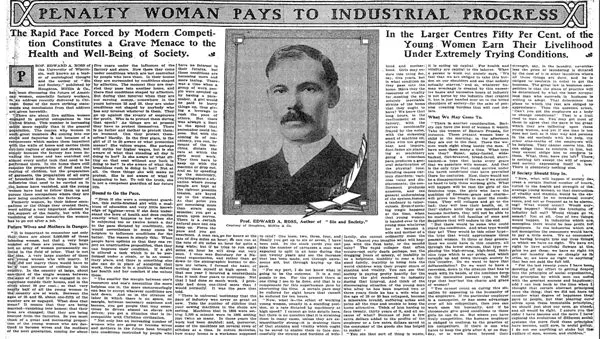
If women were permitted to work, an evolutionary selection process would govern their reproduction to the detriment of the human race. The graceful women who would otherwise bear beautiful children would be pushed out of the gene pool and replaced by “squat, splay-footed, wide-backed, flat-breasted, broad-faced, short-necked—a type that lacks every grace that we associate with women.”
Ross’s example: “the women of East Prussia,” who “bear a child in the morning” and “are out in the field in the afternoon.”
The professor explained that women who had worked in factories would not make suitable bearers of children. “Think of the discouraging situation of the young man who after he has been married two or three years finds he has a wife who at the age of 28 or 30 has collapsed, become a miserable invalid, suffering aches and pains all the time.” Why, she might find herself “unable to keep the home attractive.” And all of this “because of just a few extra dollars added to the profits of the employer or a few extra dollars saved to the consumer.”
Because of the dangerous combination of employment and natural selection, Ross contended, the government had to extend a hand to help these women by limiting working hours and establishing a high bar to enter the workforce: minimum wages.
Only through such enlightened interventions could government save women from the workplace, so that they could return to the maternal duties of rearing “girls who have the qualities of fineness—grace and charm.”
Is This Satire?
If this reads like satire, sadly it is not. Nor were such views unusual in a generation of ruling-class intellectuals, politicians, and activists that embraced eugenics and rejected capitalism as too random, too chaotic, too liberating. Their plan was to reestablish and entrench by law the family and marital structure they believed in, which absolutely precluded a generation of women making individual choices over their own lives.
Every trend panicked the eugenic generation. They fretted about the falling birth rate among those who should be reproducing and the rising birth rate among those who shouldn’t be. They worried about morals, about competition, about health, about culture. Most of all, they regretted the change that a dynamic economy was bringing about.
Thus, from 1900 through 1920, a period that set the stage for a century of interventions in the labor market, hundreds of laws stifling women were passed in every state and at the federal level, too. None dared call it misogyny, but this is real history, however rarely it is told.
Feminists against Regulation
Laws that disemployed thousands of women nationwide led to vast protests. The Equal Opportunity League, an early feminist organization in New York, lobbied the state legislature to repeal the bans on work. And it received quite the press coverage.
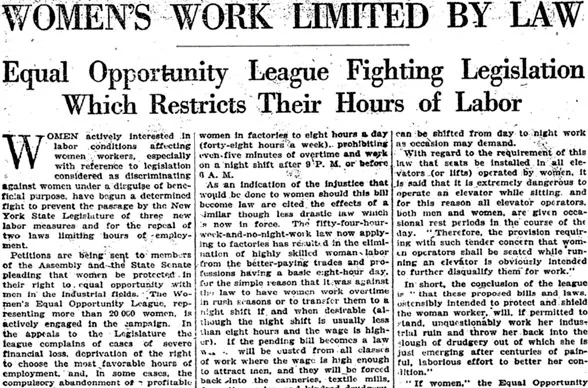
“So-called ‘welfare’ legislation is not asked for or wanted by real working women,” the league said. “These ‘welfare’ bills are drafted by self-styled social uplifters who assert that working women do not know enough to protect themselves.”
“Are women people? Women are no longer the wards of the State and a law that is unconstitutional for a man voter is equally unconstitutional for a woman voter.”
“Working at night is not more injurious than working in the daytime,” the league argued. “Many women prefer to work at night because the wage is higher, opportunities for advancement greater, and women with children can enjoy being with their child after school hours in the day time.”
In fact, the phrase “equal pay for equal work” was not created to mandate higher wages for women. It was a league slogan invoked to argue against laws that made it “a crime to employ women even five minutes after the eight-hour day.” The phrase emerged as a preferred slogan to protest in favor of free markets, not against them.
The Equal Opportunity League also passionately opposed the minimum wage law. Such laws, it argued, “while purporting to be for [women’s] benefit, would really be a serious handicap to them in competing with men workers for desirable positions.”
In short, the conclusion of the League is that these proposed bills and laws, ostensibly intended to protect and shield the woman worker, will, if permitted to stand, unquestionably work her industrial ruin and throw her back into the slough of drudgery out of which she is just emerging after centuries of painful, laborious effort to better her condition. (“Women’s Work Limited by Law,” New York Times, January 18, 1920)
Restriction Becomes Liberation?
The fairy tale version of history says that during the 20th century, government freed women to become newly empowered in the workplace. The reality is exactly the opposite. Just as the market was granting women more choices, government swept in to limit them in the name of health, purity, family values, and social uplift. Such laws and regulations are still around today, though they have been recharacterized in a completely different way. As Orwell might say, somewhere along the way, restriction became liberation.
Right-Wing Collectivism: The Other Threat to Liberty
Read the whole book online · Book details
This work is published under a Creative Commons licence. You may copy, share, and re-host it with attribution.