
Chapter 4 of 44 · The Case for Legalizing Capitalism by Kel Kelly
Chapter 2: Trade: What It Is And How It Works
Trade:
What it is and How it Works
The more trade we have, the better off we are. The public generally supports the notion of free trade in theory, but if the average person is asked whether there should be no government restrictions on trade whatsoever (another way of asking if they support free trade) they default to the position that we still need government to regulate and control trade. In the same way, politicians, for the most part claim to support free trade, yet they spend considerable time and energy preventing it by implementing tariffs, quotas, subsidies, embargos, sanctions, and other types of trade restrictions, not to mention verbally criticizing America’s trading partners for allegedly not trading “fairly” (there is no such thing as being able to trade unfairly, as we’ll see below).
Trade is misunderstood by the lay person and politicians alike. While politicians don’t care how trade really works, since their only goal is to impose whatever trade restrictions are perceived to help their constituents in order to gain votes, it is still important for the average voter to understand it, so that they can demand of their politicians to have the government cease using the tools it implements to reduce trade. This chapter will first cover the basics of how trade works, and then apply these principles to popular political issues related to trade.
The Basics of Trade
Specialization in production is the key to creating wealth for every single country. It was explained in the desert island example in Chapter 1 that individuals produce what they are best at making and they exchange what they produce for what others produce. The same concept applies to world trade. Each country specializes in the things it can produce most efficiently and it trades with other countries for what they produce.
The table in Figure 2.1 shows two different hypothetical scenarios of both trade and lack of trade between two countries, China and Greece. In the first scenario, i.e., the top part of the table, there is no trade. Each country produces its own supply of both shirts and olive oil. Greece is a somewhat more advanced country with higher labor productivity than China; therefore it can produce more of both products than can China: $600 worth of shirts versus China’s $500 worth, and $700 worth of olive oil versus China’s $200 worth. If each country produces both products, Greece can produce $650 worth of goods and China $350. Both countries together can produce a total of $1,000 ($650 + $350) worth of goods.
In the second scenario, in the bottom part of the table, each country produces only the product at which it is best at producing: it specializes. Since China can produce a greater amount of shirts relative to olive oil, it produces shirts. Since Greece can produce more olive oil than shirts, it produces olive oil. With each country specializing in what it is best at, the two countries can produce more goods in total: $1,200 worth. Note that the total amount of production between the two countries is higher with only China producing shirts even though Greece is better at producing both shirts and olive oil. With Greece concentrating on the product in which it has a comparative versus absolute advantage, and letting China do the same, both countries benefit. The same concept applies to all countries and all things they produce.
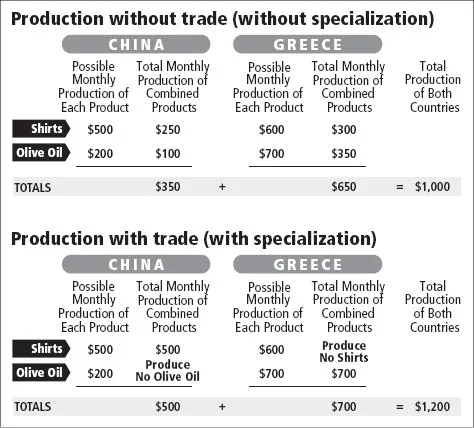
Figure 2.1: Countries that specialize in making products in which they have a comparative advantage are able to increase their total production.
Domestic/Local Trade (Domestic/Local Specialization)
Trade is commonly thought of as taking place only at the international level between different countries, as shown above. But of course, it takes place at every level of society, even at our work places.
Just as countries specialize in producing what they’re best at, so do individuals in an advanced society. Specialization of individual labor applies not only to self employment such as being a barber or free-lance photographer — where haircuts and photographs are exchanged in return for money with which goods and services are bought — but also to work within a company. A machine operator, packing specialist, marketing assistant, and CEO, all work together for a particular firm to produce a specific final product. The money which the company receives for the product is distributed amongst these laborers, and they in turn exchange their incomes for other goods from other companies. But even within this structure, each worker focuses on producing what he or she is relatively best at (as decided largely by supply, demand, and market prices for the jobs in question). If the marketing assistant were to also try and run the assembly line machines, while the CEO tried also to package the product for shipping, neither of them would accomplish as much as they could if each focused on the work in which they have a comparative advantage — it would not be nearly as efficient.
Trade also takes place at our doorsteps. Instead of spending your working hours only at work performing in your job, and then trading your salary for things you need, what if you tried to be self-sufficient? What if you tried to produce your own home, clothes, food, bed, television set, cell phone, medicines, automobile, and hot water heater? Your standard of living would be drastically lower than it is now. This is why specialization, or a division of labor, is so important. The more of a division of labor we have, both domestically and internationally, the more things we can have in our lives. Trade is simply the result of having a division of labor.
This logic would dictate that the worst thing we could do is try to be self sufficient and not exchange with those either near us or far away. If we aimed at self-sufficiency, we would not have specific knowledge of how to produce particular products. Instead, by having specialized knowledge, we can excel at being able to improve the things we produce and the ways we produce them. For example, one who makes picture frames constantly advances the technologies, machines, glues, types of wood and metal used in producing, etc., and can figure out how to make frames more cheaply and efficiently through the years, and with higher quality. Further, the more people there are involved in trade, the more specialists there are, the more brains that are involved, and the more unique ideas that come about. This alone is a reason why centralized command economies cannot work: government officials, or even regional officials and “industry” managers have no way to acquire the specialized knowledge needed for progress. Only profit-seeking, specialized, individuals build better mousetraps, not government bureaucrats or self-sufficient farmers.
Understanding how trade really works has very important implications for both social conditioning and government policy. The rest of this chapter will address common misperceptions about trade by both the man on the street and by political economists.
Don’t Buy American — Buy What’s Best
One of the consequences deducible from the principles stated above is that having the goal of “buying locally” does not help anyone. To take the logic to its end destination, buying everything locally would mean having our local economy entirely self sufficient. This absence of trade would severely diminish our standards of living.
This lesson includes understanding that it does not help to “buy American.” To be clear, it helps to “buy American” for those products which America has a comparative advantage in making, and to “buy foreign” those products which it does not. The question naturally arises as to which is which, and how we should make purchasing decisions. The answer is that we can’t know, so we should just buy in a way that we feel that we benefit on a case by case basis instead of purchasing for illogical political or emotional reasons. We don’t know in advance which products should be produced by whom, but the market will tell us, but only if the marketplace is not distorted by government interference or consumers’ deliberate attempt to change their buying patterns in the name of ineffective political “buy local” mentalities.
By listening to leftists or ultra-patriotic people who think they’re helping the laborers in their country, consumers who deliberately buy American when foreign products are less expensive, and/or higher quality, keep the world production structure as it is. What’s wrong with that, one might ask? The problem with an artificial production structure that it is not arranged in such a way that countries are producing what they are best at is less overall production and thus higher consumer prices and lower real wages; it means a reduction in our standard of living.
Intentionally buying only American goods when one would otherwise choose foreign products keeps American workers employed — temporarily — in jobs where they are producing goods which should be produced by other countries, while their labor would be more beneficial in another line of work. Because of this, there are fewer total goods produced and lower real salaries for both the laborers and the consumers.
For the same misguided reasons of trying to protect American jobs, governments apply import tariffs to foreign products to make them more expensive, causing consumers to buy [then] cheaper American products instead, when they otherwise would not. But this only hurts consumers, because without the tariffs, the foreign products would be cheaper. Consumers could instead buy the foreign products, and the domestic producers could instead make something else — something that they could make more cheaply than foreign producers. We would have a drastically higher standard of living today if it were not for the fact that world governments apply trade restrictions that prevent the optimal world production structure from taking shape, all in an attempt to protect their (inefficient) producers from competition or to increase government revenue. Just because the word “optimal” is used, or just because there was “only” a 20 percent difference in total production in our theoretical example in Figure 2.1, does not mean that the difference between our world production structure today and what it could ideally be has only a small effect on our lives. The difference between restricted trade and free trade is immense.
In either of these scenarios above, if domestic workers are in jobs that are truly not competitive, the day of reckoning is only being delayed by these policies, and money is wasted in the meantime in trying to keep an the economy artificially manipulated. In sum, trying to protect workers or trying to help the American economy by intentionally buying local goods when one would not otherwise, does not help the workers or the economy.
We Don’t Need Energy Independence
By understanding the workings of trade, it is plain to see that there is no need for energy independence. America can always obtain oil by trading what we produce in exchange for oil produced by others. An often raised objection, that we could be held hostage by being deprived of oil by those who produce it is unfounded and will be discussed in detail in Chapter 4. America is obsessed with the idea that we should be energy independent, yet no one worries that we are not “shoe independent” or “television independent” (since most shoes and all televisions are made outside America). Living by being independent means a life of poverty. Living by engaging in trade means a life of prosperity.
The Economic Threat from China
As China is becoming more capitalistic and prospering, and as America is becoming more socialistic and falling behind, there is a popular concern that China will overtake us. To the extent that this theory hints ultimately at China’s ability to have greater military power over the U.S. and the world, the concerns are valid. In that case, the roles will reverse: America would now fear China’s military might just as China has feared America’s potential military aggression for many years (as did the Soviets, who saw America as aggressors).
As far as the possibility of China harming us economically as it becomes economically stronger, all fears are unjustified. Whether or not the U.S. progresses economically, having China or any other country in the world become dramatically stronger economically is a benefit to America and every other country, because it will add to the world-wide production of goods and services, creating more useful things for citizens in every country, and lowering world prices. Additionally, another country with billions of brains and new ideas creating new inventions and new technologies, can only improve our lives. Consider how much worse off the rest of the world would be if they didn’t have American (or western) technologies and goods. We can observe from documentaries and movies showing poor backward countries that their lives are improved by having western medicines, automobiles, telecommunications equipment, airplanes and the like. New creations from China would further our own prosperity. Having not one, but tens of new countries rising into economic adulthood is a thing we should wish for.
In order for China to interact with us economically, they must trade with us. Free trade never involves one group gaining at the expense of another. Trade is beneficial to both sides; each side is willingly giving up what it has for what the other side has, because it feels that it will be better off. If one side does not think it will benefit from trade, it will not willingly engage in it.
Additionally, though the average person thinks we are being taken over by China and forced to take its cheap goods, it must be understood that less than 16 percent of US imports come from China, and only about 20 percent of China’s exports go to the U.S.; about 80 percent go to other countries.
As a side note, China’s rapid economic growth in the last three decades should serve to show that having a large or increasing population does not cause impoverishment. China was a nation of starving people under the communist policies of the 1970s, at which time the population was a little under a billion. After capitalism began to be allowed in modest increments starting in 1976, China became more prosperous, improving the lives of most citizens, including subsistence farmers. Today, its population is over 1.3 billion, and there is an abundance of food, consumer goods, and capital. The more people a nation has, the more hands and brains there are to engage in producing the things a country needs — assuming technology increases, which is almost certainly the case in a capitalist society. An increased population should increase economic growth and prosperity. Some socialists today comment that China is now growing by way of exploiting its workers. Besides the fact that such a notion is untrue, if it really were exploitation that brings increased wealth to a society, shouldn’t all of us workers want to be exploited?
Trade Deficits Don’t Persist in Free Markets
A common economic concern in the media is the size of America’s trade deficit. What’s seldom revealed is that the deficit is a result of government paper money. In a free market, under which gold would serve as money or would fully back money, trade deficits could not exist on an ongoing basis because of the free-market self-correction process that would take place under a gold standard. Historically, when countries were on gold standards, their trade balance tended towards zero. Gold would exist as money in a free market because it is the money that societies have chosen over and over through history, based on its possessing the ideal characteristics of a medium of exchange. Were it not for our government’s preventing gold from being used in exchange (by making paper money legal tender, and by not legally enforcing contracts made in gold), our money today would be based on gold.
The self correcting mechanism, termed the Price Specie Flow Mechanism by classical economist David Hume, works as follows. If country A imports more than it exports, gold would flow out of the country, so as to pay for the goods being imported from country B, causing prices to fall in importing country A (and to rise in exporting country B). With prices becoming lower in country A than in country B, country A could not afford to import as many higher-priced goods, and would instead begin to export goods to country B, since country B would then want to purchase (import) more of the lower-priced goods from country A with its increased amount of gold. With goods then flowing from country A to country B, gold would flow back from country B to country A. Over time, prices would equalize between the two countries, and each country would have a zero balance of trade.
In our government controlled world, things don’t work according to natural market forces. Instead, since America’s central bank constantly adds to the quantity of paper money in the economy, our balance of trade is skewed, and we persistently import more than we export. Much of the money our central bank prints goes to pay for goods we import from foreign countries. Exporting countries are often willing to accept only our paper bills as payment, choosing not to in turn exchange them for our goods. In this case, they usually invest their dollars in American assets such as stocks, bonds, and factories. Many observers consider the amount our imports exceed our exports the amount by which foreigners “finance” us, since we Americans, in this case, are seen as buying beyond our means. But the trade imbalance can also be seen as the amount of excess consumption Americans can undertake because foreigners are willingly handing over goods to us without requiring that we produce and exchange something of value, since printing up paper bills creates purchasing power without having to produce in order to achieve that purchasing power. These are all problems arising from government intervention in the free market.
Who is “We” and Who is “Us”?
Let’s take a moment and look more deeply at the structure of our trade deficit. We will soon see that the mere fact that a trade deficit exists is not necessarily meaningful in and of itself.
When defending the massive debts the U.S. government incurs, right wing economists and politicians (and now left wingers too, since they are now once again spending us into oblivion) usually state that “deficits don’t matter” because “we owe it to ourselves.” But the “we” who are spending the money (the government), and the “we” benefitting from the receipt of it (the poor), are different people than the “ourselves” who finance most of the debts (the rich). In the same way, our trade actions are comprised of different entities, the primary ones being the government, private businesses and private individuals. Some of these entities export more than they import, and some import more than they export. The total trade figures are really an amalgamation of multiple unrelated trades. The sum, or the net, is simply just that, and is for the most part meaningless.
The fact that trade totals do not tell the whole story can be more clearly understood by realizing the facts. Economist Sudha Shenoy53 has shown by careful analysis of the official trade figures that the private sector trade deficit is actually balanced.54 It is the government’s particular trade position that is out of whack. Shenoy shows that government capital inflows — U.S. government borrowings which are an accounting counterpart to a trade deficit — started rising in the early 1980s, the same period in which America’s trade deficit began to appear. Since that time, government capital inflows have risen 2.5 times faster than private capital inflows (and thus government trade deficits have increased in proportion).55 Between 1980 and 1985, 17.3 percent of total capital inflows consisted of US government borrowings, on average. Between 2002 and 2004, 34.4 percent of total capital inflows consisted of government borrowings, on average. Thus, the share of total capital imports belonging to the government almost doubled over that 24 year period. This increase reflects the government’s borrowing in order to spend money it does not have. Understanding that the “state” is different from the individual should also help us see that the notion of a “national interest” is not necessarily a healthy one. What’s important is not the interest of the state per se — the government and its officials — but of individuals citizens and their ability to improve their lives. The two are usually not in synch.
Additionally, it is usually stated that our trade deficits, which result in America’s importing much more than it exports, reflect the lavish consumption of American consumers in excess of what they can really afford.56 But this is not the case. The truth is that the bulk of private U.S. imports has always consisted of capital goods (factories, tools, machines, etc.), not consumer goods. In fact, as the trade deficit has grown, the proportion of consumer goods imported has fallen.57 Therefore, it is completely wrong to say that American consumers are binging on imported consumer goods.
The Misconceived Notion that Trade Surpluses are Ideal
While much is made of America’s trade deficits, and while they are viewed by most as a bad thing, in truth, our deficits are not necessarily harmful, because they are largely offset by capital surpluses. The flip side of importing more goods than we export is that we receive more investment capital than we send to other countries. A country which has a trade deficit (of goods) tends to have a capital surplus (of money — investments in stocks, bonds, real estate, businesses, etc.), and vice versa. These inflows serve as capital that America desperately needs. They are real savings, i.e., unconsumed production, which serve to promote a further expansion of real wealth in the U.S.
Type of investment in the U.S. conducted by foreigners
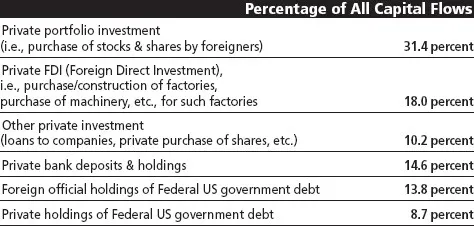
Figure 2.2: Allocation of Investments by Foreigners in the U.S., 1983–2004.
It is often argued that much of the capital inflows to the U.S. are not very helpful because they flow mainly into government coffers, not into the private, productive, sector. But the official figures tell a different story. Shenoy showed (Figure 2.2) that for the 22 years between 1983 and 2004 more than 75 percent of all capital flows into the U.S. have been private investments in the private sector.58
Additionally, even though capital going to the private sector where wealth is created is always more beneficial than that going to fund government consumption, having foreign capital flow into treasury bonds does help the country, given our government’s penchant for spending. When government spends, it takes capital away from the private sector. The government’s being funded to a large degree by foreign savings means the government needs to take less capital from domestic private enterprise. Foreign money flowing into the U.S. treasury has prevented increased destructive effects on capital accumulation that would have otherwise resulted from the government’s policy of deficit financing. Then again, it could be argued that the foreign savings consumed by our government could instead go to the private sector in foreigners’ own countries, so that they can create more wealth; in this case, both foreigners and Americans would be better off.59
Most people, economists included, believe that a country gains jobs by exporting more than it imports. This leads most governments to tax and regulate the economy in a way that artificially increases exporting sector. But both deficits and surpluses can be beneficial. By exporting heavily, economies can gain (monetary) purchasing power in order to acquire the things they need: a country buys imports by offering its exports in exchange. On the other hand, incurring trade deficits by importing more than it exports means an economy can receive large quantities of (physical) capital goods it needs. And, since trade deficits result in capital surpluses, investment capital also enters the economy in the form of monetary investment.
Different countries benefit from different types of trade balances. Britain has had a trade deficit since the end of the seventeenth century. It was also the largest single exporter of capital in the nineteenth century. Australia has been a net capital importer since the 1860s, with a trade deficit of 6.2 percent of GDP in 2007 versus America’s 5.7 percent. Canada, New Zealand, and South Africa also import capital. Countries can continue developing with both surpluses and deficits. What’s important for any particular country is not whether it imports or exports more goods, but whether it is importing or exporting in a way that helps it attain capital goods as much or more than consumer goods — that helps it produce rather than consume.
The conventional mercantilist notion that a nation’s exports should exceed its imports merits a deeper analysis. We should undertake this by first remembering that real wealth is not money, but what money exchanges for — goods. The goal of both production and exchange is to accumulate goods. Therefore, let’s consider what would happen if a country exported everything it produces, and imported nothing. It would ship all of its goods abroad, and would take none in. It would get rid of all amounts of the very thing it is trying to end up with — goods. We can see from this that government policies which cause a country to export much more than it imports are not necessarily a good thing.
Remember, a country’s trade balance reflects the net trade of multiple parties, each having different goals. It is really not useful to be concerned with an overall balance of trade, since it does not reflect the state of individuals and does not relay whether or not they are accumulating capital. After all, in our own lives, we are not so concerned with trade balances. I have massive trade deficits with Walmart, Pet City, and my local pizza place, importing lots of goods and services from them and exporting nothing to them in return. All of my employers have had large trade deficits with me. Yet all of us with trade deficits are saving, producing, and obtaining wealth.
Does Trade Harm Poor Countries?
Leftists often complain that free trade harms poor countries and disproportionately helps rich ones. This is not true in any way. Poor countries can only benefit from trade — their workers and entrepreneurs are paid for what they produce and sell to others, and all of their citizens gain access to additional goods they otherwise would not have access to, an occurrence which also lowers consumer prices in their country. There is no country that has ever become poorer by engaging in world trade. Quite the opposite is true: Many of the now first-world Asian countries experienced strong economic development only after they opened their markets. Japan has few natural resources, but became wealthy by exchanging labor services, and acquiring know-how and capital investment in the process.60 Hong Kong, a country with an area of only 427 square miles built on hills that slide into the ocean, was a very poor country in the middle of last century. Within 40 years it became one of the wealthiest countries in the world because it engaged in almost completely free trade. It is the only country that to this day has no direct trade restrictions at all, and it exports more than most developed countries. Hong Kong is a prime example of the fact that trade agreements are unnecessary. Any country can and will benefit even from unilateral free trade, letting their trade “partners” impose restrictions without taking any similar action themselves. The country with trade restrictions will get fewer goods at higher costs than they need to, while the country with no trade restrictions will be able to buy more goods at world prices.
In light of this fact, it should be understood that trade agreements are all about politics and protecting industries from competition and protecting workers from having to move to more appropriate employment — they are not about free trade in the least. Like most things political, the terms and descriptions used are contrary to the truth. Free trade means free trade: it is not necessary to write 1000-page-long trade agreements in order to freely trade without restriction. Truly free trade would require zero words and zero agreements.
Poor countries remain poor because they are un-free. Their lack of external free trade reflects (in part) their lack of economic freedom. For many decades, western “development” economists have taught poor countries that subsidies, tariffs, planning, and regulation will bring them prosperity. But those countries that have ceased adhering to the central planning suggestions of these economists and have instead opened their borders to competition and trade — such as many of the Asian nations — have realized dramatic economic growth.
Many left-wing economists point to the fact that America became prosperous while having government-restricted trade as a reason for not needing free trade. But two things should be considered. First, America had free internal trade between its various states which were not yet a consolidated single nation. Second, just because America intervened to prevent its economy from being free does not mean intervention brought prosperity. America progressed in spite of the government’s obstruction. The case is no different today. We do not have free trade; we do not have free industries or free businesses. The government has its long arm in everything that takes place in such a way that we produce less than we otherwise would and have salaries lower than we otherwise would. So far, we have managed to progress even with this wind — or blizzard — in our faces. A dog with a missing leg can still run, just not as well and as fast as if it had four legs. Thus, three legs is not better than four. (Similarly, arguments that Sweden prospers while being socialist in a different way than America is socialist does not mean socialism brings wealth. It means that Sweden has enough capitalism to move forward despite socialist policies that hinder it.61)
Another false accusation is that prices in poor countries are low because western buyers are paying less for foreign goods than they should be. But the fact is that prices there are set by the market. The prices of many goods exported by poor countries are due to low labor costs, which in turn are due to low productivity levels, which in turn are due to a lack of capital and lack of freedom to produce capital. But it also is very often the case that export prices are lower than they would otherwise be because governments in these countries subsidize production of the exported products. This is often the case with farmers. With monetary encouragement by governments in these countries to enter the industry, too many people become farmers, causing production to be artificially high and prices and profits artificially low. Because of this, Indian farmers, for example, have been committing suicide at astonishing rates. Yet socialists, in wanting, through misguided desires, to help these farmers, constantly promote more of the same government actions as before that will actually make them worse off, not better. Some would argue that the farmers need to farm because there are no other jobs. This argument is absurd. There are not enough other jobs because local governments have not allowed the economic freedom needed that would create capital and jobs economy-wide. They have instead chosen such wealth prohibiting policies as trade restrictions, including farm subsidies — policies that socialists promote as wealth creating. These will be addressed next.
Restrictions on Trade
Interference with trade harms poor and rich countries alike. Any policy that prevents as many goods from being exchanged as otherwise would be the case reduces supply and raises prices. It also prevents people from having the things they would desire but are prevented from doing so. These policies usually exist to “protect” workers and industries in the home countries, but in the long run, they do the opposite. This can be seen quite easily by observing the demise of our steel industry, which has been “protected” for years by labor laws and trade restrictions. Still, earlier this decade president Bush imposed new steel tariffs, raising the cost of steel to U.S. (and world) producers and consumers, and reducing the supply. Then, in retaliation, Europe imposed restrictions on imports, thus hurting European citizens. Who was better off? No one but workers, temporarily, and politicians who could claim to have saved jobs; at least for a year or two.
In spring 2009, Mexico slapped tariffs on 90 agricultural products coming from the U.S., thus depriving its citizens of more food at lower costs. Why? Because the U.S. failed to comply with North American Free Trade Agreement (NAFTA) requirements that Mexican trucks be allowed on American highways.62 The U.S. reneged on its previous agreements because the trucking unions were upset about having to face competition. Therefore the government allowed the teamsters to benefit at the expense of the rest of the American people. The Obama administration said that it would work to create a new cross-border, long-distance trucking program between the two countries. The white house stated that:
The president has tasked the Department of Transportation to work with the U.S. trade representative and the Department of State, along with leaders in Congress and Mexican officials to propose legislation creating a new trucking project that will meet the legitimate concerns of Congress and our NAFTA commitments.
What “legitimate concerns” does congress have, you might ask? Getting re-elected. It needs to have the unions’ support to do this. Therefore, congress is saying to hell with the American people and to “free trade” agreements that it had already agreed to. It wants to re-write the rules in its favor at the expense of both the American and Mexican economies.
Often, countries impose restrictions for no apparent reason. The U.S. protects rice and mohair in the name of “national defense.” Many poor countries have very stiff tariffs on goods they don’t even make, when they have no workers needing to be “protected.” For example, many poor countries have tariffs of 20 percent, 50 percent, 100 percent and higher on automobiles. The same used Ford Taurus for which you might pay $15,000 for could cost as much as $30,000 or more in some countries. I had a friend in graduate school from Haiti who would take a different used car with him every time he returned home, so that he could smuggle it in to sell for a profit. The selling price would be higher than the purchase price in the U.S., but less than the market price in Haiti. Without the tariffs, more people could afford automobiles, and more money would be available for investment.
The United States, like many poor countries, pays farmers to farm, when otherwise many would not, since limited profits would exclude many farmers. The main argument for subsidies is that we need to protect our poor farmers from “low” prices and incomes. But most subsidies go to commercial farms with incomes of $200,000 and net worth of nearly $2 million.63 Plus, the average farm household earns $81,420 (29 percent above the national average), and has a net worth of $838,875 (over 8 times the national average). The resulting overproduction of food in the U.S. means that many farmers from poor countries can’t compete. In a free market, poor countries would provide much more of the world food supply. American (and European) farmers, instead of being paid to produce food that other countries could produce for less, would instead be employed producing things developed countries are relatively better at. In this case, all world citizens would be better off.
We should all be so lucky as to have our jobs protected just because we prefer to do a particular job instead of another. For instance, if I would rather be a rock star than an office worker, why shouldn’t the government pay/subsidize me to do that? If someone else wants to write poetry instead of working at the bakery, why shouldn’t we all pay taxes to support her? If a doctor would rather be paid to race cars rather than perform surgeries, why shouldn’t we contribute to his cause for “labor freedom” and “worker’s rights”? The answer: besides the fact that most of us don’t want to give part of our incomes to others just so that they can do what they want, if we all did the work we would like instead of doing the work that market prices tell us needs to be done, we would all be producing little that people wanted to buy. Therefore, we would receive little or no income from customers, and thus would have little or no money to pay in taxes, taxes that the government would use to pay everyone for doing “nothing.” The whole system would collapse.
Preventing goods from being moved between borders, by means of quotas, tariffs, or subsidies, results in diminished capacity to acquire goods, and thus a reduction in standards of living. Importing fewer capital goods and materials to be used as inputs results in less of an ability to produce still more goods. Subsidies and tariffs also prevent day-to-day adjustments that are needed to meet the changing conditions of production abilities in various other parts of the world. Since these incremental adjustments are not allowed, market forces usually bring about sudden, drastic changes that cause a shock to countries with regulated economies. In these cases, ironically, the free market — and speculators — not government intervention, is seen as the cause of the problem. Further, the prevention of trade between countries often tends to create conflict between nations and thus promotes war.
Globalization
In light of the facts stated here about world trade, it should be seen that globalization is simply that — world trade. It is an increased interconnectedness of various countries (just as our individual states are interconnected). Though ignorant leftists see Globalization as harmful to the world, this is not the case. World trade benefits entire countries just as it benefits individual people, towns, and states. For few people in Florida are upset that they import forest products from Wisconsin. Most Oklahomans are not concerned that they are dependent on telecommunications products from other states. Illinois does not fear the import of cheaper cotton from Mississippi (although it used to, and used government control to prevent competition). Ohio does not impose trade restrictions against other states when jobs move to those states. Economic changes that result from globalization are part of the normal process of trade, both domestically and internationally. In the early 1990s, “experts” predicted that Columbus, Georgia would become a ghost town after its textile jobs were lost to Mexico upon trade restrictions being taken down due to the NAFTA. Indeed, textile work moved to a more efficient location, but Columbus reinvented itself as a financial services city (its comparative advantage).
Trade is beneficial between any two regions. Just because there is a geographical border — an imaginary line dividing two areas — does not mean that the concept of trade changes in the slightest. If this were the case, New York City should impose trade restrictions against other states, and even against the rest of its own state, because it imports most of the goods it consumes across a body of water.
Nonetheless, some of the concerns of anti-globalists are in fact valid. For example, trade restrictions such as subsidies in so-called “Northern” (rich) countries harm so-called “Southern” (poor) countries. And debt accumulation in poor countries does indeed put them at a great disadvantage. But these issues are derived from government intervention and influence, and are unrelated to free markets. For instance, increasing massive accumulations of third-world debt would not and could not exist in free markets where government had nothing to do with production and exchange. Still, Bono insists that we in the west should give away yet more of our money to third-world dictators so that they can make their people worse off. He cozies up with government officials on both sides in this effort, yet apparently spends little time learning how the poor of the world can truly escape poverty. If he did, he would be encouraging leaders on both sides to open their borders to private capital and goods. He would demand the protection of private property rights of third world citizens and demand the legalization of capital accumulation in the third world, instead of trying to force both sides to exchange other people’s money.
The anti-globalists also blame the World Trade Organization (WTO), the International Monetary Fund (IMF), the World Bank, the Organisation for Economic Co-operation and Development (OECD), as well as free trade agreements for harming world citizens. It is valid to hold strong opposition to these organizations, but not for the reasons leftists contend. They see these groups as agents of classical liberals (true free marketers), promoting (somehow) harmful free trade. In fact, these are all government organizations which exist to prevent free trade. They exist to impose trade restrictions, to allow “Northern” governments to hold sway over “Southern” governments and to manipulate their economies, and to try and achieve a centralized world government.64 Even to the extent that these organizations are really and truly attempting to help developing countries, they do more harm than good, because they alter, via government force, what individuals in all of the participating countries would otherwise choose for themselves if left to their free will.
If world citizens would stop voting for world governments to manipulate world economies and if they would ignore illogical leftist ideologies, they might see that globalization has the potential to raise the productivity of labor, and thus living standards, across the entire planet.
Not only can globalization bring poor countries to the level of development that currently exists in the developed world, but it can much more drastically develop the developed world. If we will allow ourselves to progress, we could achieve a fantastic level of inequality. Within a generation or two, the poor could be in a position to drive new Mercedes and live in one of their several four-bedroom homes, and the rich could all own private planes or flying cars, and take excursions to Mars for the weekend to get away from their boring private islands, personal skyscrapers or underwater homes. In this more prosperous future world, everyone, of course, would have medical care that is a quantum leap ahead of today’s antiquated technology, and they would pay a fraction of today’s costs. The inequality description is used tongue-in-cheek (since inequality would still exist), but the scenario is a very realistic one. But if we prevent globalization, we can expect our economic progression to be slowed, if not arrested.
World integration at the private level — as opposed to the government level — promotes capital accumulation that allows for increased production capabilities. Globalization is the process of including the entire world into the division of labor. Today, only a small portion of the world’s citizens — the hand-full of developed countries — produce an overwhelming majority of its goods. With everyone — including all of Asia, Africa, the Middle East, and Latin America — involved in production, and especially if complete economic freedom were universal, the poor and the rich alike could live an order of magnitude above the highest standard of living today.
It is often thought that low-wage developing countries will begin producing everything, leaving no production and thus no jobs in the developed world. This is a fallacy. The developing nations have comparative advantages, but only in some areas. Not only does every nation have work they can perform comparatively more efficiently than another nation (per our example in Figure 2.1, this is a mathematical truism), developed countries are capable of producing many things that other nations are not advanced enough to handle (and poor countries have comparative advantages because they are poor — in labor-intensive work, etc.). Also, developing nations often don’t have the same particular natural resources many developed nations have. These types of considerations mean that North America and Europe will be leaders in many fields. The United States produces and exports electrical machinery, appliances, vehicles, office machines, transport equipment, scientific instruments, telecommunications equipment, chemicals, and other technology, among many other items, that most nations could not begin to compete with. Even those poorer nations which do compete in many of these areas are years away from being able to produce the same quality of product. Quality and productivity both affect wage rates; wage rates are in fact in proportion to them. For example, a $50,000 per year bulldozer driver in Ohio can compete with $500 per year workers with shovels in Mozambique, because he can move 100 more times dirt per hour than the workers with shovels. The key, again, is capital accumulation and technology.
Economic Arguments Against Globalization65
One of the most prominent academic economic arguments against globalization is the concern that there will be a downward pull on sales revenues and GDP if poor countries become richer. This is in fact true in terms of having a static quantity of money, but not in real terms. Recall, that if the quantity of money in a society is constant, prices will fall. In a world with a static global quantity of money, as other nations begin to produce more goods, since the same quantity of money must cover the increased amount of goods, prices in developed countries will fall not only in normal nominal terms, but also in relative proportion to other countries’ production volume. In other words, in economic terms, a greater proportion of global income will accrue to developing countries, and a smaller proportion of global income will accrue to developed countries, in terms of money. This is simply a mathematical necessity. But economists who argue this point as something detrimental are way off base. For these money incomes are not related to the income of physical goods or standards of living. The reality is that the quantity of goods produced and existing in developed countries, along with developing countries, will increase. The increase in the quantity of goods will serve to decrease our costs in real terms, and increase our buying power.
If the developed world did not increase its production of goods at all, the increase in the quantity of goods produced in the developing world would cause reduced prices that exactly offset the reduced incomes of the developed world.66 But, in reality, the developed world will also be increasing its production of goods — this increase will cause prices to fall well in excess of incomes, just as increases in domestic production makes prices fall as explained in Chapter 1 (and further explained in Chapter 3). In sum, additional production from the rest of the world lowers both our real incomes and our costs equally, but the additional production created in our own country lowers our prices relative to our incomes. Real wealth is still increased.
But in fact the quantity of money will not stay that same in the future: its supply will be expanded by the government. Thus, the decreasing proportion of domestic nominal incomes relative to developing countries will not be noticed because nominal incomes will rise. In other words, we will continue to progress in real terms, but the real changes in purchasing power or relative purchasing power will not be noticed because they will be masked by the increase in prices and incomes, just as they have been for 100 years.
A second prominent concern over globalization by economists is that it results in the loss of capital of advanced countries. It has always been acknowledged by most economists that the products that are made might be switched from being produced in one country to another; but the concern now, in light of modern technology, is that the actual movement of the tools that make the products, the capital goods, will move from one country to another, leaving workers in the former country without anything to produce or any tools to produce with.
The concerns make sense on the surface. If a company can save millions by having products made or services provided by lower wage labor overseas, then indeed, companies will move factories and office buildings to the location of the cheap labor (as they are currently doing). But, first, the money companies save by operating overseas becomes additional capital available at home. The additional funding serves to bring about more production and thus more goods and lower prices for us at home.
Second, we are not in actuality losing capital on net. America has been exporting capital since the late 1800s and that has not yet made us poor because we import more capital than we export. This truth is revealed in the very fact that we have a trade deficit; and it was shown above that we import more capital than we export, and that 75 percent of what we import is in fact capital goods. With these capital goods we create and then export the materials, equipment, and machinery to supply the workers in developing countries who are now producing for us: any capital we send overseas is in the form of exports. Therefore, if we were currently losing capital, we would be exporting much more than we are importing. These facts show that we are not depleting our capital base by moving it overseas — we are doing the opposite.
The world does not stand still. Changes in technology, production, tastes, and trends, along with economic development in various regions, mean that jobs, factories, or even entire companies might move to a new location, change what they produce, or go out of business all together. These changes cause changes in the comparative advantages between countries. Thus, we should not expect that jobs, companies, and products, will remain the same.
Outsource Everything Possible67
Outsourcing, in the general sense, is the act of retaining an outside party to perform a service. A localized example is having a plumber to fix a leaky faucet because he or she can do it better or more cheaply or efficiently (in the latter case, we’re talking about cost in terms of time out of our day — an opportunity cost — which translates into a monetary cost). Companies outsource many of their services, including telephone-support services (sales, reservations, information, etc.) and the reading of MRIs by radiologists. Also prominent for many companies is the outsourcing of back-office processing such as accounting tasks, IT support, analysis work, procurement, and human resources activities. This work is outsourced because, given both the lower labor costs overseas, as well as the current state of technology which enables the movement of the work, it can be done much more cheaply in this manner.
The immediate concern most people have about outsourcing is the loss of jobs by those whose work is moved overseas (along with the already-discussed concern that there will be no jobs left for us in the U.S.). This topic will be addressed in the next section. The larger problem that will be addressed currently is the fear that because higher-wage jobs here are being moved to lower-wage areas, average salaries in the U.S., and the developed world in general, will decline. These fears are unmerited: while salaries might in fact decline, prices, as just noted, will decline more than salaries. As costs of production decline, selling prices — due to competition — will decline in line with costs. (If companies did not reduce selling prices as their production costs declined, opportunities would arise for a host of competitors to exploit the large profit margins now available in the industry, and thus reduce the market share of the original firms experiencing lower costs; the new, additional firms would simultaneously expand production and supply, forcing all firms to reduce costs).
If economy-wide salaries were to fall due to outsourcing, we would currently be observing workers’ wages falling as more outsourcing is taking place, but we are not. In today’s outsourcing world, overall salaries are not falling as much as costs because higher paid workers are not dropping the level of salary they are willing to work for to the low level of those overseas — their new competitors — who are now taking their jobs. Our outsourcing-induced displaced workers are settling for replacement jobs paying 90 percent, 70 percent, or even 60 percent of their previous salary, not 10 percent or 20 percent as would be the case if they were having to meet the wage levels of the overseas workers. This is because there are other jobs available to them that do not have comparable competition overseas (jobs in industries that other countries are not capable of competing in). Most people are already in these other industries that do not have overseas competition and are thus not losing their jobs to overseas workers, and most people are therefore having their salaries remain at their historical level. Thus, overall wage rates in the American economy fall very slightly, while prices fall by a much greater degree. It should be obvious that having our economy-wide costs decline by a much greater degree than our wages is sign of increasing, not decreasing, prosperity.
Additionally, the increased incomes offshore workers in India and China acquire from outsourcing results in more money they will have with which to import goods from the U.S. Thus, our exporting industries benefit. And, as poor countries develop economically their wages will rise toward our level. So socialists who want to stop outsourcing should support capitalism in poor countries, so that workers there will not remain competitors salary-wise.
The economic effects of outsourcing are really no different than the effects of having technology and machines replacing workers, something that has been happening for over three hundred years. These workers have always had to move to other jobs for which they were then best suited. From time to time the public fears that all of our jobs will be taken by computers and machines. Clearly this never happens; the computers and machines free up labor that is then available to be used in producing the next best thing that should be produced, or for producing more of the current things being produced. Besides, what if all our jobs were eventually taken by computers and machines? This would be fantastic! We do not hold jobs for the purpose of simply performing labor for the fun of it; we hold jobs in order to acquire money to exchange for things we need. We need things, not money. If we had computers and machines automatically producing everything for us, we would not need to work, since we would have all the goods and services that we would ever need created for us for free without having to make them ourselves. What a great world that would be.
Outsourcing began happening in Britain, Australia, and Europe 20 and 25 years ago. The U.S. has been adjusting to this phenomenon only for a few years, for the most part (however, some types of outsourcing took place in America starting in the 1970s when American [along with Japanese] electronics firms began moving their production facilities to low cost locations such as Taiwan and Singapore). Though these other early outsourcing nations experienced uproars from their citizens who complained that low-cost nations would undercut everything they did, that it would be impossible to sell to these nations, and that industries in the developed world would be destroyed, none of these concerns ever became reality.
What About the Lost Jobs?
It has been stated already that many of our jobs need to be ended or changed in order for us to engage in outsourcing and in world trade in general. This is of course seen as a terrible thing by most people. In reality, it is a bad thing only for those who lose their jobs, since the rest of society benefits from this process. Losing one’s job is not an easy thing, and should not be taken lightly (and has happened to this author because of outsourcing). However, it should be seen as a necessity for economic progress and improved standards of living for everyone.
People tend to regard jobs as though the jobs themselves are what one needs to survive. Instead, what is important about jobs are the things the jobs bring us — the ability to produce goods and services we need. Therefore, jobs need to be structured in a way that are profitable and most productive (yes, it is, and should be all about profits, as I will explain in later chapters). Attempting to make sure jobs are not allowed to change or disappear, which can only be done by using government force to control the private property of privately-owned companies, results not only in making everyone worse off immediately, but simply delaying the changes and challenges that market forces will eventually bring protected workers.
Almost all jobs in this country used to consist of agriculture. What if we had prevented farmers and field workers from having to leave their jobs (to a greater degree than we previously have)? We would have an overabundance of food and little else in our lives. We would have very little to buy because people would not be producing things like beds, stereos, satellite TV, and medicines, since they would instead be producing food. What if we had tried to save horse-and-buggy jobs when the automobile came along by subsidizing those jobs or by making it illegal for the automobile companies to exist since they would steal jobs? Even if we had simply subsidized the horse-and-buggy makers, it would have been a loss to all in society. More money would need to have been taken from incomes and productive sectors of the economy in the form of taxes in order to support workers producing things people no longer want to pay a profitable price for. If the workers were instead allowed to experience change, most could have been re-employed in the profitable automobile industry.
These types of changes have been taking place for hundreds of years now. There are always new jobs and new careers available for those unemployed; there has certainly been an abundance of jobs in countries and during eras where labor regulation did not prevent jobs from being available. Indeed, switching jobs and learning new skills might not be easy, and it might take some time. But life is not easy; we have to do what we need to do in order to progress. The first settlers of this country had no choice of employment; they simply had to do what was needed in order to survive. There is no way incomes can be guaranteed to us; we must create incomes by creating products that people want, or relying on others to create these jobs for us. At least today we have more choices than times past, thanks to entrepreneurs and rich savers. We would have many more choices if the government would allow it, or, more specifically, if you would vote for free markets.
The fact is, jobs are lost and created daily, and people voluntarily and involuntarily leave their current employment constantly. According to the Bureau of Labor Statistics, each month roughly 11.8 million people take a job, leave a job, or switch jobs, all while the official unemployment usually stays virtually unchanged.68 A study by economists Clair Brown, John Haltiwanger and Julia Lane regarding employment trends over a 20-year period shows that (1) over the period in question, the proportion of low-income jobs fell in proportion relative to high-income jobs, (2) though job seekers faced tough times at first, the long-run job change usually led to improved circumstances for workers, 3) in low-end jobs, workers generally moved up into better jobs, and 4) “Firm entry and exit tended to reduce dramatically the percentage of low-income workers.”69 The freer economy we have, the more jobs and more choices there would be, and at higher income levels.
Change is inevitable. Individuals around the world are taking actions to try to further their lives on a daily basis. Their individual attempts at progressing result in changing what is being produced and therefore in the types of work needing to be done. The more we allow change to take place, the faster our lives improve. This is why unprofitable companies such as the faltering car and airline companies should be allowed to fail. These companies have been protected from competition for years by the government, and their workers have been protected from both other workers and from marketplace wages their employers needed to pay them in order to prosper. These policies have obviously failed by causing the firms to be inefficient: their costs are so high that their operations are not profitable. Looked at another way, people are not willing to pay enough for the products these companies have to offer. These products should therefore not be made by the current companies since doing so means an economic loss for all of society.
Instead of handing out more taxpayer money to workers simply in order for them to keep their unprofitable jobs, the labor and capital used by these failing companies should be allowed to move to places where they can instead be employed to make profitable things. The job losses would not be as bad as it seems. The likely scenario is that (1) the assets of the car companies would be purchased in bankruptcy by German, Japanese, or South Korean automobile companies, and (2) most of the laid-off workers would be hired by these companies,70 but at market labor rates, not artificially high labor rates paid for by the rest of society. Think this is a terrible idea because the U.S. should produce automobiles? Well, the U.S. would probably still be producing automobiles profitably had these companies and their workers not been regulated and protected through the decades (and had they designed cars that were more attractive). In short, this is what you have voted for. Alternatively, if these firms would somehow need to go out of business even without having had government help, then that fact would reveal to us that the U.S. does not have a comparative advantage in producing autos and should not attempt to do so.
The airline companies that we would let fail (not all would) would similarly have their assets acquired by more efficient domestic competitors such as Southwest Airlines and Allegiant Air. If the United States would allow foreign competitors to compete in the country, many European, Asian, and Gulf Region airlines might take the place of the previous inefficient competitors.71 However, some of the most profitable airlines in the world that might end up dominating the U.S. airspace are profitable because they receive subsidies from their governments. One might ask why these subsidized airlines should operate in place of domestically subsidized airlines. The answer is that by having foreign subsidized airlines operating instead of our own, we will waste fewer people and resources domestically, resulting in increased standards of living here at home. If the French taxpayers, for example, want to throw away their money for the purpose of transporting American passengers around the United States on Air France,72 by all means we should let them.
By letting unprofitable companies go bust and moving labor and machines into more useful hands, domestic productivity will improve, ultimately raising wage rates relative to prices. This is positive progress, this is real change. We must understand that change is inevitable, and we must not fight it. Even if we are able to protect a small group of people, they will gain at the expense of the rest of society, and only temporarily. By allowing companies and individuals to adjust as needed to market forces, everyone benefits in the long-run.
It should now be a logical conclusion that using taxpayer money to keep people in their jobs, or preventing economic progress for the sake of keeping things the same, reduces our quality of life. Workers around the world who constantly protest their employer’s actions or seek government assistance to this end prevent economic progress.
Free Trade is Good
There should really be no debating that free trade is good for everyone. Most economists actually agree on this, even though many of them often advise foreign countries to restrict trade. Even most left-wing economists are decent on the trade question, including Paul Krugman, of all people. These economists still try to get governments to manipulate trade because they erroneously believe they can arrange more beneficial scenarios, but they generally agree with other economists and true free marketers on the concept of competitive advantage and the general notion that free trade is best. So the next time you hear your politicians claiming a country is not trading fairly or that we need to “protect” workers from foreign competition, send them a message that you know they are trying to fool you and that you want free trade.
The Case for Legalizing Capitalism
Read the whole book online · Book details
This work is published under a Creative Commons licence. You may copy, share, and re-host it with attribution.