
Chapter 5 of 44 · The Case for Legalizing Capitalism by Kel Kelly
Chapter 3: Inflation: The Printing Of Money Is The Root Of Most Evil
Inflation:
The Printing of Money is the Root of Most Evil
Consumers blame greedy oil companies for high gas prices, mercenary Wall Street moguls for the decline of the markets, biofuel crops for higher food prices, mortgage lenders for falling home prices, and profit-hungry businesses for other rising prices. All this blame is misdirected: the real culprits are governments and the printing of money.
This chapter will show that the only explanation for annual economy-wide price increases is that the government, through its central bank, continually adds more money to the economic system. It will show that this increase in money is the sole cause of consumer price inflation — especially healthcare costs — and rising oil and food prices, as well as increasing stock and bond markets, real estate, corporate revenues, and even the gross domestic product (GDP). It also will show that the central bank is solely responsible for the regular occurrence of recessions, rapidly rising unemployment, and devaluation of the currency, and is the cause of crises around the world — to mention only a few of its ill effects.
Inflation, created and continually exacerbated by the government’s printing presses, has immense and pervasive negative effects on all sectors of the national and global economy. But because the general public doesn’t easily recognize the consequences of printing money as actual inflation, the practice continues unabated and unopposed. Hence, inflation spreads like an insidious, invisible disease that infects our daily lives.
In the movie My Big Fat Greek Wedding, the father of the Greek bride-to-be proudly claims that for any particular word mentioned, he could show how that word was derived from the Greek language. Similarly, but without the claims being exaggerated, for so many of the ills our economy and society suffer today, I could show you how the printing of money by the government is the originating cause. This chapter discusses some of these ailments, and shows the damage we do to ourselves by supporting politicians who try to manipulate the economy by printing money.
The History of Banking
A brief foray into the history of banking will be both interesting in itself and key to understanding our current economic crises. Though various forms of banks have existed for well over 2,000 years,73 it is helpful for our purposes to learn how goldsmiths became bankers. In the Middle Ages, people took their gold and silver wealth for safekeeping to goldsmiths who had storage vaults. The goldsmiths would issue receipts, or promises to pay, as claims for the stored wealth (deposits), and these receipts became history’s first bank notes. After some time, goldsmiths noticed that few people came on a daily basis to claim their gold and silver and that most of the time it simply sat unused in storage. The goldsmiths realized that they could make money by loaning out idle gold and silver, charging interest for the loan — in other words, they engaged in what should legitimately be termed fraud and counterfeiting by issuing claims to money that already was spoken for. They would loan out as much as 90 percent of the stored wealth, given that no more than 10 percent at a time was withdrawn. This lending of some portion of customers’ wealth while keeping available some other proportion for redemption purposes is called fractional reserve banking. Banks engage in substantially the same type of operations today. The process of creating new loans from deposits is called “credit expansion,” “money creation,” “loan creation,” “expanding the money supply,” and “printing money,” among other things.
One of the important things to understand is that when banks allow a third party to use the funds another person has placed in the bank for safekeeping — as opposed to placing them there for the express purpose of having the bank assign the use of the funds to someone else74 — two different parties believe they have purchasing power with the very same funds. When more people gain additional purchasing power which is not brought about by previous production, and without new goods having been created to meet the additional demand of the new purchasing power, problems, as we shall see, arise.
Many banks throughout history began as deposit banks, offering true safekeeping storage units to warehouse wealth for clients, who paid for the service. Banks also were paid for transporting the wealth from one city to another to settle exchanges of money for goods. But most banks, once they obtained government permission, eventually began to lend out the wealth they had promised to hold in safekeeping75 — and most of them eventually collapsed. There is a natural tendency towards insolvency of fractional reserve banks, since they give claims to multiple people for the very same money. When too many people come to the bank to claim their money at one time, there is not enough to go around, and banks go bust.
This was the problem with our banking system in the United States in the 1800s when banks issued their own bank notes — their own currency. Having multiple currencies would have worked fine, given that the these currencies were backed by gold, except that the banks, with government permission and encouragement, also engaged in fractional reserve banking — promising their clients that their money was safe in the bank, while in reality lending it out to others. Banks regularly expanded their loans by pyramiding them on top of a given quantity of real money on deposit with the bank, taking a risk on both the rate of default on loans and on the rate at which clients would reclaim their money. It should be understood that for a bank to loan out clients’ funds that are there for safekeeping (deposits) is different from the situation in which clients knowingly agree to give up the use of their funds for some period of time (bonds, CDs, savings accounts, etc.).
These banks expanded the supply of money (i.e., in the form of loans, the receipts/claims to the money stored in the “warehouse” by issuing receipts for gold to ever more people. The new receivers of credit (borrowers) then used the claims to purchase goods. The sellers of the goods would then deposit the claims in their banks, which would present the claims to the original issuing banks to be paid in real gold. The more claims presented to the issuing banks, the more gold they were required to pay out. Naturally, those banks that printed the most money (wrote up claims to gold and loaned them out) lost the most gold. Ultimately, they were unable to return their clients’ money and thus went bankrupt, often dragging their clients down with them.
Most banks in this period were careful not to exceed the pace of other banks in creating new loans from depositors’ funds so that their depositors would not come to distrust them and thus withdraw their funds. Therefore, each bank was frustrated that it could not create money as fast as it wished. So the banks did what most businesses do that dislike being restrained by the marketplace from making excess profits: they collaborated in turning to the government to seek special privileges.
The banks worked out a deal with the government to be regulated whereby they would form a cartel with government sponsorship in the form of a central bank. This government-sponsored monopoly to create money as a single official body allowed all the banks to synchronize money creation so as to grow their loans at a higher but uniform pace, reducing the chances of any particular bank’s going bust from printing money more quickly than others. But if a bank did get in trouble, the monopoly central bank could create more money with which the ailing bank could be nursed back to health (socialism for banks). Most importantly, the average rate at which banks could create money would be greatly increased (thereby causing inflation), even though a primary public argument promoting this monopoly was that the central bank could better control inflation.
Central Banks: Creators of Money “Out of Thin Air”
Central banks appeared on the scene in the 1600s in Europe, primarily as a means for kings to steal additional money from citizens above and beyond what they could manage to collect in taxes. Rulers have stolen from citizens for centuries. Historically the theft was in the form of such tactics as coin clipping (shaving down the size of gold or silver coins so as to make additional coins from the clippings while keeping the face value of the coin the same) and diluting the content of coins by replacing some of the gold or silver with cheaper metals. The more modern way for rulers to steal from their citizens in the monetary fashion is to form a central bank. Central banks typically came about in the following way: a king would want, as usual, to extract more money from his subjects than they would allow through taxation without rebelling. So the king set up a national bank that was given the authority to provide the only money that legally could be used — the “legal tender” — in the country. The king would instruct the bank to print new money for him to “borrow,” and for this he would issue an IOU to the bank. In this way, the king could create his own money to spend.
Today, central banks work largely the same way, but the money-creating process is more formalized so as to appear more legitimate. In order for our government to obtain new money from our central bank, the Federal Reserve (Fed), the central bank buys government bonds (IOUs) from the US Treasury. The U.S. Treasury issues bonds that are both bought and sold in the marketplace, and many of these eventually are purchased by the Fed. In order for the banks to create new money, all the Fed needs to do is to buy something from someone. For many reasons, it chooses to buy primarily government bonds from banks and from the Treasury. Since the Fed is the bankers’ bank and acts as a clearinghouse for all bank transactions, when the Fed buys government bonds (or anything else, from paper clips to a big new marble building), it pays for them simply by issuing a credit to the seller’s account at the seller’s bank, which becomes a sum of money that appears in their bank account. The credit is not real money: it consists merely of keystrokes on a computer keyboard. This process is still commonly referred to as “printing money” (as well as being called the various other terms mentioned above) even though the technique of money creation has become more technologically sophisticated.
The bank that sold the bond to the Fed now has more “money” in the form of credit (since it was paid for the bond it sold to the Fed). The bank legally is obligated to keep 10 percent of the new money on deposit with the Fed as reserves (for those few people who come to claim their funds in cash) but can loan out the other 90 percent. This 90 percent, once it’s loaned out, represents new money in the actual economy that never existed previously — it is an addition to the stock of money. It represents immediate new purchasing power in the marketplace that someone has with a new bank account, with money which still belongs to its original owner who also has purchasing power with the very same money. When the 90 percent is loaned out, it is usually deposited in a bank different from the originating one. This second bank also keeps 10 percent on deposit and loans out 90 percent (81 percent of the original amount). This second 90 percent arrives in yet a third bank, which loans out 90 percent (72.9 percent of the original amount). This process, of “credit expansion,” continues to a point where the amount of new money created in the banking system amounts to 10 times the original amount created by the Fed. In other words, a new $100 dollars created by the Fed results in the creation of a new $1,000 in the economy. This money- and inflation-creating system of holding fractional reserves is not only fraudulent but also the cause of many of our economic ills.
Banks should keep not 10 percent, and not 50 percent, but 100 percent of the money they hold for us; it should be backed by something of real wealth (like gold), and we should have the right to convert our banknotes and bank accounts into this real wealth. Yet the government forces us to accept only Federal Reserve paper money and electronic credit for paper money (bank accounts), and fully supports and encourages the fractional reserve system. In absence of this government endorsement, people would lose money constantly and it would not be long until they would refrain from putting their money in banks until they were sure that their money was actually being stored in the bank. Alternatively, there would be true banking insurance, and insurance companies would force banks to act morally. England attempted to force banks to have 100 percent gold backing for money in the 19th century. The Peel Act, as it was known, was unsuccessful in preventing artificial creation of money because lawmakers applied the 100 percent backing only to banknotes and not to bank accounts, which have the same purchasing power (think checks, debit cards, etc.) as paper bills. Today, most of the money supply is in the form not of cash, but in bank deposit accounts, which are simply IOUs issued by our respective banks for particular dollar amounts. Most of your money, even if it consists of millions of dollars, is simply electronic credits for money, not real money. A wide-scale financial catastrophe could wipe out every bit of your net worth. You may technically be owed that amount if your failed bank is taken over by another or by the government, but good luck actually getting your hands on the money.
And FDIC insurance could not help. The government’s FDIC exists simply to make your money appear safe so that you will have faith in the pyramid scheme. In reality the FDIC has only enough money to save a handful of small or medium-sized banks (FYI: during the Great Depression 9,000 banks collapsed). In fact, the entire U.S. government does not have enough money to save more than a fraction of all banks should there be mass failure — without printing it, as they have been doing recently. In 2007, the entire government budget was $2.8 trillion,76 while the total value of commercial bank deposits (which does not include investment accounts and other types of deposits) was $6.6 trillion.77 The government could print trillions of dollars to give to us all, but that would result in hyperinflation, effectively voiding the effect of recouping your funds.78
In general, there is nothing to keep the government’s central bank from printing as much money as it wants except the fear that the public will not tolerate prices rising too quickly. The Fed and the banks are entrusted to do the right thing. But how many people or businesses would limit the amount of money they would print if the government gave them a monopoly to print paper dollar bills?
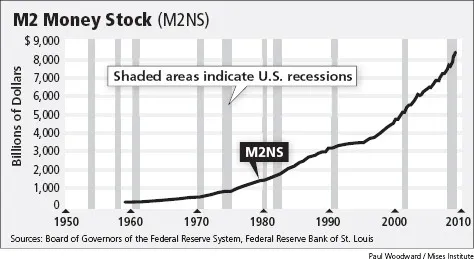
Figure 3.1: The total (and increasing) amount of money in the U.S. economy, as measured by the Federal Reserve Board’s M2 calculation.
This process of credit creation brings many problems to the real economy; some we see, and some we don’t. The rest of the chapter will look at the major problems associated with credit creation, the “printing” of money.
How New Money Causes Inflation
Historically, inflation was accurately defined not as rising prices, but as an increase in the quantity of money in circulation. This definition has changed over time in such way as to conceal the real source of the rising prices — credit creation and expansion.
We learned in Chapter 1 that expanding the quantity of money in circulation makes prices rise because more money is then chasing the same quantity of goods. There are only two ways in which the average selling price of all the goods across the economy can each sell for a higher price: (1) there are fewer goods to be sold, or (2) more money is spent to buy the goods. It is a statistical fact that we produce many more goods each year than the year before. We also can look around us and see that we don’t have fewer goods each and every year; we obviously have more. The quantity of goods expands, on average, about 3–5 percent per year. Therefore, the explanation for rising prices must be the existence of more money each year; money must be added to our economy at a rate in excess of 3–5 percent per year. In fact it is: Figure 3.1 reveals a chart of one measure of the supply of money in our economy, called M2.79 Money supply growth in the U.S., while varying from year to year, now averages about 7.5 percent per year (reaching 12.5 percent in some years).
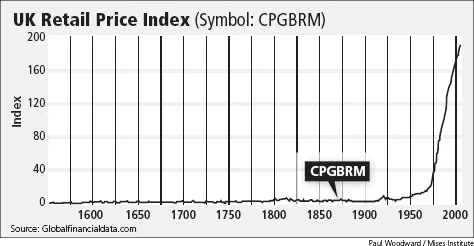
Figure 3.2: Historical price levels in the United Kingdom.
Figure 3.2 reveals the historical rate of inflation in the United Kingdom since the 1500s in the form of the retail price index. A comparable price index for the United States since 1800s is in Figure 3.3. From these charts, it is clear that once our governments’ central banks began regulating banks and the amount of credit they could create, the money supply grew rapidly, resulting in unprecedented inflation rates never before seen in the history of the world. From 1750 to 1914 (the year after the Federal Reserve was created in the United States80), inflation rates in the United Kingdom averaged 0.63 percent. Since 1914, they have averaged 4.91 percent, and since 1950 they have averaged 5.61 percent.
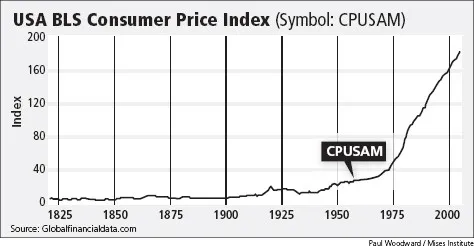
Figure 3.3: Historical price levels in the United States.
To get an idea of the compounding effect of inflation growing at 5 percent per year, consider that something that costs $100 in any particular year would cost $1,146 after 50 years of 5 percent inflation. Conversely, consider that $100 worth of wealth in any given year would be worth only $8.72 after 50 years of 5 percent inflation. At 10 percent inflation, the respective numbers would be $11,739 and 85 cents. The present U.S. dollar is worth no more than 10 cents of the 1970 dollar and 50 cents of the 1980 dollar! This is the case even though politicians always claim that “a strong dollar is in our nation’s interest.”
Our economy does not need more money to grow, although Keynesians, monetarists, supply siders, and other mainstream economists apparently fail to grasp this point. If printing money brought prosperity, we would have alleviated world poverty by now. Any static quantity of money can fulfill the needs of exchange in society, year after year, as prices adjust to the quantity of goods existing. In fact, if the quantity of money remained stable through time, we would be wealthier: imagine that the quantity of goods continued to increase, as it does every year, but that the quantity of money did not increase. Prices would then decline every year! This is precisely what happened in the United States during most of the 1800s, except for periods of large discoveries of gold and when the government printed money to pay for the Civil War. Since goods were added to the economy faster than money was (the production of goods outpaced the production of money), prices declined.
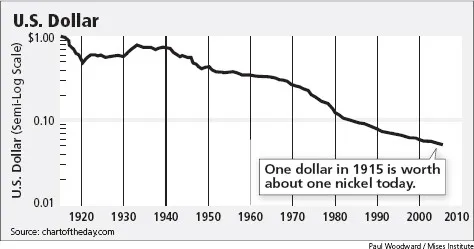
Figure 3.4: The purchasing power today of a 1915 dollar.
The quantity of new goods outpaced the quantity of new money created during most of the 1800s because our money was backed by something real and tangible — gold and silver. Though individual banks were creating money, they were more constrained than are today’s banks because they faced the threat of ultimately having to pay depositors in real gold and silver. They could expand the money supply only until the risks of losses or customer demands for redemption of gold threatened their financial viability, at which point the money supply would collapse (causing only regional recessions). It was impossible for individual banks to constantly increase the supply of money over long periods of time.
Ultimately, however, our government chose to abolish the restraint on credit creation by dropping the gold backing precisely because it limited the creation of money — more money was what the government needed. The government even went so far as to make possession of gold illegal from 1933 to 1976 except in small amounts and in the form of jewelry, fillings, etc. Thus the government prohibited Americans from owning real money and instead forced them to hold only paper dollar bills, which it continuously devalued and does so to this day (as shown in Figure. 3.4). The government thus reneged on its obligation to pay holders of dollar bills the gold to which the dollar bills entitled them.
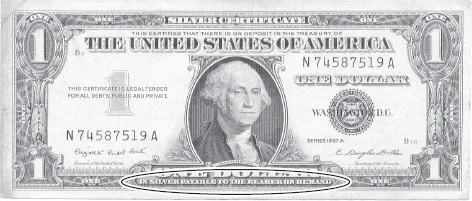
Figure 3.5: An example of historical dollars, which used to actually represent claims on real gold and silver. — Source: collectselltrade.com
Today, there is nothing backing our currency except the belief on the part of the people that the paper bills will retain their purchasing power. Our dollar bills used to bear the inscription “This certifies that there is on deposit In the Treasury of the United States Of America one dollar in silver payable to the bearer on demand.” Look closely at the text of the dollar bill from 1957 (Figure 3.5). Now, without gold or silver backing our currency, our dollars say no such thing, and the Fed can print as much money as it wants, as fast as it wants to, without any legal restraints whatsoever — as long as people en masse accept paper and electronic bank accounts as real money.
How Printing Money Constitutes Theft and Forced Wealth Redistribution
When new money is created, it enters the economy — technically — in the form of loans to businesses and individuals. The government gets money by selling bonds, which the Fed later buys, and which gives reserves to new banks, reserves that will back new loans to businesses and individuals. But since those bonds are bought by the Fed for the very purpose of funding the government, government spending is effectively new money entering the economy as well. The receivers of the new money spend it by buying things from others. Then, those who sold goods to the new borrowers take their increased sales revenues and spend the money, in their turn. As the money is spent and re-spent, prices begin to rise from the increase in demand. Once the new round of money has fully flowed through the economy, prices will be higher than before the new money was created. But here is the tricky fact: those who receive the new money first spend before prices rise. Those who receive the money last spend after prices rise. The late spenders and those who did not borrow and spend part of the new money are left with less purchasing power and a devaluation of their assets. Thus wealth is transferred from the last receivers of money to the first. The ones who are hurt most are the poor and the retired and elderly citizens, who live on fixed incomes.
Naturally, as a first receiver of money, government gets to spend new money before prices rise, financing a large portion of its deficit by printing money. Without the central bank, deficits would be impossible because the government would have to rely solely on the amount of taxes it could force citizens to pay. By using the Fed, the government can have all of us subsidize it further by having it gain more income at our expense — the higher costs we pay for goods each year constitutes the amount that we are losing and the government is gaining. This is what is known as the “inflation tax.”
Most government spending consists of social programs81 that transfer wealth from one group to another — most taxes are not spent on schools and infrastructure and fighting unnecessary wars. Therefore, the higher costs you and I pay for goods and services each year mostly reflect what we are paying to give money to someone else. The receiver of wealth distribution is taking money from citizens through the government’s monopoly printing press. As we learned in Chapter 1, this ultimately causes them to be poorer, not richer. Either way, forcing money away from one group by devaluing their money, and giving it to another group, constitutes theft: a forced tax that no one voted for.
Another group that suffers from the wealth redistribution effects of the government’s inflation is the holders of the government bonds (almost 50 percent of whom are foreigners), bonds which enable the entire process. The money the government owes to holders of its bonds is devalued during the inflation process, allowing the government to benefit from borrowing at the expense of the lenders, who are repaid in money worth less than it was at the time the bonds were purchased.82
The Inflation Rate: Lies, Damn Lies, and Statistics
Most people think of inflation as a natural and inevitable phenomenon. But it is not. In an economy without government intervention, most prices would constantly go down; it is only with government regulation and control that inflation occurs. Ironically, people who give any thought at all to the central bank believe that it is there to, among other things, prevent inflation. But the inflation it is to prevent is the very inflation the bank itself creates! The Museum of the Federal Reserve Bank of Atlanta celebrates the efforts of the Fed (where, hypocritically, the guide explains how the banks in the 1800s created too much money!) in taking the decisive action of stepping in to stop our high inflation in the early 1980s. Yet it says nothing about how the inflation came about to begin with. There is no mention of how the Fed had printed so much money in the 1970s that by the early 1980s inflation was out of control. The Fed got rid of the Federal Reserve Chairman who created the inflation (along with his predecessor), G. William Miller, and brought in a new one, Paul A. Volker, who did the only thing that could stop inflation — he simply quit printing money, at least for a while. Inflation is neither natural nor inevitable.
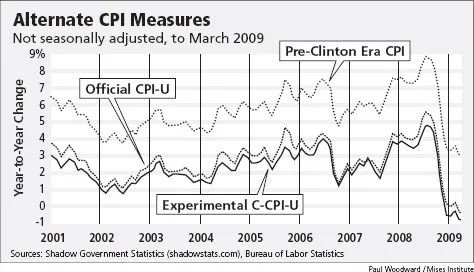
Figure 3.6: Inflation rates manipulated by government to show less inflation.
Government-published statistics about inflation are deceptive. Since most people have no idea why consumer prices rise, they accept inflation — as long as it remains below 2–3 percent — as a necessary evil, trusting that their seemingly benevolent government tells the truth with its statistics on the rate of inflation. But the government rarely tells the truth.
Take the so-called Consumer Price Index (CPI). The CPI claims to be a barometer of the true rate of consumer price increases. But it is not, for many reasons. First, the government does not count all prices. Omitted from the CPI, for example, are the prices of houses — the single-largest expense most people have. Instead it uses something called “equivalent rent,” which is supposed to represent the cost of renting one’s own home. This, however, is a misleading figure, because as housing prices rise from more people buying houses, rental prices fall since fewer are renting. Other sly calculations such as what is known as “hedonics,” or quality adjustments, make prices appear lower than they are. With this calculation method, the government can claim that prices of goods have fallen even though their retail prices have risen! For example, a Honda Accord may cost 8 percent more this year than last, but the government, in its opinion, might consider that after taking quality improvements into consideration (airbags, satellite radio, etc.), the price actually fell by 10 percent. It is this reduction of 10 percent that goes into calculating the CPI. Though we see with our own eyes prices on the store shelves rise by 6 percent in a given year, the government will tell us through the CPI number that prices have risen only 1.5 percent. Similarly, and to the same effect, when the government reports inflation, it always focuses on the “core” CPI, which excludes “volatile food and energy prices.” In this case, volatile of course means rising, because we all see that food and energy prices do not fall over time.
These few examples, along with many more that could be mentioned, allow the government’s CPI numbers always to understate inflation, and they tend to understate it increasingly through time. CPI calculations have changed dramatically just in the last ten years. Consumer inflation, when measured with the same techniques used until several years ago, shows prices rising currently at close to 3 percent, even though the government is telling us that they are hovering around 0 percent as of the time of this writing. Figure 3.6 shows the difference in CPI calculations just since 2001. It shows the old CPI calculation, the current one, and the calculation currently being considered.
With tactics like these, the government can always misrepresent the real rate of inflation. Further, it can even make money from artificially low CPI rates by reducing the amount it owes. The government promises many groups to whom it pays money, such as welfare and social security recipients83 and buyers of inflation-indexed bonds, to adjust the payments each year by the amount of inflation. But since it does not compensate them for the true rate of inflation, those receiving the government payments still lose out. Another example is income taxes. As inflation raises wages, it pushes individual salaries into higher tax brackets (“bracket creep”). But even where government adjusts tax brackets to increase with the rate of inflation, salaries will not increase along with the true rate of inflation; the artificially low CPI will not adjust brackets enough each year to keep up with this real rate — brackets still creep!
Consumer price inflation, however, does not always exist in the form of rising prices. When producer input costs rise and companies cannot afford to pass on costs to consumers, they reduce the amount or quality of their products: a cereal producer may put less cereal in the boxes, or soda makers may replace real sugar with artificial sugar (as Coca-Cola did in the 1970s because of rising commodities prices). I have observed that my favorite brand of frozen chicken patties now comes four to a box instead of five, but the price remains the same. The box became more expensive even though the price tag did not budge. This year, my nutrition bar shrank by about 10 percent, leaving spare space in the package and the price the same. During times of high oil prices, and when they can’t raise prices due to competitive pressures, airlines often move seats closer together to squeeze more people on a plane. Many restaurants that used to give cloth napkins now give paper ones. The examples of hidden inflation go on and on.
Bet You Didn’t Know That This Was Inflation!
All prices, not just consumer prices, are affected by the central bank. The average person does not associate rising stock and bond prices, rising house prices, rising corporate revenues, gasoline/oil prices, or even GDP itself with inflation — and certainly not with the government printing money. But as we saw in the chart above, it is impossible for prices of any sort to rise continually without more money being inserted into the economy. For example, what is there to cause an inflow of money into the stock market year after year to push it higher? One might argue that, as more people continue to earn wages, they save more and invest more. But while some are investing funds in the market, others, such as older people no longer working, are withdrawing funds. What is there to cause a net inflow of money into the market? Theoretically, larger proportions of future savings could go into the market, but then spending on other items would necessarily be reduced, and the prices of those other items would necessarily decline. In other words, prices of other goods would have to fall to enable a rise in the stock market.
Similarly, how can housing prices continually rise through time without additional money existing? Many argued during our recent housing bubble that prices could not fall because there was an increasing demand for houses. It is true that “demand” is what was raising the prices, but what exactly is “demand”? Does an increase in population necessarily mean an increase in demand? No, it doesn’t. An increase in demand requires more money in people’s hands. When that money is no longer there, neither will be the demand.
As a concept, “demand” is subject to misunderstanding because we use the term in several different ways. I might have a demand (desire) for a house in the south of France in order to have a place to park the yacht I also demand (desire). In this case demand is without consequence because I do not have the means with which to actually pay for these items. Real demand can affect prices only if there is real purchasing power, in the form of money, to support the demand. Consumers cannot demand and, thus, pay for increased consumption of food, houses, gasoline, and stocks without more money, which can only arrive in their pockets after being printed by their central bank. They can have an increased real demand by way of producing more goods with which to pay for more things, but this would serve to reduce prices, not raise them.
To be clear, it is not the companies that people work for that are producing money because companies don’t produce money that they pay out as wages — they produce only goods. For all companies to have more money (i.e., sell their goods at higher prices than the previous year) and pay out more money in wages to workers, more money has to be created by the government in the form of credit expansion.
In the bigger picture, for salaries to rise and consumer goods to increase in price while simultaneously stocks, bonds, real estate, commodities, company revenues, and oil all increase in price as well, more money has to be coming into existence to enable companies and consumers to continually bid up prices. If we all, in the aggregate, earned the same amount each year (the sum of all our wages stayed the same), how could we all bid prices higher year after year? We couldn’t.
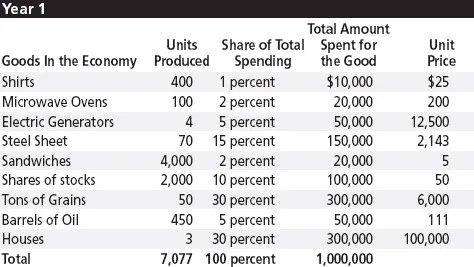
To make sure this very important point regarding the cause of inflation is understood, let’s take a brief look at a more detailed mathematical example. Figure 3.7 and Figure 3.8 below show two different scenarios of a progressing economy — an economy in which the amount of both consumer and producer goods is increasing. Both figures show a sample economy or, at least, sample goods in an economy. (You can imagine that these are all the goods existing in an economy.)
In Figure 3.7, the amount of money in the economy stays static while, in Figure 3.8, the quantity of money increases. In both examples, the production of goods increases by 10 percent. In Figure 3.7, the price of each good falls because the same $1,000,000 of spending must buy more goods. In this scenario, the rate of inflation — the average percentage price change of all goods — falls by 9 percent. In the second scenario, Figure 3.8, the government increases the money supply by 20 percent to $1,200,000 in year 2. In this scenario, even though production increased by 10 percent, the pace of money creation was higher at 20 percent, and prices thus rose by 9 percent (prices rose by 20 percent due to the increase in money supply and fell by 9 percent due to the increase in goods produced). It is this second scenario that is more similar to our economy today. The first scenario largely represents what an economy would be like in a true free market where the government did not expand the quantity of money in the economy, and even in the case that we returned to the gold standard.84
It should now be clear that for the price of anything to increase, in absence of a decrease in the price of other goods, there must be more money entering the economy to push up prices. This “quantity of money” explanation for rising prices is the true one, no matter what other explanations are offered by those who supposedly understand economics. Even most economists naively argue that rising oil prices can raise the price of all other goods because oil goes into making these other goods. But this is demonstrably wrong. If the quantity of money in the economy were static and our demand for purchasing goods was not expanding due to newly printed money, then as the price of oil rose, the price of other goods (or the quantity purchased) would necessarily fall. As the higher cost of gasoline and the higher cost of oil-dependent products took a greater portion of our paychecks each month, we could not buy the same amount of other goods we previously bought and would, thus, cut back on other things — eating out, movies, travel, and so on. With less demand for these other goods, the prices would fall (or fewer quantities would be purchased).
Scenario 1:
The quantity of money remains unchanged
Assumptions:
Quantity of money = $1,000,000 in Year 1, and remains $1,000,000 in Year 2
Production of all goods increases by 10 percent per year
Demand for each product relative to other products stays the same every year*
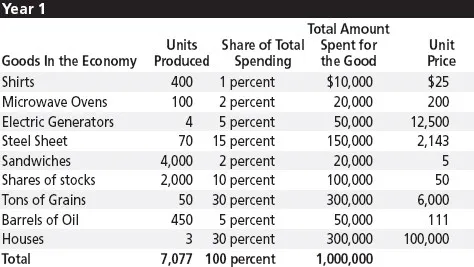
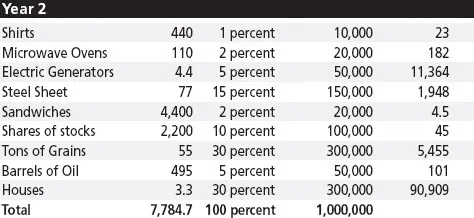
- Increase in quantity produced: 10 percent
- Rate of inflation: –9 percent
* Even if production of goods did not increase equally and/or if the share of total spending of each good did not stay the same from one year to the next, the overall amount of spending would not be influenced.
Figure 3.7: Consumer price changes in an economy with a static amount of money.
Scenario 2:
The quantity of money expands by 20 percent
Assumptions:
Quantity of money = $1,000,000 in Year 1, but increases to $1,200,000 in Year 2
Production of all goods increases by 10 percent per year
Demand for each product relative to other products stays the same every year*
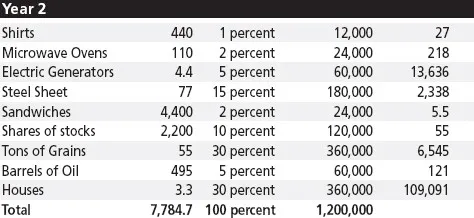
- Increase in quantity produced: 10 percent
- Rate of inflation: 9 percent
* Even if production of goods did not increase equally and/or if the share of total spending of each good did not stay the same from one year to the next, the overall amount of spending would not be influenced.
Figure 3.8: Consumer price changes in an economy with an increasing amount of money.
Perhaps you might argue that you and people you know did cut back on other goods because of high gas prices, and yet all prices kept rising. This does not mean that the quantity explanation of money is wrong. It means that there are still other people bidding up the prices. Somebody somewhere has newly printed money they are spending.
It was newly printed money flowing into the stock market in the 1990s that caused the NASDAQ bubble to expand and then burst. This money then flowing into housing prices, along with the existence of artificially low interest rates resulting from printing lots of still more new money, is what caused the recent housing bubble. The cost of home financing fell dramatically as the interest rate fell while the newly printed money financed the actual purchase of the houses. Because much of the new money created in the last few years also flowed into the commodities markets, oil and food prices rose dramatically. It is true that there were legitimate supply-and-demand issues with respect to commodities and agriculture, but in a world with a fixed quantity of money, any fundamental decrease in the supply of oil and other commodities would cause their prices to rise while other prices would necessarily fall — the overall CPI could not rise.
To better understand the effects of more money pushing up prices, consider the charts below. In each set of charts, the first one is plotted using dollars as the measure of value while the second plots values in gold grams. Gold is used as an alternative pricing mechanism because it represents the amount of the decline in value of the dollar relative to gold. The dollar’s decline relative to gold, in turn, largely represents the increase in the supply of dollars relative to the increase in the supply of gold. Gold, unlike paper money, cannot be created so easily. It must be dug out of the ground at great cost, time, and energy. Therefore, the supply of gold increases by only about 3 percent or 4 percent per year.
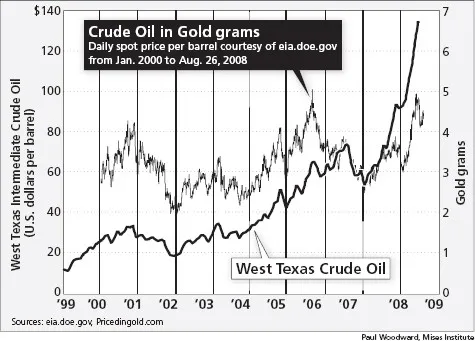
Figure 3.9: Oil priced in dollars; Oil priced in gold.
Figure 3.9 shows the price of oil in dollars and the price of oil in gold. It should be understood that all commodity prices, not just oil, rose throughout most of the past decade as the Fed printed new money and devalued our currency. With more money existing, the purchasing power of each existing dollar diminishes, particularly against other currencies that are not being printed as quickly as ours. Because commodities are priced in dollars, as our currency declines against other currencies, commodity prices become cheaper to foreigners, who, thus, increase their purchases. This is precisely what has been happening in recent years. But since the dollar also declined in value against gold, the gold price reveals how little the price of oil has increased in “real” terms.85
The oil charts in Figure 3.9 reveal the real misguided politics behind commodity prices. While consumers blame greedy oil companies for high gas prices and biofuel crops for a food shortage in many countries, the real culprit is the governments and the printing of money. As explained in Chapter 1, due to competition and absent new money being printed, it is impossible for companies to constantly raise prices. American oil companies, in particular, would not have that pricing power as they are a very small minority of global oil producers and gasoline providers. Even OPEC could not substantially raise prices to the rest of the world without causing demand (and thus their revenues) to fall off. The government(s) gave the oil companies their profits by printing money. Yet congress keeps putting oil CEOs on in the hot seat in televised hearings, scolding them for their large profits!
Figure 3.10 shows the price of the stock market, as represented by the Dow Jones Industrial Average, in dollars and in gold. The price of the stock market in gold is a good representation of what the real stock market performance has been this decade. While investors thought they had big gains during the bull market of 2003–2008, in real terms — that is, in terms of how much the value of their currency has declined and how much inflation has eaten into their gains — they made very little, even before the current sell-off. Clearly, not only would gold have been a better investment vehicle in the 2000s, but so would stocks in other countries whose currencies have risen in value against the dollar. So would have been European or Asian money markets. For example, between 2002 and 2008, on average, one would have gained more money by simply putting their money in a European bank account and having it sit there in cash, rather than having it invested in the U.S. market. The Dow Jones saw an increase of 52 percent over this time period, while the Euro saw an increase of 71 percent.
The phenomenon of people saving and investing part of their income for the future would mostly not exist were it not for inflation.86 We are all forced to try and save because we know that the value of our wealth today will be worth less in the future when everything costs more. Imagine that we had a free market in money and prices actually did fall each year. How much money would you need to save if the lifestyle you have today (mortgage, food, vacations, medicine, entertainment, etc.) costs you, say, $50,000 per year, but that same lifestyle in 30 years would cost you $15,000, because everything became cheaper? This would be a very realistic scenario since, without government printing money, the production of goods would increase about 4 percent per year, and prices would therefore fall by almost 4 percent per year. We save and invest for the future mostly just to keep our purchasing power in the future equal to today’s buying power.
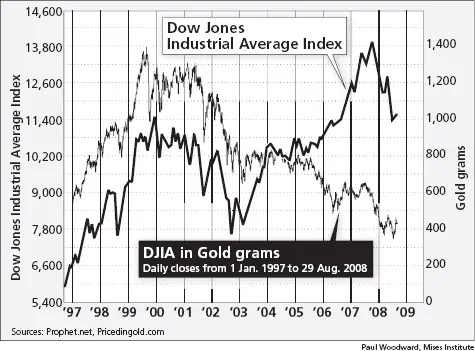
Figure 3.10: Dow Jones Industrials priced in dollars; Dow Jones Industrials priced in gold.
But of course, any gains we make from investing, even in our own houses, are unnecessarily taxed by the government (capital gains tax), pushing us further behind. Still, what harms us the most is not the loss of our own savings, but the loss of the savings of the rich.
Alternative Excuses Offered for Rising Prices
Given the by now clearly unarguable truth that the government’s printing of money causes inflation, we must ask why there are alternative explanations offered as to how and why prices rise and what the motives are of those who offer them. In the first instance, there are those who were mis-taught and misled by government textbooks and socialist professors calling themselves economists who firmly believe inflation is good.
There are still others who fully comprehend the quantity theory of money but choose to accept the effects of government money creation for political reasons or for reasons that allow them to advance in their careers by “consulting” governments on the issue or even to actually run the government printing presses. For example, Alan Greenspan, the previous Federal Reserve chairman, is not only extremely knowledgeable about the quantity theory of money and its devastating effects on prices and on the economy, but actually used to write scathing critiques of the central bank and of creating money. Consider for example the following quotation from him in 1967:
The law of supply and demand is not to be conned. As the supply of money (of claims) increases relative to the supply of tangible assets in the economy, prices must eventually rise. Thus the earnings saved by the productive members of the society lose value in terms of goods. When the economy’s books are finally balanced, one finds that this loss in value represents the goods purchased by the government for welfare or other purposes with the money proceeds of the government bonds financed by bank credit expansion.87
Clearly, Greenspan, given the chance to run a prestigious and economically powerful governmental agency, pursued policies inconsistent with the above-cited insight. He is thus responsible for creating trillions of dollars in fake money, thereby helping the government steal from citizens and creating multiple financial-asset bubbles and economic collapses (including the housing market bust and the current recession).
Shockingly, the most common alternative explanations offered by professional economists and academic textbooks for the cause of rising prices are based on the notion that inflation will appear simply because people expect it — that is, the “inflation expectations” argument. I kid you not — this is a real proposed argument, actually discussed regularly in the academic world. For example, in a 2007 speech, Fed Chairman Ben Bernanke relayed that it’s possible for “people [to] set prices and wages with reference to the rate of inflation they expect in the long run.”88 Supposedly, according to this argument, workers expect inflation and, therefore, start demanding higher wages, or consumers begin paying higher prices for goods, even in the absence of these two groups having received additional monetary purchasing power with which to bid up wages and prices. Thus, this ridiculous argument does not take into consideration that there would be no additional money in the economy with which to pay higher wages or higher consumer prices. These economists live in an imaginary world of mathematics and statistics that are not bound by reality.
Several years ago I was invited to a debate/discussion with economists at the Federal Reserve Bank of Atlanta. The visit confirmed my suspicion that these economists know some of the basic causes and effects of their intrusions into the economy and that they undertake these moves with cynical clarity. One of the economists at the meeting said, “We could stop inflation tomorrow if we wanted.” (In reality, they could begin the process tomorrow, but it would take a year or more to actually stop it.)
Most revealing was their answer to my question of why they enact inflationary policies, namely that “market participants have contracts where inflation is expected.” Presumably this meant that unions were expecting inflation. Workers cannot demand and get paid higher wages without causing unemployment for themselves. But with the help of the Fed bringing about an increase in general prices, unions can ask for and receive seemingly higher wages because economy-wide prices would be rising along with union wage increases. Unbeknownst to union workers, therefore, an important goal of the Fed is to have union members believe they are actually earning more money as a result of demanding higher wages when in fact they usually are just keeping up with inflation (while non-union workers usually experience wage increases below the rate of inflation).
These economists at the Federal Reserve also told me that they were not the only ones creating inflation, but that private businesses were as well. Unfortunately, they did not have the opportunity to explain to me how this can happen, but had they, they might have cited one of the many other supposed explanations typically offered for rising prices. The most common of these are the following:
- The “cost-push” doctrine: rising business costs bring rising prices
- The “wage-push” doctrine: unions (primarily) force business to pay higher wages
- The “profit-push” doctrine: greedy businesses raise prices in seeking higher profits
- The “crisis-push” doctrine: temporary economic “shocks” raise prices permanently
- The “demand-pull” doctrine: an “overheated economy” raises prices
- The “velocity” doctrine: consumers start spending the very same money more quickly (for no reason), increasing demand
- Credit cards: spending rises because of increased spending ability with plastic
- Installment credit: consumer home, auto, and other personal loans increase spending
- Derivatives: options, futures, swaps, and so on (financial market products that provide leverage) create increased spending
- Government budget deficits: excess spending by government
All of these arguments are fallacious. For each of these, and any others that could be offered for higher prices, it can be easily proven that the hypothesis is faulty and that inflation could not be created by the means proposed. In fact, if the items listed above were investigated thoroughly, it would be found that most further prove the quantity of money theory. For instance, it can be easily shown that quantity of money is the factor that affects velocity the most and that the ability to use credit cards or alternative payment systems and derivatives requires that more money be created and credit extended. In a world with an invariable quantity of money, and in the absence of a reduction of spending that would bring about increased saving, it would be impossible for more credit to become available. I will not digress further in order to disprove each of these alternative explanations, but rest assured that disproving them is easily done.89
How the Government’s Central Bank Creates Recessions and Financial Crises
The most damaging effects of the central bank are the economic crises it creates through its creation of credit — that is, by printing money. Recessions and depressions, along with the associated job losses and financial hardships that accompany them, are not normal occurrences in any economy. They are government made. The following sections explain the deleterious effects of the government’s inflationary policies on various sectors of the economy: the first focuses on the real economy (production of goods, payment of wages, etc.) and the second on the financial system (banks, financial markets, etc.). In the former case, problems are manifest as declining output, job cuts, and business failures. In the latter case, problems are manifest as banks going bust; stock, bond, and real estate markets falling in value; currency exchange rates collapsing; and credit generally disappearing.
The Creation of Recessions
Nationwide recurrent recessions and expansions — that is, the business cycle, as it is known — did not exist before central banking and centralized banking systems became institutionalized in the 17th century. Even now, business cycles don’t occur in either communist countries or in developing countries that lack centralized fractional-reserve banking systems.
The expansion of credit by the central bank, and in particular the banking system’s government-endorsed fractional-reserve system, cause large-scale economic imbalances in the real economy — imbalances that must eventually be corrected — because the money that banks create and push out into the economy in the form of loans does not affect all prices and all sectors of the economy equally.
New money entering the economy, in the form of credit, lowers interest rates artificially (i.e., lower than those rates would be without the additional money), thereby increasing capital investment disproportionately in the capital goods industries relative to the consumer goods industries. Why? Because capital goods industries require large-scale investment in factories, equipment, technology, and so forth and can always benefit from more and new investment, and thus additional funds available at low interest rates. The lower the cost of borrowing monetary capital, the more these industries borrow, especially because of what is called “net present value” calculations in the world of corporate finance: the method of discounting the future value of investments via prevailing interest rates. With artificially low interest rates, the profitability of investments is artificially increased. Businesspeople, unaware that artificial money is causing their projects to look more profitable than they are, assume that the interest rate reflects the true amount of savings and money (i.e., real physical materials, tools, supplies, etc.) available to fund their investments when, in fact, it does not.
New money entering the economy competes with real savings for a limited amount of real resources. Businesses, therefore, compete with their new funds for these limited resources whose prices do not reflect their real cost. This situation is similar to the game of musical chairs, which ends with too many people trying to obtain too few chairs, except that, in this case, the number of chairs would remain the same while more people joined the game. With interest rates misrepresenting the real price and availability of resources, some of the borrowed new money is used in investments that appear to be profitable, but in reality are not. Were the interest rate higher (i.e., at the real rate determined by the market instead of by the government), the real threshold of profitability would be revealed, and if fake money were not competing with real money for limited profitable investments, only the truly profitable investments would be undertaken (with, of course, some natural margin of error).
Additionally, many of the investments being made are not in accordance with consumers’ desires. More true money would be available to invest in capital goods only if consumers had decided to consume less in the present and more in the future. They would have saved more of their income and made it available as real monetary capital to be used in producing more capital goods. Because it is capital goods that make consumer goods, an increase in capital goods would eventually provide consumers more consumer goods in the future. But, in fact, consumers have not abstained from spending at the time the Fed pushes credit out to capital goods firms, and they have not saved more money that can be used in increased capital goods production.
The economy is, therefore, being pulled in two directions: businesses are trying to use the limited savings available to invest for the future while consumers are not curtailing spending so as to make the savings available, as businesspeople are led to believe. But as long as businesses have access to more and additional credit (fake savings masked as real savings), they can get by without losses. This additional availability of credit from the Fed also encourages them to rely on its constant availability; thus, they minimize the cash they keep on hand (worsening the ensuing “credit crunch”).
However, after some period of time, all the new money that has entered the economy through business loans begins to make prices rise. Costs of producer goods rise because companies are buying them. Costs of consumer goods rise because more workers working and receiving higher salaries (as more companies compete to hire them with their newly borrowed funds) are spending more money on goods. Consumer goods also rise because, since the investment of new resources has been primarily in the capital goods industry, the consumer goods industry has not yet expanded its capacity to produce current goods and is, thus, not creating many more goods each year than the last. With more consumer money chasing a steady or even declining volume of consumer goods, prices rise. Moreover, prices of financial assets also rise when too much of the new money makes its way into the financial markets, and asset bubbles sometimes appear. It is for fear of either increasing price inflation or of asset bubbles that the Fed stops printing money because regulators know that it is the money being printed that is causing these occurrences.
Once the Fed’s credit creation comes to a halt, or even slows down, like a public water fountain that falls after the force of water shooting up below it is diminished, there is not enough money to keep funding the ever-more-costly investments; similarly, as the quantity of money falls or accelerates too slowly, there is not enough money to support asset prices, and they fall. It follows, then, that once the pace of credit expansion slows, that business projects cannot be completed or become unprofitable, and asset prices, which also often serve as collateral for business for loans supporting these investments, must fall. Losses naturally ensue.
Business losses become widespread after the money stops flowing and the pace of spending declines. Projects already undertaken are often abandoned, unfinished, due to lack of funds and higher costs. Many businesses that were profitable during the boom become unprofitable once less credit is created because the flow of new money itself was a source of demand for products and services. Without that demand, business revenues fall while costs remain the same or decline more slowly.
A Monetary Perspective of Recessions
It is also important to understand booms and busts from a purely monetary perspective. Since Reisman has explained this so brilliantly, it is well worth summarizing here.
Recessions come about only by a preceding expansion of money which leads to an artificial elevation of spending brought about by the increased money in the economy (A credit-induced boom leads to an inevitable bust).
When credit expansion begins, it raises the velocity of circulation: as new money enters the economy, it appears that credit is cheap and easy to come by, causing people to hold fewer dollars, because they feel they can easily access funds when they need them. But the availability of funds leaves businesses less liquid. Why? Since businesses can easily obtain money, they don’t need to hold as much of it, and they therefore spend the money they were keeping in checking accounts. With businesses (and people) holding less money and spending it more rapidly, the velocity of circulation increases. As velocity increases, demand increases.
But an increase in the money supply has another important effect: it increases debt in the economic system. This is because as the quantity of money is expanded, interest rates, and thus borrowing costs fall. But the rate of profit for businesses remains the same as before. As interest rates fall relative to business profits, which remain the same, it becomes more profitable to borrow. Thus both businesses and (individuals) take on more debt and extend their leverage.
But when the credit expansion ends or slows, debt becomes harder to repay. The belief that people can operate with lower cash holdings is predicated on the continuation of credit expansion. When credit expansion ceases, velocity falls, and this alone can cause serious problems, as those who relied on cheap and easy credit, instead of holding adequate cash, scurry to build up their cash holdings. With reduced velocity and spending, increased cash holdings, and less credit available at higher prices (interest rates rise with a cessation or reduction in credit expansion), payment of all outstanding debt can’t be maintained. With outstanding debt levels too great to be repaid; bankruptcies inevitably ensue.
But things really get bad when unpaid debts cause business firms to default on their debts to banks, which lowers the value of bank assets. Due to fractional reserves, bank deposits — the bank’s liabilities — are backed, via currency on hand, by only 10% of the value of the deposit. The rest of their assets are in the form of loans and securities. If loans go bad, leaving fewer total assets backing bank liabilities, banks can’t pay depositors all their money — they go bankrupt.
When banks go bankrupt, their checking account money — promises to pay on demand — no longer have value; they are worthless. Those checking deposits are no longer part of the quantity of money. When the money supply is reduced in this way, there is less money spent. The ability to repay debts is thus reduced further, setting up more bank failures and more money supply declines. Due to reduced demand and business losses, unemployment ensues. This is the vicious cycle that took place during the bank failures of the Great Depression.
Capital goods companies, and other companies that produce intermediate goods, experience steeper losses of revenues and profits during recessions than consumer goods companies — retailers, service-oriented companies, and so on — that hold up relatively well during tough economic times. Companies in areas such as manufacturing, infrastructure, materials, and construction are hardest hit. Likewise, it is primarily workers from these industries, not those from the consumer goods industries, who are laid off. Many of these businesses go bust, resulting in layoffs, the closing of factories, and unused idle capacity of plants and equipment (for example, steel mills, dot-coms and the housing industry).
Companies that become less profitable or go bust cannot repay loans to banks. Banks must write off loans and close accounts. Deposit accounts then evaporate into thin air just as they were created out of thin air. Banks are then forced to call in other loans in order to meet reserve and capital requirements. At some point, at least one or two banks go under. The bankruptcy of one bank causes many others to fail because they are all interconnected through the pyramided financial payments system. Just as money was created with a multiplier effect, it is destroyed with a reverse multiplier effect. The lack of credit available to businesses leaves them in still worse shape, and this downward spiral continues until the bad investments are cleared out and banks’ balance sheets are restored (when permitted; when bailouts do not occur).
The inflationary booms and busts bring about lasting damage to our capital structure. The misallocated capital resulting from the business cycle described above entails a destruction of real wealth and thus of the ability to create new and additional tools, technology, and machinery. The result is lower real productivity, lower salaries, fewer goods, higher real prices, and a reduced standard of living. Had this wealth never been destroyed, we would all have a much higher standard of living than we do currently. Instead of average household incomes of about $44,000, as we have today, we could have average incomes of $60,000, $80,000, or $100,000, with the same cost of living we have today.90
In sum, recessions are not a natural phenomenon. There is a reason that thousands of companies, most of which do a great job of forecasting and planning most of the time, suddenly all experience bad investments and losses simultaneously. The mainstream pro-government economists, such as Keynesians, have no clear and logical explanations for business cycles: their best theory for business cycles is that wild “animal spirits” cause businesspeople and investors to spend crazily but then suddenly stop without reason.91 It is simply spending and re-spending, they hold, not saving and investing, that causes economies to grow. It should be apparent from Chapter 1 that it is real savings, not paper bills being passed from one person to the next, that grow our economy. Instead of some unpredictable wild animal spirits, it is fake government money that causes the boom and then the bust.
These pro-government economists also argue that during the boom there is economic overinvestment and overproduction. This cannot be true, of course, because we could never produce more goods than we could use (not to mention, that if we did overproduce, the “excess” goods would be free, since no one would want them). Even if we somehow could overproduce, prices would fall to adjust to our purchasing power — along the way, not all of a sudden. The reality is that we overproduce in some industries and under-produce in others. The government distorts the price system that coordinates resources and causes a misallocation of capital. Recessions are actually the corrective healing process wherein workers and materials are reallocated to where they should be, based on consumers’ ultimate wishes as revealed by their spending patterns. Even so, much capital and real savings are destroyed in the process.
The Creation of Financial Crises
Soon after the first central bank arrived in the Netherlands in 1609, so did the first known financial bubble. The famous “tulip mania” occurred in the 1630s and consisted of dramatically rising prices of Tulip bulbs.92 New money created by the Dutch central bank (much of it pyramided on new gold and silver flowing in from America) was funneled into, among other things, tulip prices, just as new money is funneled into particular stock and bond prices today. The Dutch sold homes, farms, and many acres of land just to buy as little as a single tulip bulb, with hopes of becoming rich, until the tulip bubble collapsed and prices came crashing down.
Perhaps the most famous bubbles are those of the South Sea and Mississippi Companies from 1717–1720, which were associated with the origination of the first state-chartered bank of France. Here, un-backed currency was created in the form of loans, many of which were used to buy shares in two companies that were run by the central banker himself. Again, after extraordinary gains, share prices plummeted in what was probably history’s first market crash.
More recent asset bubbles include the 1989 property boom and bust accompanied by the S&L bailout; the Japanese economic boom and, as of now, 19-year bust; the 1990s economic boom and collapse of the “Asian Miracle” countries; the late 1990s dot.com stock market bubble and subsequent collapse; and the recent world real-estate boom and current bust. All of these financial/economic booms and busts are the result of the worldwide printing of money, which originates predominantly in the United States with the Federal Reserve Bank. Our inflationary trade imbalance, as will be explained below, causes money to leave the U.S. and flow into other countries, causing other countries to print money. Additionally, money created by the Fed (as well as the E.U. central bank) and loaned out to institutional investors, flows into other countries as investment capital, and swells asset prices and bank balance sheets in those countries.
Financial bubbles result from new money being channeled into financial markets and remaining there (i.e., not leaking out into the real economy). As more and more money flows into financial assets, their prices rise, often at an increasing rate. Because rapidly rising asset prices are such a profitable endeavor, not only do individual investors invest more of their savings, but institutional players (hedge funds, insurance companies, mutual funds, etc.) borrow increased amounts of the new money in order to participate, often using a large degree of leverage to multiply their returns. Particularly in the later stages of the “game,” the prices of the assets involved in the bubble become completely divorced from the underlying fundamentals and true amount of risk involved in the purchase of the assets. The driving force is simply the flow of money. Then, as is the case with inflation in the real economy, once the Fed’s money stops flowing, the asset fountains fall back to the ground. No matter what the talking heads on television say about “the new economy” or about housing prices being solely a function of population and demographics, the inescapable truth is that when the money that has been pushing up asset prices begins to flow less strongly prices will fall.
Prior to the recent real estate bubble, physical and monetary overinvestment took place in dot-com companies. When the Fed’s fake money stopped flowing, hundreds of these companies — many of which should never have received funding to begin with, and would not have without the Fed’s monetary manipulation — ceased to exist and real capital was lost. In fact, the housing market, which was already hot at that time, became a bubble precisely because the Fed was trying to save the economy in the early 2000s from being negatively affected by the collapsing dot-com bubble. The Fed’s money-pumping actions, beginning in 2001, prevented the economy from healing from the massive imbalances that existed, making them drastically worse over the next six years as it created a new bubble, this time in real estate.
During the recent real-estate bubble, the Fed began slowing its rate of credit expansion in 2004. Though interest rates rose for almost two more years, by pumping enough money to keep them at still artificially low levels, Alan Greenspan and company were continuing to expand credit at high (but decelerating) rates. By mid-2006, interest rates had risen to a rate of over 5 percent, up from their two-years-prior low of 1 percent. Within a year’s time, the slowing availability of money for financing real estate and rising interest costs caused homebuyers to slow their pace of buying. With less affordability and less money from the Fed with which to bid up prices, housing prices began to fall. When homeowners’ variable-rate mortgages purchased when interest rates were lower were reset to higher market interest rates, many of those who had bought houses they could not really afford were unable to make mortgage payments at the higher rates. This caused losses on the balance sheets of banks and investment firms that held the leveraged mortgages or mortgage-backed securities (groups of mortgages packaged together to be traded on financial markets; also now known as “toxic assets”.
As real estate prices fell, banks’ balance sheets began to deteriorate because the houses themselves, which were falling in value, served as collateral for loans, and, because many customers were not repaying their mortgage loans. Additionally, many investment banks owned mortgage-backed securities, which were declining in value for the same reasons. Their deteriorating state of finances caused widespread bank insolvencies.
In 2008, we witnessed U.S. and U.K banks going bust left and right. One-hundred-fifty-year-old financial institutions went out of business overnight. Most major Wall Street banks either failed and were taken over by others or transformed themselves into deposit banks (where they can always create their own money). Quasi-governmental mortgage agencies Fannie Mae and Freddie Mac, already government sponsored, imploded and were (unconstitutionally) nationalized by the government. The same happened to AIG, one of the largest insurance companies in the world.
For fear of these events resulting in widespread credit contraction and a failure of the entire American financial system, the Federal Reserve has been trying to paper over current credit losses with more new money and new debt. But it is not yet clear as to whether its successes so far will be permanent. If the injections of newly printed money and bailouts work, we can expect higher inflation and less real economic growth — even though the stock markets and GDP will register a considerable increase (see more on the meaninglessness of GDP in Chapter 10). If the bailouts fail, we can expect rapidly falling prices (not in a good way) and less real economic growth. Either way, we have incurred a reduction in standards of living (whether we notice it or not!) due to the latest effects of the government’s money machine.
But there is one essential thing that should be understood: there is no way that the housing bubble and burst, mortgage implosion, financial crisis, and recession could ever have occurred without an expansion of the money supply by the government, no matter what derivatives were used or what bad choices were made. In fact, the derivatives went bad because the underlying assets went bad. And as we have seen, it was the manipulation of money and credit which caused the underlying assets to go bad (and for seemingly uncorrelated assets to suddenly become correlated). It was government intervention — in the form of regulation — that caused the crisis.
Consequences of a Financial Implosion
It could be the case currently that the imbalances in the whole of the economy have been large enough to cause such a destruction of real savings and capital that new credit is not enough to cover up the problems. In this case, it is possible that an implosion of the money supply, resulting deflation (falling prices arising from money disappearing), could cause a nasty economic downward spiral. Many have pooh-poohed the notion that this deflation could happen today and dismiss those who claim that it could as doom-and-gloom crackpots. But it is precisely for fear of this implosion that our “leaders” are desperately trying to prop up the system.
Bernanke has said previously that a 1930s-style money supply collapse could not happen today because the Fed would print enough money to prevent it. This is questionable, however, because the same strategy failed in the 1930s. Contrary to popular opinion, the Federal Reserve did try to expand the money supply back then by pumping bank reserves into the system. As evidence of this attempt, the Fed’s holdings of bonds purchased from member banks for the purposes of expanding reserves increased by 400 percent between 1929 and 1931.93 However, this maneuver did not stop the falling market and the collapsing economy, mainly because citizens withdrew their deposits from banks, which reduces the money supply. But as long as people believe the government will and can compensate them for their deposits in a bankrupt bank, they will not withdraw their funds. As long as this continues, the government, by creating credit, can always replenish the amount of money that evaporates in the system as a result of bankruptcies and lack of debt repayment.
The other reason the money supply could not be re-inflated in the 1930s was because much of the newly-created money was not loaned out and did not enter into the money supply. In order for the new money to make it into the money supply, banks have to feel financially healthy enough to lend their excess reserves94 to the public, and the public has to feel financially healthy enough to borrow the new money.
The banks did not initially lend out their bailout funds in 2008 and 2009 precisely because they were not healthy enough to do so; they first needed to recapitalize themselves with the funds merely in order to survive. In the same way, the public will be reluctant to borrow more money if they already feel that they’re under water from their current debt. If neither the banks nor the public make use of the new funds, the money will not make it into the money supply to push prices up. When the demand to hold money is strong and when large amounts of credit have been destroyed while at the same time banks refuse to lend more credit due to ongoing losses from the previous credit, what exists is commonly known as a “credit crunch.” When business and bank losses are not liquidated, credit can remain frozen, bringing the wheels of the economy to a standstill. This is why it’s imperative for losses to be realized and for institutions that would otherwise collapse not be propped up with taxpayer money — it’s all for naught, as it throws good money after bad, and results in a net loss of wealth.
If the Fed manages to save the banking system, it will be all of us who pay the price. “Being saved” means having money printed, borrowed, or taken in additional taxes in order to recapitalize the banks and to pay for losses the Fed and the Treasury will take on from buying the banks’ deteriorating assets. All of this will result not only in higher consumer price inflation, but in less capital available for us to use to improve our standards of living, and more crises in the future. Nobel Prize-winning economist Friedrich A. Hayek had this to say in 1928:
To combat the Depression by a forced credit expansion is to attempt to cure the evil by the very means which brought it about; because we are suffering from a misdirection of production, we want to create further misdirection — a procedure that can only lead to a much more severe crisis as soon as the credit expansion comes to an end.95
This is the cost we will pay to compensate financial institutions for the mistakes they made in using the money they stole from the rest of us (remember, they are intertwined with the Federal Reserve). The Fed’s existence encourages these firms to take on risky gambles over and over, because they know that the Fed will bail them out with our savings. It is very possible — though not a certainty96 — that the large price tag will be in the form of the highest inflation rates in many years.
Bankers have spent over a hundred years arguing that fractional-reserve banking is a natural product of the free market and is harmful to the economy only when it isn’t properly regulated by the government. We have nothing resembling a free market in banking and finance, however, and clearly fractional-reserve banking is tantamount to fraud, since it is selling claims to someone else’s money. Inevitably, our current problems will result in politicians arguing we need more regulation to prevent crises, while they will make sure to leave fractional reserve banking in place to fund wealth redistribution.
International Financial Crises
Since the last remnants of the gold standard were snuffed out by the U.S. government in the early 1970s, worldwide creation of money — and with it the frequency of financial bubbles97 — has grown at the fastest pace in history. While few large-scale financial and economic calamities simultaneously affecting multiple countries occurred prior to the 1970s, crises have been popping up around the world ever since, and are becoming more common. The Latin American runaway inflation of the 1970s and 1980s and subsequent debt crisis in the early 1980s, the 1989 S&L crisis, the 1995 Mexican “tequila” crisis, the 1997 Asian currency crisis, the 1998 Russian debt crisis, the 2002 Argentine debt crisis and subsequent economic implosion, the competitive currency devaluations between countries, currency collapses, and the many more worldwide events of financial destruction were all caused by the massive amounts of debt the world’s central banks created.
It should be pointed out that much of the debt created by various central banks in the world is a direct result of America’s trade imbalances. Foreign exporters who receive our dollars as payments for goods they shipped to us exchange those dollars for local currency at banks in their countries. But most of the local currency paid to the exporters by their banks is newly created money: for each dollar they collect from us, foreign central banks create an equivalent amount of money in their currency in order to pay their exporters. The dollars, instead of being converted into local currency, are reinvested by foreign central banks in the United States, mainly in financial assets, so as to keep their currency low so that their exports will be more competitive. These dollars held by foreign central banks are known as foreign exchange reserves or reserve assets. The international central banking system revolves in this away around the dollar because of the government-installed Bretton Woods regulated monetary system that preceded the current state of affairs.
Not only does the money that flows back to the United States become a driving force pushing up U.S. asset prices, but money foreign central banks print in their own countries creates asset bubbles and distorts economic growth in the same way that it does in this country. This, along with international investment capital flows created in both the United States and Europe, is the “fuel” that causes the types of booms and busts described above. As evidence, consider the chart in Figure 3.11 showing the increase in total world reserve assets since going off the gold standard in 1971. The increase in reserve assets reflects the increase in world money supply. No wonder international crises have been so predominant since the early 1970s. Though the total reserve assets in this chart, which goes through 2000, are just shy of $1.6 trillion, the total as of 2010 is over $9 trillion (up $1 trillion over mid-2008).98
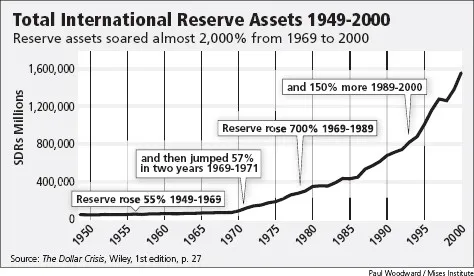
Figure 3.11: The rapid increase in world reserve assets since going off the gold standard in 1971.
The massive world inflation created by central banks shapes the events in our daily economic lives, even though the only measure of inflation you probably are aware of — the CPI — states that inflation is tame. The above-mentioned crises are all caused by inflation that you do not see, affecting your well-being, and reducing your wealth and your standard of living in the multiple ways described above.
The Crazed Desire for Price Stability
In “managing” our economy, most central banks supposedly aim for stable prices. More specifically, they aim for a stable, positive, but low rate of inflation. Most economists fear falling prices because they associate them with deflation. They believe there should be some inflation for fear that if the inflation rate gets too close to zero, it will slip into deflation. This fear is misguided, however, as deflation comes about only with a collapse of the money supply. Deflation — prices collapsing from a collapse in the money supply — is in no way related to falling prices that arise from the production of goods and services. Further, even stable prices (an inflation rate of zero) constitute inflation because without the printing of more money, as we have learned, prices would fall. Therefore, the amount of money that is printed in order to keep prices unchanged still has the same negative effects on the business cycles and financial markets described above.
Still, central bankers believe that having price stability — instead of merely letting prices fall — is a panacea for all inflationary ills, even though inflation would still be prevalent in the form of an expanding quantity of money and rising asset prices, in addition to the 2 percent to 3 percent inflation they plan for. Even with their intended goal of a positive rate of inflation, they often get more than they bargained for. An example is Iceland’s recent inflation rate of 14 percent, even though its central bank’s stated inflation target is 2.5 percent, as shown in Figure 3.12.
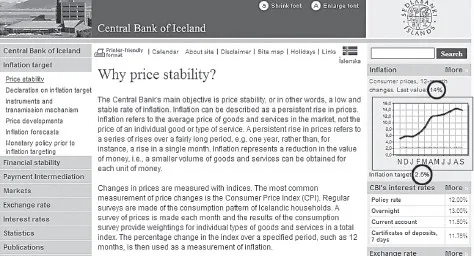
Figure 3.12: Iceland’s inflation level of 14 percent versus its stated goal of 2.5 percent. Source: Central Bank of Iceland: http://www.cb.is/.
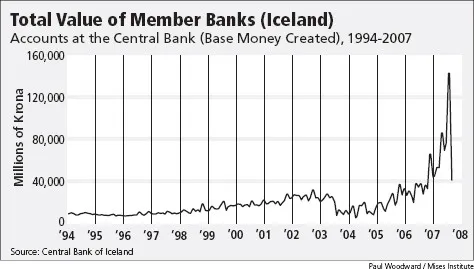
Figure 3.13: Iceland’s inflation level of 14 percent versus its stated goal of 2.5 percent. Source: Central Bank of Iceland: http://www.cb.is/
The primary reason that Iceland’s inflation rate achieved 14 percent was its increase in the money supply. Figure 3.13 shows that the amount of money in Iceland’s economy increased dramatically between 2004 and 2007.
The reality is that for many reasons central banks can’t maintain a particular target rate of inflation. The inflation rate will vary widely around the targeted number. Additionally, there is every political incentive to print money at a faster rate than planned, as the government never has enough money, and it always needs to try and pump up the economy so that politicians can get re-elected. We would all be better off if the government simply quit printing money and let prices fall.
Stop the Insanity!
It should be seen how ridiculous the whole system of creating money is. There is no need for it. It does not help true economic growth —i.e., the increasing production of goods and services and rising real wages. Only real savings can grow the economy. Diluting the amount of limited real savings with paper money results only in some portion of the real savings and real wealth being destroyed. If money were never printed, or if we were legally allowed to use the money that the marketplace has chosen for hundreds of years — gold — money would never be at risk of disappearing because it would not be based on debt, it would be real. Deflation, credit collapses, multiple bank failures, and recessions come about only as a result of the central bank.99
It is probably safe to say that voters are not aware that by supporting the current policies of today’s politicians, they are voting for inflation and a destruction of wealth. If voters let their politicians know that they are as upset about inflation, recessions, and economic crises as they are about reproductive, immigration, and civil rights (not that these issues are not important!), politicians would respond accordingly in order to get elected. The sad reality is that voters rely on the politicians to somehow fix the economy. Voters have no idea that the economy is already in a mess precisely because of what the politicians have been up to. It is the printing of money that helps pay for wealth redistribution, finances wars, temporarily causes higher employment, and makes the so-called GDP rise — the things voters think benefit them. Only with an understanding of what really helps us become wealthier as citizens can we encourage our politicians to do the real right thing.
The Case for Legalizing Capitalism
Read the whole book online · Book details
This work is published under a Creative Commons licence. You may copy, share, and re-host it with attribution.