
Chapter 18 of 44 · The Case for Legalizing Capitalism by Kel Kelly
Chapter 6: When Capitalism Is Taken Away
When Capitalism Is Taken Away
The last chapter discussed, in part, how the economy functions in direct accordance with consumers’ desires: production is based on what consumers signal that they want, as determined by their purchases. These desires are transmitted through prices they pay and the costs and profits associated with those prices. Profits and the price system lead to a smoothly functioning economy where most things desired exist,177 but shortages don’t.
We have also seen that when government intervenes in this system by means such as imposing price controls, mandating production in ways different than would otherwise take place, preventing the ownership of the production processes, preventing money from flowing to or from an industry or country, printing new money (inflation), or heavily taxing production and wealth, the market does not function efficiently. Slight government interventions will result in a little less production of wealth; significant interventions will result in economic stagnation (which is what we’re near today); heavy intervention or a complete takeover of the price and production system will result in economic decline and impoverishment.
This chapter reviews several historical scenarios where different large-scale acts of government intervention in the marketplace led to reductions in economic growth in some instances and outright destruction of the entire economy in others. The first is the Great Depression of the 1930s, the second is the rise and fall of the Roman Empire, and the third is the twentieth century development of communism in selected countries. The chapter will conclude with a comparison of the different levels of economic freedom between various countries, showing that those which are the freest generally have higher standards of living.
The Great Depression: Government’s Creation
Most people’s impression of what happened during the Great Depression goes something like this: because of greedy businesspeople and investors, and because of the free-market policies of President Hoover (Republican), the stock market crashed and plunged us into a depression resulting in millions of people being unemployed and suffering. It was then that Franklin Delano Roosevelt came along with ingenious policies of social protection, wealth redistribution, and regulation that got us out of the depression. Believing this story is like believing that black is white or that up is down. Let’s quickly review the years of the Great Depression, and observe economic cause and effect.
What Created the Onset of the Depression?
As is the case today, it was in fact the government’s central bank, not the stock market crash itself, that started the economic problems of the 1930s. As we have seen, when the central bank pumps money into the economy, it causes not only inflation, but it ultimately also causes a large-scale misallocation of capital, financial losses among companies, bank losses, and a contraction of the money supply, all of which result in reduced production, bankruptcies, layoffs, and increased unemployment, not to mention stock market booms and busts.
It was precisely this sequence of events that caused not the Great Depression itself, but the initial economic downturn. The U.S. central bank, the Federal Reserve, expanded the money supply by about 60 percent between 1921 and 1929.178 Official inflation rates were low, primarily due to extraordinary technology-based productivity increases. But the fact that prices rose at all, instead of falling, during this time of high productivity, reveals that real inflation (i.e., increases in the money supply) was high. The large amounts of money being inserted into the economy, along with, to a lesser degree, gold (real money at the time) flowing in from WWI debtor countries, started a large economic boom that caused this period to be called the “roaring 20s.” But when the Fed shut off the money valve and thus reduced its rate of printing money (interest rates rose from 3.5 percent to 6 percent between 1928 and 1929), the boom came to a crashing halt.
The reduction in money supply, which fell by 30 percent over the next three years, caused the economy to collapse and the stock market to fall. Up until that point in our nation’s history, the government mostly did not attempt to manage and intervene in response to recessions (some more than others) and most recessions lasted less than two years. The 1930s “depression” too would have been an ordinary recession had the government refrained from intervening. Natural market forces would have corrected the economic imbalances: the price system would have moved labor and capital back to where they were most effective, and losses would have been realized. But the market was not allowed to “clear” (supply and demand stayed misaligned) — as is the case today. Our politicians prevented the free market from working.
The Economy Under Hoover
Once the recession began, Hoover engaged in unprecedented interference in the economy in order to try and “help it.” He was rightly accused by his 1932 presidential opponent Franklin Roosevelt of taxing and spending too much, boosting the national debt, choking off trade, putting millions on the dole, and trying to centralize economic turmoil in Washington. Hoover’s administration created 30 new government departments and hired 3,000 new bureaucrats. John Nance Garner, Roosevelt’s running mate, stated that Hoover was “leading the country down the path of socialism.”179
In 1930, Hoover, ignoring the pleas of many economists, signed the Smoot-Hawley Tariff, virtually preventing foreign goods from entering the country. This act increased tariff rates on various imports by between 20 percent and 60 percent, on average. Production processes that used inputs imported from abroad were thus hit with higher costs, resulting in unemployment. For example, most of the 60,000 employees of plants making cheap clothing from imported wool rags became unemployed after the tariff on wool rags rose by 14 percent.180 Hoover and Congress thought that by raising trade barriers they would cause more citizens to buy American goods, thereby reducing unemployment. But they didn’t consider that tariffs, besides raising costs to consumers, would cause unemployment in those sectors making goods to be exported to other countries.
Once foreigners became less able to sell their goods in the American market, they became concomitantly less able to buy American goods. American agriculture was hit the hardest. Thanks to their politicians, farmers immediately lost a third of their market, causing (along with a declining money supply) agricultural prices to plummet and tens of thousands of farmers to go bankrupt. (Keep in mind that during this time, almost 30 percent of the population was involved in farming.)181
Losses from farming and other industries caused losses for banks, since their loans were not repaid. Over 9,000 banks went out of business between 1930 and 1933. The stock market, as measured by the Dow Jones, fell by almost 90 percent by summer 1932. It would take 25 years for the market to reach once again its 1929 peak (and 35–40 years when adjusting for inflation).
Since falling prices were hurting farmers, the government attempted to raise farm prices by reducing agricultural production. Thus, the government, with public tax money, paid farmers not to work, not to grow food, and not to grow livestock, which also implicitly means it paid them not to hire farm workers. Not only were they directed not to produce, they were directed actually to destroy crops and animals. Federal agents sanctioned the plowing under of fields of cotton, wheat, and corn — mules had to be retrained to walk on the crops, since they had previously been trained not to. Healthy sheep, pigs (including six million baby pigs), and cattle were slaughtered and buried in mass graves. While much of the rest of the country was desperate for food, the government was destroying it in order to attempt to benefit a single political group. Roosevelt, in his administration, not only continued these policies, but accelerated them.
Some farmers also took matters into their own hands. One farm union, led by a preacher, tried to force all farmers, against their will, not to produce food.182 To ensure that independent farmers did not increase supply, the farm unions in several midwest states created an embargo that prevented food from being exported from those states — even threatening fellow farmers and the public with guns in enforcing their blockade. The governor of Minnesota went so far as to assist the union by offering to use the state militia to prevent innocent citizens from engaging in the trade of crops.
Farmers were also aided by the senate, which directed the FTC to investigate the supposedly too-low export prices being paid to grain farmers.183 Congress, in doing its part, helped farmers to threaten the meatpacking industry. Farmers had always complained that the meat-packers paid them too little for livestock (while consumers, of course, complained that the meatpackers charged too much at retail). Since meatpackers were not a big voting block, congress, under the pretense of a war emergency, threatened to authorize the president to take over and manage their operations. The meatpackers were eventually forced to curtail many of their (harmless) operations and to accept regulation by the Secretary of Agriculture. Thus, farmers were allowed to benefit at the expense of the meatpackers and the public.
With economy-wide consumer prices falling, wages rates needed to fall as well. But Hoover single-handedly came up with the idea to keep wages high.184 His notion was that high wages bring wealth, although in fact, as we have seen, it’s savings and productivity that bring high wages. He thought that by restoring wages to what they had been, he would restore wealth.185 He thus forced businesses to keep wages high. Shockingly, many business leaders — not just unions — were at first on board with this idea, because they, too, thought it would help the economy, and eventually, the plan became broader and mandatory. But since companies’ revenues were falling — due to deflation — in order for businesses to be profitable, costs, including wages, needed to fall as well. During the period in which consumer prices (business selling prices) fell by 25 percent from 1929 through 1933, wages decreased by only 15 percent. This represented a relative increase in wage rates and thus in business costs. The result, obviously, was widespread unemployment. Had wage rates been allowed to fall to the market price, production would still have been profitable for businesses, and they would still have needed the workers — there would still have been a demand for business products either by other businesses or by consumers, who would still have had jobs, and would have kept spending. The only difference in terms of total production, employment, and wages by businesses would have been the change in prices of goods and labor (except that a change would have needed to occur in the distribution of labor and production: many people would have needed to switch jobs, given that the change in the flow of money from the central bank had caused a change in the demand for consumer goods relative to capital goods industries). The Great Depression wage experiment proved that wage rates are a result of economic environments, not the creator of them.
As often is the case, businesses were all too happy to cozy up to government in cases where they could benefit. Gerard Swope, the head of General Electric, called for the cartelization of American business. This regulation, where the Federal Government would “coordinate production and consumption” was welcomed by much of the business world, including the U.S. Chamber of Commerce.186 Why? Because such (socialist) planning would result in restricting production in order to increase selling prices, an outcome that could not be accomplished without government regulation. In free markets, companies could not achieve a cartel because the various members would ignore cartel rules and increase supply by more than they are supposed to in order to gain extra profits. Plus, there would always be new outside competition.
Because of the widespread unemployment, Hoover dramatically increased government spending on subsidies and relief schemes. The government’s share of GNP increased from 16.4 percent to 21.5 percent over a single one-year period between 1930 and 1931. Since farmers had been hurt by Hoover’s previous policies, he handed out to them hundreds of millions of dollars paid for by other taxpayers. Billions more were given out to other businesses and individuals suffering from prior government actions.
Similar to the politicians of today, Hoover blamed the crisis on a lack of credit stemming from free-market failures, without identifying exactly what caused that lack of credit.187 Hoover wanted to loosen bankruptcy laws so as to make lenders, instead of consumers, suffer from the lack of being able to pay debts (just as our politicians today have done with consumer mortgages and credit cards).
As though the previous policies of high tariffs, large subsidies, and a deflationary monetary policy were not enough, congress then passed, and Hoover signed, the Revenue Act of 1932, which resulted in the largest tax increase in peacetime history. This act doubled the income tax, raising the normal rate from a range of 1.5–5 percent, to a range of 4–8 percent.188 The top tax bracket increased to a marginal rate of 63 percent! Additionally, exemptions were lowered, corporate and estate taxes were raised, new gift, gasoline, and automobile taxes were imposed, and even the writing of checks became taxed (just as some in congress today want to tax each and every stock trade). Not only were people made poorer by these tax increases, but their savings, particularly those of the rich, were desperately needed in the private sector in order to produce goods and to pay wages. By 1933, the results of these policies resulted in one quarter of the population being unemployed. Some states saw as much as 40 percent unemployment and some cities reached 80 percent.189
The Economy Under Roosevelt
Unlike Hoover, Roosevelt blamed the depression on “unscrupulous money changers,” just as our politicians today blame “predatory” lenders for the housing bust and speculators for high oil prices. And like Hoover (or Obama), he placed no blame on the central bank or the previous government policies which had brought about the problems at hand.
FDR won the 1932 election on the promise of a 25 percent reduction in federal spending, a balanced budget, a sound currency based on gold, an end to the “extravagance” of Hoover’s farm programs, and the elimination of government from areas that “belonged more appropriately to private enterprise.”
But Roosevelt delivered on none of these promises. He used the very same economic manipulation tactics as Hoover, and simply magnified their intensity. As Murray Rothbard stated, Hoover and Roosevelt were ideological twins. Rexford Guy Tugwell, Roosevelt’s close advisor and a great admirer of Stalin and socialist central planning, stated that “We didn’t admit it at the time, but practically the whole New Deal was extrapolated from programs Hoover started.”190
During the first year of the New Deal, though government revenues were only $3 billion, Roosevelt proposed spending $10 billion (equivalent to $16 trillion today). Federal expenditures would rise 83 percent in the three years between 1933 and 1936.191
As is the case with our crisis today, banking regulation in the 1920s not only caused the Great Depression, but made it worse. Almost all of the banks that went under during the Great Depression were those in states with unit banking laws — i.e., laws prohibiting branch banking that allows banks to diversify their assets and reduce their risks.192 Canada, which allowed unit banking, had not one bank failure, while in the U.S., 9,000 banks failed.193 Further, Canada did not have a central bank “saving the economy” during the worst part of the Great Depression.194
Roosevelt, who promised during his elections to take care of the nation’s money, instead stole it. Upon being given the power by congress, he seized citizens’ private gold holdings, taking away the only real money citizens had, forcing them to hold only paper bills instead. After doing this, Roosevelt devalued the dollar by 40 percent, causing citizens to lose 40 percent of their wealth in global terms. It was one morning over breakfast that Roosevelt decided to change the ratio between gold and paper bills, arbitrarily settling on a 21-cent price hike, because it was a lucky number.195 When Roosevelt ultimately made holding gold illegal, he caused the government to renege on its previous promise to convert citizens’ paper bills to actual gold and silver — into real wealth.
The largest of the many New Deal government agencies was the Works Progress Administration (WPA), which employed millions of Americans to build highways, bridges, public buildings, canals, dams, and sidewalks, as well as to engage in artistic projects such as the production of paintings, theatrical and musical performances (about 4,000 a month). In contrast to most of these other government works projects, it could be argued that infrastructure projects truly contributed to economic growth and did have economic value. But most of the construction did not consist of work that directly benefited the production of goods and services. The myriad projects such as bridges, canals, and roads that were seldom or never used were a complete waste, not only of funds that paid workers’ wages, but also of physical resources that could have been used elsewhere to produce goods consumers needed more urgently.
Similarly, even those projects that were conducive to economic growth still mostly resulted in a decreased standard of living. This is because the labor, materials, and machines employed, for example, to pave a road, could instead have been used to produce household goods or other capital goods. The real importance and the need of one type of investment (such as highways) relative to another type (such as bread and sugar) can be determined only by consumers and businesses through the price system. It is highly likely that had government allowed a free market, suffering consumers would have first chosen to have more food and clothing during the decade of the 1930s, and settled for postponing new sidewalks and public buildings until more immediate needs were satisfied.
Perhaps the most dramatic regulation enacted under Roosevelt was the totalitarian-style National Industrial Recovery Act (NRA). Passed in 1933, the NRA suddenly forced most manufacturing industries into government-mandated cartels — and forced businesses to finance them with newly assessed taxes (throwing yet more workers on the street). The mammoth bureaucracy created under the act was given unprecedented powers that would have made Italian dictator Benito Mussolini proud. General Hugh “Iron Pants” Johnson, who ran the NRA, and who was an admirer of Mussolini, proclaimed: “May Almighty God have mercy on anyone who attempts to interfere” with his agency.196 And he personally threatened to publicly boycott or “punch in the nose” anyone who refused to comply with the NRA.
The NRA developed more than 500 codes that regulated prices and terms of sale of individual products, transforming American industry into a fascist operation. The codes, which spanned a slew of manufacturing categories, covered more than 2 million employers and 22 million workers. As Lawrence W. Reed states:
There were codes for the production of hair tonic, dog leashes, and even musical comedies. A New Jersey tailor named Jack Magid was arrested and sent to jail for the “crime” of pressing a suit of clothes for 35 cents rather than the NRA-inspired “Tailor’s Code” of 40 cents.
The NRA had its own enforcement police who would enter factories, send out the owner and confiscate their books, and line up the employees to interrogate them. These enforcers would storm through the clothing district at night knocking down doors with axes to look for those who were committing the terrible crime of sewing clothes. For such NRA accomplishments as these, Time Magazine named Hugh Johnson the New Dealer Man of the Year in 1933.197
In the five months prior to the act’s passage, the economy was finally showing some signs of recovery, with factory payrolls having increased by 35 percent and employment by 23 percent. But six months after the implementation of NRA rules that raised business costs, taxed production, limited the hours worked, and raised wage rates, industrial production fell by 25 percent. The Supreme Court judged the NRA unconstitutional in 1935.
Not only did Roosevelt raise minimum wage laws that threw an estimated 500,000 blacks out of work,198 but he further increased taxes, insuring that fewer jobs would be created, and likely more destroyed. Naturally, like politicians today, he increased taxes on the evil rich, and introduced a five-percent withholding tax on corporate dividends. After several rounds of tax hikes, he eventually achieved a top marginal tax rate of 90 percent.199 He was accused by Senator Arthur Vandenberg of Michigan of doing what virtually every politician does today, namely, following the socialist notion that America could “lift the lower one-third up” by pulling “the upper two-thirds down”200 (today, however, we try to lift the bottom nine-tenths up by pulling the top one-tenth down). In 1941, he even attempted to have a 99.5 percent marginal tax rate imposed on incomes over $100,000. When an advisor asked him why, Roosevelt replied, “Why Not?” He also issued an executive order to tax all income over $25,000 at 100 percent — to take every bit of income anyone earned that was in excess of $25,000! Soon after, congress rescinded the order.
Dramatic legislation supposedly intended to aid workers directly was also passed during the depths of the depression. For example, the Wagner Act in 1935 removed labor disputes from courts and placed them under the National Labor Relations Board, which was full of union sympathizers who distorted the law and shunned equality under the law. Most employer resistance to labor unions was crushed. Anything businesses did to defend themselves against unions that were destroying them was deemed to be an “unfair labor practice” punishable by the board. The NLRB ultimately made it illegal to resist the demands of labor union leaders, leaving businesses forced to “negotiate” with them. Naturally, with these kinds of laws, union membership more than doubled, and boycotts, strikes, seizures of plants, and violence increased strongly, causing sharp reductions in productivity and sharp increases in unemployment. Due to union coercion, wages increased by 14 percent in 1937 alone, meaning that fewer people could be employed.
Roosevelt, in being anti-business, was then necessarily anti-economy, and therefore anti-prosperity. He blamed businesses for blocking the recovery and for not hiring and not producing, even though it was he and congress — unbeknownst to them — that were responsible for the continued depression. Instead of freeing the economy and allowing business to be more profitable, Roosevelt punished businesses further, therefore also punishing workers and consumers. He imposed new restrictions on the stock market and assessed a new tax on corporate retained earnings (profits not paid out as dividends). He increased the capital gains tax from 12.5 percent in 1933 to 39 percent in 1937.201He tried his best to extract all possible wealth from investors responsible for providing capital for companies to operate with. The result was a depletion of capital, and investors who were too scared, for fear of confiscation, to fund business operations.
While very modest economic improvement had been occurring in the mid 1930s, these additional anti-business policies, along with a sudden reduction of a previously high pace of money creation, caused a second round of economic suffering. From spring 1937 to spring 1938, the stock market fell by almost 50 percent. Unemployment, at 17 percent in 1936, rose to almost 20 percent in 1938. Bad economic policies generated a recession within a recession.
Overall, the economy did not improve until World War II came along. For on the eve of the war in 1939, GNP per capita was lower than in 1929. Similarly, unemployment, which was 3.2 percent in 1929, was still over 17 percent in 1939.
But contrary to popular opinion, it was not the economic stimulus of the war which improved the economy, as production of bombs and tanks — instead of bread and houses — make an economy weaker, not stronger. As Figure 6.1 reveals, unemployment declined because the value of what workers could produce was no longer below the cost of employing those workers (there was increasingly less payment of wage rates above and beyond the value of what businesses were getting in return for those wage rates). Wage rates became more profitable primarily because of the wage and price controls government instituted at the start of the war. The wage controls prevented wage rates from increasing, while high inflation rates raised business selling prices.202 The mix of price controls and inflation is not, however, a productive way to have full employment: citizens were still relatively impoverished during WWII because they earned wages, but had few goods available to purchase. The unemployment rate also improved from the fact that we sent 16 million of our youngest and least skilled workers off to war, thus reducing the number of those out of work.
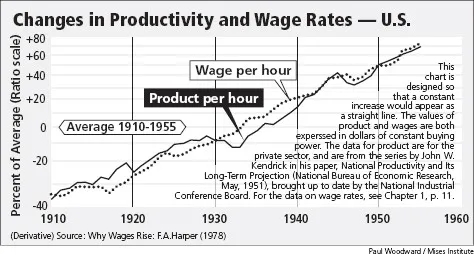
Figure 6.1: Why wages rise
As is usually the case with government spending and government “help,” the actions taken during the Great Depression were based more on politics than on truly helping those in need. Economists Couch and Shughart, upon statistically analyzing New Deal government spending, concluded that “The weight of this evidence thus points to a political explanation for New Deal spending patterns: other things being the same, more federal aid was allocated to states which had supported FDR most solidly in 1932 and which were crucial to the president’s 1936 Electoral College strategy.”203 They also assert that the more economically devastated south, which was already mostly democratic, received disproportionately little new deal spending since it did not need to be encouraged to vote for Roosevelt.
New Deal money intended for economic aid was misused in many areas in order to win votes. Republican government workers in Kentucky were told that they would have to change their party affiliation if they wanted to keep their jobs, as were Pennsylvania WPA workers, many of whom were fired for refusing. Tennessee WPA workers were instructed to contribute 2 percent of their salaries to the Democratic Party as a condition of receiving their wages. In Cook county Illinois, 450 men were directed by the WPA to canvass for Democratic votes in 1938. The men were all laid off the day after the election.204
The Roman Empire: From Economic Triumph to Economic Disintegration205
In the earlier and middle stages of the Roman Republic and Roman Empire, from about 600 B.C. to 200 A.D., the period in which continuous economic development occurred, there was little political or social (for many) freedom. But rulers, such as Augustus and Tiberius, did encourage economic freedom, as they favored private enterprise, private property, free trade, and reduced burdens of taxation. Importantly, during the first century B.C., the significant reduction in wars led to increased trade and commerce. With only a modest custom duty of 5 percent, there was mostly free trade throughout the empire. Thus, there existed a high degree of economic prosperity, which was enabled by the freedom of individuals to produce and exchange as they saw fit.206
Taxes were modest in the earliest days of the Republic; they were applied to all forms of personal wealth at a rate of .01 percent (1/100 of a percent), but periodically rose to .03 percent to pay for wars. Taxes first came about largely due to an expansion of social welfare in the form of free grains (and during some periods, free oil, pork, wine, salt, and in Constantinople, even houses) which were formally paid for solely by the emperor. Like today, politicians bought the public’s goodwill by giving them free things by taking them from others. One politician, Claudius, ran for tribune on a free-wheat platform.207 The more the dole was expanded, the more of an influx of people there was into Rome to receive such subsidies.
But taxes eventually rose along with the expansion of the empire. In the first century B.C., under Augustus, the wealth tax reached one percent, and a poll tax was implemented. The flat tax, unlike the previous tax system where individual tax collectors colluded with the state to extract as much wealth from high-income individuals as possible, gave greater incentives to individuals to produce, since it was less progressive.
Rome’s pro-growth policies of moderate taxes, a stable currency (lack of inflation), and a common market (the entire Mediterranean), are shown by empirical historical research to have had a positive effect on trade, namely that of the sharp increase in the number of shipwrecks during the time of the late republic and early Empire.208 The assumption, of course, is that an increase in shipwrecks arose from an increase in shipping. Social and economic historian Michael Rostovtzeff asserted that both foreign and regional trade were the primary sources of wealth in the Roman Empire.209 There were many other indices of prosperity as well: it has been estimated that money supply grew in line with production, pointing to a lack of inflation; an array of technologies such as heated pools and concrete were invented; large, magnificent buildings and homes were built; government revenues were very abundant, and the state took on many massive infrastructure projects (including roads, bridges, and water and sewage systems) that facilitated trade. Prosperity was increasing and the world had never before seen such a high standard of living (for those who were not slaves).
Once the empire stopped expanding in the second century, there were no new sources of tax revenue, and the imperial functions had to be funded completely internally. The demand for government revenue soon began to undermine the growth of the Roman economy. As the growing government bureaucracy and increasing costs of the army stretched the government coffers, emperors, beginning with Nero, resorted to debasing the currency (diluting or diminishing the amount of real gold and silver in each coin so as to pocket the difference by creating more coins with the stolen wealth). Various emperors debased their coins by anywhere from 15 percent to 95 percent. Inflation therefore began to appear.
The devaluation of the currency, however, did not help the government finances in the long run because citizens, in trying to prevent the government from stealing their wealth, hoarded the older, more valuable coins, and paid taxes with the less valuable ones. The more the government inflated, the greater was its demand for revenues, but the fewer taxes it collected relative to the rising prices. Thus, the emperors resorted to trumped-up charges to confiscate the property of the wealthy. They would also invent excuses for tax donations, such as the accession of a new emperor or a military victory. The wealthy bore the brunt of the tax increases, which later included taxes on inheritance and the freeing of slaves. Some less immoral leaders, such as Pertinax (193 A.D.) reduced taxes. He stated “that he was better satisfied to administer a poor republic with innocence, than to acquire riches by the ways of tyranny and dishonor.”210
But most emperors continued to confiscate or drive away private wealth. This policy resulted in economic growth slowing to a standstill. And when the wealthy were no longer able to support the state, the state turned to the middle and lower classes. As Rostovtzeff states: “The heavier the pressure of the state on the upper classes, the more intolerable became the condition of the lower.”211
In the third century A.D., due to high inflation and taxation, the money economy finally collapsed. But funds were still needed for the army to fight off invaders, and, additionally, to keep the emperor in power. Thus, the army needed to be maintained at all costs, even to the detriment of the people. Without a money economy, the government began taxing citizens by physically taking their wealth (which, technically, is no different from taxes): they would confiscate food, cattle, and other items produced by citizens.
The result was complete physical control of the population by the imperial government. Workers were forced to remain working and producing in their particular place of employment. As under communism, farmers and their descendents were required by the government to remain farmers, and even soldiers and their children were forced to remain soldiers. The rich were forced to work for the government, and anyone who acquired wealth hid it and acted and appeared as poor as possible.
The early centuries of the Roman Empire saw such an advanced state of economic achievement that there was a complete division of labor. In this state, citizens became wealthier by focusing their production on what they were best at, trading with others for what they needed. They forewent the attempt to be self-sufficient. Those in the cities produced various goods, and traded their production for agricultural products and raw materials from the countryside. More and more citizens moved into Rome to work in industries in the city. All regions were inter-dependent — i.e., the state in which prosperity is achieved.
But in the later part of the empire, from the late 200s until the late 400s A.D., the encroachment of the state and the breakdown of the economy led to increased feudalization and an erosion of the division of labor. Since trade was deteriorating due to a barter economy in which it’s difficult to exchange one’s particular production for that of another (there is no medium of exchange in the form of money), people fled to the country to take up subsistence farming.
By the end of the third century, Rome was no longer able to obtain the physical wealth needed to support the army and other government “services,” and resorted to more intense debasement of the currency to bring in revenues, bringing inflation rates to 15,000 percent. Since the very existence of the state was threatened, Diocletian (284-305 A.D.) attempted to solve the previous government-created problems at hand with yet more government intervention. Believing, as do politicians today, that economic crises are caused by citizens (including companies) instead of by the government itself, he imposed price controls on many goods and services. These were, as always, a failure, even though the penalty for buying and selling at the real market price was death. Some price controls were repealed after prices continued to rise even though many citizens had been murdered by the state for the crime of exchanging goods. But price controls on grains and other staples remained, as it was deemed immoral to ask more than customary prices for these important goods, and officials, like today, were quick to punish those who were seen as profiteering. The result was an inefficient wholesale trade in these commodities that led to effective nationalization. The government set the price too low, making it unprofitable to produce these important staples; thus shortages remained permanent.
Workers and businesses were eventually organized into organizations controlled by the state, wherein the government directed production of the economy — unsuccessfully. Individuals then began abandoning the land they were working on and fleeing the city. Industry moved to the country, leaving Rome an empty economic shell that produced nothing. The government also provided nothing for its people but still demanded their wealth for the sake of giving it to others.
Later emperors such as Julian (361-63 A.D.) and Valens (364-78 A.D.) continued debasing the currency and imposing price controls. With prices rising but selling prices kept artificially low, production was paralyzed. The masses could not obtain food and other needed products. Commerce in grain and other necessities ceased.
Within fifty years after Diocletian, taxes approximately doubled, making it impossible for farmers to live on their production. This led to the final breakdown of the economy. The number of tax recipients exceeded the number of taxpayers. With so much of the farmers’ land and resources taken to pay taxes, they too abandoned their land, leaving it to become forest. Still, tax rates kept rising even though tax revenues continued to fall, as burdened citizens became more adept at evading taxes, eventually withdrawing from society all together.
Large, powerful landowners, who were able to both legally and illegally (bribery) avoid taxes organized around themselves small, private, communities, or villae. Small landowners, bankrupted by taxes, when lucky, were able to offer themselves as tenants or slaves (who paid no taxes) in order to have access to food. The turning of one’s self into a slave was so widespread and so harmful to the state’s revenue collection that in 386 A.D. Emperor Valens declared it illegal to give up liberty to become a slave.
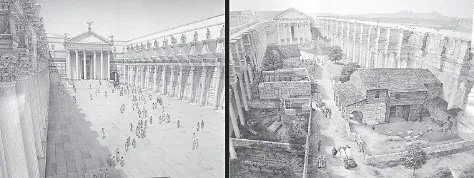
Source: Pictures from the Mercati e Foro di Traiano museum, Rome, Italy
Figure 6.2: Rome both in her glory days and after her fall.
At the end of the empire, there was no trade, no construction, no building of anything. There was only subsistence farming. There was also no money left with which to pay the army. Because of declining funding, the empire had been shrinking for 200 years.
Though the Roman state had defended itself from invaders for centuries, its ability to do so was reduced as time passed and the empire lost economic strength. The invaders had not become stronger; the empire had become weaker. Though the fall of the empire is a major event in the history books, it was rather anti-climactic at the time, as the way of life of most Romans had already been reduced to nothingness. In fact, many citizens welcomed the barbarians because they removed the source of oppressive taxation. There was nothing for the barbarians to steal or to control — all wealth and civilization was already destroyed. Figure 6.2 gives an idea of Rome’s development during the existence of capitalism and then after.
Both the Great Depression and the decline of the Roman Empire were results of the state’s intervening in the private marketplace and its seeking of power and control. But for the most part, in both cases, individual citizens had no way of knowing that their problems were caused by the very entity they relied on to solve their problems. Most people don’t understand that if there is a lack of production of goods or a lack of increasing real wages it is because government is preventing progress by taxing, regulating, or otherwise confiscating capital. Most people do not see that if there are some people (or many) unemployed, even though there is always more work to be done than there are people to do it, it can only be that something is preventing workers from being hired. And as is the case currently, citizens don’t see that the economy and the financial system cannot just collapse on their own, but that the collapse is the result of government manipulation of the marketplace.
As should be understood from these historical examples, government’s intervention on behalf of those supposedly underprivileged or exploited workers and consumers results in diminishing, not enhancing, the standard of living of these groups. This will be even clearer in the following section on communism.
Communism: Equality at Its Finest
The driving force of the desire for and implementation of communism is capitalism’s supposed immorality, its supposed exploitation of workers, and its inequality. As we have seen, the accusation of exploitation is diametrically opposite to reality. Morality will be discussed in the following chapter, but for the time being, as you read, be thinking about which outcomes and means to achieving particular outcomes are moral and which are immoral.
Inequality, specifically, is probably the primary objection people have to capitalism (and indeed, under true capitalism, there is inequality). Therefore, as you absorb the following information, also consider what is better: 1) rising standards of living for everyone, even though some become much wealthier than others, or 2) equality for all, but at a true subsistence level of existence. And remember that anything in between the two (i.e., the “third way,” or, capitalism that’s “managed” or “tamed” by government) results mostly in a static economic state.
For clarity of perspective, keep in mind that communism is in fact socialism’s most extreme form — it is in fact socialism. Socialism, in the formal sense, is a state where government fully controls the means of production (factories, shops, machines, etc.). This can be done directly or indirectly. For example, the Nazis, who most associate with the extreme right, were in fact socialists: NAZI stood for Nationalsozialistische Deutsche Arbeiterpartei, or the National Socialist German Worker Party.The Nazis controlled every aspect of the German economy. Though businesses were privately owned, it was in name only, since business-people produced exactly what the state directed. The movie Schindler’s List offers a good depiction of this arrangement. It should also be noted that the Nazis had an elaborate program of wealth redistribution which included the abolition of all “unearned income,” “the nationalization of all trusts [large companies],” and land expropriation without compensation.212 Thus, even far right dictators are also socialists when they control a nation’s economy, which is the case most of the time.
Throughout this book, I label those who promote even limited socialism as socialists because they in fact want some government control of the economy, and because some always inevitably leads to more and more. This is not only due to the continued existence of the “moral” reasons for which the initial few social policies were initiated, but also because their effects always lead to more economic problems which must be addressed, and which are almost always addressed with yet more government control of the economy (in other words, as time progresses, there’s no such thing as only a little socialism), as is the case in the U.S. today. It should not be forgotten that government control, under socialism, is always for the supposed benefit of society as a whole, thus the name social-ism. Communism is simply the full and complete state of socialism, wherein government controls every aspect of the economy by claiming ownership over every part of it in the name of making society better off by ridding it of the immorality and inequities of capitalism.
Socialists Can’t Calculate
There are two fundamental problems with communism. The first has to do with the lack of incentives; since no individual can personally benefit from inventing, creating, building or doing in any way anything above and beyond what is ordered, there is no incentive for them to do so. People therefore don’t take the risks necessary to offer new products or create new companies, not only because they are not allowed, but because even if they were, they could not increase their own standard of living in doing so. The second problem with communism is that, since there is no price and profit system, no one knows exactly what or how much to produce. They also don’t know whether they are creating or destroying wealth in the process. Without a market and associated market prices driven by consumer spending, they can’t calculate profits and losses, which are the sole means of determining what and how much should be produced. In free markets, by contrast, production is always in accordance with consumers’ wishes; businesses and consumers have their interests aligned.
Additionally, in a free market, it is millions of individuals interpreting the signals given by prices and profits, and using this information to take their own initiative to act in a way that is best for themselves. These millions of individuals then engage with others, to design, produce, market, distribute, trade, and sell the resources they have at their disposal.
Under communism, in contrast, a group of men sit around a table and attempt to coordinate an economy consisting of millions of individuals, machines, and tools, tens of thousands of mines, farms, factories, transportation equipment, warehouses, and stores. Under capitalism, those who specialize in particular trades or intimately deal with particular resources or pieces of equipment best know the subject matter in which they engage. They are, therefore, more than anyone else, experts at deciding how much of each input should be used, which particular combination of limited resources should be used, where new products or services are most needed, and what means are best for achieving particular goals. There is no way that a group of planners — even at an industry level — can issue mandates for businesses and individuals to follow which result in greater efficiency and effectiveness at producing goods and services than can millions of individuals working independently (yet together as a whole) through the guiding direction of free market signals.
Consider, as just one example of millions of goods, the production of sofas. They can be produced in various styles, with various materials; by hand or by machine or a combination of both. They can be produced in the mountains, by the sea, in warm or cold places. There can be a few or many, given that everyone already has a sofa. How many will need to be produced for replacement purposes or for additional rooms in homes? How will these different production considerations be resolved?
These questions are important because the answers will affect the rest of the economy. If the couch is made of leather, how much leather should be used to make couches versus making shoes, car seats, purses, belts, or baseball gloves? Should the sofa frame be made of wood or metal? If wood should be used, how will the wood that is taken to produce couches affect the amount available to produce desks, chairs, houses, and book shelves? If the sofa cushions are stuffed with foam, how much foam should be allocated to sofa cushions versus beds and pillows? And would it be more efficient to use the petroleum that goes into producing the foam in the production of gasoline, natural gas, lubricants, wax, asphalt, or other chemicals instead? What is the most efficient mix of the use of these scarce resources? How can a small group of economic planners not only determine how much of which resource should be used where, but whether or not the result of the millions of different combinations of these groups of resources in the various places across the thousands of cities, thousands of companies, hundreds of industries, and in millions of products will result in increased wealth and not a net waste of resources? How can a small group of people contain the knowledge, insight, and skills equal to that of millions of individuals and orchestrate a comparable outcome as those thinking for themselves? They can’t.
Communism Results in Suffering
In fact, no communist regime has been successful at coordinating production to a level that results in even a subsistence standard of living. Communist countries survived only because they received help from capitalistic countries in the form of donations of food and the building of factories. Before Russia became communist, it was a large exporter of wheat, rye, barley, and oats. Under communism it could not grow enough of these items to feed its people, eventually becoming the largest importer of grain, as the United States and other countries either donated grain or guaranteed the loans that enabled grain to be imported from other countries. Similarly, the U.S. and its allies are keeping North Korea communist today by continually sending them food and other aid, without which they would implode. Aid to the Soviet Union took place only after government leaders finally agreed to the imports; under Lenin, the intellectuals that arranged for foreign aid were arrested and sent to death on Lenin’s orders.213
There were several periods of starvation in Soviet Russia simply because the lack of profits and incentives led to the lack of food production. As one example, after communism first took hold in Russia, Lenin assured peasants that they owned their own land, but they were forced to sell their production to the state for ultra-low prices. When they refused to sell for such low prices, the state eventually took their production by force — including seed grain needed to prepare the next year’s crops. The result was widespread famine where more than 7 million eventually starved to death, and millions more died in concentration camps in Siberia — punishment for complaining about such acts of oppression.214
Communist China under Mao and his “Great Leap Forward” was no better. Mao also expropriated farms, a process begun by shooting the richer peasants who were accused of exploiting the poorer ones. When the once fruitful lands could not achieve enough production under government control to feed the population, widespread famine took hold. Starvation was so tortuous that families swapped children in order to eat them.215 Eventually tens of millions of Chinese starved to death, and tens of millions were either executed or held in concentration camps. This is why, for example, my good Chinese friend Maurice says he’s shorter and smaller: because he was malnourished at the time he was growing up in a land lacking food. The suffering ended only as the Chinese government allowed freer markets to exist beginning in the 1970s; the freer the markets became, the more food and consumer goods Chinese citizens produced and consumed.
The lack of private property, incentives, and profits results in chaos. The Soviet Union claimed to be building plants and factories for decades, yet never achieved a wide-scale production of consumer goods. Grocery store shelves were usually mostly empty (as exemplified in Figure 6.3), and people had to wait in long lines just to obtain basic necessities, of which there was only a limited supply often accessible only by using “ration cards.” People often had to wait ten years to obtain a telephone, and once they got it, it often never worked, as was also the case with electricity.
The inability to coordinate production resulted in tooth brushes without bristles, machinery without replacement parts, and buildings without window panes. Scientists often had to make their own tools because they could not rely on their being available. Because of the unreliability of suppliers, most factories attempted to be self-sufficient, thus failing to integrate into a division of labor and making the economy less efficient and poorer.
In 2007, it was reported that a Polish man woke up from a 19-year coma surprised to see how much better life had become under freer markets.216 He stated that “the world is prettier now” and that he was shocked to see the vibrant streets and the shops in the town. He remembered shelves filled only with mustard and vinegar.
Upon a visit to Warsaw in 1996, while sitting at a warm café sipping tea, I was told by a local couple I was visiting with that such a thing was a new experience for them. Under communism restaurants and cafes as they have today did not exist — only several dingy government-run restaurants. Further, they said, most people did not go out much at night because it was dark due to a lack of street lights, and because there was nowhere to go and nothing to do.
Life under communism is dull and grey because no one is trying to figure out how to please others. The lack of the ability to get rich from using private property and capital to fulfill the desires of consumers who want to improve their lives results in the absence of most things people would like to have. Socialism is not an actual economic system of any sort that encompasses a plan to produce and create; it’s simply the abolition of individuals working and acting in their best interest. It results in an outcome that is therefore contrary to what individuals would desire in order to improve their lives. Similarly, in my view, capitalism is not a “system” (or ideology) per se; it has no design or formal organization. Capitalism is simply what occurs if all people are left free to live life the way they choose (harming others being prohibited). Though capitalism does not entail planning in terms of designing its operations, it fully consists, effectively, of planning every moment of the day. Individuals plan how they can better their lives by pleasing others. And they are usually successful at it, because if they fail, they suffer losses.
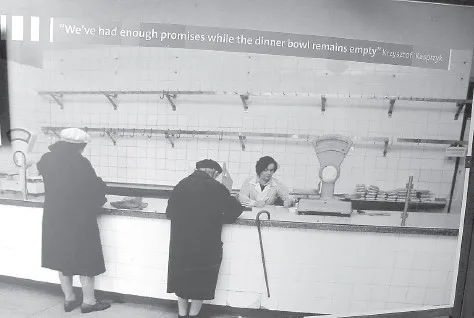
Source: A summer 2009 exhibition on communism at the Università di Roma “La Sapienza”
Figure 6.3: A picture from Soviet Russia showing a meat store with little meat available.
Social and Economic Restrictions Under Socialism
Under full socialism, the state declares all property its own. Its property can be used only as the state specifically directs, and for nothing more. Therefore, citizens of a communist country end up being complete slaves to the state. They are not allowed to travel beyond certain regions or to move to cities they choose. They are prevented from farming or selling for their own profit. In the U.S.S.R., the penalty for renting out a room in your home for profit was to have one’s home taken away. A New York Times magazine article recently touched on this point in regards to Cuba. The writer was documenting her trip with her mother and aunt to Cuba to visit her mother’s childhood friend. The friend’s neighbors had reported her for having houseguests, suspecting that she was renting rooms to tourists. Eventually the writer and her family, after waiting for hours in a government office, had to pay $200 to the government to stay at their friend’s home! After the writer expressed frustration at having to pay such a cost, her mother’s friend stated in all seriousness to her and her family that if they did not pay, she would “hang.”217
Even those who did nothing “wrong” were not safe from state punishment under communism. When the Soviet Union made a half-hearted attempt at private ownership in the 1980s, government bureaucrats simply found a new way to extract money from citizens; for as soon as someone started a business, they would be shut down until bribes were paid to the local party members.218 A person who was head of a large manufacturing business had one enemy in the government who accused him of accounting dishonesty. Instead of paying a bribe to settle the matter, the man proclaimed his innocence. Therefore, he soon found a team of government accountants who pored over his books for weeks until they found a very minor and accidental mistake. For this he was threatened with eight years in prison until he decided to pay off the prosecutors, judge, and bureaucrats. The judge still gave him a one-year suspended sentence.219
Another young man who heard that market activity was legal raised a pig, hoping to sell it for a profit. After months of carefully growing the pig, he took it to market where the health inspector immediately chopped off a third of the pig claiming that he was looking for worms. Then the police came and took the best pieces for themselves, without even a thank you. He then had to a pay a bribe to the market officials in order to receive a space in which to sell what was left of the pig. By the end of the day, he earned only enough to buy the bottle of Vodka with which he needed to drown his sorrows.220
Just like our half-socialist governments in the west, communist governments take additional wealth from their citizens through inflation.221 Communist leaders then respond to price rises in the same way as do our leaders: with price controls. But price controls lead to unprofitable production, which leads to a need on the part of citizens to evade the price controls. Thus, black markets develop. The government responds with harsh penalties for selling at these true market prices, instead of the artificial government-dictated prices. This leads to government spies, who cause the black market to become even more secretive. Thus, officials begin to rely on the citizens to become informers, and to rat out those selling or producing illegally (like the neighbor in Cuba above). But since it is difficult for people to convict their fellow citizens and send them to jail for several years for selling shirts or potatoes above a certain price, the government instead relies on tribunals consisting of government officials.222 Since the state owns everything, anyone who does act in a way that is not in accordance with what is dictated by the state is accused of “stealing from the state” or sabotaging the national plan. Punishment can range from several years in prison, to exile, to slave labor in Siberia, to firing squads.
Rule by Terror
Knowing that citizens are outraged at the way they are handled like animals, the state keeps its citizens highly repressed, so that they don’t have a chance to stand up for themselves. They are not allowed to speak or write their thoughts, and if they do, they are often killed. But they are in danger of this regardless because leaders are often not sure who might turn against them, and therefore have to kill entire groups of people in order to make sure they purge all dissenters. One is no safer as a member of the government. In order to stay in power, communist rulers have to rule with an iron first, and everyone is a possible enemy and target.
When the citizens of Ukraine rebelled against Stalin’s forcing them to be part of the Soviet Union, Stalin cut off food supplies. The starving who went to farm fields to take grain were shot dead on the spot. It became commonplace to see people lying dead from starvation on the sidewalks. Many were buried alive. Cannibalism became so widespread that the government printed posters which read, “Eating your children is an act of barbarism.”223 Eventually, seven million people, or one quarter of the population died.
Yet all of the terror and repression under full socialism is still claimed to be in the name of taking care of the people. Communist (as well as less socialistic) states usually call themselves a “people’s democracy” or “people’s republic” as though it exists to serve the people, even though the “people” have no choices or say-so whatsoever. The “common good,” in reality, ends up being only the “leaders’ good.” The individual is simply a means to the state’s ends. Indeed, the results are as good as can be expected under a system in which the government controls everything and the individual controls nothing, including his own daily life.
On a somewhat similar note, government ownership of companies in a non-communist society should be addressed here. Socialist commentators, such as Bill Maher of HBO’s Real Time with Bill Maher, ask what the problem is with state ownership of companies, since it means that everyone owns the companies. The discussion thus far should give the answer: if the state owns something, citizens get either less or absolutely nothing from it.
The Audacity of Defending Communism
I will not indulge in questioning why there are still individuals living in relatively free societies such as the U.S. and Western Europe who promote communism, and even go to the trouble to advertise their desires with such things as Che Guevara t-shirts. Though most of these people will claim communism has never been done correctly, in their ignorance they fail to see that it is impossible for it to be done without the very outcomes seen in every communist country. But what I believe should be discussed briefly are some general academic defenses of socialism.
More specifically, I would like to address some public responses which were made by anti-capitalistic commentators regarding the publishing of the book The Black Book of Communism: Crimes, Terror, Repression (abbreviated as BBOC henceforth) by Stéphane Courtois and other European researchers.224 The comments in question are those listed in the “criticism” section of the book’s Wikipedia entry.225 I believe the response to these comments will clarify common misconceptions many have of the supposed ills of capitalism.
Why would one bother to put themselves out in the public to defend communism? Barring those who live in the middle of the Amazon forest, any person living and breathing who has engaged in even slight research on communism is well aware of the death and destruction it caused, no matter what its supposed moral aim. Thus, I ask rhetorically, what agendas one would have in attempting a defense of it?
A recurrent argument throughout the criticism section is that many of the deaths under communism were unintentional. This is, shockingly, stated as though it actually makes a difference. Granted, shooting people in the head or torturing them to death is more evil than preventing them from being able to save their own lives from starvation, freezing cold, or incompetence (as when government officials accepted bribes from food vendors to permit them to declare their product radiation-free after the Chernobyl nuclear accident226). But this in no way diminishes the fact that allowing people to die, to forcibly prevent them from doing what is needed in order not to die, is itself evil. This is especially true considering that deaths were (and still are) occurring for decades under communism, although it had long been clear that preventing citizens from being free was what caused the deaths, in numerous ways. Especially after leaders learn the negative effects of their own actions, to continue with those same deathly policies is almost as brutally sinister as is murder. Defending communism by attempting to distinguish between the intentional deaths of millions and the “accidental” death of millions, both which result from aggression against citizens by their government, is sinister as well.
The fundamental cause of both the direct and indirect deaths under communism is the prevention of people to be free to act as they wish, as long as they observe the rights of others. With this in mind, we can immediately identify the flaw in another of the criticisms of the BBOC, namely, that many of the crimes, terror, and repression discussed in the book did not take place in actual communist countries, but under other types of regimes. It should be clear at this point that the title of a regime matters none — it is the actions which count. Though the United States is held to be a free country, government takes more control of the economy and people by the year. At the point that famines and overt murders of citizens by the U.S. government take place in an America where the state controls all personal production and exchange, it too should then be classified under full socialism, even if our flag of “freedom” is still waving. What constitutes the level of socialism is not a name; it’s the extent to which government has in fact socialized the country in question. Any famines which occur in today’s modern world can only be found to have taken place in a socialistic country — whether it calls itself socialist or not — where citizens are not able to produce, sell, or import food. This is true because a free market would have prevented such famine.
The most important criticism to address in the Wikipedia entry, made by socialist academic Noam Chomsky and others, is that the book fails to account for deaths made by capitalistic countries. In his ignorance, Chomsky audaciously identifies India as a capitalistic country. First, there is in fact NO capitalistic country in the world. Not one. There are those that are more and less capitalistic only. Every single country has some degree of government intervention in the economy. Every country, to some degree, prints money, confiscates incomes, regulates industry, subsidizes companies, prevents competition, or imposes price controls, tariffs, or quotas. Most countries, including the U.S., do all of these things to some degree.
According to The Heritage Foundation’s 2007 Index of Economic Freedom, India, overall, is 56 percent free, which means it is 44 percent socialistic (and that’s after many years of increasing economic freedom). The United States, in contrast, is 82 percent free. (These rankings will be discussed in detail in the next section.) Clearly India is not a capitalistic country — it is one in which some aspects of the market are free to function, but others are not. Not only is much of the Indian parliament made up of socialist and communist parties, but its constitution states that it is a “socialist secular democratic republic.”227 India, in fact, is a sort of poster child for many free-market economists; it is often referred to as an example of how an economy can stagnate and its people can suffer due to a lack of free markets.
After the 2009 Indian elections, a news report read, “The left-of-center Congress, ...has long tried to balance free market reforms with a vow to protect the downtrodden in this country of 1.2 billion people.”228 As is the case in the U.S. and other countries, most people will gloss over the part of the statement which says free markets were balanced with protection of the poor (a thing they’ve not been too successful with). They will pretend that this government intervention does not exist and does not have any impact whatsoever, and retain in their mind only the statement about free markets. They and the media, and leftists such as Chomsky, will simply call India (and America) a free-market, capitalist country. The fact is that the “balancing” is much more than even balancing, it is tantamount to handcuffs being placed on the marketplace.
But to the critic’s point, indeed, tens of millions of deaths have occurred in India. But these are the results of socialism, not capitalism. For it is the socialist part of the economy — that which prevents the market from working — to which we can attribute almost all of the deaths (to the extent that the deaths occurred as, say, a result of one businessman choosing to kill another or a citizen, it is due to the failure to adhere to free market principles). Similarly, deaths that occur in America from, for example, an absence of available healthcare due to the prevention of a free healthcare market, or in other countries from a war that our presidents initiate, can also be attributed only to socialism (i.e., government control), not capitalism. For under free markets, as we’ve seen, needed goods would be produced, and starvation would not occur, and diseases would be rare. Also, government would not have the ability to kill people or to prohibit, e.g., free exchange like healthcare services from being rendered. These things can only happen after a country’s citizens allow their governments to engage in harmful actions.
Similar to the comment about India being capitalistic, one critic argues that capitalism should be blamed for causing poverty in the world today. The argument is that millions have died (somehow) because of inequality which arises from capitalism.229 Though capitalism indeed brings inequality, the kind of inequality that separates the rich west from those starving in the dirt in Chad or Angola occurs because capitalism lifts nations up while socialism drags them down. Otherwise, the less equal poor in Chad and Angola would live, at a minimum, more like the “poor”230 in America. True poverty cannot occur under capitalism. Blaming world poverty on capitalism is like blaming a plane crash on the fact that planes have the ability to fly — the plane crashed precisely because it didn’t fly.
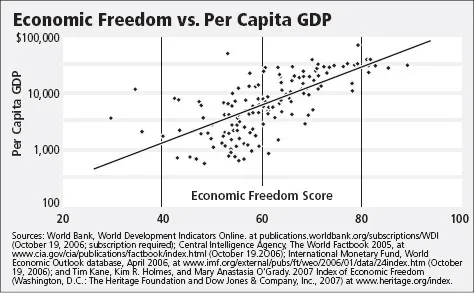
Figure 6.4: Economic Freedom and Prosperity.
Source: The Heritage Foundation and Dow Jones & Company
Economic Freedom in Various Countries
This chapter’s purpose has been to show the difference in how economies function with and without capitalism. In some cases we have seen where economies thrived because freer markets existed, and in others we have seen how economies collapsed when free markets were prevented. As a departure from examining economies in transition, it should be useful to compare economies that are freer with those that are less free, as they exist today, and have existed in recent years. To do this we will look at the relationship between economic freedom and standards of living among countries.
Two sources of information will be used for this purpose. The first is the Economic Freedom of the World Index, published by the Frasier Institute, and the Index of Economic Freedom, published by the Heritage Foundation and the Wall Street Journal. Both indexes, using 2007 data, assess the extent to which countries are economically free, as measured by variables such as the size of government, strength of the legal system, security of property rights, extent of inflation, freedom to trade, burdens of business and labor market regulation, and levels of corruption. Both indexes obtain statistics for each of these categories, listing them on a scale from lowest to highest, and then aggregate the individual statistics for each country so as to form an overall score.
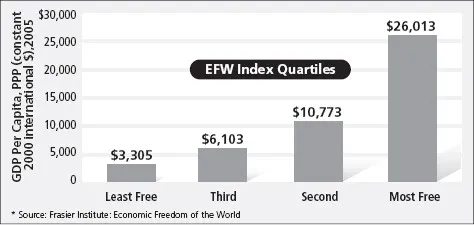
Figure 6.5: Purchasing Power for Countries Grouped by Quartile.
Source: Heritage Foundation: Economic Freedom of the World.
First, let’s look at the overall picture. Figure 6.4 shows the general relationship between economic freedom and prosperity. It reveals that, on average, the greater the economic freedom, the more prosperous countries are. Similarly, Figure 6.5 reveals the level of economic prosperity for different groups of countries. Specifically, it shows that those countries which fall into the top quartile of economic freedom have average incomes (purchasing power) of $26,013 while those countries in the bottom quartile have average incomes of $3,305.
The ten freest countries are as follows:
Economic Freedom of the World
- Hong Kong
- Singapore
- New Zealand
- Switzerland
- United States (tied for 5th-7th)
- United Kingdom (tied for 5th-7th)
- Canada (tied for 5th-7th)
- Estonia (tied for 8th-9th)
- Ireland (tied for 8th-9th)
- Australia
Index of Economic Freedom
- Hong Kong
- Singapore
- Australia
- United States
- New Zealand
- United Kingdom
- Ireland
- Luxembourg
- Switzerland
- Canada
The ten least-free countries are as follows:231
Economic Freedom of the World
- Zimbabwe
- Myanmar
- Democratic Republic of Congo
- Angola
- Republic of Congo
- Central African Republic
- Venezuela
- Burundi
- Togo
- Niger
Index of Economic Freedom
- North Korea
- Cuba
- Libya
- Zimbabwe
- Burma (Myanmar)
- Turkmenistan
- Republic of Congo
- Iran
- Angola
- Guinea-Bissau
There is obviously not enough space here to show the detailed results of each country in the indexes, but it should be helpful to see some examples of sample countries in the top, middle, and bottom of the economic freedom rankings.
The freest country in the world is Hong Kong, which comes in at 89 percent free in both indexes. Its top marginal tax rate is 20 percent (up from 15 percent in 1980); government spending as a percent of GDP is 18.3 percent; the government prints money at a pace of 5 percent per year; it has almost completely free ability to trade internationally; and it has moderate regulations on employing workers and operating a business (86 percent free from regulation). Hong Kong’s unemployment rate over the last 10 years has been 5.1 percent, and its GDP per capita is $42,000 (by comparison, the U.S. is $45,800).232 Hong Kong is known as a nation of stability. It was a British territory that was allowed to be a free trade port, and grew rapidly after WWII, based on policies of mostly free trade — one of the premier historical episodes of a country growing from poor to rich through engaging in capitalism. In the 1960s and 1970s, it was “Made in Hong Kong” (instead of India or China) that was stamped on so many American imports. As the country became more developed, it evolved into a services-based economy.
An example of a country which is halfway free is Argentina, which ranks 54 percent free on one index and 57 percent free on the other. Its economic profile is as follows: government spending as a percent of GDP is 20.9 percent; the top marginal tax rate is 35 percent (but 46 percent for payroll tax); it has a less than trustworthy legal system (46 percent free); money supply growth is 33 percent per year (33 percent free); international trade freedom is less than 60 percent; and freedom from business regulation averages less than 50 percent. In 2007 the country had an unemployment rate of 16 percent and a GDP per capita of $13,100.233
Argentina was one of the richest countries in the world at the turn of last century. Through the years the country grew into a welfare state, which, along with direct government intervention in the economy, caused it to decline. Argentina has been one of the famous “Banana Republics,” even though it is one of the more developed Latin American countries. It has had constant bouts of hyperinflation since the 1970s. Of its many economic collapses, the most recent was in 2002 when the government’s printing of money crashed the economy and caused the entire banking system to collapse.
Towards the bottom of the list of economic freedom is The Democratic Republic of Congo (formerly known as Zaire), which is ranked 29 percent free and 36 percent free. It is 53 percent free in terms of the size of government; marginal tax rates are 50 percent; there are virtually no property rights or reliable legal system; money supply grows at 2,290 percent per year; and businesses are 67 percent controlled by the state. The resulting unemployment rate cannot be determined due to a lack of reliable government figures, but is likely similar to that of Zimbabwe or Liberia, which have unemployment rates of 80 percent and 85 percent, respectively, and which have similar GDP figures and comparable economies in general. GDP per capita in the Congo is $300 per person.
From 1965 until 1997 the country was run by a dictator, Mobutu Sese Seko, who, like many dictators, gained power through a CIA-sponsored coup. He confiscated all property of foreign firms, often redistributing it to family members and friends. That, and the act of confiscating property from his own citizens both directly and through printing money, allowed Mobutu to build a wealth of $5 billion, the same as the national debt.234 The economy has retrogressed every year since 1989. The infrastructure is in shambles and industry represents less than 2 percent of GDP. According to the UN, less than 15 percent of the population has access to clean water, and malnutrition is widespread.235 Yet President Bush called Mobutu “our best friend in Africa,” and the Carter administration financially supported him in fighting off political rebellions aimed at removing him from power.
The Congo, like Argentina, is packed with natural resources, and should be one of the wealthiest countries in the world. But what counts is whether a country’s resources are managed profitably. Conversely, a country lacking resources would not be prevented from becoming wealthy. Japan, for example, with very few natural resources, became wealthy by importing various materials and assembling them into final products with its (then) cheap labor. Most of the newly developed Asian countries — not to mention Switzerland — also have few natural resources. But any country, no matter what resources, capital, or education levels it has, can become a prosperous country if allowed the freedom to become so. If citizens are given the right to own their property and are insured that it will not be taken by the state, they will find ways to produce and exchange for profit. A newly-free country starting with nothing can exchange its labor for foreign capital and for foreign knowledge of production techniques.
Most people think that a formal education is the key to prosperity, but it is not. Knowledge of literature, plays, geography, history, and the arts is useful, but does not produce goods. Too many countries have learned that throwing more and more money at traditional education is insufficient in itself. The important education — the one that creates an increase in prosperity — takes place in the factories and the fields. If a country is allowed the freedom, in time, knowledge, productivity, capital, savings, and wealth will all increase. Poverty, hunger, disease, insecurity, fear, and suffering will all decrease.
Some who read these words will accuse me of being naïve and of indulging in narrow ideological fantasy. I would argue that it’s the other way around. The United States, the U.N., IMF, World Bank, etc. — in other words, taxpayers — have spent hundreds of billions for decades to educate poor countries and to them give money, knowledge of production, and even to buy them factories, tools, and machines. We have had our best and brightest Harvard and Yale economists design and plan their economies. We have instructed their leaders as to exactly what must be done. It has all failed — in just about every single instance. On the other hand, there is not one example of a country whose people were allowed to be free — truly free — that still failed. Shouldn’t we try capitalism in third world countries once? Just once? Nothing else has worked for these poor countries, what could be the harm in letting them own property and run their businesses freely? If American politicians insist upon using government force to control other countries, they should at least use it in the way it was largely used in Japan, Hong Kong, and West Germany after WWII — by imposing freedom and free markets, not some bogus “democracy” that really consists of total government control. Iraq would be a great place to start.
Similarly, it is only freedom and free markets which will solve the problems that we face today in the U.S. It should be clear that government intervention in the economy does not work, but in fact multiplies problems — problems caused by previous intervention. Just as the Roman Empire slowly retrogressed over time, so could the United States. As we continue to tax and inflate away our wealth, and prevent our people and businesses from producing and selling as they see fit, we will surely continue to see lower real incomes (incomes not keeping up with inflation). As we destroy our capital and our productive capabilities, we will have fewer goods and innovations each year. It is highly possible that in 100 years from now we will live just as we did 100 years ago.
In contrast, imagine what life would be like today had the Roman Empire continued its economic growth with its advanced engineering. It was on the verge of an industrial revolution like the one which began in 16th century England. Had Rome experienced such an industrial revolution in say, 500 A.D., the world could have lived just as we do today — with automobiles, airplanes, washing machines, and cell phones — in 900 A.D. Instead, the world was in the middle of the dark ages. If the world was similar to today’s world in 900 A.D. or 1000 A.D., imagine what life would be like for us today. We would have an unimaginable standard of living! We would have to work 1/100 as long or hard to achieve 100 times our current standard of living. Currently, we expect our descendants to live 100 times better than we do in the years 2500 or 3000. But if we continually have less wealth in future years with which to build fewer factories and machines, our children’s children could wind up as our ancestors did after the Fall of Rome.
The Case for Legalizing Capitalism
Read the whole book online · Book details
This work is published under a Creative Commons licence. You may copy, share, and re-host it with attribution.