
Chapter 19 of 44 · The Case for Legalizing Capitalism by Kel Kelly
Chapter 7: The Morality Of Capitalism
The Morality of Capitalism
I have demonstrated throughout the previous chapters that capitalism results in prosperity while socialism results in poverty, destruction, and suffering. But since capitalism is clearly superior to socialism and benefits everyone who lives under it, why do so many people still support socialism, or some slightly attenuated form of it (American Democrats, social democrats, labor parties, etc.)? Obvious answers include ignorance and politics.
But another driving force in the advocating of socialism, especially among people who are thoughtful about moral issues, is the notion that capitalism is morally corrupt, while socialism is morally good. Their assumption is that capitalism is selfish because individuals are first and mostly concerned about themselves and profit instead of about their fellow man. But 1) are most people, including socialists, really concerned with others before themselves? And 2) even if people are concerned with themselves before others, does that mean that others necessarily suffer as a result? Let’s explore these moral accusations in detail.
Do Socialists Really Care About Others First?
But socialists and the supposed disenfranchised people — the interest groups that socialists seek to protect from abuse — themselves exhibit self-interest as much as anyone: it is because of their own self-interest that left-leaning unions want higher pay for themselves at the expense of the rest of society. It is due to self-interest that our supposedly high-minded political leaders, particularly Democrats in this case, who get votes by promising to help others, often engage in illegally receiving funds, gifts, or favors, or failing to pay income taxes.236
Self-interest is why so many homeowners support proposed legislation allowing the government to bail them out at the expense of other taxpayers; they are concerned with their own mortgages, not the mortgages of their neighbors. Those same homeowners, many of whom are Democrats or harder-core socialists, want to get wealthy through increasing home values, and don’t want prices to fall, even though it is precisely falling home prices that would help poorer families to be able to own homes. It is left-wing environmentalists who want government to prevent production and progress just so that they can get their green world at society’s expense and detriment. This is pure selfishness.
As another example: although socialists would not admit it publicly, they usually put time and effort into seeking a new job or a pay raise for themselves before helping others do the same — but, of course, they don’t mind voting for government to take money from the rich to help their fellow men in the meantime — and they don’t usually care about other people in general, just other “disenfranchised” people.
I live in an extraordinarily socialist part of my city, and the supposedly morally concerned citizens here are selfish enough to litter and leave dog droppings on public grass and sidewalks, to complain that neighbors in their condo building are “stealing” air conditioning by keeping their hallway door open, and to demand that the local zoning board prevent new apartment buildings from being built next to them so that they will not have to share the roads with more cars, lose the views from their living room windows, and have their property values threatened.237
Socialists despise self-interested entrepreneurs or other business-people because they see them getting rich. Probably, then, it is a kind of envy that makes them want to compel the rich to be interested in others in that they (the rich) are forced by government to give the socialists or socialists’ interest group their money.
Socialists should accept the fact that, absent exceptional circumstances, we all care about ourselves and our families first, and others second. But most importantly, socialists should recognize that under free markets, in pursuing our own self interests, we inevitably help everyone else. Under a government manipulated economy, as the examples from the last chapter show, this is not the case. Knowing that those who are successful in getting rich do so by providing needed goods, services, and jobs, and lower prices to others in the process tells us that what socialists should be concerned with are outcomes, not the means of achieving the outcomes. If so-called “greed” results in lifting up all of society, but the “concern for the common good” does the opposite, should we not accept the seeming paradox that greed is good?
Capitalists Are Not Greedy, You Are
The term greed is used by socialists to deride people or companies for both 1) becoming wealthy in free markets wherein wealth could not have been gained without having created much more wealth for the rest of society, and 2) causing the economic problems that are in reality caused by the government leaders the socialists voted for. The word greed is used in the former case merely to express jealousy for actions which involve nothing negative or shameful, and in the latter case to assign blame to those who socialists wish were guilty, even though they have no idea who is really at fault.
Both greed and wealth are relative terms. The word greed, defined by Merriam-Webster dictionary as “a selfish and excessive desire for more of something (like money) than is needed,” shouldn’t even be part of our vocabulary for the most part. Who is to say how much is “needed”? People usually argue that a rich businessman does not “need” billions of dollars, or does not “need” millions of times more wealth than the average person has. But why not? After all, the average person today has millions of times more wealth than the poor in many countries. Those poor would look at us and say that we don’t “need” mp3 players, trips to Disney World, three bedroom homes instead of two, or two family cars (or even one). Three hundred years ago no one had such things. Why do we have and need them now? But had you been a commoner back then, you would have said that the King did not “need” all his wealth; but most today live better than did kings back then, even if we don’t have as many physical possessions. When future generations live like millionaires do today, they will say that those who have a trillion dollars (instead of tens of billions that the richest have today), do not “need” it, but will defend their own “need” for living like a millionaire does today. It’s all relative.
The fact is that most of us largely rational human beings are never wholly satisfied. Given the opportunity, we would all like to have more food, more clothing, more or bigger homes, more vacations, a nicer or more elegant automobile, or more dinners and drinks out with friends. My mother has said, as so many people do, that she has everything she needs. She does not want a bigger house or a boat or a newer car. Yet she decided not to travel to Europe last year because of the falling dollar, not to redecorate her out-of-date home, not to buy a separate utility vehicle for running errands — all because these things are too expensive. Though she claims she doesn’t need more wealth, it’s clear that she would enjoy her life more if she had certain things that wealth could buy. We should therefore understand why Donald Trump “needs” five houses, Paris Hilton “needs” a $500,000 clubbing budget, and I “need” an apartment in Paris. These things make our lives more enjoyable.
This is not at all to discount the happiness that comes from spiritual, emotional and cultural experiences; but such things are outside the scope of this book, the subject of which is economic. Although money does not always buy happiness, it often does. It may not solve all our problems, but it sure can solve many of them. It can definitely buy us safety and security for the most part. And once we have our basic needs, money can buy us relaxation, pleasure, entertainment, and a focus away from our worries. It can even get us out of prison in a third-world country (via bribes) after partying too hard and being arrested for drunken tirades towards police officers. Whatever other problems we have in our lives, money can make things better. The more money we have, the more we can enjoy ourselves.
What about corporate “greed”? Again there is no such thing: don’t confuse greed with theft or mismanagement. The actions of Bernie Madoff, Jeffrey Skilling, Ken Lay and the like are actions of thieves — like those of a burglar, scam artist, or mugger. These are actions which are against the laws of capitalism.
Materialism and Money
People are always claiming that the world is too materialistic, and that capitalism promotes this materialism. Yet, enjoying material goods is not a bad thing — it’s a fantastic thing! Indeed, we care about material things because they enrich our lives by either making each day on earth less challenging or more entertaining. But that does not mean that society cares more about, say, new clothes from Dolce and Gabanna or a nifty gardening tool from Home Depot than it does about spiritual beliefs or the well-being of other people. Besides, material goods can make better off our family or others in society we care about. A family member might benefit from a new medical device or new shingles for their leaking roof; a poor family could certainly benefit from new shoes or a new home (and the more we build, the more affordable these things are).
Socialists in particular are hypocritical when they say that people or society in general are too focused on both money and material things. They state that they need only so much, and the rest of us should need only so much as well. But as much as they want to help the poor, we seldom see them willingly giving up considerable amounts of their own money to send to others around the world who are poorer than they.
There are signs all around us that prove people want more “money.” The constant call for better working conditions in some countries, or more and better homes in others reflects the need for more capital, or money. And the fact that even though we live better today than previous generations, most people still want higher wages relative to the “rich,” shows that human wants are practically unlimited, and that we can always make further improvements.
Obviously, then, we want more money in order to have more things. Money is the medium of exchange we use to obtain the quality of life we desire. Money buys beer, mattresses, dental floss, medicine, movies, toothbrushes, computers and software, and trips home for Christmas with family.
To have more of these things we need to earn more money. But socialists believe making high incomes is wrong, if “high” means considerably higher than others make (and only socialists can truly tell us how much of an income is too high). But according to their own altruistic beliefs, they should see that high incomes are good: higher incomes only come about from providing more things to others that they need. The greater a man’s income, the greater has been his service to others. Therefore, were one to take a lower, more modest job and income because they believe it’s wrong to take a higher one, they are acting selfishly, and not serving their fellow man by providing him things he would like to have (remember that salaries are in accordance with the value of what one produces).
Even if socialists truly want to have fewer things, they have no right to make everyone else in society have fewer things by employing government force for these purposes, as they currently do through regulation, taxation, and other intervention. So then who should decide how much we work and how many things we produce? We all should, individually. Our own actions will reveal how much we want to consume and therefore how much should be produced. For all the complaints that Americans do not have as many government-mandated holidays that force companies to give employees more time off, the fact is that people can choose to work fewer hours and settle for having fewer material goods if they want to.
If we choose to consume less, market prices will reveal this, and production will therefore also decrease. Also, the price of labor corresponding to various amounts of production — the level of salaries being paid — will in turn help us determine how much we want or need to work. High wages might give us incentives to work more and earn more money, or they might give us incentives to work less, since we can maintain a particular lifestyle by working fewer hours in order to achieve it. We will each decide which case applies to us individually.
The Immorality of Democratic Voting
Businesspeople, if they are successfully “greedy,” become rich by providing their fellow citizens (i.e., consumer) with things that make them better off. In other words, they have to earn it. But many who espouse that people don’t need more than a basic level of existence, in their own greed, constantly vote for politicians who will take money from others and give it to them. They, just like the businessman, want more than they currently have. But instead of earning it as the businessman or capitalist does, the socialists steal it from those who have more. The businesspeople’s actions are moral (unless they earned their money by theft or by being given privileges by government), while theirs are not.
The sad fact is that this is exactly what our political system — democracy — is all about. It is a system where the masses, those with less money than the minority group that has great wealth, vote for politicians who offer to take money from the wealthy minority and redistribute it to them in return for giving the politician their votes. Voting wealth out of the pockets of those who have it is socialism, because it is for done the “common good,” for the benefit of helping that part of society which earns less. This is why Democracy has been likened to two wolves and a sheep voting on what to have for dinner. This is also what is known as “social justice.” Politicians are simply people who learn to be good actors in order to win your vote. They ultimately care little about real progress for the country or the lives of individuals; they care about their political careers.
Wealth redistribution, therefore, is theft. It is the taking by force from one group in order to give to another. Force is involved because anyone who fails to pay assessed taxes — confiscatory taxes that mostly go directly into someone else’s pockets — will be put in prison. People from whom money is taken have not usually voted for this action,238 but those who wanted to receive others’ money usually have voted to take it from them. Many socialists will dispute this and argue that most people want to pay the amount of taxes they pay. This implies, for example, that when the government doubled the tax rate during the great depression, people, coincidentally, simultaneously wanted to voluntarily pay double the amount of income tax. It implies that when marginal tax rates reached 90 percent, people truly wanted to work and hand over 90 percent of their marginal earnings. The argument is too weak to take seriously. Besides, if most people want to pay all the taxes they pay, socialists will have no problem switching the payment of taxes from being required by law to being voluntary.239
Wealth redistribution does not involve only social programs such as welfare, Medicaid, and Medicare. It involves any occurrence of one party receiving money, physical goods, or services, that they did not pay the full cost of, but that another party did, on their behalf. For example, public transportation involves wealth redistribution because most who use it did not pay for the bulk of the cost. Even though they contribute by purchasing their tickets, the ticket is highly subsidized because wealthier taxpayers fund most of the cost. Similarly, National Public Radio is a wealth redistribution program (mostly from the rich to the middle class). Many who listen to it paid taxes towards it, but many of those who do not listen also pay for it, and often pay more. If NPR is a viable business that would have enough people wanting to use it, it would be profitable on its own without government funding. If NPR could not survive without the government, it is a loss-making enterprise that is consuming wealth. That wealth could instead be used for profitable ventures, which would better serve society. We can see from this last example that only by having profit and loss statements can we determine whether a product or service is something consumers really want to have. There are never any profit and loss statements associated with anything the government operates, so we do not know which services are really beneficial in economic terms.240
Most of the taxes paid in the U.S. (and most countries) are paid by a small group of people, the rich. In 2005, 53.7 percent of all income taxes in the United States were paid by those earning over $200,000. Those earning between $100,000 and $200,000 paid 28.3 percent of all taxes. This means that 82 percent of all taxes were paid by those earning over $100,000.241 Those with incomes below $40,000, in total, paid no income tax: their tax liability was more than offset by the tax rebates from the Earned Income Tax Credit. In other words, many receive money (from the rich) “returned” to them for taxes that were never paid.
Further, most taxes do not go towards essential government services such as road infrastructure, parks, education, the legal system, or police and fire departments — they go directly into other people’s pockets. No more than 10 percent of the 2009 Federal Government Budget goes towards these essential government services (and most of these services are taken care of with separate state and local taxes). More than 65 percent of the budget goes towards social programs or some other type of income support or assistance. (Most of the remaining portion goes to fund our wars, or, “national defense” as it’s called.)
Many claim, without an understanding of what’s really happening, that somehow the rich take money from the poor. The facts show it is quite the other way around, considering the following numbers. According to a detailed report242 by the Tax Foundation,243 in 2004, the bottom 20 percent of all income earners received $8.21 in government spending for every $1.00 in total244 taxes they paid (and $14.76 for every dollar of federal taxes paid). The middle 20 percent received $1.30 for every $1 in taxes paid. But the top 20 percent of income earners received only $0.41 for every dollar of taxes paid. (Though they don’t give the figures for the top 5 percent of taxpayers, who pay almost 60 percent of all taxes,245 their receipt of government spending, by logical deduction, must be below $0.05 or less for every dollar they pay.)
In dollar amounts, households in the lowest-earning quintile in 2004 received about $31,185 more in government spending than they paid in taxes, while the middle quintile received $6,424 more than they paid. The top quintiles, however, paid $48,449 more in taxes than they received in government spending. In the aggregate, the top 40 percent of income-earning households paid roughly $1.03 trillion more in total taxes than they received in government spending, while the bottom 60 percent received $1.53 trillion more in government spending than they paid in taxes (the difference being the amount spent by government in excess of what it brought in — an excess mostly financed by the future top income earners). This is wealth redistribution.
We can see from these statistics how absurd is the phrase “tax breaks for the rich.” The rich do indeed benefit most from tax breaks because of the fact that they pay most taxes. Tax breaks are the giving back to the rich some of the money that was previously taken from them. Yet socialists call this redistribution from the poor to the wealthy! In other words, if the poor aren’t allowed to receive as much of others’ incomes as before, and the rich are allowed to keep more of their income, then, in the eyes of socialists, the rich are taking from the poor. This is like saying that a thief who must return a woman’s purse after getting caught stealing it is redistributing money from himself to her.
When the government imposes taxes on the rich or less rich for the purposes of giving the money to another it is no different than taking his car, house, farm, or individual possessions. It is often the case that people who inherit property from deceased family members, even property that has been in their family for generations, have to sell the property just to pay the taxes. They really do lose their physical property. Even when taxes are taken straight out of people’s salary, the monetary income taken could instead have been spent to buy physical goods or assets. It is family property that will never exist but would have otherwise.
What is the morality of forcing wealth from those who have it to those who have less? How is it that people are outraged when a CEO steals from his company, or a street thug steals a car, but they are not upset with themselves and their poorer neighbors for stealing from those who rightfully earned more money than they? Indeed they actively support such theft and vote for more of it! I conclude that society does not really care about morals. They care about what’s best for them, defining terms in different ways in different situations, to fit their own personal or ideological agenda. Socialists condemn the businessman who becomes rich by pleasing others and providing jobs for workers and who harmed no one else in the process. But socialists claim that workers (and non-workers) who were paid the full value of their work by the businessman but still choose government force to make him pay more, are innocent, righteous, and deserve “social justice.”
As a reminder of why businesspeople take nothing from others but simply benefit from creating wealth for them, consider the fishing net example from Chapter 1. If an island businessman creates a fishing net, he is able to reap the reward of more fish (more wealth). If he sells the net to others, he becomes wealthy by exchanging fishing nets for money (which exchanges for wealth). With others having a net, too, they can have more fish at lower prices (fewer hours of labor). Plus, those who help the fisherman make nets get paid wages in the process. The businessman creates wealth for everyone without taking from anyone in the process. Everyone benefits!
When people elect politicians who make campaign promises to interfere with the marketplace, they implicitly instruct government to take control of private companies. Businesses of all sizes, whose owners voluntarily went into business to bring us goods and services in order to make a profit then become slaves to society because the government, representing the people, dictates to companies how much to produce, what it must produce, what is not allowed to do, what prices it must sell above or below, what materials it is allowed or forced to use in production, and how much of its income must be sent to other people or companies.
Suppose your family decided to start a business. You invest time, sweat, money, and opportunity costs in creating a new product or service. Your company’s product did not previously exist, but you made it available for others, without harming or forcing anyone to exchange their income for the product. After some years, your product becomes so popular that your family has now become wealthy through voluntary exchange. Others, who engage in forceful, not voluntary, exchange, in their jealousy, use the government to regulate you. They force you to sell part of your company to your competitors (anti-trust legislation) who are not able to compete as efficiently and effectively; they force you to pay your workers more than you can afford (union legislation); they force you to sell your product for a lower price than the market demands and for a lower price than you would like (price controls); they force you to produce in a way that pollutes less but raises your costs and reduces your output (EPA legislation); they then impose a “windfall profits tax” because they think you’re earning too much money this year. Your company started out being your private property that benefited society, but then society — through government regulation — took control of it and sucked it dry. Now your family earns less, your workers earn less, and less of your product is available to consumers, and at a higher price. The consumers got what they voted for. Voting for the government to improve one’s life almost always results in the opposite.
In 2008, congresswoman Maxine Waters threatened, on behalf of “society,” to nationalize (i.e., to steal) the privately owned companies in the oil industry246 due to the “large” profits they were making, since oil was at the highest price in years. But Congress itself brought about the high profits by 1) sanctioning the printing of money by the Fed (increased demand) and 2) preventing new oil drilling and refining (reduced supply). One hundred fifty years ago, oil was a worthless substance. Companies voluntarily extracted and refined it, and made it useful, significantly improving our lives in the process. But by threatening nationalization, the government now threatens to take away the property of the millions of individuals who own these companies, by force, against their will. Americans should have been shocked and aghast that this government threat could happen in their own “free” country; instead, most agreed with her sentiments. If this is moral, then virtually anything could be argued as being moral.
The Delusion That There is Need for Wealth Redistribution
While many socialists think there should be some particular way to “distribute” “society’s” wealth, there is no such thing as a stock of ownerless goods that need to be divided. Goods and services come into existence as somebody’s property. If they are to be distributed, one must first confiscate them from their rightful owners.247
Most people incorrectly believe that there is a limited and unchanging amount of wealth in the world. Based on this, they fear that the rich somehow steal too much of it for themselves, and that government should be used so as to redistribute part of the wealth to those who “deserve” it. But there is not a definite and unchanging amount of wealth. There was originally no wealth in the world. When the first cave men created the first clothes, set up the first cave homes, and collected the first food to eat, wealth was first created. As time passed, and men built homes, transportation, tools, food, and other necessities, along with goods for pleasure, more wealth was created. Today, our wealth is produced in (and partially consists of) factories, mills, mines, and workshops. We literally create more every year (or did until recently). Those who invent, design, direct, fund, and risk their savings and careers to produce this wealth are the ones who naturally get compensated for doing so. In the process, these people appropriately compensate workers for the amount they produce. But the incomes the rich receive in this process are earned by them by having created something that did not previously exist; they created their own wealth, they did not take it from someone else. Thus, in free markets, the rich can never, ever gain at the expense of anyone else.248
There is, therefore, no need for a societal question of “how to distribute the wealth,” as socialists claim. Under free markets, the wealth is allocated efficiently to each of us in proportion to how much of a role we had in creating it. Some workers, such as programmers, marketing executives, inventors, and entrepreneurs, have skills and knowledge that allow them to produce many times what others are able to produce, and are in higher demand. Lower skilled workers, such as manual laborers, clerical staff, operators of industrial machines, and repairmen, are greater in number, and have fewer skills and knowledge; thus, they contribute less to wealth production. They are, however, due to market forces, paid for every bit of the value that they help produce, and they constantly have more wealth created for them.
Because some are capable of producing more than others, they are compensated more than others. But since what everyone is engaged in is increasing the supply of goods, everyone’s wealth is increasing (or at least it would under free markets), since almost all prices are then falling in real terms, and even in nominal terms when inflation does not exist. In fact, even those who produce nothing gain from this process because things they buy cost less each year (in actual prices if money is not being printed, and in real terms if it is being printed). Businessmen make even the non-workers better off!
And without the rich — the businesspeople, entrepreneurs, and capitalists — workers would have no work to do or salaries to earn. Wealth creation is a partnership between the “poor” and “rich,” between the workers and businesspeople.249
Imagine what would happen if all businesspeople and rich capitalists ceased to exist tomorrow. Workers would have no offices, factories, or distribution centers to go to for work, as they would all be gone since they are the property of the capitalists. These workers would also have no more salaries. There would be no way to produce anything, except by self-producing at home and trading with neighbors. With the rich and their capital gone, standards of living would plummet.
No matter how hard workers might try to replicate the offices and factories the businesspeople and capitalists had previously built, they would not be as successful because if they were as successful as were the previous-existing rich individuals, they would have already out-competed the rich to begin with. The rich give us poor and middle class our wealth — they don’t take, they give.
If we will agree to let the wealthy earn many more times than the less wealthy, since they create many more times more wealth, we will still have their factories, offices, and tools — their capital — with which to keep producing. The more wealth we let them keep, the more of it we can use in order to produce for ourselves. For this, we only have to allow them to receive interest payments, in the form of profit, interest, dividends, and draw. Most of the wealth of the rich is always distributed among workers; the rich simply retain formal ownership.
The Flawed Notion of “Giving Back to Society”
We hear constantly about the need to give back to society. But it does not seem that people think through what they are advocating when they propose this idea. The concept is naturally aimed predominantly at successful people; and the rich in general. But the rich should not feel obligated to “give back” anything, since they already give the most. They are the ones who pay the most taxes, and are therefore the ones who mostly provide society with roads, schools, colleges and universities, public parks, libraries, museums, armed forces, police, fire departments, football stadiums, public transportation, welfare, Medicare, Medicaid, and other government institutions and services. They are the ones who give massive amounts of donations to charities, universities, and other private institutions, separately from the amount they give through forced taxation. They do all this in addition to funding our jobs and producing our goods and services. How, then, can it be that they need to give back? It is the rest of society who should give back to the rich.
Who is society anyway? Isn’t it you and me, all of our friends and family... and the “rich”? Aren’t we all society? If we are, then don’t we all make success possible? Therefore, shouldn’t we all keep our money since we all contributed? If our taxes are to be paid to society, then who exactly comprises society that will receive it? We all do. So why should we pay ourselves to compensate ourselves for making it possible for ourselves to be successful?
And the rich should not pay more in giving back to society because it was not society (i.e., the non-rich, as it is implied) that made it possible for the rich to have more success than the rest of us. This weak argument basically reduces to the unfair belief that simply because one is rich, one has to “give back” (i.e., “give”) to “society.” And somehow, the rich are not members of “society.” The notion that the rich should pay disproportionately more in taxes presupposes that even though we each had the opportunities to succeed, those who are more successful should pay the rest of us who were less successful even though the successful ones made success possible just as much as the rest of us made it possible? Obviously, the whole thing boils down to having those who were not as good at creating wealth for themselves and for society wanting to take from those who were better at doing so. The rich, along with the rest of us, should give charity and donations to those in need, but it should be done voluntarily, not by government force.
Obviously “society” (the non-rich, as it’s implied by socialists) does not provide the opportunity for success since it does not fund the federal, state, and local government institutions listed above. Society, for the most part, provides neither our wages nor goods available for our purchase. The rich entrepreneurs, investors, businesspeople, and capitalists provide those things. What does “society” provide? Members of “society” are net receivers of wealth and government services which are paid for by the rich. The only thing “society” provides is the relative freedom (relative to not being free at all) to produce and exchange and operate a business as one pleases, based on society’s voting to elect rulers who allow this relative freedom. Without this freedom, no riches could be had (except, of course, what the king, dictator, or commissar, who would otherwise rule society, would take for himself through forced labor).
How Anti-Inequality and Anti-Poverty Policies Cause Inequality
The desire to create equality is itself a major cause of rising inequality. The expansion of credit by the central bank, the primary purpose of which is to fund government spending on wealth redistribution,250 is a primary driver of sharply rising income disparities between the income classes.
In a free market, those who save would increase their wealth more rapidly than those who don’t, because they would be earning a rate of return on their saved incomes. But their increased incomes, on average, could only be in line with the going rate of economy-wide profit (about 5–10 percent per year). There could not be a class of people who pull away from the rest of society by such a large degree as exists today.
But the incomes of rich savers rise disproportionately today due to the central bank’s credit expansion. As the Fed prints new money, a significant amount flows into the financial markets, pushing the prices of stocks, bonds, and real estate, among other assets, higher and higher. Because of changes in the financial system structure, this disproportionate increase in incomes from investments in financial assets (as opposed to income from wages) exists to a larger degree in the last twenty, and especially ten, years.251 The rise in the value of these assets has far outpaced the rise in wages paid to workers since more money, proportionately, has flowed into pushing asset prices higher than has flowed into the real economy to push wages higher. Since most people on the wealthier end of the spectrum hold a substantial portion of their wealth in these assets, their total incomes rise faster than those of average wage earners, who hold much less of their wealth in financial assets. Thus, this asset inflation created by the central bank makes the incomes of the rich outpace the rest of society.
CEO salaries rise for similar reasons — newly existing money pushes them higher. Companies borrowing newly created money have increased buying power with which to bid a higher price for a new CEO or to keep their current CEO from going to another company that is looking to pay higher CEO wages with their new money from the central bank.
While incomes of the rich continue to rise, workers’ wages are increasingly reduced by salary deductions employers are forced by government to withhold. Costs such as social security contributions that are deducted from paychecks have increased through the years, lessening workers’ take-home pay. The same phenomenon applies to other costs imposed on companies, some voluntary, but most of which are mandated by government. Costs for such things as workplace gyms, health insurance, daycare services, family leave benefits, OSHA requirements, environmental regulations, workers compensation, licenses, permits, and all other regulatory costs constitute costs deducted from wages. Since there is only so much money a company has to spend, any amount spent on costs other than capital goods and labor are amounts deducted from what is spent on capital goods and labor. Business spending still increases through time along with increases in the money supply, but less of the spending makes it into the take -home pay of workers.
Spending on government social programs and any other redistribution schemes also lowers wages. Any money that is taken from businesses — directly through business taxes, or indirectly through personal and inheritance taxes — is money that would otherwise mostly go specifically to paying wages (along with purchases of factories and machines) during the same time period (and if the money were paid out as wages instead of as free money for individuals to consume, the payments would be repeatable). Taxes do not come out of profits — companies will make sure to maintain their rate of profit or else they cannot afford to stay in business. Thus, taxes come out of productive expenditures, or, the money that companies would otherwise spend on wages and capital goods.
A last point is that minimum wage and pro-union legislation cause inequality in a slightly different manner. Those who are knocked out of the work force due to these laws obviously receive no wage income, but those who remain employed share all of the income that is available to be paid out in wages by companies. The salaries of the employed are elevated because were it not for the unemployed being so, the unemployed would receive part of the wages being paid out to those who are not unemployed.
The Poor
Socialists commonly cite the existence of the poor as a reason for socialism, and they claim that their concern for the poor shows compassion and morality. Since the topic of poverty is a key battleground in the war of socialism versus capitalism, it is relevant to examine what poverty is, how much of it exists in the U.S., and how we can truly eliminate it.
Who Are The Poor?
When we hear of the poor, we envision a massive group of people without food and shelter. In reality, most of the poor in capitalistic countries such as the U.S. are not in such a state. Data from the most recent census reveals that of the official “poor”:252
- 76 percent have air conditioning
- 66 percent have more than two rooms of living space per person
- 97 percent own at least one color television
- 62 percent have either cable or satellite television
- Almost 75 percent of households own a car (30 percent own two or more)
- 73 percent own microwave ovens
- More than 50 percent have stereos
- 33 percent have automatic dishwashers
- 99 percent have refrigerators
- Virtually none lack running water or flushing toilets
- 46 percent own their own home, the average of which is a three bedroom house with 1.5 baths, that has a carport and porch or patio, and the average value of which is 70 percent of the median American home
If we observe our presumably poorest citizens on our public transportation systems we see that they have cell phones, adequate clothing, personal audio devices, and are generally clean and free of disease and deformities. They also have the comfort of using a heated and air-conditioned transportation car that has carpet and flat-panel televisions for their amusement (paid for primarily by the wealthy, of course).
If you were to compare these American poor to the poor in Bolivia, Honduras, Cambodia, or India (or even to many of the poor in Mexico, Romania, Thailand, and Russia), you would see a stark difference. The poor in these countries often literally live in open-air huts with large leaves for roofs and stacked bricks that serve as a shared stove for multiple families. For the poor of the third world countries, there is, for the most part, no money, no exchange of goods — just basic survival by subsistence farming or by hunting or fishing for food. To these people, American street sweepers and factory workers live a life of luxury.
The difference between the “wealthy poor” in capitalist countries and the “deprived and desolate poor” in non-capitalist countries is no coincidence. The freedom that exists in capitalistic countries results in more invested capital per worker. This means that workers can produce far more wealth for themselves and for the rest of society. In non-capitalist countries today (and in the days before capitalism first appeared) poverty really means that no work is available; there is no means by which to improve one’s state of being, or even to maintain it. Under capitalism, as we see, there is almost no question of poverty existing in this sense. Anyone who is not mentally or physically disabled can perform work and earn an income if they choose (except when prevented by the setting of minimum wages by government). Today, any poverty in the world is caused by an absence of capitalism, not the existence of capitalism.
Though the poor in this country have continuously seen their standard of living rise by capitalism, anti-capitalists continually point to the poor as evidence of a need for wealth redistribution (i.e., less capitalism), just because the poor earn less than do the rich. But there will always be a bottom 10 percent or 20 percent of the population in income in any society no matter how wealthy we all become. Thus, politicians and socialists always have a group to point to that are always in need of “assistance.”
But even if we focus on the bottom 10 percent or 20 percent of Americans, it would still be difficult to identify who the poor are, because the composition of this group changes constantly. The “disadvantaged,” the group that is supposedly made poor by the rich, are not a static, defined group. A study by Michael Cox and Richard Alm of the Federal Reserve Bank of Dallas showed that of the bottom fifth of income earners in 1975, only 5 percent were still poor 16 years later. Less than 1 percent remained in the bottom fifth for the entire 16 years. Thirty percent rose from the bottom fifth to the top fifth. In sum, few people remain at subsistence level. There are ways out of poverty for most.
Not to diminish the pains and difficulties of poverty, but in terms of the ability to achieve an absolute level of health and strength, the “poor” are usually in the same shape as the average person. Poor children take in virtually the same amount of protein, vitamins, and minerals as middle-class children; and they actually consume more meat. Most poor children grow to be larger, stronger, and healthier than the average WWII soldier. Though some poor families have temporary challenges with hunger, 89 percent of the poor report that their families have “enough” to eat; only 2 percent say they “often” do not have enough food.253
Further, the poor are not as poor as government statistics intentionally misrepresent. For example the ratio of “incomes” — the primary measurement used by government — of the top fifth to the bottom fifth of income earners is 15 to 1, but the ratio of their consumption is 4 to 1. This is because the poor usually have access to money that does not fall under taxable income, including government handouts. Their assets and wealth are not considered at all. The census bureau previously stated that people it deems “poor” typically spend $2.24 for every $1.00 in [government] reported income.254
Though there are indeed people who are in dire straits and need immediate help, most of the people we generally call “poor” are not as poor as anti-capitalists make them out to be. Depending on whom they are compared to, the poor can appear to be outright rich. Socialists make it appear as though there are many more poor people than there really are, so as to justify stealing more money from the rich to try and “equal out” society. When we speak of the poor, we should only speak of those who are physically unable to work and provide for themselves, not the entire bottom 20 percent of income earners who represent tens of millions of people.
More on the Minimum Wage
It was explained in Chapter 1 that the minimum wage raises labor costs to the point where companies cannot afford to hire all the workers they previously did, since they have a limited amount of funds available with which to hire workers.
Even ACORN, the organization that claims to help the poor by, among other means, promoting a “living wage,” learned this first hand.255 ACORN sued the state of California in 1995 for exemption from state labor laws, in order to avoid having to pay the minimum wage to its own employees. The organization argued before the court that “the more that ACORN must pay each individual outreach worker — either because of minimum wage or overtime requirements — the fewer outreach workers it will be able to hire.”256 (As a comparable example, esteemed minimum wage advocate Nancy Pelosi also refused to pay minimum wage to her own workers.257)
But besides the fact that the minimum wage cannot truly help low-skilled workers earn higher salaries, it’s not needed in order for them to do so anyway. Low-end wages, just like high-end wages, will increase through time as increased capital accumulation brings about increased productivity, and especially as workers improve their skills. For example, wage rates for minimum wage employees grew at more than five times the rate for those earning above minimum wage between 1998 and 2002. Nearly 66 percent of all minimum wage employees who remain employed earn more than the minimum wage after one year of employment.
Since most of the low income earners are newer workers starting out and acquiring skills that will enable them to eventually earn more money, over 97 percent of all employees in the U.S. earn more than the minimum wage by age 30. Those who do not achieve this rate of pay do not acquire the needed skills for one reason or another; the explanation likely has to do with mental illness or personal motivation. Just about all workers can progress by remaining employed and gaining experience. But those who are forced into unemployment by the minimum wage often never get the opportunity.
And contrary to what ACORN, our politicians, and other socialists would have you believe, it is not usually the case that minimum wage earners are single mothers raising children. The 1995 Current Population Survey showed that of all workers earning the minimum wage immediately prior to President Clinton’s 1996 increase of that wage, 37.6 percent were teenagers living with their parents, 17.1 percent were single adults living by themselves, and 21.5 percent were adults married to a spouse who was also employed. Only 5.5 percent of workers earning minimum wage were single parents, and only 7.8 percent were married but still the sole family wage earner.258
The Failure of Anti-Poverty and Wealth Redistribution Schemes
Our government has been “fighting poverty” for most of the last century. Tens of trillions of dollars have been spent. Yet success never comes. When it becomes apparent that “poverty” is not being eradicated, our politicians throw yet more money at the supposed problem. The increased money comes from our increased taxes (including the inflation tax).
Original tax rates in this country were 0 percent. The first official income tax appeared in 1913 with the passing of the Sixteenth Amendment.259 It was a rate of 0.4 percent — a rate that Congress deemed “fair.” The original marginal tax rate on the super rich was 7 percent. It eventually reached a peace-time high of 92 percent (Sweden reached an unbelievable 102%). Once our effective tax rates reach 100 percent, we will effectively be a communist country.260 Year by year, working persons have had to pay a higher proportion of their incomes for their own compulsory “insurance,” or to support other people. But year by year there are still more people in need of government support. This is partially because as more people understand that incomes can be had without working for them, more people position themselves as poor so that they can receive benefits. No matter how much money is thrown at the problem, there will always be both the government-defined poor as well as the natural non-disability poor; there will always be people who choose not to better themselves, due to various psychological or mental desires to remain in their current state.
Yet any attempt to equalize people by redistributing wealth must result in a destruction of capital and of the ability to create jobs and prosperity, and thus reduced incomes. Even Leonid Brezhnev, First Secretary of the Soviet Communist Party, stated that “One can only distribute and consume what has been produced; this is an elementary truth.”261 What he failed to learn, as history shows, was that only the protection of private property and free markets can bring about the coordination of people and physical resources in a way which increases the production of wealth, while government economic planning and forced redistribution reduces production.
But besides the fact that so-called poverty will never be eliminated simply because at least one person will always be poorer than all others, politicians have a vested interest in preventing the alleviation of poverty. If Americans are fully employed and earning continually increasing wages, who needs the thousands of welfare bureaucrats in Washington? Though socialists believe that these bureaucrats (at least the Democrats) are truly benevolent individuals concerned about the well-being of others, in reality they are there to gain power, live off of taxpayer money, and advance their careers. Why else, for example, would Congress vote to repeatedly give itself wage increases — along with lifetime pensions in the millions262 — that far outpace the consumer price index and the wages of workers.263
Thus, politicians will always claim that masses of poor people need their assistance. This is why they continually re-define poverty and raise the income threshold for the “poverty line.” In this way they can instantly have more poor people who need help from more taxpayer money and more bureaucrats. Our welfare and redistribution system sustains an industry of tens of millions of both public and private “aid” workers. Actual facts and outcomes of this industry’s work demonstrate that its goal is not to eliminate poverty, but to expand government dependence through increased taxing, spending, and regulation.
Why do voters not see that the welfare policies of the last hundred years have failed to alleviate “poverty” and that something different should be done? Many do, but too many other people benefit (or so they think) from the current system by having money redistributed to them; they thus keep voting for it. Also, many of the people are socialists with socialist ideals detached from reality. I suppose the rest of the well-intentioned voters are simply naïve.
Real Solutions to Poverty
Very few people examine why the poor are poor. We generally give our and others’ money to “the poor” because we blindly believe that they can’t help the situation they’re in and that they would otherwise starve or freeze to death. But if we really delve into their past and look at the decisions they have made, we would find that most of the ongoing poor are poor largely because they have, through their own actions and inactions, chosen to be. Many people think it is immoral to “judge” them and to consider the notion that they might have brought it on themselves. We don’t question why we observe many of the poor visibly doing nothing day by day while we are at our offices working to support them.
Similarly, many of us workers see even co-workers who are not nearly as hard-working and who clearly just show up to collect a paycheck between nine and five without putting a lot of thought and care into their work. We don’t like to admit that these work habits could be related to why these workers do not earn as much as others who work much harder.
As another example, most of us have family or extended family members who do not have much wealth because they have lived well beyond their means and have made poor personal and career decisions. We have family members that chose not to continue their education — education that is free to the poor — and chose not to work hard to have a career (granted, it’s not obligatory to have a “career,” but it is in fact what usually brings in more money). We ignore these things and pretend that each and every poor person achieved their current state by being held down by the exploitative actions of others. We thus vote over and over to hand over money, not mostly from ourselves, but mainly from the rich, to the poor. The more we give the poor, the more incentive they have to rely on what we give them instead of earning more for themselves, an act which would require time, effort, and hardship on their part.
Redistributing wealth from the rich to the poor only reduces the wealth of both groups, but particularly of the poor. Every country that has ever made a serious attempt to equalize its citizens has gone to ruin, because forced equality reduces the incentive the rich have to invest capital and instead encourages the consumption of it, since it is likely to be taken from them. Additionally, as more and more people choose to become receivers instead of givers, there is not enough wealth being created by those who produce to support both themselves and the rest of society. The system breaks down and poverty for all arises.
Socialism and communism always falsely parade as systems of equality and liberty of all citizens, but they have always resulted in economic retrogression for all (except the rulers). Partial socialism, as we have today, has always resulted in stagnant or slowly retrogressing economic performance, as we have today. The general public does not understand that taking money from the rich has a very real and negative economic cause and effect; they imagine some economic vacuum in which there is no real change in the amount of capital per worker and their corresponding wages. They think that government, not businesses, creates wealth and provides for them. They see government as a spender, not as the taker that it is. As Ludwig von Mises stated, “spending and unbalanced budgets are merely synonyms for capital consumption.”264 The only real way to improve the lot of the poor is to replace their payments from government with payments from companies, in the form of wages.
The first and easiest step to increase the incomes of the poor would be to eliminate all laws that fix the price of labor above the market price. This alone would create full employment. The average poor family with children is supported by only 800 hours of work each year. This is equivalent to 16 hours of work per week. If the average poor family was able to increase the hours worked to 2,000 hours each year (i.e., one adult family member working a full 40 hour week), nearly 75 percent of poor children would be lifted out of poverty. This could be achieved by eliminating labor laws that require potential employers to pay workers wages higher than the market price they would otherwise pay. If poor workers were able (and willing) to work as many hours as a lot of middle and upper class workers do — 50, 60, or even 70 hours per week — they could afford to live on minimum wage and below, especially if they had few or no children (the government currently gives them the incentive to have children by paying them for each child).
The second step towards helping the poor would be to cease all redistribution payments. This would cause workers’ real wages to increase because the money that was previously consumed by being redistributed through antipoverty programs would be used by companies to purchase more capital goods and pay more wages, resulting in increased productivity and thus more consumer goods, resulting in lower prices relative to wages. This is true even if we take into account that the government might still be printing money, causing all prices to rise. In this case, all prices will rise, but the price of labor — our wages — would rise faster, because the supply of labor would not be increasing as fast as the supply of goods; in other words, inflation would not push prices of goods higher as fast as it pushes prices of wages higher. Changes in real wages always follow changes in productivity. When real wages don’t keep up with inflation (such as right now), the explanation is almost certainly that real productivity is not increasing.265 This is ultimately because we are consuming capital as fast or faster than we are replacing it.
Real wealth is created only through production. Thus, the only possible way to help the poor is to provide jobs that are profitable. Providing jobs without the corresponding creation of more goods — such as unprofitable, government-created “green jobs” — does not help anyone. These, and other government-created jobs involving public works projects result mostly in the destruction of capital and wealth. The few government jobs that involve improving roads, ports, and railways do allow us to produce more goods, but these projects could be performed more cheaply and efficiently by individual firms. More importantly, government does not use market prices to determine which projects need to be undertaken when; instead, the decisions are made based on politics. The result is too much of one good or service and too little of another. This is why, for example, we have too few roads and therefore “too much traffic.”
Government works projects are usually taken on during bad economic times when unemployment is high. Politicians “create” these jobs in addition to the ones that already existed to serve the same purpose. But what is needed is not new jobs to perform inefficient, wealth-consuming work, but jobs in private industry to create real wealth. Government works projects hire workers that, had they not been prevented from doing so by previous government regulation and intervention, would otherwise be working for individual companies and contributing to the production of real wealth.
Real wealth-producing jobs that contribute to increasing real wages can come about only by allowing companies the freedom to produce as they see fit, and by allowing capital to work for us instead of being consumed in redistribution. Poverty can be solved only with profitable wage payments and lower costs of living arising from increasing productivity. As long as we are producing and as long as there are not regulations preventing employment, there will always be jobs for everyone.
Living on an Income Lower than that of a “Living Wage”
Those opposing free markets usually support minimum wage legislation and wealth redistribution because, they state, no one could live on the basic wages employers would offer those unskilled and unknowledgeable workers. Remember, this level of worker has no more than a high school education (and possibly not a real one of those), even if he or she officially graduated or obtained a GED. Otherwise, with even basic skills and knowledge, most workers would likely start off in life with a much higher salary than minimum wage. One could ask why such unskilled and unknowledgeable workers exist when they have free government education,266 free college education (there is always a grant available for one who is poor, but worst case, there are guaranteed school loans that one can actually get away with not having to pay back), and free government libraries where they can learn all day long. But we will ignore this valid question and assume that there are those who are just in this state for no reason, and especially at no fault of their own.
Let’s see how one could live while earning $6 per hour, which is considerably less than the current minimum wage of $7.25 per hour, and a wage that would likely be paid in a free market. We will consider the costs of a single person with no children — a typical profile of minimum wage earners (single parents with children on minimum wage is a rarity).267
Figure 7.1 shows how a single individual earning minimum wage can afford to live, using average nationwide costs as an example, and assuming a 60-hour work week. Many variations of this model could exist: A less expensive apartment rented; public transportation could replace having a car; more medical care could be had by spending less on movies and going out; one could work even more hours by working weekends too, etc. It might seem inhumane to socialists that minimum wage earners might have to work 60 hours per week to get by, even though the rest of us often work that much and more. But since these workers possess very low productivity due to a lack of skills and knowledge, they have to make up for it by working more hours, just as all Americans did 150 years ago when our national productivity was so low.
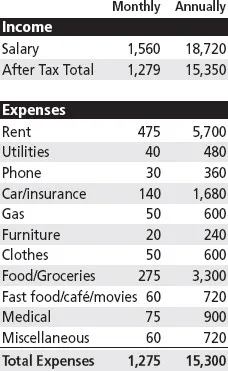
Figure 7.1: Incomes and Expenditures of a Minimum Wage Salary
Comments / assumptions:
- Hourly Wage of $6/hr.; 60 hr. work week
- Rent: Equals 63 percent of median national rent of $760 per month
- Car: assumes purchase of a $4,000 used car financed over 48 months @ 10 percent interest
- Gas: assumes car is mostly driven only for work
- Furniture: assumes rental of bed, couch, and table
- Medical: assumes no health insurance through employer; also assumes the need of less healthcare than average since minimum wage worker is likely younger and healthier
One could object that the model presented here is not realistic because it does not include travel, Christmas presents, or visits to the zoo. But there are in fact many things people would have to go without if they are poor — at least until they improve their productivity. This should be a primary incentive to try and earn more money. Also, if needed, a minimum wage earner could take on debt by way of loans or credit cards, and they could pay off the debt within a few years, since earning minimum wage would be temporary. However, many remain on low salaries because they choose not to do the things that would earn them more. They thus choose lower wages over working harder.
The model in Figure 7.1, which is based on our current mixed economy, would be improved under capitalism. If income taxes were lowered or abolished, the worker would have a higher take-home wage. If corporate income taxes were lowered or abolished, all workers, besides higher salaries, would have higher productivity, which means that all of the costs in the model would decline, and houses and shoes and most other goods would cost significantly less. If regulations were reduced or repealed, money that employers spend on regulation would instead be paid to workers and machines, raising both nominal and real incomes.
Helping the “Real” Poor
If we did not pretend that one fifth of our society was poor, and if we instead focused only on the true poor people — those who are truly unable to help themselves because of mental or physical disabilities — we could afford to provide a true safety net through charities and voluntary giving. Most of us care tremendously about these people and would gladly spend part of our incomes helping them. The numbers of people truly in need are relatively so few that we would be able to support them with a fraction of what we currently pay in taxes to support the much larger number of people we currently support. For example, were government to provide this true safety net — which would not be the recommended route for multiple reasons beyond the scope of this book — it could certainly do so with less than a 1 percent tax rate. We could actually eliminate most current federal taxes and use our current state income taxes or state sales taxes to provide such a safety net. This is because most state and local taxes, currently funding local wealth redistribution programs, could be given only to those in true need (and the rest could be spent on infrastructure and the like, as they are supposed to be).
Under a free market, our tax rates and our costs of living would be drastically lower; our real incomes would thus be drastically higher. We could therefore afford to give more real charity. Whereas today, even though we give millions to charity and to government programs, our low level of real incomes cannot fully support the large number of people who are supposedly in need of help. Since we classify so many people as poor who are not, there are tens of millions of people who siphon money away from those who really need it. The selfishness of the “fake poor” (including many middle class citizens), creates a monetary shortfall for the “real poor” which leaves them with terrible, suffering lives.
We can afford to help those who are truly unable help themselves solely with the funding from charity; and we do not need forced taxation. It is often argued that we must have government to provide for the truly needy because individuals are too selfish to care about these people. This is an offense. Most of us positively want to help those truly in need. And it is already proven that people will give: on top of the trillions already taken from them, people willingly gave over $300 billion to charity in 2007.268 If we assume that as many as one out of every two hundred people (half of one percent of the population) are mentally or physically incapacitated and unable to earn an income during any given year, and if we assume that of all charity, only half goes for the sole purpose of helping incapacitated people get along in life and have an income, that leaves $100,000 in income per year per incapacitated person (($300 billion × 1/2) / (300 million Americans × .5 percent)). This compares to the median income per family currently in the U.S. of $48,000. Additionally, most of these people will have family or even friends who will take care of them physically and financially, including a working spouse, in many cases. Not to mention, in a free market, people who were not previously incapacitated would have insurance that covers them both temporarily and for life in case they became incapacitated.
Those who can usually provide for themselves but who might face sudden hardships for whatever reason would have true unemployment insurance provided by private insurance companies that would fill the gap. The premiums would be affordable because the likelihood that something would prevent them from being able to work, and that it would not be a temporary inability to work, would be unlikely. But if such a calamity were to occur, they would be taken care of.
In free markets, people have jobs and high enough salaries to buy goods they need. The unemployable would be protected by both charity and insurance (on top of help from friends and family). Considering all the points above, you can see why there is no reason why anyone would not have enough employment and money, or insurance, to live without suffering.
It’s Never Enough
Still, even the situation described above would not satisfy the real socialists. They do not ultimately support freedom and prosperity for all; socialists support having everyone live as they see best according to their moral views. As Victor Sperandeo put it: “The essence of the communist’s, socialist’s, collectivist’s, and liberal democrat’s goal is the ethics of altruism, which is not the policy of being kind or nice to people in need, but rather the view that sacrifice for whatever cause sounds necessary is ‘the good,’ and living for your own self-interest is ‘the bad.’269
Most religious organizations also promote an anti-capitalist mentality, even though most biblical passages, regardless of what most people think, absolutely promote capitalism and accumulating wealth.270 In his Christmas Day speech of 2009, Pope Benedict XVI warned that the world was headed toward ruin if selfishness prevailed over solidarity during tough economic times for rich and poor nations. He stated, in similar manner to how the Catholic Church271 supported early Italian Fascism in the 1930s, that “If people look only to their own interests, our world will certainly fall apart.” This is absolutely false. Unbeknownst to him, the full range of economic problems in the world today, including war and starvation, is caused by governments seeking control of both society and national economies. The Pope does not understand that the economic problems we have are a direct result of actions already taken based on the moral philosophy he preaches. If the pope would mind his own business and let self interest take place, the very issues he wants us to pray about would not exist. Alternatively, if he learned how prosperity and economic (as well as physical) security are created, instead of preaching false prophecies, he would instead promote capitalism and save lives instead of ruining them.
Another example of this mentality, again by Victor Sperandeo, is best presented in its original form:
Today’s political mentality is best summed up by the chairman of the House Ways and Means Committee Dan Rostenkowski, Democrat of Illinois, who said, “I’ll do anything to go after the pocketbooks of those who have been enjoying themselves for the last decade.” Contrast this with James Madison, the fourth president of the United States and the man called “Father of the Constitution,” who wrote, “[The] chief object [of government is] to protect the separate and unequal faculties of acquiring prosperity,” and you can see more than a slight change in the government’s view of moral and political beliefs since 1913.
We have so long believed that we must give and give in order both to help the poor and punish the rich that the average person now pays roughly 50 percent of their income to the government, in one form or another. Most of what we pay simply goes towards building the socialist dream of having the government control citizens dependent on it, instead of the traditional dream of having citizens control a government dependent on them. We as a society have voted for this situation because we are under the false belief that it will make us better protected and financially secure. It should be seen by now that it does the opposite.
An Unsustainable Economy
While our means of producing are sustainable, the current structure and path of our economy are not. This is because we continually engage in less production. This fact is proven by observing that our wages no longer keep pace with inflation. The cause of our economic stagnation is our “progressive” social structure which prevents a truly progressive economic structure because it consumes more wealth than it creates.
In sum, “progressivism” helps no one. Both the poor and the average person would have their economic state significantly improved by allowing others to keep their own property. Counter-intuitive as it might seem, letting the rich stay rich will bring more jobs, money, and wealth to everyone. Preventing envy from getting the best of us is the only way to eliminate poverty as well as to act in a morally correct fashion.
While capitalism harms no one and has the chief goal of protecting people and their property, socialism harms everyone and has the primary purpose of taking property from one group to give to another. Though socialists make use of the terms “freedom” and “liberty,” in truth, so-called “liberal” policies take away liberties. Capitalists are the true liberals, both socially and economically. Capitalism is moral while socialism is immoral.
The Case for Legalizing Capitalism
Read the whole book online · Book details
This work is published under a Creative Commons licence. You may copy, share, and re-host it with attribution.