
Chapter 6 of 8 · The De Moneta of Nicholas Oresme and English Mint Documents by Nicholas Oresme
English Translation
EXCHANGE
Temp. Henry III
Silver has the following varieties: from Montpelier, which is so good that a pound, when assayed, is only a penny or twopence at most short of purity. That from the Ariége is the same. Silver from Foix, a pound of which is at most fourpence short. Silver of Sangüesa and of Malines is always pure and does not fall short. Silver from the Empire is almost all pure. Silver of Brussels and Flanders, of which the pound is fourpence short. Silver of Verona, the pound is usually twelve pence short. Silver of Le Puy, of which the pound is fifteen pence short. Silver of Valenciennes (?), the pound is eightpence short. Silver of Pampeluna, the pound is twopence short. All these are silver in plate.
Of pence of Venice the pound is only a penny short. So also of Genoa. Likewise the Mylerenses of Spain. Lawful pence of Cologne, a pound of which is sixpence short. Forged pence of Cologne; the pound is three shillings short. Brussels pence are usually three shillings in the pound short. Those of Marseilles, sixpence.
In all this let the changer take care to buy a pound of any silver according to what he believes will bring him the best profit, since he shall answer for the profit to the king, because he himself has fixed wages of £10. But the profit will be the king’s, but not the loss, because he is either diligent or not. For the king has no need of a man who is not diligent.
But of silver vessels without gilding the changer receives each pound at a discount of eightpence and gilt vessels likewise. And if the vessels are saleable and entire and can be sold at a price higher than their weight, the changer must answer for the price and likewise for the extra value of gilt vessels, since a gilt cup is sometimes worth twenty shillings, a mark, or ten shillings beyond the weight.
[DUTIES OF THE OFFICERS OF THE MINT]
c. 1248
In a bag found in the Treasury in which are contained accounts of various officers of the Royal Mint, there is found a schedule in these words:
The office of the Changer lawfully is: to take in every pound of the old money sixteen pence, namely to the use of the king and the earl, by weight, 6d of the right and accustomed farm and tenpence to the use of the moneyers for loss in the fire. And by the same weight that the Changer receives and exchanges the old coin, he shall deliver it to the moneyer to melt. And if the Changer buys pure silver in bulk, he shall take 6d in each pound of the right and accustomed farm and deliver the same silver in bulk to be melted by the same weight by which it was bought. And the moneyers shall add to each pound 6 dwts of copper according to the right and ancient custom; of which 6d the moneyers shall give to the workmen making the new money 3d in each pound, and from the other 3d they must hire the houses for the melters and pay the wages of the workmen and hire their servants in their office and find the dies and buy the charcoal and everything else belonging to their office. And if the Changer buy silver in bulk which is not pure by his estimate (of its value) and the moneyers refuse to accept it at that estimate, the Changer shall purify that silver in the fire, provided that if there come any profit from it, that shall accrue to the king and the earl. And they shall pay for the firing out of the issues of the dies and he (sc. the melter) has a halfpenny in the pound.
There shall be in the Mint an Assayer who must assay the blanks before they are brought to the die, that they are of right weight and of good silver and shall make each assay of twenty blanks weighing twenty pennyweights of lawful money, which assay should not be out more than a halfpenny more or less. And when the blanks have passed through the dies, the assayer must make an assay of twenty pence in the Mint, and that assay must be judged before the clerks and the Changer and other assessors, that it is of lawful weight and of good silver, as is said of the blanks. And after this the Changer must give these pence in exchange.
Also it is the duty of the Keepers of the Dies to sit and see that the workmen strike the blanks sent to the die well and that no blank be struck or pass through the die unless it be good, lawful and right. And for doing this duty they shall receive twelve pence from the moneyers in every hundred pounds.
Also the duty of the usher is to keep well the door of the Mint for men going in or out, and to call and assemble all belonging to the office of moneyers, as he may be commanded.
[ASSAY OF THE NEW MONEY]
A.D. 1248
In the thirty-second year of King Henry son of King John, on Wednesday before St Gregory’s day (11 March 1248), an examination was made as well of the new as of the old money of England, by a writ of the king addressed to the mayor and citizens of London in the terms following:
Henry, by the grace of God king of England, etc., to the mayor and citizens of London, greeting. We command you to elect twelve of the more discreet and lawful men of our city of London and join with them twelve good goldsmiths of the same city, making twenty-four discreet men in all, who shall go before the Barons of our Exchequer at Westminster and examine, upon oath, together with the barons, both the old and the new money of our land, and make provision how it may be bettered; and that it be made of good silver, and that it be lawful and for the good of the realm. Saving to us our approved and ancient farm.1
The said mayor and citizens of London, therefore, assembling at Westminster on the aforesaid Wednesday according to the tenor of the said writ, chose from among themselves twelve of the more discreet men of the said city, to wit, Michael Tony, then mayor of London, Nicholas Bat and William Vyel, then sheriffs of London, Adam of Basing, Thomas of Durham, John of Gisors, Stephen Bukerel, Lawrence of Frowick, John Adrian, Ralph Hardel, Ralph the Smith, Ralph the Spicer, Hamo de Castello, John le Minur, Odo the Smith, to make the aforesaid assay. And these thirteen,2 in the fealty which they owe to our lord the king, together with thirteen sworn goldsmiths, to wit, Thomas of Staines, Richard Bonaventure, Robert Pentecost, Bartholomew Ilger, Richard Abel, John Fitz, Richard le Bacheler, Reginald le Noir, Thomas of Wimborne, Adam of Staines, Peter of Bristol, Thomas Rosemud and Peter of Standen, in the presence of our lord the king, the Earl of Cornwall, his brother, William de Haverhull, his treasurer, Edward of Westminster, William Hardel, then warden of the Mints of London and Canterbury, Ralph of Ely, baron of the Exchequer, and other of the king’s lieges then there present, made the said examination, which they call an ‘assay,’ as follows: to wit—
One pound of the new money from the new dies having been taken, more than once, before all the persons named, placed in the refiners’ fire, examined, taken out and placed in the balance, it was found not to weigh more than six pence less than the (standard) pound; wherefore by the custom of the realm of England it had been good and lawful and approved by all. But one pound of the old money having been taken likewise more than once, and put to the fire and weighed in the manner aforesaid, there was lacking from the pound, on the aforesaid examination, ten pence; wherefore it was clear to all that it was not good nor lawful. It was therefore provided and granted by all that those who wish in future to come to the king’s mint to exchange their old money, shall pay for each pound, in addition to the king’s farm (i.e. seignorage and mintage) ten pence, because that was the deficiency per pound in that money; or that anyone wishing to exchange such money may choose to have his money tried in the fire, or to pay ten pence beyond the farm as aforesaid.
And lest in time to come there should be deceit in the lawful coin of the realm by the counsel of the persons aforesaid, for the good of the commonwealth there were made two trial-plates (assaia), each of the weight often shillings, one of which is of pure silver and the other of standard silver. And these two trial-plates were stamped with a certain die, placed in the treasury of our lord the king at Westminster under the seal of the mayor of London.
There were likewise made several trial-plates after the same manner, stamped with the said die, and delivered to the various places in which mints were set up: to wit, at London two of forty pennyweights each, one of pure silver for testing the silver, and one for the coin; at Canterbury two similar plates; at Bury St Edmunds, Norwich, Oxford, Northampton, Lincoln, Winchester, Gloucester, Exeter, York and Ilchester, the same.
But afterwards the king’s order was sent to the mayors, reeves and bailiffs of the aforesaid towns, where money is to be coined outside the cities of London and Canterbury, that each of them in their towns choose from the more discreet and loyal men of the towns four moneyers, as many keepers of the dies, two assayers and one clerk; provided that they be such and so fit that the whole town will answer for their conduct; and present them by their letters sealed with the seal of the community to the Treasurer and Barons and the Wardens of the King’s Mint. The which mayors, reeves and bailiffs, having heard the king’s command and proceedings to make choice as aforesaid, presented to the said Barons the men chosen to the said offices, with their letters patent containing the names of the persons chosen, which are in the Treasury; and the Barons, taking their several oaths to perform their duties faithfully, appointed them to their posts as appears below.
THE FORM OF THE NEW MONEY
A.D. 1279
First, a standard must be made which shall remain at the Exchequer or in such a place as our lord the king will. And the money shall be made according to the form of the standard and of the same fineness as the standard. And (the standard) must be marked, made and struck with the stamp of the old money and of the new.
Item. The groat of four sterlings must be of the same fineness as the standard.
Item. The farthings shall be round and must be made at London and nowhere else and shall be called ‘Lundreis,’ so that any one who chooses to melt down four farthings may find in them as much fine silver as in one sterling, except what is needed to cover the extra cost of making. And because the farthing would be too weak and small if it were of the same alloy as the sterlings, it is provided that it shall have so much more alloy. And be it known that they shall be of the weight of sixty-five shillings and eightpence to the pound and shall be cut in such a way that there may be five heavy and five light in the ounce; and the heaviest shall not be fewer than sixty shillings and eightpence to the pound nor the lightest more than seventy shillings and eightpence to the pound. And there shall be made a standard for them as for the farthings and placed in the Treasury with the other; and it must be struck with the stamp of the farthing.
Item. The Master must be given a Warden and the Warden must see that the pence be of [just] weight and tale, i.e. that there must not be more than six heavy and six light in the pound. So that one may not weigh more than another beyond one and a half grains [above or below] the weight of the just penny. And the Warden must weigh the said money, and if it is found well of the right weight the Master is quit and free from blame as to the weight of this money which shall be delivered of (just) weight and tale. And if it should happen that a penny were found in the pound heavier or lighter than the just penny by a grain and a half, the money shall be accepted. And the pound must contain twenty shillings and three pence. And if there be one penny more or less in the pound, the money may still be accepted for the Master to pay to the merchants. And the Master is bound to amend the fault of excess or defect in the money he shall afterwards make.
Item. There must be a box with two keys, one of which the Master of the Mint must keep and the Warden the other. And in the said box must be put one sterling out of each ten pounds coined, to make the assay. And this box must be delivered four times a year by the assayer to the king, and this shall be at the Exchequer.
Item. Our lord the king must have a good and lawful assayer, and let the assayer make the assay four times a year as is aforesaid. And if it happen that the pence in the box be found two and a half grains short in half an ounce, the Master shall not be punished for that, but he shall be bound to make good the defect (at the Treasury) at the delivery of the box, and more or less according to the verdict of the assayer and the wardens. The same shall be done as to the farthings called Lundreis with regard to the grain, the box, and everything, like the pence.
Item. The king shall have it proclaimed throughout the realm that no man change money, plate or any other kind of silver except at the king’s exchange, or with such persons as are there appointed; and that no man be so bold as to take coined money out of the realm of England; and whosoever shall contravene this, his body and goods shall be at the king’s will.
Item. That no goldsmith buy any silver except old plate but at the exchange; nor shall there be worker (in) silver or goldsmith in any town except in the main streets in public view, under heavy forfeiture at the king’s will.
NAMES OF THE OFFICERS OF THE MINT
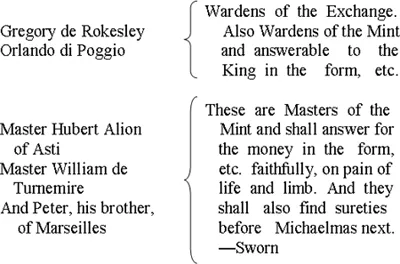
Boniface Galgani of Florence, Assayer of the Mint.—Sworn.
John of Maidstone, Clerk of the Exchange, shall be controller on behalf of the king.
[PROCLAMATION FORBIDDING CLIPPING]
c. 1280
Memorandum. That it be proclaimed throughout the realm that there be no clipping of the new money at peril of life and limb and of all the property and goods of whomsoever it shall befall to be convicted by judgment of the court of our lord the king. And the king will forbid any clipping of the same money under the aforesaid penalty. The king will also forbid anyone to receive any such clipped money under the said penalty. And the king forbids any goldsmith . . .
[INDENTURE OF WILLIAM DE TURNEMIRE]
1279, December 8
It was agreed with Master William de Turnemire of Marseilles on Friday, the feast of the Conception of St Mary, in the eighth year of king Edward, as follows:
Namely, that the same Master William shall be Master of the King’s Mint in England and shall cause money to be worked for the present in four places, viz: at London, where he shall have as many furnaces as he can. At Canterbury, where he have working and maintain eight furnaces, together with those three which belong to the Archbishop of Canterbury. At Bristol he shall have twelve furnaces and at York he shall have twelve furnaces. And in each of the aforesaid three places, Canterbury, Bristol and York, he shall have under him a master to keep the said mint and its appurtenances; and he shall at his own expense bear the expenses and payments of his men in those places; namely the said master-moneyer, and the keeper of the blanks, the melter, the foundry-man and the other servants. So that the said Master William shall bear all the charges and expenses in the said four places, and shall deliver the money to the king made and blanched and ready in every respect at his own expense. And the king shall give him for every pound of sterlings seven pence, namely three pence farthing for the wages of the moneyers striking and making the coin, and there shall be allowed to the same master one penny farthing for the loss of the silver in the fire and one penny halfpenny for the remedy of each pound of money. So that for the remedy of the money and the loss by fire there shall be allowed him in every pound eleven farthings, as aforesaid. There shall also be allowed to the said Master one penny in each pound for his own wages and expenses and those of the other masters under him, and their servants, as well in food and drink as in his robes and other things, and for charcoal and for purchasing and cutting the dies and other expenses concerning the mint. And our lord the king shall find for the same Master William houses in each of the said four places fit for working in and shall bear the charge of Sir Hugh fitz Otho, guardian of Otho his nephew, which he claims to have in the keeping of the dies and shall satisfy the same Hugh for that fee. But the tools which our lord the king has at London in his houses of the mint shall be delivered to the said Master William in their present condition on loan; and the same Master William shall restore them at the end of the year, or when he resigns his office, in the same condition as they then were.
It was also agreed with the said Master William that he shall make the groat sterling, which is worth four lesser sterlings, throughout England at the same rate and on the same terms as he shall make the aforesaid lesser sterling; but with this addition, that because the same great penny can be made more easily than the common sterling, whatever profit may accrue shall be the king’s.
It was also agreed with the said Master William that he shall likewise make farthings throughout England which are now round and are called ‘Lundreis’. So that the king shall have of each pound as much profit as he will have of the common sterlings, to wit twelve sterlings. And be it known that each pound shall contain four score ‘lundreis’ and three shillings over by tale, since more alloy is added in this money than in sterlings on account of the great expense which must be incurred in making this small money. And it is reckoned that in each pound of this small money there ought to be allowed to the aforesaid Master William tenpence halfpenny for the making and all the costs of manufacture. And there will remain to our lord the king a profit of twelve pence in each pound at least. And be it known that the said Master William shall begin to coin on the Morrow of the Circumcision of our Lord in the aforesaid year, according to the form enrolled in the Exchequer, all the aforesaid moneys.
It was likewise agreed with Boniface the merchant that he shall be chief Assayer, Buyer and Weigher of the Mint, having a key to every box of pence for assay.
[THE REGOINAGE OF A.D. 1300]
A.D. 1300, March 29
Be it remembered that the 29th day of March of the 28th year of the reign of king Edward it was ordained by the king and his council at Westminster to set up Exchange and workers of money in the undermentioned places in the realm of England: namely, at the Tower of London, thirty furnaces; at Canterbury, eight furnaces as there have been before; at Kingston-upon-Hull, four furnaces; at Newcastle-upon-Tyne, two furnaces; at Bristol, four furnaces; at Exeter, two furnaces. And be it known that John Porcher, Master of the Mint of England, himself dwelling in London to coin the money, must set in each of the other places named a man in his stead to coin the money, and must find everything necessary for a master, for which he himself will answer at the same rate to the pound as in London. And Roger de Frowyke, Changer, dwelling in London, must find a changer at Canterbury and another at Bristol, for whom he will answer, and must take for himself and a clerk, from the time when the Pollards and other bad counterfeit moneys are put down till the main press is over, forty marks per annum. And for the Changer of Canterbury, from the time of his appointment, twenty pounds a year; and for the Changer of Bristol, from the time of his appointment, twenty pounds a year; so long as they shall remain in the said places. And Taldo Janiani and Coppo Cottenni and their companions, merchants of the company of the Frescobaldi of Florence, shall have the exchanges of Kingston-upon-Hull, Newcastle-upon-Tyne and Exeter and shall find changers and pence in the said exchanges to maintain them and all other things which pertain to the changers; provided that they render account to John de Sandale, Warden of the King’s Exchanges; which John must set clerks in his stead in the said places to control and charge the said merchants and they shall answer to the said John for the issues and John shall answer for them to the king.3 And Lapyn Roger, assayer, dwelling at London to make the assays of the control boxes and all other assays pertaining to the mint, must take from the time that the bad money is put down till the main press is over, forty marks a year. And if it happen that the said Lapyn be sent out of London elsewhere than to Canterbury to make assays, he must have his reasonable expenses for it from the king. And John de Sandale, Warden of the King’s Exchanges aforesaid, must take for himself and his clerk dwelling in London, the same fee that his predecessors in that office have taken, and besides that ten marks a year for another clerk whom he will have to keep at the London Mint as long as the press lasts. And for the clerks whom he shall find at Canterbury, Kingston-upon-Hull, Newcastle-upon-Tyne, Bristol and Exeter, who shall also be the keepers of the dies in those places, twenty marks a year each. And the keeper of the dies at London must also have as other keepers before him have had. And the ushers of the doors at London and at Canterbury must take each of them threepence a day. And whenever the said John de Sandale goes out of London on the king’s business to visit the other places, he must take for his expenses three shillings every day.
And furthermore, on the same day, it was ordained that Alexander Norman of Lucca must be Master of the King’s Mint at Dublin in Ireland, and must take with him, at the king’s cost, three furnaces, and must take of every pound of money that he shall make sixpence for all costs, on condition that he must find the engraver of the dies at his own cost and all other things pertaining to the Master, as John Porcher does in England. And he must make money of like weight and alloy as has been made aforetime. And he has to answer well and lawfully to the king for all things which shall be delivered to him to keep and to work. The said Alexander has found the following security to the said Taldo and his companions, who must be answerable for everything, to wit:4
Taldo Janiani and Coppo Cottenni and their companions aforesaid shall have the exchange there and shall find a changer and pence and the other things which pertain to an exchange at Dublin out of the issues of the said exchange, and answer for the said issues to the king; so that the Treasurer of the Exchequer at Dublin shall assign them a clerk to control them and charge them with the aforesaid issues. And because the voyage between Ireland and England is perilous, and the box must be carried to England to be assayed, it is ordained that they make two boxes, so that if one were lost it might be replaced by the other. As to the wages, mises and expenses of the aforesaid merchants, they shall be taxed by the judgment of the Treasurer and Barons of the Exchequer of England. And it is further ordained that these merchants of the Frescobaldi may change and buy silver, pollards, crockards and all manner of white money counterfeiting sterling throughout the realm of England, provided that they bring such silver and the plate as results from such counterfeit money to the king’s exchanges to be coined.
It was afterwards ordained by the Council that there should be a mint at Chester, and that John de Sandale shall appoint a clerk there for himself, Roger de Frowyke a changer and John Porcher a Master of the Mint, for whom they shall be willing to answer in the form prescribed.
A TREATISE ON THE NEW MONEY
c. 1280
I am glad to comply with the praiseworthy wish of those who, through their love of justice, desire to know the reasons for and manner of making coined money, and the trial of the assay; and although the subject is regarded as difficult and intricate, I propose, so far as my poor wits serve me, to explain it briefly in writing.
The Roman Emperor, Numa Pompilius, is said to have been the first to order the making of coins, and the several coins are called (in Latin) nummi from the name of the Emperor. But because one silver coin was worth ten copper ones, the silver coins were called denarii (pence) from the number ten. And thence arose the custom of calling any coin ‘a penny’ and usually specifying its material as ‘silver’ or ‘gold’. Money (moneta) is said to have been so called from the name of the maker, as the English ‘sterlings’ have from the name of those who made them.
In the first place then, before there is any money, there must be a statute clearly and distinctly determining the proportion of alloy, the weight and number of the coins. It must then be put in hand and finished by the order or special licence of the prince and must be made generally known by public proclamation in the accustomed way by the prince’s crier. It will then be ready for use and may not be refused by any of the public without penalty. But whoever, secretly or openly, without leave of the prince, attempts to counterfeit any coin and is convicted, is liable to suffer corporal punishment.
After this general preface, you must know that all money consists of two things, matter and form. Its matter is obtained by working in gold, silver and copper, and its form by coining, as by engraving a die which imprints a recognisable and distinguishable form on the coin, without which it can never be a coin any more than wax can be a seal until it has received the impression of its device. Hence we must treat separately in detail first, of the knowledge of material, secondly of its disposition, and thirdly of its testing. But since most of these points are matters rather of fact than of theory, which can hardly be described intelligibly unless they are seen, I must concentrate on the parts of the subject which can be distinguished and understood by the use of reason.
Knowledge of the material of which money is made, namely gold, silver and copper, is obtained in two ways, either distinguishing them by the eye or trying them by assay. We can distinguish by the eye whether the material is in bulk or in coin; so much everyone knows. Secondly, whether it is gold, silver or copper; this, too, many know. Thirdly, whether it is pure gold or pure silver, or mixed with another metal; but most people do not know this. Fourthly, how much the mark or the pound of mixed gold or silver contains of the metal with which it is alloyed; this can only be known by experts who have learned by practice. But hardly anyone can be found so fully expert as not often to be mistaken in this. But the signs by which the material can be determined by inspection can scarcely be explained or understood without practical experience. A sure knowledge of gold and silver can be obtained by testing, but among a great variety of tests, examination by assay is considered the most certain and hardly anyone can know its certain signs unless he has learned it from practice in the art. Nowadays an assay is made of ten pennyweights, that is half an ounce, weighed with the greatest accuracy. This is placed in cupels arranged in the fire for the purpose and is purged by enough lead for the assay, from all the copper or other metal which it contains. The weight of each grain of the assay is proved by correct calculation to be equivalent to a penny in every pound, and consequently half a grain equals a halfpenny and a quarter a farthing; which is easily proved, since the grain is the twenty-fourth part of a penny. Therefore, as twenty-four grains make one pennyweight, so twenty-four half-ounces make a pound. Each grain, therefore, bears the same proportion to a penny as each penny does to a pound. But since silver may easily be lost in the fire but cannot be gained, a diligent assayer is bound to take the greatest and most earnest care to preserve the silver. Thus for every grain that the assay loses in weight one penny can be accordingly reckoned in each pound.
And because I am addressing English noblemen, and in England, I must proceed to those points which are of the most importance in regard to English money and the English mint. You must know then, to explain what is to follow, that any bullion or coin half or more of which is pure silver, is called ‘silver.’ But below half it is by no means to be considered silver. Some silver, recognised as such, is bought as ‘pure,’ some as alloyed. And because there are many varieties of silver, I will give just five examples, by understanding which the method will be grasped of buying any kind of silver according to the greater or smaller quantity of copper it appears to contain. The first example is English Sterlings, of which every standard pound contains eighteen and a half pennyweights of copper; and whatever silver is equal to that standard is to be bought at fourteen pence halfpenny, which are kept back from every pound for the coining. I think the reason of this is that, whereas the kings of England used to receive only sixpence for the coining of each pound, at the beginning of the new coinage it was considered and profitably ordained that the king should receive nine-pence from each pound and the Master of the Mint should make each pound for fivepence halfpenny. Therefore, since ninepence and fivepence halfpenny make fourteenpence halfpenny, neither more nor less is to be kept back for the coining of any silver of equal goodness to the standard. All kinds of silver must be coined and bought by the same method of reasoning, according as they are found to be better or worse, so that from the issues of the mint, with a sufficiently fine alloy, the king and the Master of the Mint may be justly answered and enough money found. But of old English money another three halfpence are retained for coining, because, compared with the king’s new standard, the old money was said to be so much worse; from which it follows that whatever further is kept back from the worse silver is all to be assigned to the amendment of the same.
The second example is of Baudekyns, of which every pound contains fourteen pennyweights of copper. All the silver of this value is bought at tenpence, which is all that is kept back out of each pound for coinage, because it can take four and a half pennyweights of copper more in each pound and be of equal goodness with the standard.
The third example is of silver Tournois and silver of Ghent, each pound of which should contain ten pennyweights of copper and every pound of like silver is bought at sixpence, which is all that is kept back for the coining of each pound, because each pound can take eight and a half pennyweights of copper more and be as good as the standard.
Let the fourth example be all silver containing only four pennyweights of copper to the pound, for such silver must be bought without keeping back anything for the coining. But for the weight of silver must be given an equal weight of sterlings, because the silver can take fourteen and a half pennyweights of copper to the pound and be of equal goodness with the standard.
The fifth example is Limoges silver, which is said to be the purest, wherefore in buying it an agio of fourpence in the pound can be given in addition to the weight; because it can take eighteen and a half pennyweights of copper to the pound and be of standard fineness; wherefore the fourpence above the fourteen pence and a half should be the seller’s advantage. And since no purer silver can be found for this purpose, you must observe that the nearer any silver attains to such fineness, the less must be kept back for the coining, and the farther it departs from fineness the more is to be kept back for coining, according as it can bear more or less of copper.
But purchases are made elsewhere of bullion or silver according to the common value or price of silver at the mint in which the purchase is made. You must know, then, that at whatever number of shillings a mark of pure silver is sold, the silver content of the bullion or silver to be bought must be multiplied by the same number to get the price of a mark. Suppose that a mark of pure silver is worth 56s 4d. Then each mark of bullion or silver sixpence (in the shilling) fine will be worth fifty-six times sixpence, which make 28s; and for the fourpence I shall reckon 2d, namely a third of a shilling in the price, for a third of the fineness of sixpence. And so a mark of silver, sixpence fine, will be worth 28s 2d. And in the same way may be reckoned the value of any bullion or silver.
We must next consider the disposition of the material in making money; first, the alloy, next the shear and the coining. The fineness of the alloy is commonly reckoned at a rate of twelve pence to the half-ounce 5 and sixteen shillings to the mark, forty-eight shillings being taken as the value of the mark of silver in reckoning the alloy. You must know, therefore, that pure silver is said to be twelve pence fine, because each half-ounce (the customary weight of an assay) is of pure silver without any content or mixture of any other metal. Again, money eleven pence fine contains in each half-ounce one pennyweight of copper and you must observe that no mention is made of the copper because, of course, no account is taken of it. But the alloy gets its name from the quantity of gold or silver in the money, so that according to the amount of silver in twelve pence (i.e. half an ounce) it is adjudged to be so many pence fine. And in the same way any silver or coin is said to be of a certain fineness of alloy according to the silver content, counting from twelve pence to nothing by the grain, and going down by pennies. But since a mark contains sixteen half-ounces, if you multiply the figure of the fineness of the money by sixteen, you will arrive at the quantity of the silver; namely how much there ought to be in each mark. And the alloy of coin is made by changing high into low and vice versa. Any bullion or silver is said to be ‘high ’ when its fineness is above that of the money which is to be alloyed from it; it is called ‘low ’ when it is beneath that of the money. An example will make this clearer. Suppose I must alloy the money to be ninepence fine and have bullion or silver elevenpence fine and fourpence fine. (Forbidden money, i.e. money not current, is called bullion.) I shall therefore reckon that from 9 to 11 is a difference of 2. Also, from 9 to 4 is a difference of 5. Turning then from high to low, I shall put in the alloy 2 marks of bullion fourpence fine and 5 marks of silver elevenpence fine. And so the seven marks mixed together will be ninepence fine, neither more nor less. And this I can prove in two ways. First, I shall reckon that the bullion fourpence fine contains in each mark sixteen times fourpence, namely 5s 4d, and so two marks contain 1 os 8d of silver. I shall also reckon that each mark of the silver elevenpence fine contains sixteen times elevenpence making 13s 4d; this multiplied by five makes 73s 4d in silver. Adding to this 19s 8d for the aforesaid two marks the sum will be 84s, which make five marks and two ounces, reckoning the mark at 16 shillings. Again, I shall reckon that every mark of money ninepence fine must contain sixteen times ninepence of silver, which is 12s. Seven times 12s make 84s which is five marks and two ounces of silver, as above. Thus the silver is proved to be sufficient.
By the second method I shall reckon that a mark is valued at 48s for the purpose of checking the fineness. A mark of bullion fourpence fine is worth forty-eight times fourpence, that is 16s. And so two marks are worth 32s. Also, a mark of silver elevenpence fine is worth forty-eight times 11d which is 44s. Therefore five marks will be worth £11, and adding 32s for the price of the aforesaid two marks they make the sum of £12 12s. I shall also reckon that a mark of money ninepence fine is worth forty-eight times 11d which are 36s. Then seven times 36s make a sum of £12 12s as above. And so the correctness of the alloy is proved by the price of the silver. All alloy must be made and tested on the same principle; wherefore, because these rules of alloying and proof of alloy are infallible, the only error a skilled alloyer can make in his process lies in the material; if perchance, without his knowing it, the silver of which the alloy is made, and which he thought satisfactory, is not good enough. I have dealt briefly with all this in order to be more explicit in what follows, the alloy usual in England.
You must know, then, that in the alloy for English money, ten sterlings are reckoned to the half-ounce and 13s 4d to the mark; which only differs numerically from the ratio of twelve pence to the half-ounce and sixteen shillings to the mark. But both agree in weight and in pattern, since in both cases there are sixteen half-ounces in each mark. Hence pure silver is said to be ten sterlings fine, and the fineness of any money can be truly reckoned and effected by the number of sterlings, namely by sterlings and grains, rising from nothing to ten sterlings fine, than which no better silver can be found. You must also know that the standard money of England is nine sterlings, five grains and a half fine, and by this is proved how much silver each mark or pound contains. For nine sterlings, five and a half grains multiplied by sixteen make 12s 3½d and four grains of silver to the mark, and adding half as much again, 6s 1¾d and two grains makes 18s 5½d of pure silver in every pound of standard money of England. Add to that 18½ dwt. of copper, which makes up the weight and number of twenty shillings.
But the alloy for English money can be made entirely from bullion of old money of England which by itself, if it be neither made better nor worse, will give an alloy containing enough silver, possibly even better than that of the standard. But of the bullion of diverse moneys, as they are bought at various prices, eighteen pence or 2s or above, whatever is kept back in the exchange of each pound beyond what would be kept back if it were sufficiently fine, must all be delivered to the Master of the Mint to make good the fineness of the alloy.
The following table6 shows how the alloy is made from the silver according to the several purchases. To silver bought at fourteen pence halfpenny no alloy is to be added, for it is enough that it be equivalent to the standard.
As regards silver bought for 20s, namely that of which nothing is kept back for the coining, but weight for weight is paid in sterlings, whether the silver is good or bad, the Master is always charged with 14½ penny-weights of copper to be added to each pound, and must answer for the same in his account. Therefore, for every purchase of silver made by keeping back a certain amount from each pound for the coining, namely from I4d or less down to purchase for 20s, of which, as we have said, nothing is paid for coining but equal weight in coin is given for the weight of silver, whether the silver is good or bad, the Master is always charged with so much copper to be added to each pound of silver as, together with the amount kept back for the coining, will come to 14½d to each pound. And if any purer silver happen to be brought to the mint and is bought, the Master will be charged with a higher quantity of copper to each pound according to what the purchase requires.
[The table printed in the Latin text shows that to silver bought at I4d one halfpenny of copper is to be added. For each halfpenny that the silver price is reduced, a halfpenny of copper is added; ending with one halfpenny for the silver and fourteen pence of copper. The words between the figures may be translated. ‘Which (i.e. the pence held back in the exchange) are kept back in each pound for the exchange. Whether the silver be good or bad the Master is charged with them on every pound of silver and must also answer for them by weight.’]
It will be seen from the foregoing that no other rule is observed in alloying the money of England, unless the Master of the Mint, on his assay, chooses to make the coin better, i.e. to add less copper to the silver than he is charged with in his account. But if he does so he will get no allowance on that score in his account, unless the money so made be proved to exceed the standard. This shows that the goodness or badness of the alloy depends on the silver and on the judgment of the buyer. For it is impossible for the money to be made up to standard unless in making the alloy you have either better silver or as fine as the money which the alloying is to produce. And therefore the Master ought to be the buyer of the silver because he has to answer for the count and the fineness of the money. But if, as in England, the Warden of the Mint, or the Changer, considers himself authorized to do this without the Master’s assent, and is not concerned in his purchases of silver to be absolutely fair, indeed if perchance, inflamed with hatred or envy, he is saddened and grieved at the Master’s comfort and honour, and rejoices in the multitude of his misfortunes, and so can be proved guilty by his malice and fraud, not only of cheating the Master, but also of injuring the king’s coinage by his dishonest purchases of silver, no law should hold him unpunished but should compel him to make good the damage to the Master and pay a severe penalty for his crime.
The next subject is the shear of the coin. Now the shear is the cutting up or division of the silver as equally as possible, so that it may correspond with the mark and the pound in the appointed number and weight. For example, the shear of English money is 20s 3d to the pound, as evenly as it can be cut, but if the coins be found to be not more than a penny stronger or weaker than a pound, they will pass. By ‘stronger’ I mean if in the pound weight there are only found 20s 2d by tale. By ‘weaker’ I mean if in the pound weight there are 20s 4d by tale. Also in each pound one strong and one weak penny may pass uncounted, and two other pence stronger or weaker by one and a half grains than the just penny of 20s 3d to the pound sterling. But this shear or cutting of the silver must be done on the Master’s order by certain workmen on the staff of the mint, by whom the silver is prepared by remelting and fashioning and making into the required number of blanks. Then, after a proper check of the weight and tale, the workmen give back their day’s work to the Master and receive for their wages from the Master 2½d for every pound. But the Master will, if necessary, have the blanks blanched and deliver them to the moneyers to strike, who shall also after finishing the coining receive a halfpenny for each pound as their wages.
You must know, by the way, that there are two offices necessary in every mint; those of the Master of the Mint and of the Warden of the Mint. It is the Master’s business to appraise and purchase bullion and silver and to alloy it, and all the details of making the money and also the government and restraint of his workmen and moneyers, for in all that pertains to the exercise of their office they cannot be governed and kept in order by anyone more suitably than by him. The Master also has been used to receive only 5½d in every pound for himself and for all his workmen and moneyers, for all expenses and costs, and for the loss of silver in coining.
The business of the Warden of the Mint is knowledge and skill in assaying, testing and everything else by which the goodness of the money can be tested and known. And if the Warden be ignorant of this let him have some fit person in his place. It is also his supreme duty, in person or by deputy, most diligently to keep in every place and even in the hands of the cutter or engraver of the dies, as though they were the king’s seal, the dies for the coin, and to see that the pence are rightly coined from the dies as they should be. He is also bound to keep the pence, after the coining is done, with all diligence and care, that they may not be taken out of his keeping in any way until they have been delivered by a fit assay; for so is the coinage most safely kept. But let the assayer be careful in making any assay of coin, and all the more diligent, delicate and intent, because the charge of which the Master of the Mint is cleared by the assay, is entirely transferred to the Warden or the Assayer, so that after the verdict of delivery the Master is no longer answerable. For it is in the power and the duty of the Assayer to deliver the money which he finds fit, and to reject the unfit and send it back to the foundry to be made good at the Master’s cost and if necessary melted down and completely remade.
We have still to see how the testing of the money is to be done. And you must know that it has been usual to test it in two different ways. First, by weight and tale of the pence against the mark and the pound; secondly, by fire and assay of the alloy or silver of which it is made. The test of the pence by weight and tale against the mark or the pound must always and everywhere be made before the pence pass out of the hands of the Warden and Assayer of the Mint. And if they are found good enough in weight and tale, they shall be delivered as fit for use. But if they are found wanting, this may be in two ways; for they will be either stronger or weaker than just pence. And because the principle is the same in both cases, what applies to the strong pence owing to their strength will also apply in what will be prescribed for the weaker. Consequently, the weakness of the weak pence will either be within the appointed limit, within which by the prince’s ordinance the money is fit for delivery, and then its delivery must not be prevented because the pence are decreed to be fit for use; or their weakness will be beyond the limit. In that case, the weakness may be either small or extreme. If it is small, as being only a little weaker than money fit for delivery, then its issue will be stopped, but if a slight improvement is made or it is mixed with better money, it will be delivered without difficulty. But if the weakness is excessive, as greatly differing from money fit for delivery, then if it cannot otherwise be mended, it must be melted down as rejected and must be struck and completely amended at the cost of the Master of the Mint.
But the test by fire and assay of the alloy or silver of the money may be made in three ways, according to what the prince may have ordained. For the silver will either be examined before the pence pass out of the hands of the Warden and the Assayer of the Mint and are turned to other uses; or afterwards at a definite time, a ‘pyx’ being made up from one or more days’ work [or ‘journeys’] which have been done within the time; or in both ways, if the money shall be found sufficient or the contrary in silver or alloy before the pence pass out of the hands of the Warden of the Mint. If sufficient, the money will be delivered as fit and the Master will be quit. If deficient, the defect will either be within the limit within which the money may be delivered according to the prince’s ordinance, or outside that limit. If the defect is within the limit, the delivery of the money is not to be stopped, since the money is fit for use, but the Master must be ordered to make an equal quantity of better money. But if the defect is beyond the limit, the money being only a little short of being fit for delivery, then its delivery will be stopped, but if it is mixed with better money it shall be delivered without difficulty. But if the defect is excessive and it is much different from money fit for delivery, then it must be melted down, since it cannot otherwise be amended, and must be struck and entirely made good at the cost of the Master of the Mint. And since the Master is not convicted of damage to anyone by this, he is not fairly punishable in any other way. For there is always an opportunity of amending the money until it has been assayed for delivery and put out for use. But then the Assayer will be held answerable for its goodness, according to his own judgement in issuing it.
But if a trial of the pyx be made at a certain term, as a pyx under three keys or locks has been used to be made of one or more days’ work which happen to have been done between one term fixed for the delivery of the pyx and the next; after all the needful preliminaries an assay is to be taken of all the pence in the pyx mixed together in the usual way; and so the assay shall be rightly made and a single equitable judgment will result. For it is unheard of by moneyers everywhere that the trial of the pyx should ever be concluded otherwise. For in making up the pyx, it is always permissible for one batch of money to be made good by another in the same pyx. For it is enough for the money of the whole pyx to be good and fit to deliver as a whole when mixed together. And this is attested by common custom hitherto approved both in the realm of England and elsewhere.
The assay duly made will be found either satisfactory or defective. If it is satisfactory, the Master will be altogether quit. If it is defective, the defect will either be within the limit within which the pyx of money is fit to be delivered according to the prince’s ordinance or not. If it is, on the delivery of the pyx, the Master will be ordered to make an equal quantity of better money and will not be quit until that amendment is completed. Or the defect will be beyond the limit beyond which the pyx is not by the prince’s ordinance to be delivered; and then, since there is no place for amendment, the Master will be at the prince’s mercy or will in life and members. But the prince will consider whether the defect was small or excessive, and also whether the pyx was made up of few ‘journeys’ or of many, and whether the defect arose by accident or by deliberate fraud; and after considering the circumstances will decide whether the offence should be mercifully pardoned or justly punished. But if the test be made both ways, namely both before the pence are delivered out of the hands of the Warden of the Mint and again at a fixed term by the pyx, as has been mentioned above, then the first test will only serve to keep the Master from straying from the right way. The second examination, by the pyx, will end with a judgment. For justice does not suffer two judgments on the same matter.
NOTE ON THE ASSAY
c. 1300 (?)
Note also that whenever the money is tested by assay, in order that the judgment of the test may be more certain, at least three impeccable assays should be made, lest through overheating or otherwise the silver should have spurted out from one of the assays and lest from draughts or a failure of the fire, the assay should have cooled, or by the fall of coals or in any other way the assay or silver should have been diminished. And when the three impeccable assays have been made, then first must they be judged by the Assayer himself, namely which of the three assays is to prevail (i.e. which is the purest in silver and most correct) in giving judgment, or whether they are all equally good. And whichever assay he shall judge the best shall be first weighed and then the others. And if they are judged equally good and are found to be of equal weight, the assay and judgment are correct. But if the weights are unequal, judgment should always be given for the assay which weighs heaviest, whether the other two agree or differ. And the reason is, because silver can easily be lost and can never be gained in the fire, so that judgment must be given where the most silver is found.
You must know that an assay of money is made by the half-ounce, if that be the weight of ten pence, which is the twenty-fourth part of a pound of twenty shillings, which contains 16 dwt. of alloy, according as the king is answered for the profits. And each penny weighs 24 light grains. And so each half-ounce, which is the twenty-fourth part of a pound, will have for every dwt. of alloy added to the pound one grain. For 16 dwt. of alloy is added to the pound and so the half-ounce will have 16 light gr. which is the twenty-fourth part of the alloy added to the pound. And when the aforesaid assay is made of the said half-ounce, it is said that 18 light gr. are added to it, that is a twenty-fourth part of the alloy of the whole pound and 2 gr. over; and these two grains are added to take into account the waste of two pence of pure silver in the pound, which ought to fall upon the alloy and not on the silver.
You should observe that if you take pure silver, it can be divided into fourteen equal parts, and the alloy for the whole added, of the same weight as the parts. For instance, fourteen times sixteen pence make 18s 8d, and so the weight of 16d is a fourteenth part; and if that is added to all the rest they make one pound, 20s. And so the king should rightly be answered for 16d profit on the weight of 18s 8d pure silver, but the reverse is often the case.
[GOLD COINAGE OF EDWARD III]
c. 1350
Be it remembered that a pound of pure gold consists of 24 carats of pure gold; and each carat weighs as much as half an ounce of silver containing 10 dwt., which is the twenty-fourth part of one pound of silver. And each carat contains four gold-grains, and every gold-grain contains sixty light grains, whereof 24 gr. make a pennyweight; and these 60 gr. make 2¼ dwt. the eighth part of an ounce, which ounce contains 20 dwt. and so half a grain of gold contains 30 light grains, namely, 1½ dwt. And this half-grain of gold, namely, 30 light grains, should be the alloy for a pound of pure gold, according to the form of an indenture made between king Edward III and the Masters of the Mint of gold and silver as to the money made of the same dated 27 January, 23 Edward III, in which is contained among other things that the pound of coined gold shall be of 23 carats, 3½ gr. of pure gold. And so by reason of the alloy there will be wanting half a grain of pure gold, namely, 30 light gr., in the pound which contains 24 carats of pure gold, as stated above. Dividing these 30 light gr. by twelve, a twelfth is 2½ light gr. which by the previous reckoning should be the alloy of one ounce of pure gold, the twelfth part of a pound. For the pound of pure gold and the pound of silver both contain twelve ounces.
Be it also remembered that according to the form of the aforesaid indenture, the Master of the Mint shall have a remedy, beyond the aforesaid alloy, in every pound of gold, of the sixteenth part of a carat, amounting to 15 light gr. making a halfpenny and half a farthing’s weight, which 15 light gr. are one quarter of a grain of gold; and dividing these 15 gr. by 12, the twelfth part of the remedy for one ounce is 1¼ light gr. And so the alloy and the remedy for one ounce of gold amount to 3¾ gr. And so if an ounce of gold contains more alloy, on examination, than 3½ gr. it is inadequate in material and cannot duly be coined on the terms of the indenture.
Note, also, that the alloy to be added to the gold may be either copper or silver, but if it be made of silver, even though the gold be afterwards duly purified from the alloy by fire, namely, by being in the fire three days and three nights, the gold so amended and purified will still retain some colour of silver; and the same holds of copper also, the gold will have some sort of a coppery colour, as the experts tell us. And such an assay of gold should be made in the fire for three days and three nights, in a pot, with a cement of the dust of good red tiles and Bay salt to be made and taken for this purpose, to the quantity of four times that of the gold to be refined. For example, to a pound of gold to be refined, which contains of pure gold 23 carats 3½ grains, as above, you must take four pounds of cement, a seventh or eighth part of which shall be of Bay salt,7 and the rest of the dust of good red tiles : namely, so that when the gold contains more alloy, more salt must be put in, and if less, less, etc. And in the same way to refine silver, sterile lead, that is, pure lead without silver or other metal, must always be used in four fold proportion. For example, to half an ounce of coined silver, that is, 10 dwt. to be refined, you must take 40 dwt. of sterile lead; and so the silver is purified by the lead, as by its own cement, from the alloy, which amounts to 18 dwt. to the pound weight, just as the gold is purified by its cement as said above from the alloy in the gold.
An assay of gold may also be made by the touchstone; but that assay can only be determined by experts in the art, and hardly by them without frequent failures.
AGAINST THE ABBOT OF ST EDMUNDS
1280, June 8
Whereas the abbot of Saint Edmunds besought our lord the king to restore to him the die, as his predecessors had it before; and our lord the king has restored it as aforesaid; and the same abbot afterwards came to the king and begged him to order that the standard should be given him as an appurtenance of the die, it was agreed by the council that the standard should not be delivered but that the abbot should be told, by word of mouth, how much pure silver is in the pound of the king’s new money; and how much alloy must be added to the silver; and how much the pound of silver ought to weigh; and how many pence there should be in the pound by tale; and he should be told to make his money just as the king does.
[THE ST EDMUNDSBURY TRIAL PLATE]
A.D. 1280
When a change was made in the English coinage after the death of king Henry son of king John, in the seventh year of king Edward son of king Henry, king Edward granted St Edmund his die, namely an iron pile and two trussels. The convent of St Edmund further petitioned the king for the standard and assay of the money, and also the weight of pure silver and the number of pence in the pound coined. But because these demands were unheard of, and there was no mention of any such petition in the past in any of the king’s rolls, the matter was postponed until the king’s eighth year. In the meanwhile it was discussed and examined by the king and his full council, and finally, on 8 June, in king Edward’s eighth year, at the Exchequer, and of other the king’s chief counsellors, the following judgment was pronounced for St Edmund’s die.
Whereas the abbot of St Edmund’s prayed our lord the king to restore the die, as his predecessors had had it before, and our lord the king restored him the die in the form aforesaid; and the abbot afterwards came to the king and prayed him to command that the standard should be given him as appurtenant to the die; it was agreed by the council that the standard should not be delivered to him, but that the abbot should be told by word of mouth how much pure silver there is in the pound of the king’s new money, and how much alloy must be added to so much silver, and how much the pound of coined silver must weigh, and how many pence, by tale, there must be in the pound. He must then be told to make his money just as the king does.
Gregory de Rokesleye, then mayor of London and Master or Minister of the king’s dies, was ordered by the council to inform us accordingly. He gave us the following information, not in writing, but by word of mouth.
The mint pound contains twelve ounces.
The pound must contain 11 oz. 2¼ dwt. of fine silver, and the rest alloy. And the pound should weigh 20s 3d. So that no pound be more than 20s 4d or less than 20s 2d by tale. And the money must be so cut that there are not more than six heavy and six light in the pound : the heavy [up to] a grain and a half heavier, and the light as much lighter than the true penny. And if there be found to be seven light, over the grain and a half, in the pound, by the assayer, he may nevertheless deliver them, if there are no more.
And such is the king’s money : The ounce weighs twenty dwt. The penny weighs 24 gr. A heavy penny weighs 25½ gr. A light penny weighs 22½ gr.
We have not yet mentioned the farthing, the halfpenny, or the groat worth 4d.8
Note also that 11 oz. 2¼ dwt. must be of pure silver, like that of which silver leaf is made. And such silver is commonly called silver of Gutheron’s Lane.
[CHANGE IN MINTAGE RATES]
1284, February 10
Be it remembered that whereas Master William Turnemyre was given seven pence for the working and mintage of English bullion, he is now only given six pence halfpenny. And for working and mintage of overseas silver, five pence halfpenny, as he still is. And for working and mintage of halfpence, 8½ pence. And for working and mintage of farthings 10½ pence. For charcoal and all manner of costs. And because the halfpence and farthings cost more to make and coin than the sterlings do, they are of as much less weight as they cost more. And be it known that the groats and the sterlings, the halfpence and the farthings, shall be of the same alloy and the same assay as the standard. Given the tenth day of February, the twelfth year of King Edward’s reign.
TREATISE ON THE NEW MONEY
(Revised Version)
Since some people consider the causes and principles of making money and the judgment of its assay a difficult and abstruse subject; I shall set it forth briefly in writing, so far as my limited faculties permit.
It is said that one Numa Pompilius, a Roman emperor, was the very first to order money to be made, and that a coin is called nummus from his name Numa. Now coins were made of copper, silver and gold; and because each silver coin was worth ten copper, and each gold coin ten silver, pence (denarii) were so called from the number ten; and from that time until now it has been customary to call every coin a ‘penny They are also often called gold or silver pieces from their material. But English money is said to get its name from the name of the makers; as the florin takes its name from the Florentines, so does the sterling from the Easterlings.9 But since we need not speak of the halfpenny or the farthing, of which the constitution and reckoning are more complicated, because they are only made at the London mint; let us now only speak of pence, commonly called ‘sterlings’.
We must first treat of the officers of any Mint, and their duties, and afterwards of acquaintance with the material of which money is made, of its disposal, of alloy and of its assay, in due course.
[Duties of the Master of the Mint]
. . . And if the Warden can compound with the Master for less, he is free to do so.
[Duties of the Warden]
. . .; and that he may be able to answer to the keeper of the king’s dies for the sum coined at each die.
And because there are in the London Mint two persons concerned with keeping the king’s dies; one on behalf of the king, whose duty it is to buy the iron and steel, and to have the finished plates conveyed from the smith to the hands of the engraver of the dies, and to deliver the dies engraved duly prepared for use as often as money has to be struck and coined, and to see that the moneyers strike the blanks in view of the public10; and another on behalf of John de Botetourt, who is married to the daughter and heir of Thomas FitzOtho, who has the hereditary duty of cutting the king’s dies used throughout England, and receives for the engraving and fashioning of every dozen dies, seven shillings. It is also his duty to deface the worn-out dies so that they may not be used again, and to keep in his hands all the old dies to the use of his master, and for his fee. But because an indenture is made between these two keepers, both of the new dies and of the old and worn-out ones, and both of their deliveries and their restitutions, and because it is their affair to answer to the Barons of the King’s Exchequer and to their Warden how many pounds have been coined with each worn-out die at London, Canterbury, St Edmund’s, Durham and elsewhere, when coining has been going on all over England by the aforesaid indenture and by a tally made between the smith, the engraver and themselves; it is expedient and well worth while that the Warden of any mint, as often as he sends to London for dies and receives new dies from the keepers and restores the old ones, should enrol the day of the receipt of the new dies and the restitution of the old and the sum of money struck with them, to the best of his recollection. The Warden also, after the coining and blanching, is bound to keep the coins carefully, so that they shall not be taken elsewhere until they have been duly assayed.
Let the Changer therefore be careful and make every trial of the coin more delicately, because of whatever charge the Master of the Mint is acquitted in the trial, the Changer and the Warden are debited. Because, after delivery, the Master is not bound to make further answer except in the Trial of the Pyx. [The Warden can however send defective money back to the foundry at the Master’s expense.]
We have still to see how the trial of the money is to be conducted. When the Master of the Mint has brought the pence, coined, blanched and made ready, to the place of trial, e.g. the Mint, he must put them air at once on the counter which is covered with canvas. Then, when the pence have been well turned over and thoroughly mixed by the hands of the Master of the Mint and the Changer, let the Changer take a handful in the middle of the heap, moving round nine or ten times in one direction or the other, until he has taken six pounds. He must then distribute these two or three times into four heaps, so that they are well mixed. Then he must weigh out, from these well mixed pence, three pounds, well and exactly, by a standard pound of 20s which is correct to a grain. And so, having weighed out each pound by itself as correctly as possible, he must hand one pound to the Warden to count, another to the Master of the Mint, the third to any of the company or to himself, and they shall count diligently. And if one of them find 20s and 2d over, another 2d and the third 3d the pence are to be entered in the indenture and the account at 2½d and they are still fit to deliver; since it is just that every merchant have for his profit on every pound 3d. And if one find 20s and 3d over, another 3d and a third 4d, they are to be entered at 3½d. And if one find 20s and 3d over, another 4d and another 4d, they are to be entered at 4d. And if it happen by accident, say once in a year, that one finds 20s and 4d over, another 4d and another 5d, they are bad and unfit for delivery. But as this hardly ever happens, they are to be entered at 4d and only very seldom delivered. Provided that the cutting or ‘shear’ of the money agrees with the standard in weight and tale, i.e. 20s 3d to the pound, as near as possible; still if they are found a penny in the pound heavier or lighter, they are still fit for delivery. Provided that a shear of fewer than two or more than four pence over 20s be only fit for delivery as specified above.
[Payment of shearers and moneyers.]
But let the Changer beware that he deliver no money exceeding the 20s by more than 4d for this would be to the damage of the king and the realm; because the increment above 20s by tale goes to the profit of the merchant bringing his silver to the mint, and to no-one else.
Then let the Changer take 20s out of the three pounds so counted, and weigh each penny by itself with accurate balances, first against a light penny, and if he find three light pence in the pound the delivery is stayed. Then after making a small remedy, i.e. when it has been mixed with other heavier money, weighed and assayed, it may be delivered. He must weigh each penny separately with the same balances against a heavy penny, and if he find two of them in one pound, the delivery shall be stayed till it have been mixed with other lighter money, again weighed and assayed, as above, and may then be delivered. So that, between two light pence and one heavy (provided the difference is not more than two full grains), and two heavy pence and one light, the money becomes fit for delivery. However, in every pound six heavy pence and six light may pass. And if any pence are adjudged unfit for use as being too heavy or too light and so much different from money fit for delivery, then, if they cannot otherwise be bettered, all the money shall be melted down as rejected, and be cut, struck and entirely renewed at the cost of the Master of the Mint.
Then the Changer shall, at each delivery, take of the money which is approved and fit for use, one penny for each ten pounds, or tenpence for each hundred pounds according to the quantity delivered; since from less than ten pounds the pyx cannot be made up nor pence taken. And he shall put a penny from each ten pounds, or ten pence from a hundred pounds, choosing the best coins, into a linen bag, and write the day and year of the delivery on a small label in these words : ‘This is one penny taken out of ten pounds,’ or ‘These are ten pence taken out of a hundred pounds of sterlings delivered on such a day, in such a month, in such a year, etc’; and the Master of the Mint shall set his seal to the bag. And the Master of the Mint, or the Changer, should, if possible, have at least one assay made of each delivery against the Trial of the Pyx, whereby he can as often as necessary test his own pyx.
Now these bags are carried [to the assay] in a box or ‘pyx’ with three locks, of which the Warden is to have one key, the Master of the Mint another and the Changer or Assayer the third, because it involves danger, and judgment of life and limb. But the pyx in which the bags are locked up serves this purpose : that when the king chooses to examine, by means of the common assayer, the only person appointed to the duty, the money made, coined and issued for use in his realm, he may be able, by examining the bags, and the chirograph or indenture between the Warden and the Master of the Mint as to the deliveries of money made ‘journey’ (or day’s work) by ‘journey,’ to test and determine the number of pounds coined and the goodness or badness of the money from the last trial to the present, and to give a judicial decision upon the trial. We shall speak more fully of the judgment later.
Acquaintance with the material [as above, p. 66]
. . . Secondly, whether the silver is mixed with copper or lead. This many know. Thirdly, how much alloy a pound of such mixed silver contains. This can be known by practice. But scarcely anyone is found so perfectly skilled that he is not frequently deceived. But the test by which any such material can be judged by the eye can hardly be explained or understood without great experience.
But among all the tests the most certain and intelligible is considered to be that by an assay of 10d in the pound; the correct method of which nobody can know unless he has had practical teaching from a skilful craftsman. The following description will show how delicate it is.
When the Changer has bought silver from a merchant and assessed it (that is, has deducted what is due for the exchange and coining), as for instance if a merchant has brought silver in bulk to the Mint, whether English, foreign or ‘billon’ (supposing it to be silver of Ghent which is usually bought at 3d the pound), the Clerk will enrol it in the Roll of Purchases as follows, ‘Of such a merchant, on such a day, in such a month, 100 pounds at 3d.’ And the Clerk and the Warden must subtract 3d from every pound, making 25s and take that from the said 100 pounds. And the assessment remains £98 15s od and this is called the Tally. Then the Clerk shall make out a bill of the said tally for the merchant bringing this silver as follows, ‘Mint of such a place. From such a merchant £98 15s od by weight, on such a day, such a month, in the year of the reign of king Edward, etc’ And this bill shall be as good as a bond to the merchant. And repayment shall be made to the merchant by the same weights with which the silver is bought, except the deduction for the tally.
Then an indenture is to be made between the Warden and the Master of the Mint about the silver purchased for coining, and the amount entered in it, and the Warden shall deliver the silver to the Master, who shall receive it, go to the melting-house and at his own risk alloy the metal according his estimate of its value. For 100 lbs. bought at 3d he shall put in the crucible for each pound 8½ dwt. of alloy, so that, taking into account the aforesaid 3 dwt. in the 100 lbs. and the 8½ dwt. of copper, the whole amounts to 11½ dwt. which our lord the king receives from every pound coined in his mints. From which he pays : to the Master of the Mint for every pound coined, viz for coinage of pence only, as above mentioned, 5½d. And so there remain to the king 6d from which he pays wages to the Warden, the Clerk, the Changer, the Keeper of the Dies and the Usher.
We proceed to the title and the arrangement of the Roll of Purchases used in the London Mint.
PURCHASES OF HOME AND FOREIGN SILVER AND BILLON MADE IN THE MINT
from 1 October in the year of the king’s reign, etc.
From Tideman atte Wych, 1 October. 160 lbs. at 20s. Tally, £160 (wt.)
From John de Loo, 1 October. 160 lbs. at 1d. Tally, £159 6s 8d (wt.)
From Terry le Vileyn, 20 November. 160 lbs. at 2d. Tally, £158 13s 4d (wt.)
From Giles de Herst, 1 December. 160 lbs. at 3d. Tally, £158 (wt.)
From Baldwin de Loveyn, 31 January. 160 lbs. at 4d. Tally, £157 6s 8d (wt.)
From Peter de Bruges, 26 February. 160 lbs. at 5d. Tally, £156 13s 4d (wt.)
From Francis Bardi, 5 March. 160 lbs. at 6d. Tally, £156 (wt.)
————
Instructions as to the quantity of alloy to be added by the Master of the Mint [as above, p. 73], but substituting 11½ dwt. for the 14½ dwt. of the original. The Master will get no relief in his account if he makes money better than the standard. And then the money made may exceed the standard. And he will find this in the assay of his pyx.
1 Waltham. 23 February
2Sic in MS
3 In the original draft the merchants were to answer directly to the king. The amendment was made by the Council of 11 April 1300.
4 The particulars of the security appear to be omitted.
5 The weight used in purchasing silver is ‘Tower’ weight, the pound being 5,400 gr., i.e. 12 oz. each of 20 dwt. and the dwt. of 22½ gr. But in reckoning fineness a mint-mark is used with a dwt. of 24 light grains and an ounce of 24 dwt. and 5,760 gr. to the pound.
6 Given on p. 74
7 Salt from Poitou, made by evaporating sea-water.
8 The Pinchbeck register (ed. Hervey, p. 2) adds: ‘Anno domini igitur m°.cc.lxxx°., qui edam fuit annus regni Edwardi filii regis II. viij, die uiddicet sanctorum Johannis et Pauli (Jun. 26), iuxta euidenciam, per preceptum domini regis in eius curia, ut supra dictum est, nobis factum, primo apud Sanctum Edmundum fecimus monetam.’ (A.D. 1280 being the eighth year of King Edward, son of King Henry, on the feast of SS.John and Paul (Jun. 26) according to evidence, by the king’s order in his court as aforesaid to us made, we first coined money at St Edmund’s.)
9 From this point the revised version will only be given when it differs from the original.
10 Perhaps ‘properly’; reading apte for the aperte of the MS
The De Moneta of Nicholas Oresme and English Mint Documents
Read the whole book online · Book details
Free to read online and to download from this archive.