
Chapter 14 of 21 · The Economics of Illusion by L. Albert Hahn
11. Wage Flexibility Upwards*
All business-cycle theories work on certain basic assumptions. One of the more important, if not the most important, of these assumptions concerns the movements of wages in relation to advancing and receding prices, for the resulting rise and decline in real wages have been, and are still being, cited by many writers as the cause of fluctuations in employment during inflationary and deflationary movements.
It is the intention of this study to prove that the prevailing assumptions must be modified if a realistic, rather than a purely speculative, theory of business-cycle movements is to be developed. In order to show the consequences of what we think are the correct assumptions, we shall proceed with the same analytical method that Lord Keynes used in his General Theory.1As a matter of fact, we shall regard as entirely correct the functional relationships as outlined by Keynes; what we object to is not his theoretical concept. In the course of time, however, certain basic assumptions about wage inflexibility, which were introduced by Keynes as valid “in the general case” and “as a rule,”2 have been tacitly assumed to be present in every case, with the result that far-reaching theoretical and practical conclusions have been drawn unconditionally. Keynes’s responsibility for this situation, which to the present author seems very dangerous, lies in the fact that he failed to emphasize sufficiently that his theoretical conclusions are valid only under very specific conditions. Perhaps he felt this responsibility when he spoke in his posthumously published article of “modernist stuff, gone wrong and turned sour and silly.”3 Perhaps he regretted his wholesale rejection of the “characteristics” assumed by classical theory which, as he says at the beginning of his General Theory, “happen not to be those of the economic society in which we actually live, with the result that its teaching is misleading and disastrous if we attempt to apply it to the facts of experience.”4
SOME HISTORICAL REMARKS
In classical theory, the idea that wages are sticky in comparison with prices plays no important role. Classicists were concerned chiefly with long-term analysis and were therefore not interested in changes of profit margins resulting from lags which they considered transitory. A remarkable exception is David Hume’s famous description of the short-run effects of inflation and deflation in his essay on money,5 in which, incidentally, almost all correct notions of modern theory are anticipated, while unwarranted generalizations are avoided.
In neoclassical literature, especially where business-cycle theories are developed, wages are generally assumed to be “moderately” sticky in both upward and downward directions. The increasing profits that entrepreneurs derive from a lag in wages behind rising prices offer an explanation for credit and employment expansion. And the declining profits or the losses that entrepreneurs suffer from a lag in wages behind falling prices serve to explain credit and employment contraction. A multitude of other minor features of the business cycle are also explained by what Schumpeter calls “the race between prices and wages.”6 On the other hand, it is assumed that after a certain time the wage-lag disappears and wages become entirely adjusted to rising and falling prices. These final adjustments offer the explanation, at least in part, for the turn from prosperity to depression or from depression to recovery.
This was essentially the position that Keynes, too, took in his Treatise on Money. 7 In his General Theory, however, not only does the stickiness of wages play a much stronger role within the whole system but also the basic assumptions themselves are strengthened. The inflexibility of wages is seen as a quasi-permanent and general, rather than a transitory and self-liquidating, phenomenon. This leads, on the one hand, to the idea that lowering of money wages can no longer be relied upon for the attainment of full employment, and, on the other, to the conclusion that lowering of real wages by raising prices will, within a certain range, always be an adequate means of increasing employment. Indeed, this conclusion represents the core of Keynes’ views on the connection between investment and employment. Because “the supply of labour is not a function of real wages,”8 and because it is not the workers’ “practice to withdraw their labour whenever there is a rise in the price of wage-goods,”9 “it will be possible to increase employment by. increasing expenditures in terms of money.”10 The “decreasing return from applying more labour to a given capital equipment has been offset by the acquiescence of labour in a diminishing real wage.”11 And all this will be the case “until a point comes at which there is no surplus of labour available at the then existing real wages; i.e. no more men (or hours of labour) available unless money-wages rise (from this point onwards) faster than prices”12—which is, by definition, the point of full employment in the Keynesian sense. It need not, as is so often believed, coincide with the point of full employment in the everyday sense, because, unfortunately, the supply price of labor, as fixed by unions, can move upward, even if there are millions of unemployed workers “available at the then existing real wage.”
It is obvious that if the Keynesian assumptions are not correct the essential parts of his entire system are shaken. His “investment theory of employment,” with which he replaces the classical “wage theory of employment,” is tenable only for a system in which wages are not variable. Outside of such a system his contention that increasing “effective demand spends itself, partly in affecting output and partly in affecting price”13 becomes of dubious value, just as ‘do most of the conclusions drawn from Keynes, especially the advocacy of an easy-money policy and of government deficit spending.
Post-Keynesian literature seems to take the parallelism of investment and employment for granted. This suggests that the correctness of Keynes’ basic assumptions is tacitly accepted.
It might be pointed out that less productive labor can be paid for not only out of the profit margins from lagging wages14 but also out of the profit margins from rising productivity of labor or capital. This presupposes, however, that wage rates remain unaffected by such increasing profit margins, a matter to which we shall return.
THE CLASSICO-KEYNESIAN ASSUMPTION
It may remain undecided whether Keynes’ assumption of protracted inflexibility of hourly or piece wage rates in an upward direction was correct at the time of its introduction. Today it is certainly incorrect. By this statement and all that follows we do not, of course, mean to imply that in reality complete flexibility has already been achieved. There are always special reasons why the adjustment of wages to prices is not yet instantaneous.
For example, there was the hesitation of labor during the winter of 1946-47 to claim full compensation for rising costs of living, a situation probably attributable to the sharp increase of real wages per hour during the war. Or, when an economy comes out of a very deep depression during which real wages have increased substantially, owing to the Keynesian wage rigidity in a downward direction there may indeed be an “acquiescence” of labor to declining wages, at first. An increase in weekly working hours may be considered compensation for reduction of real wages per hour. It was probably this situation that led Keynes to his assumption of wage rigidity in an upward direction.
It is also true that living costs need not always move up with prices; therefore wage demands may not be raised in accordance with the increase in prices, especially in commodity prices. If living costs really lag behind prices in general, this means that other production factors are no longer receiving their previous reward in real terms. The owners of houses may be receiving a lower real rent because of long leases. The retailer may be selling his goods at cost instead of replacement prices. Such “inflexibilities,” however, are temporary and their end can be clearly foreseen. Thus we do not believe that the lag between prices and living costs is sufficiently substantial or protracted enough to invalidate our thesis that wages move up with prices.
And finally, wage agreements may frequently prevent labor from asking for an immediate adjustment to changes in the cost of living, however much such adjustment is desired. Since entrepreneurs know that the agreements will end sooner or later, for any long-term investment they will calculate their wage costs on the basis of the future higher, rather than the present lower, wages.
Our conclusion is that if any general statement on wage movements can be made nowadays, and especially for this country, it is to the effect that wages move up with prices. Labor, especially in all those cases in which it has fought for higher nominal wages in the belief that its real wages were too low, will not tolerate a lowering of real wages by inflation, but will immediately claim higher wages. Nevertheless, as stated before, we do not contend that wage flexibility will always prevail. We merely state that it will prevail “as a rule” and “in the general case,” just as Keynes assumed that a protracted “Keynesian range” prevails “as a rule” and “in the general case.” But even if this contention is rejected, it will surely be granted that it is interesting and necessary to describe an “ideal-typical” state of affairs in which these conditions are fulfilled. Economic theory always gains more by picturing the future on the basis of present trends than by examining the present, which is generally outdated as soon as it is fully understood.
Accordingly, we introduce a new set of assumptions: with regard to the downward direction the Keynesian assumption of quasi-permanent inflexibility remains unchanged, whereas for the upward direction it is replaced by the classical assumption of complete flexibility of wages and their capacity to move up to the same extent and at the same pace as prices. We consider this assumption, which we shall call the “classico-Keynesian assumption,” much more realistic than the one currently accepted.
This “classico-Keynesian” assumption is not at all incompatible with Keynes’ system. On the contrary, Keynes makes explicit provision for the case of wages moving up simultaneously with prices.15 But he assumes that the upward movement of wages will never be “fully in proportion to the rise in the prices of wage-goods”16 as long as there is substantial unemployment. Thus, what we are really doing by introducing the new assumption is to shorten to negligibility what one could call the “Keynesian range,” and what I myself have called the “reaction-free period”;17 in other words, the “illusion effect,” by which changes in the value of money are veiled, is immediately destroyed.
Keynes himself was well aware of what occurs outside the “reaction-free period.” As a matter of fact, he noticed clearly the “apparent asymmetry between Inflation and Deflation” which must develop in a system in which labor is unwilling to tolerate lowered nominal wages when real wages rise, but insists on raising nominal wages when real wages decline: “Whilst a deflation of effective demand below the level required for full employment will diminish employment as well as prices, an inflation of it above this level will merely affect prices.”18 That is, there will be “true inflation.”19 So, though Keynes assumed this case to be only exceptional, he did envision it clearly.
Unfortunately, however, this contingency has been almost entirely neglected in contemporary literature. The possible occurrence of such a situation has not been mentioned, nor have its features been described.20 This is the more astonishing since the assumption of wage flexibility is much more plausible than the assumption of rigidity. The latter presupposes a very peculiar difference in price anticipations on the part of entrepreneurs and of labor. The entrepreneurs are supposed to recognize that the increased investment leads to higher prices, on which they must rely in order to be able to pay the same money wages for less productive labor. Labor, on the other hand, is supposed either not to recognize the consequences of higher investment or, at least, not to take them into account in its economic decisions and strategy.21
WAGES, PRICES, AND EMPLOYMENT UNDER THE CLASSICO-KEYNESIAN ASSUMPTION
Under our new assumptions, “it would ... be impossible to increase employment by increasing expenditures in terms of money.”22 Increased investment will give rise to higher prices and wages rather than to increased employment. To follow Keynes, “the crude quantity theory of money . . . is fully satisfied; for output does not alter and prices rise in exact proportion to the quantity of MV.”23
This means, incidentally, that cyclical movements will be characterized by the “apparent asymmetry” mentioned above. The cycle, while remaining a price-and-employment phenomenon during the downswing, will have become a pure price phenomenon in the upswing, the intercyclical trend of employment being downward.
Some additional remarks, however, seem warranted. For one thing, it may be doubted whether prices would always rise under the impact of higher demand. Under the assumption of perfect competition (in Joan Robinson’s terminology) prices move upward in accordance with the increasing marginal costs, or, all other things being equal, in accordance with the decreasing marginal productivity of labor. If the marginal productivity of labor were not to decline and if the supply curve of labor were to run absolutely horizontally, prices would not need to rise. Higher demand would spend itself in higher output. But an entirely horizontal supply curve is excluded by the assumption of perfect competition and limited labor supply, as expressly acknowledged by Keynes.24 It is true that marginal productivity could diminish very slowly and the labor supply be very elastic. In such a case, prices would not increase very substantially. But however small the price increase, the corresponding wage increase would always be sufficient to cancel the margin out of which entrepreneurs must pay the same wage for labor of decreased productivity.
It is possible that even under the system of perfect competition prices would not move up at all. This would be the case if the productivity of labor increased simultaneously with rising wages to such an extent that the newly employed units would not be less productive than the former marginal units. It can be safely assumed, however, that wages tend to move up with increasing marginal productivity of labor. This assumption is in conformity not only with everyday experience but also with the opinions of all contemporary literature, especially that on postwar full employment, which takes it for granted that an increase in the productivity of labor—and, for that matter, of capital too—must be used to raise wages.25
When, and in so far as, conditions of imperfect competition prevail, higher demand need not lead to higher prices. The monopolists or quasi monopolists may prefer to hold prices down if the demand is sufficiently elastic and if they can gain more by higher sales than by higher prices. If this happens in a relatively small sector, the general price level will hardly be affected. In large sectors of the economy, demand curves of high and of low elasticity must balance each other, for if all demand curves were of an elastic structure there would not be enough money to pay for the output. Therefore, even under the assumption that competition is overwhelmingly imperfect, prices must be expected to move upward with increased demand.
During a depression, output can fall in many industries in such a way that the optimum combination of variables and fixed costs at the lowest average cost no longer prevails. In a subsequent recovery, output can therefore be increased with no increase, or even a decline, in average costs—a very important case of imperfect competition. But for the price system of the economy, as a whole, this is irrelevant as long as any new plants are erected, because the marginal costs of the new plants are decisive for prices and wages. What happens during recovery is that losses in the under-utilized industries are converted into profits, or smaller profits into larger ones. We shall return to the question of these profits later.
Finally, it is sometimes argued that employment could be increased, not by lowering real wages but, on the contrary, by raising them, because an increase in real wages would lead to a change in the income distribution in favor of labor. This change in turn would imply a higher propensity to consume in the community; workers are supposed to spend more from 100 dollars of wages than employers do from 100 dollars of profits. Under the conditions here assumed, however, the higher demand and higher prices that would follow from the higher propensity to consume would, in turn, lead to higher wages, because under our assumption wages move up with prices. So again there would be no margin left for the employment of less productive labor. Indeed, the margin would have become even smaller because of the original wage increase. For it would be highly unrealistic to assume—as is sometimes done—that a shift of income from the few (saving) entrepreneurs to the masses of (spending) workers could—except under very peculiar conditions—compensate the inflation of wages of the working masses.26
LABOR’S CLAIM ON INCREASED CAPITAL PROFITS
Without extra profits, out of which the less productive labor could be paid, employment could never increase. As mentioned above, however, these extra profits need not originate in the wage-lag. They may have their origin in the real or expected increase of the marginal productivity of capital, the same increase that induces to higher investment. It is on such extra profits that classic, non-monetary, long-term analysis relies when it concludes that inventions, which increase profits on capital, and savings, which lower the cost of capital, create employment. And it is on such profits from the use of capital that certain recent business-cycle theories—e.g., the “acceleration principle”—seem to rely. I myself have relied on them in my earlier writings.27
There is no doubt that increased marginal productivity of capital can furnish profit margins out of which less productive labor can be paid, especially if no part of the resulting profits goes to the lender of the investible funds, because the supply curve of these funds runs horizontally. (For all practical purposes, we can assume this is so in these days of “easy money policy.”)28
All this presupposes, however, that profits from increased marginal productivity of capital are not claimed by labor. Without discussing here to what extent labor is successful in satisfying these claims, we believe that, in view of prevailing trends, no analysis is realistic unless it examines what will happen if wages move upward as profits on capital increase. We proceed, therefore, by introducing the radical assumption that labor does succeed in obtaining the profits from increased marginal productivity of capital.
It is true that this assumption is somewhat vague, just as the claims of labor on these profits are vague. There seems to be agreement that entrepreneurs should pay wages according “to their profits” or “their ability to pay,” but it is not at all clear whose “ability to pay” is meant. Is it the ability of the intramarginal entrepreneur who has succeeded in obtaining increased profits from his capital by his monopolistic or quasi-monopolistic position? Is it the ability of an entrepreneur who gains from full utilization of formerly under-utilized fixed equipment, as mentioned above? Such intramarginal profits could, of course, be claimed by intramarginal labor without any disadvantage to employment. Or is it simply the ability of any entrepreneur to derive profits from the more productive combination of capital and labor?
We exclude the first two possibilities from our discussion. Despite the fact that in recent labor disputes with large quasi-monopolistic corporations the “ability to pay” argument has played a major role, wages cannot be fixed according to the monopolist’s ability to pay as long as the same wages are paid for the same quantity and quality of labor by other entrepreneurs. We concentrate our analysis on the question of what happens when labor claims the profits of increased productivity of capital.
The consequences are obviously more far-reaching than in the case cited above, in which labor claimed only the additional profits from falling real wages and from an increasing marginal productivity of labor, and left the profits that stimulate entrepreneurs to higher investments undisturbed. Here labor’s claim cuts into these profits, producing a curtailing reactive effect on investment.
The effect of a rising marginal productivity of capital and of simultaneously rising wages cannot easily be described in the usual ways, because more than one independent variable is involved. Higher productivity of capital affects investment, prices, and employment. Higher wages also affect investment, prices, and employment, but in the opposite direction and in different degrees. The matter becomes even more complicated because higher wages do not merely cancel out productivity of capital but also lead to a substitution of capital for labor.
The accompanying graph may give a rough idea of the results to which the interplay of the various forces can lead. It attempts to represent the various possible changes in capital productivity and in wages; it is not intended to reflect changes through time. We have entered in the graph on the horizontal axis (between A and B) rises in the marginal productivity of capital from 1 to 10 per cent under the condition that labor acquiesces in leaving these profits to the entrepreneur. Then (from B on) we have entered on the horizontal axis labor’s claim to the profits from 0 up to 120 per cent. The vertical co-ordinate represents the quantitative changes that occur in the situations provided for on the horizontal.
Curve I is supposed to show the changes in investment (in the sense of monetary expenditures), curve II the changes in prices, and curve III the changes in employment. The area above the horizontal is considered the area of inflation of prices as well as of employment. The area below the horizontal is considered the area of deflation of prices and employment. Needless to say, our curves are entirely arbitrary and have only illustrative value.
We can visualize the following situations:
1. In the circumstance that labor agrees to leave the profits to the entrepreneur (A-B), investment (I) rises to a smaller or larger degree according to whether productivity of capital increases to a smaller or larger degree. Prices (II) and employment (III) also rise. But because capital becomes less expensive in comparison with its marginal productivity, while wages do not change comparatively, employment rises somewhat less than prices, and labor is to some extent replaced by capital. The higher demand spends itself partly on price and partly on employment, and the structure of the economy becomes somewhat more “capital intensive.”
Generally speaking, the pattern that develops is that of an inflationary employment increase. It differs from the traditional pattern of an inflationary boom only in that price inflation is now stronger, and employment inflation weaker, than in the past. This happens because real-wage lowering, which formerly diminished the compensation of labor in comparison with its marginal productivity, is absent.
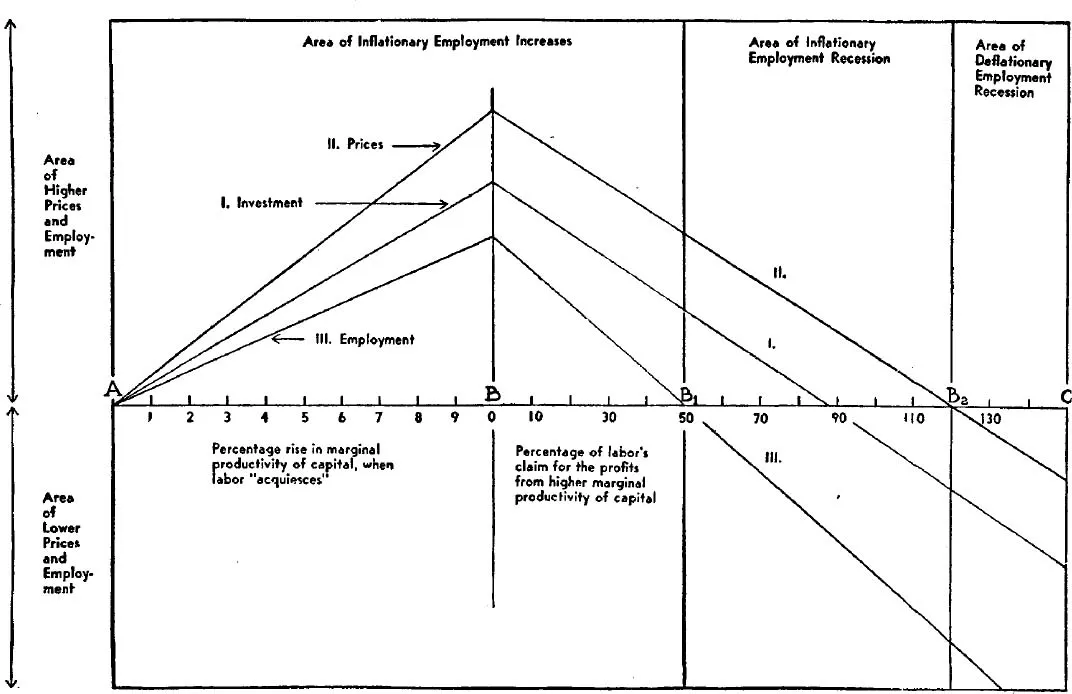
2. Under the condition that labor claims smaller or greater parts of the profits from increased capital productivity (B-C), investment (I) declines, or rather, it rises less than formerly assumed, because the curtailment of profits works as a deterrent to investment; prices (II) and employment (III) also decline, or rather rise to a lesser degree. Employment is curtailed more than prices because labor becomes even more expensive than capital in relation to productivity. Again the demand spends itself more and more on prices and less and less on output, and again the structure of the economy becomes more “capitalistic.” But until a certain point (B1) is reached, employment does not fall below the level it had reached before the productivity of capital increased.
Up to point B1 there is still some price and employment increase, but at that point there is only price inflation, and no employment increase. This is the point up to which labor can participate in the increased productivity of capital without outpricing itself and creating unemployment. The historical rise of the living standard of the masses, through increased productivity of capital, must, in general, have taken place according to this pattern.
3. After point B1 is reached, the increasing claims of labor, while still leaving some possibility for an increase in investment, reduce employment to a lower level than the original. Prices continue to decline, but less than employment. The result is a combination of price inflation and employment recession, a situation that could be termed low employment inflation, or better, inflationary employment recession. This concept of an inflationary employment recession seems to be unknown to modern literature, and the possible occurrence of such a phenomenon is hardly mentioned. We believe, nevertheless, that the concept is of substantial, practical, and theoretical importance.
There is still to be considered the situation in which labor goes further with its claims, until investment shrinks to such an extent that not only employment and investment but prices, too, are below their original level. This is the point (B2) where price inflation turns into price deflation. It is the traditional pattern of a deflationary employment recession that develops, with the difference, however, that the deflation affects employment much more than prices and with the further difference that it is the high cost of labor and not the high cost of capital—in comparison with productivity—that starts the decline. The cause-and-effect relationship is no longer (to paraphrase a well-known vulgar-Keynesian formula) “idle money, idle men” but “idle men, idle money.”
ILLUSTRATIVE EXAMPLES
For illustration of the results of the various combinations of changes in capital profits and wages we refer to the following examples:
1. Inflationary employment increases. Though it may seem paradoxical, in the light of all the regulations that prevailed, the best recent example of an inflationary employment increase is furnished by the later part of the war boom. Investment, in the broadest sense, increased substantially in the expectation of high profits on war contracts; wages, meanwhile, were more or less stabilized by government decree. This means that the economy remained for the entire time within the “Keynesian range” or the “reaction-free period,” with the result that there was extremely high employment. It is true that to a certain degree the war boom was due to an illusion on the part of labor as well as on the part of entrepreneurs. Labor failed to notice the lowering of its real wages because under the system of price ceilings goods eventually became” scarce rather than expensive. On the other hand, labor accumulated, in the form of savings, that part of wages that it could not spend, as did the entrepreneurs with that part of their profits that remained after excess profit taxation. If one considers, however, that these savings have their counterpart in an enormously increased public debt—which, after all, is the debt of everyone in the community—one realizes that, on the whole, entrepreneurs invested and/or labor worked for a compensation which was much less than they imagined. So the war boom was really created by the illusion or the hope that if anyone had to foot the bill, it would be the other fellow.29 Nevertheless, so long as the “illusion effect” lasted, an inflationary prosperity developed. Money spent itself in higher output, and, where price ceilings were not established or could not be enforced, in higher prices.
2. Inflationary employment recession. A drastic example of this phenomenon was furnished in Europe during the hyperinflations after World War I. Since the budgets of many countries were hopelessly unbalanced, entrepreneurs expected huge inflation profits from nothing but building up inventories. The high profit expectations from this specific use of capital led to ever higher investment. As long as wages were fixed only after a certain time-lag, or not at all, in accordance with the declining purchasing power of money, labor remained extremely cheap. It was possible to employ even the most unproductive units, and consequently there was not only full employment, but even overemployment. As time passed, however, the masses learned to see through the money illusion and claimed increasing parts of the inflation profits. Finally, so-called “sliding wage scales” (Gleitlöhne) or “valorized wage rates” (wertbeständige Löhne) were introduced. Wages were paid at very short intervals, sometimes daily, according to a cost-of-living index. The result was an inflationary employment recession in many respects similar to that described above. Employment began to fall, and at certain times and places unemployment reached sizable proportions. Money inflation, however, went on despite this curtailment of inflation profits by the introduction of sliding wage scales; for the credit demand of the most important “entrepreneur”—the government—was insensitive to such profit reductions, or, for that matter, to the high interest it had to pay on its borrowings. Governmental obligations from past and current expenditures had to be met at any price. So “investments” of the government (curve I of our graph) remained high. Prices (curve II) went even higher, whereas employment (curve III) declined. It was the time when entrepreneurs no longer cared for production, but only for buying and reselling, that is, speculation. Money spent itself on ever higher prices and on ever lower output.
The stabilization of the currency through stabilization loans, high taxation, and the like, put an end to the government’s deficit spending. Expenditures declined. The stabilization crisis—a deflationary employment recession—developed.
3. Deflationary employment recession. Besides the case just mentioned, such a phenomenon was clearly beginning to develop in the United States after World War II when prices remained fixed while wages were allowed to rise. When the ability of industry to absorb the high wages through increased productivity did not materialize to the extent anticipated, many enterprises, and particularly the small ones, were threatened with losses that would have made them close down. It was under the threat of a deflationary employment recession that the O.P.A. raised or abolished ceilings, whereupon prices advanced. This, incidentally, led to the popular belief that wage increases are inflationary, and not deflationary as we have contended. But what led to inflation in this instance was the fact that government agencies allowed prices to rise and that the consumer was able to pay the higher prices. The O.P.A., it is true, was forced to its actions by the preceding wage increase. Within a system of given price and profit expectations, however, wage increases must lead to deflationary employment recessions.
It is not at all improbable that the next major depression in this country will develop according to the pattern of the deflationary employment recession described above. This would mean that it would not be an interruption of the demand by liquidity preferences in the widest sense, accompanied by the traditional monetary and credit stringency, but the reluctance of marginal entrepreneurs to pay wages in excess of the marginal productivity of labor that would start the contraction process and give the developing depression its peculiar character.
CONSEQUENCES OF THE NEW ASSUMPTIONS
The new assumptions lead to a number of theoretical and practical consequences that differ in essential respects from traditional views.
For one thing, there is the matter of “analysis in terms of effective demand.” “The division of the determinants of the economic system into the two groups of given factors and independent variables is, of course, quite arbitrary from any absolute standpoint. The division must be made entirely on the basis of experience, so as to correspond on the one hand to the factors in which the changes seem to be so slow or so little relevant as to have only a small and comparatively negligible short-term influence. . . .”30 Clearly, the “effective demand analysis” is an outgrowth of the assumption that changes in the supply price of labor are “so slow or so little relevant as to have only a small and comparatively negligible short-term influence.” But if changes in the supply price of labor are no longer slow and of little relevance in comparison with the changes in demand, the approach no longer makes sense. It is no longer appropriate to base an employment theory on a system in which wages are fixed, in which the credit volume is an independent variable, and employment the dependent variable.
It is not necessary to decide whether an analysis in terms of effective demand alone was justified ten years ago.31 Today, an analysis in terms of effective demand that is not supplemented by analysis in terms of effective supply, especially of labor, is not justified in any circumstances.32 It seems both illogical and certain to lead to false conclusions if one indulges (as is so often done) in elaborate estimates of employment at various levels of effective demand, from private or public spending, without making the corresponding estimates of the employment that is created by the same effective demand at various wage levels.
A second matter for consideration is that the devices to combat unemployment known as “government deficit spending,” “compensatory spending,” or “functional finance” are clearly an outgrowth of the idea that in the general case more investment leads to more employment. If our analysis is correct, this will be true only under special conditions. Thus, before applying government spending one has to study carefully to what extent the wage situation has caused the unemployment, and whether and to what extent wages can be held inflexible in an upward direction. Unless this is done, government spending, apart from all fiscal difficulties, will only lead to price inflation. The indiscriminate creation of purchasing power every time private demand slows down for whatever reason or whenever full employment is not achieved, as advocated by the proponents of “functional finance,” is indeed “like almost every important discovery . . . extremely simple.”33 It is, in fact, not only extremely simple but also an extreme oversimplification of very complicated problems. And if another proponent of “functional finance” wishes to “persuade people that inflation is impossible as long as there is serious unemployment, for under those circumstances a rise in money demands leads to a rise in output and employment, not to a rise in prices,”34 we should like to take the opposite position: people—economists and laymen alike—should be persuaded that even with serious unemployment the rise in money demand may, under today’s conditions, lead to a rise in prices rather than to a rise in output or employment.35 The widely held belief in an a priori parallelism of investment and employment is not justified.
* Appeared first in Social Research, June 1947.
1 Keynes, The General Theory of Employment, Interest, and Money, New York, 1936, Chapters 2, 20, and 21.
2Ibid., pp. 3 and 13.
3 Keynes, “The Balance of Payments of the United States,” in Economic Journal (June 1946), p. 186.
4 Keynes, General Theory, p. 3.
5 David Hume, Essays Moral, Political and Literary, London, 1907, part n, Essay 3, “Of Money,” p. 294.
6 Joseph A. Schumpeter, Business Cycles, New York-London, 1929, p. 1019.
7 Keynes, A Treatise on Money, London, 1930, vol. 1, pp. 283 ff.
8 Keynes, General Theory, p. 8.
9Ibid., p. 9.
10Ibid., p. 284.
11Ibid., p. 289.
12Ibid., p. 289.
13Ibid., p. 285.
14 In my book, Volkswirtschaftliche Theorie des Bankkredits, 1st ed. (Tübingen, 1920), where I presented an “investment theory of employment” very similar to that of Keynes, I even then explicitly renounced the idea that less productive labor can be paid for out of falling real wages, stating that “the wage increase is not only nominal but real; for the price of goods will tend, because of the competition among entrepreneurs, always to equal their costs. As these will have increased only by the outlay for wages and not by the outlay for capital, the prices of goods will have risen only so far, that is, by less than wages. Thus there remains a real increase in the remuneration of labor, since the compensation of the other participants, though nominally the same, has been devaluated by the increase in the prices of goods” (p. 137).
In General Theory, Keynes later presented the same idea in the following form: “Since that part of his profit which the entrepreneur has to hand on to the rentier is fixed in terms of money, rising prices, even though unaccompanied by any change in output, will re-distribute incomes to the advantage of the entrepreneur and to the disadvantage of the rentier, which may have a reaction on the propensity to consume” (p. 290).
15 Keynes, General Theory, p. 296.
16Ibid., p. 301.
17 See Chapter 6, “Compensating Reactions to Compensatory Spending.”
18 Keynes, General Theory, p. 291.
19Ibid., p. 303.
20 A notable exception is Hans Neisser’s article, “Realism and Speculation in Employment Programs,” in International Postwar Problems, vol. 2, no. 4, October 1945, pp. 517-32; see also Neisser’s “The New Economics of Spending: A Theoretical Analysis,” in Econometrica, vol. 12, nos. 3 and 4, July-October 1944, pp. 237-55. Otherwise volumes upon volumes have been written in the last decade on achieving full employment by increasing investment, without mentioning the possibility of compensating wage rises, or, for that matter, the importance of the absolute height of the wage level.
21 See Howard S. Ellis, “Monetary Policy and Investment,” in American Economic Review, vol. 30, no. 1, March 1940, Supplement, Part II, pp. 31-32.
22 Keynes, General Theory, p. 284.
23Ibid., p. 289.
24Ibid., p. 299.
25 See Alvin H. Hansen, “The Postwar Re-employment Problem,” in International Postwar Problems, vol. 1, no. 1 (December 1943), pp. 31-40.
26 On this question see Chapter 15, “The Investment Gap,” pages 192-193.
27 See note 14.
28 The justification and the implications of the assumption of a practically stabilized interest rate are treated in Chapter 13, “Anachronism of the Liquidity Preference Concept,” pp. 162-163.
29 See Chapter 6, “Compensating Reactions to Compensatory Spending.”
30 Keynes, General Theory, p. 247.
31 See Chapter 6, p. 62.
32 See the corresponding remark by D. McC. Wright in “The Future of Keynesian Economics,” in American Economic Review, vol. 35, no. 2 (June 1945), p. 299.
33 Abba P. Lerner, “Functional Finance and the Federal Debt,” in Social Research, vol. 10, February, 1943, p. 39.
34 Kenneth E. Boulding, The Economics of Peace, New York, 1945, p. 215.
35 W. H. Beveridge, in his Full Employment in a Free Society, London, 1944, demands strict control of the labor supply. This is probably nothing but the tacit acknowledgment of the changes in the labor supply we have described. Yet the restoration of a free labor market remains as an alternative—and a desirable one, at least as long as we wish to live in a truly free economy, rather than in Beveridge’s pseudo-free economy.
The Economics of Illusion
Read the whole book online · Book details
Free to read online and to download from this archive.