
Chapter 24 of 27 · The Menace of the Herd, or Procrustes at Large by Erik von Kuehnelt-Leddihn
I. Notes
PART I
THE CULT OF SAMENESS
I
IDENTITY VERSUS DIVERSITY
1 “Eternity is a reminder of his (the Leftist’s) own limited existence and the unavoidable end. To escape this memento mori, the Leftist seeks the great cities, as far away as possible from real life and its significations of age and death. Hence his gregariousness. The meaning of the phrase O sola beatitudo, o beata solitudo will ever remain unknown to him. He needs not only human echoes to reaffirm and bolster up his faith, but also “distractions” in order not to be alone, for to be alone is to see death. Solitude is for him a complete waste of time — a reminder of death and a flirtation with madness.” — E. v. Kuehnelt–Leddihn, “The Anatomy of the Leftist.” The Examiner, Vol. II, No. 2. Cf. also, William Trotter, Instincts of the Herd in Peace and War (New York, 1919), p. 31, who prophesies, “Loneliness will be a real terror, unsurmountable by reason.”
2 “It is only by such external functions as the millions have in common, their uniform and simultaneous movements, that the many can be united into a higher unity: marching, keeping in step, shouting ‘Hurrah’ in unison, festival singing in chorus, united attacks on the enemy. These are the manifestations of life which are to give birth to the new and superior type of humanity. Everything that divides the many from the one, that fosters the illusion of the individual importance of man, especially the ‘soul,’ hinders the higher evolution and must consequently be destroyed.” — René Fülöp-Miller, The Mind and Face of Bolshevism.
3 “The Mediocre Man is the natural enemy of the man of genius and conviction: an enemy at the same time most cruel and ferocious. He opposes to the man of genius that most cruel and redoubtable of forces: the power of inertia. The Mediocre Man is much more evil than he appears. His basic wickedness is hidden beneath his external frigidity. He peddles against the enthusiasts his endless little infamies, which, because they are little, are never taken for infamies. He is fearless, knowing he has behind him the multitudes of his similars. He never fights, knowing he has gained the victory in advance.” — Ernest Hello, The Mediocre Man, trans, by David Gordon. America, Oct. 17, 1937.
This tallies with a curious confession based upon the confusion of liberalism and democracy. Denis de Rougemont and Charlotte Muret in their book The Heart of Europe (New York: G. P. Putnam, 1941) write on p. 114: “It must be admitted that if Switzerland is a land of liberty it is also a land of intolerance towards the best and the worst — the head and the tail of the class. Perhaps democratic liberty must be paid for at this price.”
4 “The process of success consists in marching with the others; the process of glory consists in marching against the others.” — Ernest Hello, The Mediocre Man.
5 Georg Simmel, Philosophische Kultur, Leipzig, 1911, pp. 30–31.
6 Statistics furnished by Dr. Katherine B. Davis in Factors in the Sex-Life of Twenty Two Hundred College-Women: of 1200 unmarried women the following replies came concerning the question whether during their lives they had strong emotional relations with other women of a homoerotic character: Yes — 605, 50.4 per cent; No — 576, 48 per cent; No answer — 19, 1.6 per cent. Of these 605 who confessed to have had an emotional love to other women the following proportion admitted purely platonic sentiments — 293; Lesbian practices — 234; clear recognition of the sexual character of their infatuation — 312.
7 “Equality as it is currently pursued is incompatible with true liberty; for liberty involves an inner working with reference to standards, the right subordination, in other words, of man’s ordinary will to a higher will. There is an inevitable clash, in short, between equality and humility.” — Irving Babbitt, Democracy and Leadership.
8 Passage from the speech of Comte de Montalembert at the public meeting of the French Academy, Feb. 5, 1852, on taking the fauteuil of M. Droz:
“. . . Not having known how to read the history of this world which demonstrates that everywhere democracy has degenerated into despotism, it [the French Revolution] undertook to found democracy in France . . . it dared to condemn itself to fight against the two basic principles of society in whatever form they might express themselves, authority and inequality: I say inequality, which is the obvious condition for all activity and fertility in social life; which is at the same time the mother and the daughter of liberty, whereas equality is only conceivable through despotism. This certainly does not apply to Christian equality, the proper name for which is equity, but to that democratic and social equality which is only the exaltation of envy, the mirage of jealous incapacity, which was never anything but a mask and which could become a reality only after the destruction of all merit, of all virtue.”
9 “Shigalyov is a man of genius. He invented equality. In his copybook it is well described. He provides for a mutual espionage. Each member of the society has to supervise the others and to denounce them. Everybody belongs to all and all belong to each individually. All are slaves and are equal in their serfdom. In the extreme case there is calumny and murder, but the most important thing is equality.” — F. M. Dostoyevski, The Possessed.
10 Maritain wrote in the autumn number of the Études Carmélitaines 1939: “The term Unity of Mankind (Unité du genre humain) is the truest name for the natural equality amongst men. It helps to purify the notion of that equality from all erroneous connotative associations originating either in geometrical imagination or levelling vindication. Arithmetical equality between two numbers excludes all inequality between them, but natural equality amongst men, or the unity of mankind, strives toward a dissolution into individual inequalities.”
11 Alexis Carrel says:
“Another error, due to the confusion of the concepts of human being and individual, is democratic equality. This dogma is now breaking down under the blows of the experience of nations. It is, therefore, unnecessary to insist upon its falseness. But its success has been astonishingly long. How could humanity accept such a faith for so many years? The democratic creed does not take account of the constitution of our body and of our consciousness. It does not apply to the concrete fact which the individual is. Indeed, human beings are equal. But individuals are not. The equality of their right is an illusion. The feeble-minded and the man of genius should not be equal before the law. The stupid, the unintelligent, those who are dispersed, incapable of attention, of effort, have no right to a higher education. It is absurd to give them the same electoral power as the fully developed individuals. Sexes are not equal. To disregard all their inequalities is dangerous. The democratic principle has contributed to the collapse of civilization in opposing the development of an elite.” — Man the Unknown (New York: Harper and Brothers, 1935), p. 271.
12 “For him the very image of beauty was inseparable from diversity. A society can be beautiful only if founded on truth, inequality and dissemblance. That was the axiom of the social philosophy of Leontieff.” — Nicolas Berdiaeff, Constantin Leontief, Paris, 1937.
13 Cf. Gustave Thibon, L’Inégalité, Facteur D’Harmonie Études Carmélitaines, autumn, 1939.
14 Professor A. T. Hadley of Yale in his book The Conflict Between Liberty and Equality writes:
“In fact the signers of the Declaration of Independence can hardly have meant what they said to be taken literally. Most of them were aristocrats, many of them were slave-holders, some of them defended human slavery on principle. They were simply stating a theory of democratic government as it was understood in their time and as it had been expounded by the great prophet of modern democracy — Rousseau. In this theory great stress was laid on the contrast between the natural status of man as God had created him and the legal status which other men had imposed upon him. . . . Whether such a state of nature had ever actually existed was a question about which neither Rousseau nor Jefferson nor Franklin greatly troubled themselves. The emphasis on historic fact as distinct from historic fiction is something quite modern.”
15 The summary below is taken from Dr. Geoffrey O’Connell’s Naturalism in American Education. He describes the underlying philosophy of Teachers College, Columbia — the philosophy of Professor John Dewey — as follows:
“We live in a universe without final ends, forms or assignable limits, either internally or externally, of which continuous evolutionary change is all that can be predicted.
“Man is as much a product of this process as are all other visible things, and is strictly continuous with nature. There is nothing transcendent to the visible universe and man’s home is within it. His thinking is a pure product of experience and cannot transcend it. There is no such thing as metaphysics, which is merely a collection of empty dreams and idle fancies. Man has no soul, mind or reason as metaphysicians understand those words. Ideas are merely plans of operations to be performed, not statements of what is or has been. They are merely hypotheses. Experience evolves new standards and values. All human affairs whether personal or associative are merely projections, continuations or complications of the nature which exists in the physical and pre-human world.
“God as a being does not exist; He is merely that unification of Ideal values that is essentially imaginative in origin when the imagination supervenes in conduct. There is no such thing as religion in any sense of relation to God. Faith in the sense in which the Western civilization understood it is impossible for the ‘cultivated mind’ of the Western world today.
“There is no enduring moral law of fixed principles. Morals are purely social. The question of ‘ought’ is merely one of better or worse in social affairs. The only moral end is an abundant life shared by all, achieved by growth itself. There are no absolute moral standards; the moral and the social quality of conduct are identical. There is no abiding truth; truths change in experience and can become false. There is absolutely nothing absolutely and unchangingly good.”
This relativistic spirit is, in the United States, not something entirely new. Professor Louis Mercier of Harvard leads it partially back to Unitarian agnosticism and relativism. Ralph Waldo Emerson was one of its protagonists. On the southern walls of Hunter College in New York City we find the following “immortal words” chiseled in stone: “We are of different opinions at different hours but we always may be said to be at heart on the side of truth.” Only Nazis have completed successfully with such a contempt for the laws of logic.
16 “But, one would say, where then is justice?
“It is not in egalitarianism. Egalitarianism is only the counterfeit of justice; it can be the exact opposite, we have seen that. Neither are all inequalities injust. Which means that equality or inequality are one thing and justice is another. Justice consists in giving everybody his due.” — Agénor de Gasparin, L’Égalité, Paris.
17 Dean Inge in his Protestantism admits that the calvinistic belief in predestination drove many people into suicide. Yet everybody who reads Luther’s De Servo Arbitrio will be impressed by the fact that this reformer was, not less than Calvin, a bitter enemy of the concept of free will which he considered to be more or less some sort of optical delusion.
“Ah, Lord! Why should we boast of our free will as if we were able to do anything, ever so small, in divine and spiritual matters.” CCLXII. Table Talks of Martin Luther, trans, and ed. by William Hazlitt, Esq., London, 1857.
18 “If one goes through the streets of St. Petersburg looking at the expressions of the passers-by it is easy to guess who is a Communist. Their faces are not characterized by a luscious or a beastly satiety but by boredom, the transcendental boredom of the ‘Paradise on Earth,’ the ‘Realm of Antichrist.’”—Myerezhkovski, The Realm of Antichrist.
19 In his encyclical Iamdudum Cernimus (March 18, 1861), Pope Pius IX condemned the following thesis:
“The Roman Pontiff can, and ought, to reconcile himself, and come to terms with progress, liberalism and modern civilization.” These words are here understood in the wrongful meaning which modern secular society gives to them. Similarly, in Quanta Cura, the following teaching was branded as an error: “Popular will expressed in so-called public opinion or any other manner constitutes the supreme law independent of either divine or human authority.” And the Syllabus, issued in the same year and added to the encyclical, condemns the following teaching: “Authority is nothing but the sum of numbers and material forces.” On “Majoritism,” see Max Adler, Démocratic Politique et Démocratic Sociale, Bruxelles, 1930, p. 117.
20 “To declare that authority resides in the whole multitude as in its proper subject and without being able to emerge from it and to exist in such or such responsible men — this is a trick permitting irresponsible mechanisms to exercise power over men, without having authority over them. Thus considered, power (the power of the State) masks anarchy. But, as in every case where nature is violated, such power tends to become infinite. Concentrating all their attention on the question of the origin of power, and reassured by the idea that in the democratic regime the power of the State emanates from the people, democracies of the Rousseauist type not only grant the State all the usurpations of power, but they tend toward these very usurpations. Proudhon admirably described and predicted this process. Moreover, the mass as such is by hypothesis the subject proper of sovereignty and yet lacks political discernment, except in quite simple and fundamental matters where human instinct is surer than reason. This results in an original equivocation, because those delegated by the multitude will actually direct it, but only as if the multitude were directing itself. Above all, the exercise of sovereignty under such conditions will require myths. Now, to dispense myths and collective images, can anything be more useful than a dictatorship — a dictatorship where the entire sovereign multitude is reabsorbed in the unique person of a half-god, sprung forth from this multitude? Thus, through an inevitable dialectic, and so long as a new fundamental principle has not been found, democracies of the bourgeois liberal type tend to engender their contrary, the totalitarian State.” — Jacques Maritain, Scholasticism and Politics, Trans, ed. by Mort. Adler.
N.B. But is the totalitarian state really a “contrary”?
Further reference material:
On the nature of sex:
E. I. Watkin, The Bow in the Clouds, London, 1931, p. 108.
On uniformism and social differentiation:
George Santayana, The Life of Reason (Reason in Society), New York, 1932, pp. 91, 127–128.
About political-racial-ethnic herdism:
A. Hitler, Mein Kampf, Munich, 1939, p. 433.
(Hostility toward the learning of foreign languages), pp. 465 ff.
(Authority and “Popularity”), p. 579.
Donoso Cortés, Oeuvres, published by his family, Paris, 1858, pp. 520 ff.
About the spirit of average man:
Ralph Borsodi, This Ugly Civilization, New York, 1933, specially pp. 223 ff.
II
OCHLOCRACY AND DEMOCRATISM
21 About the modern, nonantique character of democracy, see Woodrow Wilson, cited by Christian Gauss in Democracy Today.
22 The Hollywoodian happy end and the idea that the good ones are rewarded and the wrongdoers are punished here on this earth had already been foreshadowed by such Puritans as the Rev. Richard Baxter in his Christian Directory, Ch. I.
23 The first to point out the danger of seeing in Christianity a mere social panacea was Compton Mackenzie in the closing chapter of Sinister Street (London, 1914).
24 About the “liberal” materialistic optimism of Gladstone, see Kerr Boyse Tupper, cited in Modern Eloquence, ed. Thomas B. Reed, Vol. X.
25 About the relativity of Progress, see, Constantin Leontieff, quoted by Nicolas Berdiaeff in Constantin Leontieff, Paris, 1937.
26 Even Aristotle says (Politics, 1338 b): “To be always seeking after the useful does not become free and exalted souls.”
27 “I do not look upon equal voting as among the things which are good in themselves, provided they can be guarded against inconveniences. I look upon it as only relatively good; less objectionable than inequality of privileges grounded on irrelevant or adventitious circumstances, but in principle wrong, because recognizing a wrong standard, and exercising a bad influence on the voter’s mind. It is not useful, but hurtful, that the constitution of a country should declare ignorance to be entitled to as much political power as knowledge.” — John Stuart Mill, Considerations on Representative Government, New York, 1882, p. 188.
28 Without much logic the proposal to make democracy “real” by giving the franchise to children has been attacked by Professor Ph. Kohnstamm in his Democratie (Haarlem, 1914).
29The common longing is to be similar. Garb conforms to mass conceptions; divergence from the standard is resented. The mind derives its conclusions around it. Individual discrimination almost disappears; the desire is to be of the mass; for numbers indicate authority and certitude. In numbers there is strength; the man who stands apart must be wrong. He is suspected, and he suspects himself. It is better to yield to the general pressure. He follows the mob; he acts with the mob; his mind is the mob mind.
“To secure action from him the mass must be moved; he can be depended on to follow. It is more important to show him that he is with the larger number than to prove to him that he is right. He avoids forlorn hopes; they excite his derision. In the political world he desires more to be with the winning side than to stand firmly by a principle, and every fresh attempt to attract him has this as a fundamental handicap.” — James N. Wood, Democracy and the Will to Power, New York, 1921, pp. 82, 83.
30 The masses in “democratic” countries are often convinced that their representatives should be nothing else but gramophones of their opinions. Jacques Maritain does not share this view. He writes in Scholasticism and Politics (trans, ed. by M. Adler):
“In his famous address delivered in 1863, Abraham Lincoln declared that ‘government of the people, by the people, for the people, shall not perish from the earth.’ Let us observe, in this formula, that the words by the people need comment in order to avoid all ambiguities and to prevent Rousseauist interpretations. Taken in their genuinely concrete sense, I do not think, that these words mean a government exercised by the people, whose elected representatives would then serve as a pure instrument, but rather a government exercised by the representatives of the people, or by the people in the person of its representatives.”
31 Rousseau’s concept of liberty is utterly democratic. He wrote: “To the end, therefore, that the social contract should not prove an empty form, it tacitly includes this engagement, which only can enforce the rest, viz., that whoever refuses to pay obedience to the general will, shall be liable to be compelled to it by the force of the whole body. And this is in effect nothing more than that they may be compelled to be free.” — Contrat Social, I, 7; cf. Nicholas Berdyaev, The End of Our Time, New York, 1933, pp. 174–178.
32 H. L. Mencken in his Notes on Democracy observes that: “The doctrine that a man who stands in contempt of the prevailing ideology has no rights under the law is so thoroughly democratic that in the United States it is seldom questioned save by romantic fanatics, robbed of their wits by an uncritical reading of the Fathers.”
33 Cf. Friedrich Naumann, Demokratie und Kaisertum (Berlin: Schöneberg, 1904), p. 92.
34 “As surely as the Nobility is the Estate, so surely the nobility fails to feel as a party, though it may organize itself as one. It has in fact no choice but to do so. All modern constitutions repudiate the Estates and are built on the Party as self-evidently the basic form of politics. The nineteenth century is the heyday of party politics. Its democratic character compels the formation of counterparties, and whereas formerly, as late even as the eighteenth century, the Tiers constituted itself in imitation of the nobility as an Estate, now there arises the defensive figure of the Conservative Party, copied from the Liberal, dominated completely by the latter’s forms, bourgeois-ized without being bourgeois, and obliged to fight with rules and methods that liberalism has laid down. It has a choice of handling these means better than its adversary or of perishing.” — Spengler, Decline of the Occident, II. The decay and hopeless struggle of the conservative and clerical parties all over the European Continent only confirms the fact that one cannot expect a fish to win a fight on land, outside of its natural element. The temporal and spiritual aristocracies have never had a real chance to cope successfully on the base of majoritism with the masses endowed with political power and imbued by the fausses idées claires.
35 The old Aragonese nobles, ricos hombres de natura, were always particularly turbulent, reserving to themselves the right to make war individually, and to throw off allegiance to the king — their peer — when it suited. The well-known oath to their monarch is a classic of independence: “We who are as good as you swear to you who are not better than we, to accept you as our king and sovereign lord, provided you observe all our statutes and laws; and if not, no.” (Si no, no). — Allison Peers, Spain.
36 “Real kingship — hard as it may be to get this idea into the heads of our narrow-minded democrats — seems to be created by God for the special purpose of protecting the vast masses of a people against the possibility of violation by a popular elite.
“. . . The popular elite, be it a cultural, a social or an economic one does not want, under ordinary, normal circumstances to recognize a master or at least only the semblance of one, a fact which is forgotten again and again or which is purposely kept quiet. Only in extreme danger and distress this elite suffers a master and king, should one be at hand. But for the masses a king standing above all classes and parties is under all circumstances necessary and desirable.” — Dr. Schmidt-Gibichenfels, Die demokratische Lüge und der Krieg. Berlin, 1915.
37 Money, money, always money — that is the essence of democracy. Democracy is more expensive than monarchy; it is incompatible with liberty.” — P. J. Proudhon, Solution Du Problême Social.
III
THE BOURGEOIS AND CAPITALISM
38 “The bourgeois lacks piety. The first battle in which he engages to establish his superiority is that against the priests. In repeated minor engagements with the servants of the Church he prepares himself for the great conquests. In rallying the priests who do not know how to answer these rallies, he becomes conscious of what he is worth. He had been told not to meddle in matters of religion, to submit himself to what his pastors told him. But are the servants of God any better, any more intelligent than he himself? One is told that a preacher has to be a saint; but how many of that type are there to be found? And the bourgeois will insist that it is better to be an honest man than to try to become a saint.” — Bernard Groethuysen, Origines de L’Esprit Bourgeois en France, Vol. I.
39 “So we can understand how Calvinism helped to create that curious product, the modern business man, who works like a slave, and sometimes rules like a slave driver, in accumulating money, which his tastes and principles forbid him to enjoy, and about the value of which to himself or to others he asks no questions. It has been said that the successful money-maker of today is either a child of the Ghetto or a grandchild of John Calvin. No system was ever so effectual in promoting that kind of progress which is measured by statistics. If you can convince a nation that steady industry in profitable enterprise is eminently pleasing to God, but that almost all ways of spending money unproductively are wrong, that nation is likely to become very rich.
“We can study the working of this system best in America and Scotland.” — Dean Inge, Protestantism.
40 “The Protestants, having established the sacrament of the word and thereby killed the Eucharist, proceeded to chain it to the letter. They started teaching the people not to listen but to read.” — Miguel de Unamuno, La Agonia Del Cristianismo, Buenos-Aires, 1938, p. 43.
41 Advertising seems to add a specific value to goods in the American public opinion, otherwise advertisers would not point out that their merchandise is “nationally advertised.” People are sometimes even inclined to prefer inferior advertised goods (suspecting their inferiority) to better nonadvertised brands out of a deep fear to be in the possession of things “not generally known or valued.” What they possess they want to have (at least in their form) in common with others. This picture ought to be supplemented by those freakish human beings who read publications for the sake of their advertisements without an intention of buying. The general optimism spread by clever advertisement is probably only part of their magnetic attraction. On suggestibility and herdism, cf. Boris Sidis, The Psychology of Suggestion, Preface by William James, New York, 1903.
42 “Civilization is by its nature bourgeois in the deepest spiritual sense of the word. ‘Bourgeois’ is synonymous precisely with the civilized kingdom of this world and the civilized will to organized power and enjoyment of life. The spirit of civilization is that of the middle classes; it is attached and clings to corrupt and transitory things; and it fears eternity. To be a bourgeois is therefore to be a slave of matter and an enemy of eternity. The perfected European and American civilizations gave rise to the industrial-capitalist system, which represents not only a mighty economic development but the spiritual phenomenon of the annihilation of spirituality.” — Nicolas Berdyaev, The Meaning of History, trans. George Reavey, New York, 1936.
43 Six years ago the socialist writer Naomi Mitchison demanded in an article in the New Statesman and Nation, that all nuns should be excluded from the right to vote. A young Catholic writer, James Oliver, wrote a very appropriate answer but according to the spirit of true “democracy” it was never published by that paper. The Colosseum printed it later. It ran as follows:
“Sir — There have been some very interesting criticisms of the electorate. The most profound was that of Miss Naomi Mitchison, who points out how unfitted are nuns for the onerous responsibilities of voting. People should certainly be disqualified from voting, if they hold any form of religious belief; since this necessarily implies that they are not giving their whole minds to politics. To give anything less is to make a farce of Democracy.
“There is another type of voter, who should also be disqualified, he who persistently votes perversely. Miss Naomi Mitchison has shown very clearly that nuns are among the worst offenders in this voting for the Right. They should certainly be disqualified; also colonels, public-house-keepers and music-hall comedians, all of whom are notoriously Right-minded. I apologize for this unfortunate phrase. The electorate should be pruned still further. Indeed, democracy cannot really be said to have triumphed until voting is confined to the readers of your paper. Herr Hitler has been working along these lines, and very clearly, we live in a new age of democracy, of which he is the New Statesman.
I am, sir, your obedient servant,
James Oliver.
44 “A deist is a man who in the short time of his existence has not had the time to become an atheist.” — H. de Bonald, Collected Works, VI, 253, Paris, 1817.
45 “1. Individualist liberalism is of the flora of the eighteenth century; it inspired, in part, the legislation of the French Revolution, but it died with that event.
“2. The characteristic creation of the nineteenth century was precisely collectivism. It was the first idea invented by that century, almost at birth, and it grew throughout its hundred years to the point of flooding the entire horizon.” — José Ortega y Gasset, Toward a Philosophy of History, New York, 1941.
46 “I am a Materialist,” was a statement made by Jefferson. The Founding Fathers were far from being a homogeneous group. There was a great latitude of thought ranging from a Caroll to a Jefferson. We must bear in mind that Jefferson’s Religious views were not typical for the Founding Fathers. He was an extremist, a “radical,” deeply suspected by most of his collaborators.
47 “A nobleman is not only a subject, he is the most subordinate of all.” — H. de Bonald, VI, 84.
48 “Absolute bourgeoisie is absolute swinishness.” — D. Myerezhkovski, The Blossom of the Bourgeois.
49 Freedom from vanity is an absolute requirement for a good teacher.
The leftist leanings of the teacher is also to be found in such countries where the level of secondary and “college” education as well is traditionally low. American high school teachers show most of the characteristics of Continental grade school teachers and it must be said in all candor that their colleagues in colleges show frequently very similar inclinations. — The author. As to Nazism among teachers cf. Franz Neumann, Behemoth, New York, 1942, pp. 377 and 379.
50 “To observe processes and to construct means is science; to criticize and to co-ordinate ends is philosophy: and because in these days our means and instruments have multiplied beyond our interpretation and synthesis of ideals and ends, our life is full of sound and fury, signifying nothing. For a fact is nothing except in relation to desire; it is not complete except in relation to a purpose and a whole. Science without philosophy, facts without perspective and valuation, cannot save us from havoc and despair. Science gives us knowledge, but only philosophy can give us wisdom.” — Will Durant, The Story of Philosophy, p. 3, New York, 1926.
On the concept of “progress” see also René Guénon, East and West, London, 1941, pp. 23 ff., 44–45.
51 “He who in science progresses
And in morals regresses
One step forward makes
And two backward takes.”
Nevaira, Gazetta Ladina, July 21, 1939.
52 An excellent comparison between a Catholic “backward” and a Protestant “progressive” culture can be found in E. I. Watkin’s “Introduction to the Philosophy of Peter Wust,” Essays in Order, No. 2. (British edition).
53 The General: “Speaking of saints it puzzles me how so many soldiers could find a place on the same plane as monks and see their profession preferred to all peaceful, civilian professions if at all times war had been considered a necessary evil such as the liquor trade or perhaps something even worse. Evidently those Christian nations who recognize saints (not only the Russian ones but approximately also the others) have not only honored the military career but honored it in a very special manner; and of all professions it was the one which alone had the reputation of instructing its best representatives in the practice of sanctity. Such an opinion is contrary to the present movement against wars.” — Vladimir Soloviev, Tri razgovora, Munich, 1920.
54 “It may be plausibly argued that the faults of the bourgeois are no greater than those of the leading classes in other ages, while his virtues are all his own. But the fact remains that the typical leaders of bourgeois society do not arouse the same respect as that which is felt for the corresponding figures in the old regime. We instinctively feel that there is something honourable about a king, a noble, or a knight which the banker, the stockbroker or the democratic politician does not possess. A king may be a bad king, but our very condemnation of him is a tribute to the prestige of his office. Nobody speaks of a bad bourgeois; the Socialist may indeed call him a ‘bloody bourgeois,’ but that is a set formula that has nothing to do with his personal vices or virtues.
“This distrust of the bourgeois is no modern phenomenon. It has its roots in a much older tradition than that of socialism. It is equally typical of the mediaeval noble and peasant, the romantic Bohemian and the modern Proletarian. The fact is that the bourgeoisie has always stood somewhat apart from the main structure of European society, save in Italy and in the Low Countries. While the temporal power was in the hands of the kings and the nobles and the spiritual power was in the hands of the Church, the bourgeois, the Third Estate, occupied a position of privileged inferiority which allowed them to amass wealth and to develop considerable intellectual culture and freedom of thought without acquiring direct responsibility or power. Consequently, when the French Revolution and the fall of the old regime made the bourgeoisie the ruling class in the West, it retained its inherited characteristics, its attitude of hostile criticism towards the traditional order and its enlightened selfishness in the pursuit of its interest. But although the bourgeois now possessed the substance of power he never really accepted social responsibility as the old rulers had done. He remained a private individual — an idiot in the Greek sense — with a strong sense of social conventions and personal rights, but with little sense of social solidarity and no recognition of his responsibility as the servant and representative of a super-personal order. In fact, he did not realize the necessity of such an order, since it had always been provided for him by others, and he had taken it for granted.
“This, I think, is the fundamental reason for the unpopularity and lack of prestige of the bourgeois civilization. It lacks the vital human relationship which the older order with all its faults never denied. To the bourgeois politician the electorate is an accidental collection of voters; to the bourgeois industrialist his employees are an accidental collection of wage earners. The king and the priest, on the other hand, were united to their people by a bond of organic solidarity. They were not individuals standing against other individuals but parts of a common social organism and representatives of a common spiritual order.
“The bourgeois upset the throne and the altar, but they put in their place nothing but themselves. Hence their regime cannot appeal to any higher sanction than that of self-interest. It is continually in a state of disintegration and flux. It is not a permanent form of social organism, but a transitional phase between two orders.” — Christopher Dawson, Enquiries Into Religion and Culture.
Further reading material:
On “slavery” and technicism:
Ernst Jünger, Der Arbeiter, Hamburg, 1932, p. 160.
On the problem of liberty and real liberty:
P. A. Sorokin, The Crisis of Our Age, New York, 1941, pp. 173–174.
(On “Colossalism”), Ibidem, p. 255.
Nicholas Berdyaev, The End of Our Time, New York, 1933, p. 178.
On Liberty, Nationalism and Democracy:
William Lecky, Democracy and Liberty, New York, 1896, pp. 66–67, 256, 257, 258, 259–260, 479.
Sir Henry Maine, Popular Government, London, 1885, pp. 27, 28, 36.
Sir James Stephens, Liberty, Fraternity, Equality, London, 1873, p. 239.
IV
OCHLOCRATIC CULTURE
55 “This country has for its honour code the rules and loyalties of the Dear Old School, and the Dear-Old-School theory dates from Doctor Arnold in the 1830’s. . . . The Gentleman today is the Public School Gentleman pattern, not the man of taste, arrogance, and power of his counterpart in the seventeenth and eighteenth century.” Cf. Robert Westerby, Voice From England, New York, 1940. A similar view is expressed by Arthur Bryant in his Pageant of England, New York, 1941, p. 155.
56 A violent resentment against modern egalitarian progressivism has been voiced by the Russian thinker, Constantin Leontieff, (Quoted by Berdiaeff, Constantin Leontieff, Paris, 1937, p. 122.)
A similar outcry could be heard from Coventry Patmore, Catholic convert and poet, who wrote: “Democracy is only a continually shifting aristocracy of money, impudence, animal energy and cunning, in which the best grub gets the best of the carrion; and the level to which it tends to bring all things is not a mountain tableland, as its promoters would have their victims think, but the unwholesome platitude of the fen and the morass, of which black envy would enjoy the malaria as long as all others share it.”
57 “In every country and in every age the priest has been hostile to liberty; he is always in alliance with the despot, abetting his abuses in return for protection to his own. It is error alone that needs the support of government. Truth can stand by itself.” — Jefferson.
58 “The dictum that truth always triumphs over persecution is one of those pleasant falsehoods, which men repeat after one another till they pass into commonplaces, but which all experience refutes. History teems with instances of truth put down by persecution. If not suppressed forever, it may be thrown back for centuries. It is a piece of idle sentimentality that truth, merely as truth, has any inherent power denied to error, of prevailing against the dungeon and the stake.” — John Stuart Mill, On Liberty.
59 Somebody wrote in the Patterson News (New Jersey): “Thank goodness we live in a free country, where a man may say what he thinks if he isn’t afraid his wife, his neighbors or his boss will criticize him, and if he’s sure it won’t hurt his business or his reputation.”
60 Eugen Diesel in Die Deutsche Wandlung analyzes the antagonism between town and country.
61 God prefers naturally one soul in heaven to sixty million in hell. This divine priority of quality over quantity is brilliantly expressed by Newman who wrote in his Apologia Pro Vita Sua (V): “The Catholic Church holds it better for the sun and the moon to drop from heaven, for the earth to fail, and for all the many millions on it to die of starvation in extremest agony, as far as temporal affliction goes, than that one soul, I will not say, should be lost, but should commit one single venial sin, should tell one wilful untruth, or should steal one poor farthing without excuse.”
62 The myth of the existence of progress, this great consolation of the earth-bound neopagan, has been already exploded by Prince Nikolay Ssergeyevitch Trubetzkoy in his Europe and Humanity, 1920.
Says Lucien Romier in his Explication de notre temps: “Finally democratic ideology was and remains encumbered by a primary dogma, which affects the intelligence like opium: it is the beatifically optimistic and falsely scientific illusion of an indefinite progress of humanity.”
63 Already Franz Grillparzer saw clearly that there can be no true liberty within the framework of mass production. He wrote mockingly in 1854:
“To England:
“With rapturous enthusiasm in your eyes you rave of liberty in countries without factories.”
Ihr schwärmt entzückt mit begeisterten Blicken
Für die Freiheit der Länder, die ohne Fabriken.
64 Cf. Irving Babbitt, Democracy and Leadership, p. 144.
65 “The reasons for putting humanistic truth above scientific truth are not metaphysical but very practical: the discipline that helps man to self-mastery is found to have a more important bearing on his happiness than the discipline that helps him to a mastery of physical nature. If scientific discipline is not supplemented by a truly humanistic or religious discipline the result is unethical science, and unethical science is perhaps the worst monster that has yet been turned loose on the race. Man in spite of what I have termed his stupidity, his persistent evasion of the main issue, the issue of his own happiness, will awaken sooner or later to the fearful evil he has already suffered from a science that has arrogated to itself what does not properly belong to it; and then science may be as unduly depreciated as it has, for the past century or two, been unduly magnified; so that in the long run it is in the interest of science itself to keep in its proper place, which is below both humanism and religion.” — Irving Babbitt, Rousseau and Romanticism.
66 Irving Babbitt, Democracy and Leadership, p. 213.
67 “The tension between work of leadership and work of execution has reached the level of a catastrophe. The importance of the former, the economic value of every real personality in it, has become so great that it is invisible and incomprehensible to the majority of the underlings. In the latter, the work of the underlings. In the latter, the work of the hands, the individual is now entirely without significance. Only numbers matter. In the consciousness of this unalterable state of things, aggravated, poisoned, and financially exploited by egoistic orators and journalists, men are so forlorn that it is mere human nature to revolt against the role for which the machine (not, as they imagine, its possessors) earmarks most of them. There is beginning in numberless forms — from sabotage, by way of strike, to suicide — the mutiny of the hands against their destiny, against the machine, against the organized life, against anything and everything. The organization of work, as it has existed for thousands of years, based on the idea of “collective doing” and the subsequent division of labor between leaders and led, heads and hands, is being disintegrated from below. But “mass” is no more than a negation (specially a negation of the concept of organization) and not something viable in itself. An army without officers is only a superfluous and forlorn herd of men. A chaos of brickbats and scrap iron is a building no more. This mutiny, world wide, threatens to put an end to the possibility of technical economic work. The leaders may take flight, but the led become superfluous are lost. Their numbers are their death.” — Oswald Spengler, Man and Technics, trans, by Atkinson (New York, 1934); cf. also A. N. Whitehead, Adventures of Ideas (New York, 1937), p. 34.
68 Only the city, the πóλιѕ makes politics in the modern sense. Only the urban man is politically minded. The idea of a modern nation is basically urban. Territorial changes are felt in the cities first and last. When Austria was dismembered in 1919, Vienna was the main sufferer, Prague boomed, Bucharest changed its face not less than Belgrade. Forty miles from these cities life went on practically unchanged. Thus the cities profit or lose from the wars and their very hope for profit makes these great democratic centers sometimes extremely warlike and aggressive (though the lessons of the present war may finally dampen their spirits).
James Bryce in his Holy Roman Empire wrote seventy years ago: “The racial or commercial antagonisms of democracies are as fertile in menaces to peace as were ever the dynastic interests of princes.”
69 Cf. the article of Bernard Wall in Colosseum, June, 1937.
70 Mention must be made of the fact that a strong and violent anticlericalism is unthinkable in a Protestant country.
Bernard Wall wrote in Colosseum: “The persecution of Christianity is the lasting threat in those countries where the tension between Christianity and the established disorder has been greater owing to its persistence of a more living form of Christianity. Christianity has had a safe conduct in the bourgeois world of England and America because it has compromised with the commercial ethos and sanctified it; and has substituted ‘decent business dealing’ for the folly of the cross.”
Further reading material:
On political egalitarianism:
Lucien Romier, Explication de notre temps, Paris, 1925, p. 163.
On the problem of culture and civilization:
Andrew Krzesiński, Ph.D., S.T.D., Is Modern Culture Doomed?, New York, 1942, pp. 2–11.
Eugen Diesel, Der Weg durch das Wirrsal, 1930, footnote, p. 174.
On mass production:
Theodor Haecker, Was ist der Mensch?, Leipzig, 1933, pp. 36–38. The uniting power of anticlericalism:
Georges Sorel, De l’église et de l’état, Paris, 1920.
On uniformism in the American scene:
Sinclair Lewis, Main Street, New York, 1920, p. 268.
V
WOMAN
71 Cf. the letter of P. J. Proudhon dated Apr. 26, 1852.
72 Cf. the revealing letter in the New Statesman and Nation, May 5, 1934, by Clare Harvey and L. A. Harvey.
73 The political citizen with his commercialized mentality will look at the country or state as a business enterprise in which he shares actively through the taxes. In letters of protest sent to the papers the fact that the writer is a taxpayer will frequently be emphasized. There is also a tendency to pass a law that the unemployed (who does not pay taxes) should be deprived of his right to vote like a shareholder in a company who has sold his stock.
Said Mr. Paul Garrett, Executive of General Motors speaking at the Congress of American Industry in 1940: “Democracy rests not on supermen, but on the good sense of many. Our American democracy’s success is the sum total of millions of individual achievements. Ours is a business civilization. Ours is a hundred-year plan.”
74 Cf. Georg Simmel, Philosophische Kultur, Leipzig, 1911, p. 95.
75 The Dutch psychologist Heymans, once professor of the university of Groningen, seems to have had a glimpse of the main issue although he does not make as much of a case out of it as one should. He draws the following conclusions from the results of an inquest comprising several thousand people: spontaneously a woman is only interested in individual cases, not in the law, the generalizations, in formula based on conception (which is one of the most characteristic traits of masculine mentality). It is our opinion that this formula requires a slight modification. This is the way we should put it: Woman’s mind is directed primarily toward persons, man’s mind is directed toward things. — Dr. Rudolf Allers, L’Amour et l’Instinct, Études Carmélitaines, April, 1936.
76 Cf. Leon Samson’s criticism of female “superiority” in America (The American Mind).
77 “Snobbery is indeed a feminine rather than a masculine vice; it appears to show itself among women in a more positive and rabid form.” — Gideon Clark, Democracy in the Dock.
78 About the “hero” (or saint) in relation to his fellow men, see Hermann Swoboda, Otto Weiningers Tod, Vienna, 1923.
79 “In substituting the love of man for the love of God the humanitarian is working in a vicious circle, for unless man has in him the equivalent of the love of God he is not lovely. Furthermore, it is important that man should not only love but fear the right things. The question was recently raised in Paris why medical men were tending to usurp the influence that formerly belonged to the clergy. The obvious reply is that men once lived in the fear of God, whereas now they live in the fear of microbes.” — Irving Babbitt, Democracy and Leadership.
80 The pledge of obedience in the marriage ceremony has naturally been abolished by “progressive” Protestant church communities.
Further reference material:
On genius in women:
Sylvia Kopald, “Where Are the Female Geniuses” in Our Changing Morality, ed. by Freda Kirchwey, New York, 1930. See the “Statistics” on p. 107.
PART II
IDENTITARIANISM IN TIME AND SPACE
I
MONARCHY
81 “Democracy or the democratic state is the natural state for a primitive society where the diversity of conditions is not very distinct; or maybe in an arbitrary state of cells where social conditions are considered having no report to political functions. . . . We therefore find democracy sometimes at the origins of a society or in their decline but rarely at the height of their historic development.” — Le Marquis de la Tour-du-Pin la Charce, Aphorismes de politique sociale.
82 Gunnar Landtman, professor of sociology at the University of Helsinfors, writes in his book The Origin of the Inequality of the Social Classes, London, 1938, rich in personal anthropological observations as well as in bibliographic data as follows:
“Among the most primitive races tribal authority is exercised almost universally in the democratic form of general council, while governments representing the monarchical principle are almost entirely absent among peoples usually relegated to the lowest group. We regard this as a very remarkable fact concerning primitive social organization, and it has in most cases only been mentioned in passing in theoretical literature.”
Sir Harry Johnston in his The Uganda Protectorate emphasizes the democratic, majoritarian, nonmonarchical structure of the social setup of Central African Pygmees and Dr. S. T. van der Bij in his carefully prepared Onstaan en eerste ontwikkeling van den oorlog comes implicitly to similar conclusions.
The democratic character of early, primitive civilizations has also been acknowledged by Sylvester A. Sieber, S.V.D., and Franz H. Mueller, M.C.S., in their standard work The Social Life of Primitive Man (St. Louis: Herder, 1941), on pp. 38–42.
It is not in vain that Disraeli called Monarchy in Coningsby (Book V, Ch. 8) a government which “requires a high degree of civilization.” “It needs the support of the free laws and manners, and of a widely diffused intelligence. . . . An educated nation recoils from the imperfect vicariate of what is called a representative government,” he wrote.
83 “The persistence of the democratic faith in an age of science is a phenomenon of significance. The essence of the formula is faith. Not one of its doctrines can be proved in any scientific sense.” — Ralph Henry Gabriel, The Course of American Democratic Thought.
84 Cf. Otto Ammon, Die Gesellschaftsordnung und ihre natürlichen Grundlagen, Jena, 1896, p. 36.
85 In spite of William II’s domineering spirit he could be told the bitter truth. The Conservative Party (“committee of eleven”) could very well afford to make, in 1908, their famous protesting resolutions against his foreign policy.
86 Professor F. A. Woods of Harvard who made the royal families of Europe a special subject of his studies wrote as follows:
“I made the assertion that there is no doubt but that modern royalty as a whole has been decidedly superior to the average European in capacity; and we may say without danger of refutation, that the royal breed, considered as a unit, is superior to any other one family, be it that of noble or commoner. I have no wish to modify this extreme statement.” (From: The Influence of Monarchs, 1913.)
He continues later on in the same book: “The best argument in favor of the real and inherent nature of the intellectual gifts of royalty and their average superiority when judged as a single breed comes from thinking in proportion ratios. If all questions are set aside except the total within a group, a striking fact is brought out. In Heredity in Royalty I showed that out of a total of 823 royal persons there were about twenty of the intellectual eminence of Frederick the Great, Peter the Great, Gustavus Adolphus, William the Silent, Eugene of Savoy, etc. Let this proportion (1 to 40) be compared with the number of great men who arise out of a total population at any period or in any country and the contrast is astonishing. There have not been at most more than 200 men of such unquestioned genius born in any of the nations, England, France, Germany or America, during their entire history. Each has had a population of 20, 5O, or 100 million or more, yet only a 100 or 200 of such great geniuses have been produced. The differences are overwhelming. The chances in favor of royalty are several 100,000 times as great. In other words, the average prince throughout modern times has a small chance of becoming a man of genius. There has only been one chance in 40, but this is more than a 100,000 times as good as the chances for an average child of average parents.”
Professor Woods was rather critical and narrow in using the term “genius.” He seems to have a certain antipathy for the great Catholic rulers. He also adds quite rightly that the percentage of mental cases among royalty is higher than the average. (4 per cent instead of 2 per cent — the same proportion as among the closer relatives of geniuses.)
87 “But it must be emphasized that the warrior spirit is one thing and the military spirit quite another. Militarism was unknown in the Middle Ages. The soldier signifies the degeneration of the warrior, corrupted by the industrialist. The soldier is an armed industrialist, a bourgeois who has invented gunpowder. He was organized by the state to make war on the castles. With his coming, long-distance warfare appeared, the abstract war waged by cannon and machine gun.” — José Ortega y Gasset, España Invertebrada, trans, by Mildred Adams (American Edition), New York, 1937.
88 “The maintenance of a continuous policy is a difficulty in all popular governments.” — Bryce, American Commonwealth, I, 301.
89 “Among superior societies let us limit ourselves to the consideration of a single one, that of old France; here the hierarchy of birth was considered but one notion among many others; besides imposing duties on those favored by it, it was balanced everywhere by the hierarchy of merits and that of virtues; and in the foundations of a constitutional society religion annulled the inequality which it respected on the surface. In an organization whose most precious quality consisted precisely in the fact that it is not built up systematically but results from an established compromise throughout the centuries between forces of different order, power is much more apparent in its majesty than in its exigence, in this authority rather than in its domination, and august as this organization may seem it deserves to be called benign, discrete and even modest considering the liberty which it gives to man to know and fulfill himself outside of its bounds. Everybody developed his personality without leaving behind his life. The artisan in employing the tools for his work was seizing the instruments for his own perfection. Whoever did his duty was working at the perfection of his soul. To every lord in society there was a master craftsman in a workshop, on a farm. The king was the father of his people only because every father was king in his family.” — Abel Bonnard, Les Modérés. About monarchy and fatherhood see: Dr. Paul Federn, Die Vaterlose Gesellschaft, Vienna, 1919, pp. 27 ff.
90 Vladimir Soloviev, La Russie et L’Église Universelle, Paris, 1906, pp. 314, 315.
About the interrelationship between Catholic Church and Monarchy, see, “On the Monarchical character of the Church,” Tanquerey, Synopsis Totius Theologiae dogmaticae, Vol. I, Tournay, 1899, pp. 463, 464.
91 “Say then, my friend, in what manner does tyranny arise? — that it has democratic origin is evident.”
“And does not tyranny spring from democracy in the same manner as democracy from oligarchy — I mean, after a sort?” — Plato, Republic, Book VIII, trans, by Jowett.
92 The reason why we do not deal more profoundly with the state of antiquity is because we believe that the influence of the antique pattern on modern conditions is less intensive than usually assumed. This does not mean that one has to go as far as Gonzague de Reynold who says in his L’Europe Tragique:
“It has been attempted to give ancestors to modern democracy: ancient democracies, the urban or peasant democracies of the Middle Ages. These are only pictures acquired by a newly rich to adorn his château; he may take on the name but he is not of the same house.”
Yet the influence of the Antique Republic was undoubtedly very strong in the case of the American Republic of the Founding Fathers, less so in the case of modern America.
93 “Now, if an unjust government is carried on by one man alone who seeks his own benefit from his rule, and not the good of the multitude subject to him, such a ruler is called a tyrant — a word derived from strength, because he oppresses by might instead of ruling by justice. Thus among the ancients, all powerful men were called tyrants. But if the unjust government is carried on, not by one but by several, especially if they be few, it is called an oligarchy, that is, the rule of the few. This occurs when a few, who differ from the tyrant only by the fact that they are more than one, oppress the people by means of their wealth. If, however, the bad government is carried on by the multitude it is called a democracy, that is, control by the populace. This comes about when the plebeian populace by force of numbers oppress the wealthy. In this way the whole people will be as one tyrant.” — St. Thomas Aquinas, On the Government of Rulers, trans, by Gerald B. Phelan, Ph.D., St. Michael’s College Philosophical texts, pp. 37–38.
94 “If therefore the government by a king is the best, the government by a tyrant is the worst.” — St. Thomas Aquinas, De Regimine Principum, I, 3.
95 “We are not justified in concluding that St. Thomas was an early exponent of democracy. This particular form of government was for him only one of several possible forms, all of which, to be legitimate, must possess the characteristics which I have outlined. In fact, democracy was for him the least valuable form of all, as a pure form, though his ideal monarchy has the democratic element of requiring the election of both the supreme and subordinate rulers. It is only by identifying the democratic form of government with popular sovereignty that we can draw the conclusion of his supposed democratic teachings. That is an unnecessary and unjustified conclusion.” Cf. Closing sentences of Wilfred Parson, S.J., “Aquinas and Popular Sovereignty,” September number of Thought, 1941.
96 It cannot be repeated often enough that the traditional (medieval, patriarchal) type of monarchy is thoroughly compatible with (and truly necessitates) the atmosphere of liberty. Dante, the great Catholic and medieval panegyrist of the universal monarchy says expressively in his De Monarchia: “The human race is most happy when it is free. This becomes manifest when the principle of liberty is applied. In that connection one must remember that the first principle of our liberty is the freedom of will. Many talk about it but so few keep it in mind” (I, 12). Cf. the article of Drieu la Rochelle in the Revue de Paris, June 1, 1939, in which he emphasizes that a true and “manly” liberal must be a monarchist. “Apropos des 150 ans de la Révolution.”
97 St. Robert Bellarmine says in his De Officio Principis: “Kings must not grow insolent or contemn private men; but they should carry their scepter, not in pride, but as a cross. . . . A good ruler will regard his subjects as children, not as servants; as brethren, not as strangers” (Cap. XXII and VII).
In an ideal monarchy there must be a real mutual affection between monarch and people, an affection similar to that between parents and children. Durability is another characteristic of this affection in an ideal form. When Queen Astrid of Belgium died in 1935 the people cried in the streets of Brussels.
98 Calvin did not go as far as that but in his letter to the Protector Somerset in 1548 his theocratic republicanism does not seem to have restrained him from acknowledging the Divine Rights of Kings.
99 “By the way, Shatov declares, that if there’s to be a rising in Russia we must begin with atheism. Maybe it’s true. One grizzled old stager of a captain sat mum, not saying a word. All at once he stands up in the middle of the room and says aloud, as though speaking to himself: ‘If there’s no God, how can I be a captain then?’ He took up his cap and went out, flinging up his hands.” — F. M. Dostoyevski, The Possessed.
“Terrible is the Czar-Animal, but even more terrible is the Animal-People.” — Myerezhkovski, The 14, December.
100 “As individualists we are subject to the stars, as persons we rule them. . . . In the social order the modern city sacrifices the person to the individual; it gives universal suffrage, equal rights, liberty of opinion to the individual and delivers the person, isolated, naked, with no social framework to support and protect it, to all the devouring powers which threaten the soul’s life, to the pitiless actions and reactions of conflicting interests and appetites, to the infinite demands of matter to manufacture and use. To all the greeds and all the wounds which every man has by nature it adds incessant stimuli, and the countless horde of all kinds of errors, sparkling and sharpened, to which it gives the free circulation in the sky of intelligence. And it says to each of the poor children of men set in the midst of this turmoil: ‘You are a free individual; defend yourself, save yourself, all by yourself.’ It is a homicidal civilization.
“Moreover, if a State is to be built out of this dust of individuals, then — and most logically, as the individual as such is, as I have said, only a part — the individual will be completely annexed to the social whole, will no longer exist except for the city, and we shall see individualism culminate quite naturally in the monarchic tyranny of a Hobbes, the democratic tyranny of a Rousseau, or the tyranny of the ‘Providence State’ and the ‘God State’ of a Hegel and his disciples.
“Let us say that the Christian City is as fundamentally anti-individualist as it is fundamentally personalist.” — Jacques Maritain, Three Reformers.
N.B. “Person” comes from per se! The word “individual” signifies the last indivisible fragment of a whole.
101 “But liberty and equality are incompatible. One can only achieve equality by restraining liberty, by eliminating individual differences. Democracy proclaims popular sovereignty, the sovereignty of the number.” — Gonzague de Reynold, L’Europe Tragique.
102 It is interesting to note that the violently anthropocentric humanitarian has usually the tendency to indulge in an excessive and morbid devotion for animals. Atheism breeds either a severe and hairsplitting biologism which is based on racial differences and speaks of superraces and supermen or it invokes a broad materialism which lumps all “animals” from the amoeba to the glamour girl together. The atrocities committed in the name of the former brand are of an obvious nature; yet the infamies perpetrated by the latter are not less conspicuous; if the ant is as good as a human being there is no reason why man should not be treated as an insect (and frequently as an obnoxious insect).
The efforts of Leftists of the “humanitarian” wing to abolish legislation against sodomy come from the same ideological background. (F.S.C.)
103 The prediction of Mazzini, quoted by Smith and Elder, in their biography of his Life and Letters, was not fulfilled. He is supposed to have said: “The indisputable tendency of our epoch is toward a reconstruction of Europe into a certain number of homogeneous national states as nearly as possible equal in population and in extent.”
104 Regarding the distinction between British and Continental liberalism, cf. The Earl of Beaconsfield (Benjamin Disraeli), Endymion, London, 1920, p. 7.
105 Gonzague de Reynold, while seeing in liberalism the minor evil of the two, continues in his L’Europe Tragique to express the traditional Catholic attitude toward the thing labeled “Liberalism.” He sees in liberalism as in democracy ultraoptimistic philosophies of heretical origin. He says: “Prosperity is a postulate of liberalism and democracy. These are, as we have seen, optimistic doctrines which, in order to appear genuine, need a great deal of prosperity, happiness, and in any case, of confidence.”
Democracy is for him the child of liberalism, the French Revolution, the Glorious Revolution transplanted to Paris. The Platonic idea that democracy develops from oligarchy which in its turn derives from aristocracy has probably influenced him deeply. Liberalism is for Gonzague de Reynold doomed to end in democracy: “Democracy therefore will devour liberalism, whose child it is. Liberalism from the beginning on felt that it would have to be the victim. Liberalism is generous and therefore weak. Democracy is jealous and therefore strong. Socialism is tyrannical and therefore powerful.”
Yet he adds later on: “Liberalism is instinctively opposed to the system of majority.” The same idea can be found in Professor Louis Rougier’s La Mystique démocratique, Paris, 1929.
How can we account for such a relatively considerable difference of opinion between him and Dawson, two contemporary European Catholic thinkers? Dawson has probably before his mind the aristocratic libertinarianism originating from the Magna Charta. (“Liberty has always been an aristocratic ideal,” he says in Beyond Politics). Thus he puts less stress on the later, additional element of bourgeois, Manchesterian liberalism with its strong materialistic aspects and its Diesseitsoptimismus inspired by the French Philosophers. This optimism in regard to this word and to human nature is the reaction against the Lutheran despair about the alleged total wretchedness of man and the Calvinistic despair about man’s helplessness in the grip of predestination. There is nothing more truly Catholic than the healthy thirst for liberty blended with piety and real humility. (Otherwise it degenerates into some form of anarchy.) Gonzague de Reynold sees liberalism as the ism or organized philosophy of the eighteenth and nineteenth century, while Dawson turns his eye to the deep-rooted British sentiment. From their own points of view one can say that both are right. It is merely surprising that two such Continentals like Ortega y Gasset and the Bulgar Petko Staïnov take the Dawsonian view about the issue.
Petko Staïnov wrote his Competence and Democracy (Kompetentnost i Narodovlastiё) in 1923. He came to his conclusions independently from Ortega y Gasset who distinguishes between Liberalism and Democracy.
Something similar had been expressed by Montesquieu almost 200 years ago in his De l’esprit des lois (Book XI, Ch. II).
W. H. Chamberlin in his The World’s Iron Age, New York, 1941, pp. 46–47, joins the ranks of those who resisted the confusing of the terms liberalism and democracy valiantly.
Gonzague de Reynold also makes the very necessary distinction between democracy and demophily (the love and respect of the rulers and “higher” classes for the “lower” social layers). Émile Faguet in his Cult of Incompetence emphasized this before him.
106 If only one country adopts conscription it automatically forces the rest of the world to imitate its practice. The “abyss calls to the abyss.” The United States has been so forced, against her best tradition, to adopt conscription and so becomes a victim of circumstances. Yet, though the majority dislike conscription, still the majority recognize it as a grim necessity of these times.
107 “During the past century and a half civilization has re-created the armed horde. Previously a rarity, it has become the accepted instrument of any great military effort. It has not however come alone. Exactly a hundred and fifty years ago, in 1789 — shortly after the United States had sought to protect themselves against democracy by their federal constitution — the French Revolution began. From that time to our own day democratic ideas have come to dominate politics just as the mass army has dominated war. It is the thesis of this book that the two are inseparably connected with each other and with a third thing, barbarism.” — Hoffman Nickerson, The Armed Horde, New York, 1940.
A similar idea has been expressed by Guglielmo Ferrero: “Before the French Revolution, wars scarcely affected the masses. They were fought out between sovereigns — the emperor, the kings, or the aristocratic republics which were still numerous in the eighteenth century — between ruling classes few in numbers, homogeneous, cultured, and refined. These classes could fight each other without excessive animosity; they could recognize that the enemy’s cause was as righteous as their own; they could wage war as a game, respecting its rules even when it would be more advantageous to break them; and admit defeat as soon as it became too dangerous to keep on. Today it is the people who fight. . . . This mass cannot keep up the efforts of a war unless it is fired by some passion common to it all. A nation at war must therefore hate the enemy, which means that it must be convinced that it is defending the most righteous of causes against the most infamous aggression; that it represents innocent Right fighting against Evil armed with the most diabolical of long-premeditated designs.” — Guglielmo Ferrero, Peace and War (London: Macmillan, 1933), pp. 57–58, trans, by Bertha Pritchard.
108 In fact democracy is essentially militaristic. Cf. P. J. Proudhon, Le Principe Federatif. See also Lucien Romier, Explication de notre temps, Paris, 1925, p. 163.
109 About the objectivity of the “strange,” cf. Georg Simmel, Soziologie, Leipzig, 1908, p. 687.
110 “The very support which republican doctrine finds in “democracy” has been handed down directly from the royal tradition: the king, ever since the eary Middle Ages has ruled against the privileged classes, allying himself with the common people, later on with the third estate. And it is precisely the rupture of this alliance which brought about the fall of the monarchy.” — Lucien Romier, “Explication De Notre Temps, Paris, 1925, p. 195.
111 Joseph Leo Seifert, a disciple of P. Wilhelm Schmidt, S.V.D., the eminent cofounder of the Theory of the Cultural Circles (Kulturkreislehre) writes about the “totemistic man” (the modern city dweller) in his book Die Weltrevolutionäre (Vienna, 1930), an indispensable work for the understanding of Europe, as follows: “Totemistic man is from the very beginning on international, since he is made to be mediator between the peoples. Being tied neither to the soil nor to the family he is the typical individualist, the man without tradition. He therefore has no respect for either the organically grown or the intellectually acquired but tries to eliminate all differences because they only create expenses. Only when this fanatic egalitarianism spreads into national life, modern, i.e., calvinistic nationalism is born [Chauvinism].”
112 Christopher Dawson says in his Beyond Politics: “In reality the existing tendency toward social uniformity is far from solving the problem of social organization; it merely provides the material, the unorganized mass, which has to be informed by living spirits and ordered to some higher end. Without this, social uniformity can mean no more than a reversion to barbarism, and democracy nothing more than the rule of the herd.
“Obviously there is no room in such a society for liberty, as it has been understood in the past. For liberty is not the right of the mass to power, but the right of the individual and the group to achieve the highest possible degree of self-development. Hence liberty has always been an aristocratic ideal and it is no accident that England, the home of parliamentary institutions and political liberties, should also have been the European state which possessed the strongest and most unbroken tradition of aristocratic government.
“It is a survival of the vestiges of this aristocratic tradition which, in spite of the progress of democracy and social uniformity, renders English society so recalcitrant to totalitarian ideas. A pure democracy which sets equality above every other social value can adapt itself to a totalitarian organisation as easily as a pure autocracy; but a totalitarian aristocracy has never existed, and though the English state may well lose what remains of its aristocratic institutions, it cannot divest itself of the values and ideas that were developed by this political tradition without a loss of national character, in other words, without losing its own soul.”
And later he adds: “What the nondictatorial states stand for today is not liberalism but democracy, a very different thing, as the old liberals themselves recognized and as their last representative Croce still points out today. Liberalism stands for the rights of the individual and the freedom of private opinion and private interests while democracy stands for the rights of majority and the sovereignty of public opinion and the common interest.”
113 “Caesarism is the concentration of all social power inside a state in one single person or one single body. It is therefore the only form of government convenient to nations in a state of social dissolution. . . . Also caesarism is one of the phases through which a revolution necessarily passes if the multitude, having broken up the social organisms becomes conscious of the ensuing anarchy and instinctively tries to save itself without recognizing its error and turning back from it.” — La-Tour-du-Pin de la Charce, Aphorismes de Politique Sociale. Another view about the sequence of forms of government can be found in Polybius (Works, London, 1923), Vol. III, Bk. IV, pp. 2–10.
114 “These facts have been lost sight of, on account of the merciless propaganda of the French revolutionists, who desired to blacken as much as they could the system they were bent on destroying. But no intelligent man now can see anything more in that period of philosophical madness than the summit of a movement that finally broke down feudalism, not to liberate man, but to force him into the arms of a rising factory system. He became free — but only to sell his toil at a sacrifice of privilege, and for a bare subsistence wage. It is notorious that at the time the factory system arose, when France and England were warring for commercial supremacy, wages were lower than they had been for centuries, considering their purchasing power. It was only after prolonged labor conflicts that conditions again approximated ancient levels. The story of the state of English labor at the close of the eighteenth century is almost incredible, and yet the ancestors of this wretched class had been the yeomanry of Merrie England.” — James H. Wood, Democracy and the Will to Power (New York: Knopf, 1921), pp. 164-165.
Further reference material:
On liberty and equality:
John J. Calhoun, A Disquisition on Government, New York, 1853, p. 56.
On liberty, the Constitution and majoritism: Ibidem, p. 60.
On the importance of numerical majorities in primitive societies: Ibidem, pp. 61–62.
On monarchy and Aristocracy: Ibidem, p. 82.
On the constitutional character of monarchy and aristocracy: Ibidem, p. 83.
On the antithesis between liberty and equality (or democracy).
Luis Legaz y Lacambra, Introducción a la teoria del Estado Nacionalsindicalista, Barcelona, 1940, p. 49.
Max Weber, Wirtschaft und Gesellschaft, 1924, p. 745.
Radbruch, Rechtsphilosophie, Leipzig, 1932, pp. 66 ff.
About the “democratic” and libertinarian aspects of monarchy:
Salvador de Madariaga, Hernán Cortés, New York, 1941, pp. 40–41.
On regionalism and federalism in France:
Carlton Hayes, A Generation of Materialism (1871–1900), New York, 1941, pp. 279–280.
On the position of the Japanese emperor:
W. H. Chamberlin, “Who Are the Japanese,” American Mercury, No. 218, Feb., 1942.
On the militarization of Japan through modernity and “democracy”:
Cf. Ernest O. Hauser, “Are Japanese People?” in Saturday Evening Post, Nov. 16, 1940.
About Catholic and state corporativism:
Paul Vignaux, “Catholic and State Corporativism” in The Review of Politics, 1942
(January, April, and July).
On nationalism and patriotism:
Miguel de Unamuno, Vérités arbitraires, Paris, pp. 190–191.
On monarchy, aristocracy, and republic:
Lucien Romier, Explication de notre temps, Paris, 1925, pp. 195, 241–242.
An exact prophecy of the present war: Ibidem, p. 275.
About Francis II of Austria and Napoléon:
Guglielmo Ferrero, Pouvoir, New York, 1942, p. 122.
On a typical seventeenth-century opinion on monarchy:
Bossuet, Oeuvres Completes, Paris, 1836, Töme X, pp. 328–335.
On the values of even an absolute monarchy:
Guglielmo Ferrero, Pouvoir, New York, 1942, p. 52.
On “federalism” from a Christian point of view:
Dr. Eugen Stamm, citing Constantin Frantz in his preface to Constantin Frantz’ Deutschland und der Föderalismus, Stuttgart-Berlin, 1921, p. x.
On the antagonism between liberty and centralism:
M. Bakounin, Oeuvres, Tôme I, Paris, 1907, pp. 11–12.
On the insincere socialism of the Poles:
Ibidem. Tôme II, Paris, 1907, p. 172.
On the “international” outlook of monarchs:
Professor Albert Guérard cites in his The France of Tomorrow the advisers of Alexander I of Russia (p. 34): Nesselrode, a German born in Portugal, baptized an Anglican, Stackelberg, a Baltic-German, Stein, a West-German, Kotzebue, a Central-German, Capo-d’Istria, a Greek-born in Austria, Czartoryski, a Pole, La Harpe (Swiss), Pozzo di Borgo, a French of Italian-Corsican origin, the Due de Richelieu (a Frenchman), Madame de Krüdener (German-Swiss), and Madame de Staël (French-Swiss).
II
PARLIAMENTARISM AND REPUBLICANISM
115 Walter Starkie in his Spanish Raggle-Taggle reports a rather original conversation between himself, Unamuno, and Pio Baroja on this subject. He writes: “After hearing Unamuno’s long enconium on St. Ignatius, the great Captain of the Basques, Baroja would shrug his shoulders and grunt his dissent as follows: “Great states, great captains, great kings, great gods leave me cold. They are for the people who dwell in plains watered by rich rivers, for Egyptians, Chinese, Germans, and French. We Europeans of the Pyrenees and Alps love small states, small rivers and small gods whom we may address familiarly.”
“But Don Pio,” I should ask timidly, “whom do you understand by Europeans?”
“Then Baroja would answer gravely: ‘At times I think that the Alps and the Pyrenees are the only European parts of Europe. Above them I see Asia and below them Africa.’”
“To which Unamuno would murmur dreamily: ‘And I should not be ashamed to be African, yes, as African as Tertullian and Augustine.’”
116 “Free institutions are next to impossible in a country made up of different nationalities.” — John St. Mill, Considerations on Representative Government, New York, 1882, p. 310.
117 “In a struggle one must have both legs firmly planted on the earth. The Party taught one how to do it. The infinite was a politically suspect quantity, the ‘I’ a suspect quality. The Party did not recognize its existence. The definition of the individual was: a multitude of one million divided by one million.
“The Party denied the free will of the individual — and at the same time it exacted his willing self-sacrifice. It denied his capacity to choose between two alternatives — and at the same time it demanded that he should constantly choose the right one. It denied his power to distinguish good and evil — and at the same time it spoke pathetically of guilt and treachery. The individual stood under the sign of economic fatality, a wheel in a clockwork which had been wound up for all eternity and could not be stopped or influenced — and the Party demanded that the wheel should revolt against the clockwork and change its course. There was somewhere an error in the calculation; the equation did not work out.” — Arthur Koestler, Darkness at Noon, trans. Daphne Hardy (Macmillan: New York, 1941), pp. 257–258.
118 In regards to the craving for safety and the golden age of collective security one can quote H. L. Mencken who says in his Notes on Democracy: “The truth is that the common man’s love of liberty, like his love of sense, justice, and truth, is almost wholly imaginary. As I have argued, he is not actually happy when free; he is uncomfortable, a bit alarmed, and intolerably lonely. He longs for the warm, reassuring smell of the herd and is willing to take the herdsmen with it. . . . The average man doesn’t want to be free. He simply wants to be safe.”
119 See Graham Wallas, Human Nature in Politics, on the political influence of evolutionism in the nineteenth century. Also C. J. H. Hayes, A Generation of Materialism (New York: Harper’s, 1941).
120 Moritz Busch wrote in his diaries in 1870: “The enlightened ones are not tolerant either. They persecute the faithful, though not with the stake — that would be impossible — but with sarcasm and arrogance in the press and among the nonbelieving people; in this we have made no progress.” (This Professor Hayes would call “sectarian liberalism.”)
The popularity which the theory of evolution soon enjoyed on the Continent as well as in England is amply explained by Werner Sombart in his last work, Vom Menschen. He writes: “Don’t let us be surprised with Uncle Eberhard in Fontane’s book when he says: ‘I can well remember the times, when the monkey business came into fashion, when some people declared, that a certain Orang-Utang was our grandfather. You should have seen it, how everybody seemed delighted. When we were still convinced to have been created by God, no fuss was made, but when the monkeys got in vogue, they danced as the Jews of old before the Ark of Covenant.’”
The inroads made by atheism were only possible after the Protestant prelude. The Protestant religions besides their inherent “protest” are mainly characterized by their decreasing depositum fidei. This decrease is an important element in the bourgeois attitude toward integral Christianity. Bernhard Groethuysen in his “Origines de l’esprit bourgeois en France” (Vol. I), gave a brilliant analysis of this process.
121 “I am thoroughly convinced that the social instinct of an ant, stored up little by little in its heredity memory and co-ordinated by that memory, is far wiser than that of Homo Sapiens.” — Auguste Forel, L’homme et la fourmi.
122 One of the most notorious democratists of all times, the Marquis de Sade, attacked the human “arrogance” in putting humanity above the animal kingdom. (Cf. Armand, Treni, and Hood in Le symbolisme sexuel des Utopistes, Paris, 1935.)
123 Alexis de Tocqueville, in his De La Democracie en Amerique, saw, 110 years ago, the inherent connection between determinism and democracy when he wrote: “The historians of a democratic age therefore deny not only to a few citizens the power to act upon the destiny of their people, they also deny the peoples themselves the faculty of shaping their own destinies and in that way either place them under an inflexible providence or a kind of blind fatality. According to them every nation is invincibly attached, by its position, its origin, its antecedents, its nature, to a specific destiny which none of their efforts can ever change. They render the generations jointly answerable to each other, they proceed in this manner from age to age and from the necessary events to the origin of the world, they fabricate an immense, tight chain which surrounds and ties together all mankind.”
Friedrich Nietzsche follows the same idea in Beyond Good and Evil when he says: “The democratic idea proceeds toward the fabrication of a human type fit for slavery in the most delicate sense of the word. Every democracy is simultaneously an involuntary institution for the breeding of tyrants in every sense of the word, even in the spiritual sense.”
124 About the end of privacy and private life in the modern city see also Lewis Mum-ford, The Culture of Cities, New York, 1938, p. 27.
125 “The physical change in the thickness of walls since the Middle Ages could be shown in a diagram. In the fourteenth century each house was a fortress. [Today each many storied house is a beehive. It is a city in itself, and its walls are thin partitions which barely shut us off from the street.] Man spent the major portion of his day in them, in secret and well-defended solitude. That solitude, working on the soul hour after hour, forged it, like a transcendent blacksmith, into a compact and forceful character. Under its treatment, man consolidated his individual destiny and sallied forth with impunity, never yielding to the contamination from the public. It is only in isolation that we gain, almost automatically, a certain discrimination in ideas, desires, longings, that we learn which are ours, and which are anonymous, floating in the air, falling on us like dust in the street.” — José Ortega y Gasset, España Invertebrada, American Edition, trans, by Mildred Adams, New York, 1937, p. 168.
126 The Prussian mind of Clausewitz had also duly contributed to the modern chaos: “In his [Clausewitz’] eyes the main object of the state was to manufacture war power instead of merely insuring itself against war. What Clausewitz really did was to democratize war, and when the spirit of his doctrines was coupled with that of Darwin’s “The Origin of Species” (1859), they produced the Prussian Military System; and when united with that of Karl Marx’s Das Kapital (1867), they produced the Russian Military System. All three writers based their theories upon ‘mass struggle’ — in war, in life and in economics.” — Major-General J. F. C. Fuller, War and Western Civilization, 1832–1932. “A Study of War as a Political Instrument and the Expression of Mass Democracy” (London: Duckworth, 1932), p. 48.
127 “If it be true . . . that an aristocracy distinguished merely by wealth must perish from satiety, so I hold it equally true that a people who recognise no higher aim than physical enjoyment must become selfish and enervated. Under such circumstances the supremacy of race which is the key of history will assert itself. Some human progeny, distinguished by their bodily vigour or their masculine intelligence . . . will assert their superiority and conquer a world which deserves to be enslaved. It will then be found that our boasted progress has only been an advancement in a circle, and that our new philosophy has brought us back to that old serfdom which it has taken ages to extirpate.” — Disraeli (Monypenny and Buckle), quoted by Arthur Bryant in A Pageant of England, New York, 1941.
Further reference material:
On party rule:
Orestes Brownson, Works, Volume XVIII, p. 141.
Bede Jarrett, O.P., Social Theories of the Middle Ages, Boston, 1926, p. 28. (Partyrule being considered as hostile to liberty.)
On the pseudo-socialistic implications of Darwinism:
Émile Zola, Germinal, Paris, II Vol., p. 179.
III
WORLD WAR I
128 G. P. Gooch makes, in his “English democratic ideas in the seventeenth century,” allusion to Montesquieu’s observation about the innate affinity of Catholicism with monarchy and Protestantism with republicanism (Montesquieu, L’esprit des lois, xxiv, 5) and remarks: “The idea that underlies the exaggeration is to some extent correct.”
This observation has to be taken cum grano salis. A commentator and columnist once expounded the theory that every Protestant nation has an innate demand for political liberties while Catholic nations stand for authority, discipline, and suppression. Somebody mentioned Prussia and Belgium and the conversation drifted quickly to other subjects.
129 The common denominator of European movements was the hostile attitude of the masses against the Church. See Georges Sorel, L’Église et L’État.
130 Austria-Hungary: “The final dissolution of this venerable, but decayed structure will be regarded by the historian of the future as the inner explanation of the Great War.” — Richard von Kühlmann, Thoughts on Germany (London: Macmillan, 1932), p. 108.
131 “It is now generally recognized that William II was at heart a man of peace.” — G. P. Gooch, German Life and Letters, Vol. 3. See also the works of Poultney Bigelow, Daniel Chamier, Sidney Fay, and others.
There is a very good and short summing up of the arguments against Germany’s (and William II’s) war guilt in the excellent book of the German Socialist Dr. Arthur Rosenberg: Die Entstehung der deutschen Republik, Berlin, 1930, pp. 66–67. (Published under the title, The Birth of the German Republic, in a translation by Ian Morrow by the Oxford University Press, London, 1931.) The catastrophical policy of Ludendorff during the war is brilliantly described.
132 The prisoners of war in Austria-Hungary usually went hungry but so did the entire population.
Hoffman Nickerson writes in the Armed Horde about civilians in enemy countries during the wars prior to the French Revolution: “While the professional troops were performing their miracles of endurance and valor, civilians went to and fro freely between their own country and the one with which it happened to be at war. During the Seven Years’ War, a man of letters like Sterne could go from England to Paris, frequent Diderot and Holbach, be cheered by admirers of his character of Uncle Toby, and attend theatricals at Frontignac among an English colony there without troubling in the least over his citizenship in a hostile state. So little was Europe then troubled by the existence of war.”
133 The Calvinistic forerunners of organized bourgeois hate could hardly be outdone by their more “democratic” epigones. Sayous in his Études littéraires sur les écrivains français de la Reformation cites a poem of the Calvinist Théodore Agrippa d’Aubigne against the French Catholics which would outdo any modern hate song.
134 This violent propaganda of hatred is well described by S. E. Morison and H. S. Commager in the Growth of the American Republic. These authors write: “Artists, advertisers, poets, historians, photographers, educators, actors were enlisted in the campaign and the country was inundated with a flood of propaganda pamphlets, posters, magazines and newspapers. Altogether over one hundred million pieces of ‘literature’ were distributed by the indefatigable Creel, while some seventy-five thousand ‘four-minute men’ let loose a barrage of oratory at movie houses and public gatherings which prostrated the intelligence of the country. Motion pictures displayed to horrified audiences the barbarities of the “Hun”; pamphlets written by learned professors proved to the more skeptical that the Germans had always been a depraved people; and thousands of canned editorials taught the average man what to think about the war. In this campaign of education none was neglected; school children learned to lisp the vocabulary of hatred; women’s clubs titillated to atrocity stories; and foreigners were taught to be ashamed that they had not been born in America. Nor were the delights of education confined to the United States; in the spirit of Garrison’s ‘our country is the world; our countrymen all mankind’ Creel launched out to conquer the world with the spirit instead of the sword. No people was safe from his zeal, no country too remote for his concern. Three hundred Chinese newspapers supplied the palpitating celestials with “The Truth About the War,” and pictures of the American President and the American Flag hung on walls of cottages of Russian peasants and Peruvian mestizos. It was such a triumph of the spirit as the world has never known, and brought about an intellectual uniformity and a social conformity from the effects of which the generation never fully recovered” (New York: Oxford University Press, 1937), Vol. II, pp. 475, 476.
135 The Times wrote in August, 1917: “The document — (the papal peace proposals) — bears plain and large the marks of German inspiration.”
About Germany’s reaction to the peace proposals see Kühlmann und die päpstliche Friendensaktion von 1917, by Friedrich Meinecke, Berlin, 1928. (On R. v. Kühlmann’s ideas about the peace cf. op cit., p. 21.)
136 Cf. Adam de Villiers, quotation in Clémenceau parle, Paris, 1931, p. 39.
Cf. also Philippe Amiguet, Zita, Princesse de la Paix; and La Vie du Prince Sixte de Bourbon.
137 Anatole France, who remained always very outspoken during that critical period said openly: “No one will ever persuade me that the war could not have been ended long ago. The Emperor Charles offered peace. There is the only honest man who occupied an important position during the war, but he was not listened to. In my opinion his offer ought to have been accepted. The Emperor Charles had a sincere desire for peace, so everybody hates him. Ribot is an old scoundrel to have neglected such an occasion. A King of France, yes, a King would have taken pity on our poor people, bled white, attenuated, at the end of their strength. But democracy is without heart, without bowels. A slave of the powers of money, it is pitiless and inhuman.” — Quoted by Sir Charles Petrie, Twenty Years Armistice and After, London, 1940, p. 12.
138 See the brilliant description of Lloyd George’s attitude at the time of the “Khaki elections” in J. M. Keynes, The Economic Consequences of the Peace 1919 (London, 1919).
139 “The great ‘arbitrators of the Peace’ — with the exception of André Tardieu, Lord Balfour, and Nitti — were entirely ignorant of the geography, history and ethnography of the peoples and countries whose destinies they were about to decide. Wilson for instance constantly mixed up Slovaks and Slovenes and he could not believe his ears when Orlando told him that a Polish king had led the Hungarian and Croat armies against the Turks and that Venice at one time owned all the territory along the Adriatic shores in the Balkans.” — Nitti, La Pace.
Lloyd George was not better informed. All had been said about Clémenceau, his prodigious ignorance and about everything else which did not concern romantic history or interior French politics. — Cf. Henri Pozzi, Les Coupables.
“Nevertheless there is a real distinction between professional and temporary fighting men. The professional form a guild or corporation of their own, distinct from other citizens. They fight from disciplined habit. Their esprit de corps is not unlike a strongly developed school or college spirit. Their sense of honour of arms has much in common with that of a clergyman who will not disgrace his cloth or a good workman who would be ashamed to do a bad job. Thus they are ordinarily obedient instruments of the governments which pay them. The French Foreign Legion or the United States Marines have fought in many quarrels about the merits of which their individual members cared little. They need no violent emotions to make them fight. It has been well said that the grenadiers of Maria Theresa did not have to be told that Frederick the Great was a Sodomite, or those of Frederick that Maria Theresa, ate babies.” — Hoffman Nickerson, The Armed Horde, New York, 1940.
140 About the “Just War and Peace,” see Franciscus de Vitoria, Second Relectio, trans. by John Pawley Bate, LL.D. (Relectiones Theologicae XII), ed. by Ernest Nys (The Classics of International Law, edited by James Brown Scott).
141 About the diplomatic, political, and linguistic abilities of President Wilson and the other participants of the Peace Conference, see J. M. Keynes, The Economic Consequences of the Peace 1919, London, 1919.
142 The following illustrates Mr. David Lloyd George’s mind: London, September 21, 1936, Associated Press. David Lloyd George returned from a trip to Germany, told the press association in an interview today: “Germany does not want war, but she is afraid of an attack by Russia and is suspicious of the Franco-Russian mutual assistance pact.”
The wartime Prime Minister who visited Adolph Hitler added: “I have never seen a happier people than the Germans. Hitler is one of the greatest of the many great men I have ever met.”
Yet Mr. Lloyd George spoke on October 28, 1937, on Spanish “Democracy” in favor of the “loyalists.”
“The author has tried in vain to get from Mr. Lloyd George an authentic statement whether he had uttered the view that Germany could not possibly be dismembered like Austria-Hungary because she was a ‘Protestant’ power. Mr. Lloyd George declared through his secretary that he was too busy to answer the question with a straight affirmation or denial.”
(Lloyd George, asked why he was so violent a partisan of the Spanish Republic . . . replied with a twinkle: “I always line up on the side against the priests.” — Virginia Cowles in her “Looking for Trouble,” London, 1941 (Hamish Hamilton), p. 107.
143 If the principle of self-determination had been adhered to Austria would have joined Germany right back in 1919. (The Austrian republican constitution says that the German-Austrian Republic is a part of the Great German Republic.) The result of such an early Anschluss would have been an enormous strengthening of the Catholic element in Germany which would have impaired her Protestant character.
Mr. Wilson had an excuse for not permitting such a thing. In the Letters of Franklin Lane (ed. by A. W. Lane and L. H. Hall), we find the following passage: “Theoretically, the President said, German-Austria should go to Germany, as all were of one language and one race, but this would mean the establishment of a great central Roman-Catholic nation which would be under the control of the Papacy, and would be particularly objectionable to Italy.”
If the Catholic element of the Germanies would have been thus strengthened a victory of the National Socialist at the elections would have been spared. The history of Europe would have taken another course.
This is also the view of F. A. Hermens in Democracy or Anarchy, Notre Dame, South Bend, 1941. As to British anti-Austrian sentiments we have to refer largely to the “liberal” tradition. (Cf. Gladstone’s election speech on March 17, 1880.)
144 “The League of Nations is no better than a half-hearted compromise with the ideals of Catholicism — a typist’s dream of the Holy Roman Empire, for politicians, a new hypocrisy, for diplomats a sitting on addled eggs.” — Compton Mackenzie, My Religion (New York: Appleton and Co., 1926), p. 52.
145 About the Calvinistic character of the Allies in World War I, cf. Émile Doumergue, professor of Calvinistic theology, “Calvin et L’Entente de Wilson à Calvin,” Revue de metaphysique et de morale, Paris, February, 1918, and É. Doumergue “Les vraies origines de la démocratie moderne,” Paris, 1919.
146 The Danzigers, for instance, once used to be the most loyal subjects of the Polish kings, who in turn respected the privileges of the city. When Danzig became Prussian, in 1795, the Danzigers defended themselves like lions against their German blood brothers. Today the situation has naturally changed.
147 Many keen observers are inclined to believe that Germany’s prestige had increased even in spite of her defeat in 1918.
René Schickelé in his Die Grenze (Berlin, 1932, p. 146) quotes Anatole France saying in the summer of 1918: “Well, yes. we are going to defeat Germany. Yet for that purpose we will have made use of the whole world. Even if Germany is beaten she will be proud of having withstood the whole world and never is there going to be a people feeling so drunk and exalted by its own defeat.
“If the coming peace is not going to give birth to the United States of Europe it will remain a mere armistice and everything is going to start all over again.”
This increase of prestige was mainly notable in Southern and Eastern Europe. The present war will have a further effect in that direction — whatever its outcome.
148 The German Socialist Karl Liebknecht visited, in autumn, 1914, the charred ruins of Louvain and summed up his impressions with the words “Eine Nationale Schande” — a national shame — for Germany. Jacques Bainville who always maintained that the Germans are not a nation (and herein he is largely right) wrote in the Action Française on September 29, 1914, with prophetic insight: “On the contrary, a German republic, as the revealing words of Liebknecht indicate so well, would necessarily be accompanied by a strong nationalistic movement. It would be cracking a whip at a monster. The German revolutionaries of 1914 or 1915 (Bainville expected the breakdown as early as that) would be fanatic and belligerent patriots, as were our conventionalists, because the first obligation imposed upon them would be to maintain, in the face of the world, a Germany ‘one and indivisible.’”
And when more than three years later the Frankfurter Zeitung menaced the Czechs with German supremacy and domination if they dared to destroy the Austro-Hungarian monarchy, he wrote in the Action Française with equal clear-sightedness: “In these few lines is contained an entire philosophy of history. It is obvious therefrom that the disappearance of the Austro-Hungarian monarchy would improve nothing in Europe because it would only result in the transposing of the national fights from one territory to another. In the name of the same principle, which up to now permitted them to form their own national unity, and which other peoples invoked in turn, the German people will complain of being persecuted and will come back to demand its rights. It would simply be the beginning of endless conflicts.”
149 J. M. Keynes wrote in his Economic Consequences of the Peace 1919, the following lines: “My purpose in this book is to show that the Carthaginian peace is not practically right or possible. Although the school of thought from which it springs is aware of the economic factor, it overlooks nevertheless, the deeper economic tendencies which are to govern the future. The clock cannot be set back. You cannot restore Central Europe to 1870 without setting up such strains in the European structure and letting loose such human and spiritual forces as, pushing beyond frontiers and races, will overwhelm not only you and your ‘guarantees,’ but your institutions, and the existing order of your Society” (New York: Harcourt Brace, 1920, pp. 36–37).
Keynes makes here a mistake. Central Europe of 1920 resembled far more the status of that region in A.D. 660 than in 1870. The tribal regions of “noble savages” was obviously the pattern.
150 “It was toward Austria that Clémenceau seemed to have the strongest grudge.” — Raymond Poincaré, L’Invasion.
The old Tiger knew obviously better than our historians who take their cues from the columnists what it “was all about.”
151 Dr. Edward Beneš is certainly one of the most enigmatic statesmen of our times. He is undoubtedly a Czech patriot strongly imbued by the Hussite tradition and a member of the Czech National Socialist party. As a convinced “democrat” (of the continental pattern) he always preferred Hitler to the Habsburgs and had played deliberately into the hands of the great mob master by violently opposing the restoration of the Habsburgs in Vienna and Budapest. He probably hoped by keeping away the Habsburgs from the Danube to earn the everlasting gratitude of his fellow National Socialists in Berlin.
152 Thanks to the Treaty of Trianon Hungary was made completely defenseless against any possible German threat. Neuilly as well as Trianon made effective armaments impossible. (Even gas masks could only be used per nefas in the Hungarian and Bulgar armies.) Tank and airplanes were prohibited. The size of the armies was restricted to 35,000 and 30,000 men respectively. Yet there are still a few nitwits in responsible positions in London and Washington who speak with contempt about these two nations who did not oppose German pressure, German occupation, German cooperation. Have not these two nations implored the League of Nations for years and years to avail itself of the provision to revise the peace treaties? Have they not clamored for equality in armament? Did they not campaign for two solid decades for the redress of the injustices inflicted on them? Yet they never received the slightest encouragement from London, Paris, or Washington. Hungary was vilified when it reoccupied territory which was solidly Magyar and had been in Hungarian possession for over 1000 years, but in Czech possession for only 19 years.
These mistakes cost England very dearly. Czechoslovakia and Rumania, pampered for years with money and privileges, surrendered without firing a shot. Yugoslavia crumbled from inner dissent; even the Serbs who are good fighters had to give up because the Germans were able to attack from the flank, via Bulgaria. If Bulgaria would not have been driven into the enemy camp a line could have been established along the Danube and the Carst (always excluding Croatia) which could have been successfully defended. Yet blunder followed blunder and these can be traced back solidly to the arrangements of 1919 and 1920.
(Criticism of the peace arrangement, in a short outline, can be found in Algernon Cecil’s pertinent Facing the Facts in Foreign Policy, London, 1941—a brilliant short study of Britain’s disastrous dealings with the Continent.)
Further reference material:
On Italy in the First World War:
Guglielmo Ferrero, Pouvoir, New York, 1942, pp. 289, 297.
About the legal position of the ethnic groups in Austria-Hungary:
Das Nationalitätenrecht des Alten Österreich, edited by K. G. Hugelmann, Vienna, 1934.
About mass mentality in the war (First World War):
Caroline F. Playne, Society at War (1914–1916), London, 1931.
Gert Schreiner, Die Republik der 14 Jahre, Bilthoven, 1938, p. 114.
H. D. Lasswell, Propaganda Technique in the World War, London, 1927.
On the treatment of the German peace delegation 1919:
Sisley Huddleston, Peacemaking at Paris, London, 1919, p. 226.
“Allied” anti-German war literature paralleling Bernhardi’s book in aggressiveness:
Homer Lea, The Day of the Saxon, London, 1912. Specially pp. 204, 213, 226, 233, 241, 10, 15, 146. (This book was dedicated to Field Marshall Roberts.)
The anonymous anti-German article in the Saturday Review, September, 1897.
La France victorieuse dans la guerre de demain, by Colonel Arthur Boucher.
La guerre de demain, by M. Keller.
On the war propaganda of Italian freemasonry prior to 1915:
Gino Bandini, La Massoneria per la guerra nazionale, Discorso detto a Palazzo Giustiniani il 24 maggio, 1924. (Pubished by the freemasons as a defense against the accusation of lacking patriotism.) Cf. p. 97. (Roma, a cura della Massoneria Romana, 1924.)
On the prowar attitude of certain leading Americans in 1915:
Dr. Eliot of Harvard to a meeting of Baptist ministers: “Do not pray for peace now.
I cannot conceive a worse catastrophe for the human race than peace in Europe now.” (The Nation, April 17, 1915.)
On Germany and the Papal peace plan and the Papal peace effort:
Reverend Henry G. E. Rope, M.A., Benedict XV, London, 1941.
The article of L. J. S. Wood in the Dublin Review, April, 1922, gives, on p. 199, the details of Sonnino’s clause XV of the London Protocol (stipulating that the Vatican should be excluded from a participation in the peace conference).
On a French protest against the Treaty of Versailles:
Édouard Dujardin (Professor of the Sorbonne) in Les Cahiers idéalistes, May-June-July, 1919.
On the myth of the economic origin of wars:
Sidney Fay, Origins of the World War, New York, 1938, p. 46.
Albert Guérard, The France of Tomorrow, Cambridge, 1942, p. 31.
On the character of a good peace treaty cf.
Fénélon, Oeuvres, Paris, 1787, Tôme III, p. 489.
On the peace treaties and Austria-Hungary:
Algernon Cecil, Facing Facts in Foreign Policy, London, 1941, p. 69.
Sir Charles Petrie, 20 Years Armistice and After, London, 1940, pp. 10–11, 12, 126, 21, 165, 285.
Austria-Hungary as “run by Jews” decried by:
H. Wickham Steed, A Programme for Peace, Reprint from the Edinburgh Review, 1916, p. 19.
T. G. Masaryk, The Making of a State (edited by H. Wickham Steed), p. 439.
PART III
CASE HISTORIES
A) The Germanies B) The United States
I
THE GERMAN SCENE
153 Keyserling thinks that the Germanies have, on account of their nuclear “Centerness” no “national” character. He cites in his Das Spektrum Europa’s (“Europe,” London, 1927), the Russian ambassador in London, Count Benckendorff, who said: “Ne dites pas les Allemands; il n’ya que des Allemands.” (Do not speak of the Germans, there are only Germans.) And he adds (making an allusion to Leibnitz): “Every German is truly a monad without windows; it seems therefore only reasonable that the inventor of monadology should be a German.”
154 The relationship between Emperor and Pope was described by Dante in the following terms: “Yet the truth of this latter question must not be received so narrowly as to deny that in certain matters the Roman prince is subject to the Roman Pontiff. For that happiness which is subject to mortality, in a sense, is ordered with a view to the happiness which shall not taste of death. Let therefore, Caesar be reverent to Peter, as the first-born son should be reverent to his father, that he may be illuminated with the light of his father’s grace and so may be stronger to lighten the world over which he has been placed by Him alone, who is the ruler of all things spiritual as well as temporal.” — Dante, De Monarchia, III, 16.
Spiritual interests were here concerned. Neither Dante (nor Nicholas of Cusa) envisaged an absolute monarchy in the terms of James I or Louis XIV. Dante says: Upright governments have liberty as their aim, that men may live for themselves; citizens do not exist for the sake of the consuls, nor a people for a king, but conversely consuls for the sake of citizens and a king for his people (De Monarchia, I, 12). Nicholas of Cusa takes the same stand. Tyranny was abhorrent to both of them.
Yet just as the Pope was not a purely spiritual ruler the office of the Holy Roman Emperor had also its spiritual aspects. The Church has never officially abolished the prayer in the Good Friday “Mass” for the Holy Roman Emperor, a prayer, which would also be found in missals printed in the United States, China, or Ireland. It runs as follows:
“Let us also pray for our Most Christian Emperor N.N. that God, Our Lord may give him power over all barbaric nations so that we may live in peace.
“All powerful, eternal God, in thy hands are the powers of all and the laws of all kingdoms; look down with benevolence on the Roman Empire so that the Heathens confident in their violence may be suppressed by Thy right hand.”
The legal as well as the physical descendant of the Roman Emperors is Otto, Archduke of Austria.
155 Cf. Edgar Jung (murdered by the Nazis on June 30, 1934), Die Herrschaft der Minderwertigen.
Another revindication of the universal and all-European character of the Germanies can be found in Constantin Frantz’ Deutschland und der Föderalismus (Stuttgart-Berlin, 1921), the great standard work of German anti-centralism. Frantz emphasized not unduly the absolute interconnection of German inner politics (and the structural struggles of the Germanies) with the fate of the rest of Europe. This interdependence, he writes, has “been demonstrated by history ad nauseam.” The events after 1933 (and specially after 1938) have not disproved the views of the Great Seer.
156 “No fixed center point stands out but Germany as a whole presents itself as the center of Europe. . . . The Germans are a people without a pattern, for their country does not seem to be ordered according to a clear will or timing, it cannot be compared with any other people. Sweden has more in common with Norway and Finland, England more with France and Holland, Italy with Spain than Germany with any other country.” — Eugen Diesel, Die Deutsche Wandlung.
157 “To live as one likes is plebeian; the noble man aspires to order and law,” says Goethe. Yet one has to add that the blind, sour acceptance of brutally imposed chains are by themselves not “nobility.” Any servitude must be accepted by free will as a voluntary sacrifice. This has to be borne in mind, otherwise one may fall into the error of putting a Carmelite monastery and a GPU lumber camp on the same moral level.
158 This complexity of the German character was the thing Nietzsche had in mind when he wrote: “As a people of the most phantastic mixture of races, perhaps even with a preponderance of the non-arian element, as the ‘people of the Middle’ in every sense of the word, the Germans are more unconceivable, vaster, more contradictory, less known, less reliable, more surprising, even more terrible than other peoples are to themselves; they escape any definition and for that reason alone they drive the French to desperation. . . . It is characteristic of the Germans that one is rarely entirely wrong about them. The German soul contains corridors and passages, caves, hideouts and dungeons; its chaos has the charm of the mysterious; the German is expert in finding secret paths to chaos. And as everything is attracted by its similar so the German loves the clouds and all that is vague, becoming, moist and veiled: the uncertain, the shapeless, the shifting, the growing, all this he senses as ‘deep.’ . . .” — Jenseits von Gut und Böse (“Beyond Good and Evil”).
159 The same thought is expressed by Luther in exclamations like the following:
“Reason is directly opposed to faith and one ought to let it be; in believers it should be killed and buried” (Erlanger Ausgabe, XLIV, 158).
“You must abandon your reason, know nothing of it, annihilate it completely or you will never enter heaven. You must leave reason to itself, for it is the born enemy of faith. . . .
“There is nothing so contrary to faith as law and reason. You must conquer them if you would reach beatitude” (Tischreden. Weimarer Ausgabe, VI, 6718).
160 “Out of German and Slave blood, German and Slave character, German and Slave culture the giant retort which this zone resembles, produces a new brand of peoples, German in its general coloring and species and yet very different in its structure and individual organism, a new species, a new, East-Elbian race.
“So the Bohemian should be a relative of the Prussian? — Yes, that is so. Masaryk can go on anathemizing the Prussian, can go on condemning and discarding the Prussian Spirit and Prussian way of thinking. The East-Elbian Prussian is blood of his blood and even in his innermost being very nearly related to him.” — Rudolf Nadolny, Germanisierung Oder Slawisierung (Berlin: 1928), Otto Stollberg Verlag, pp. 203–204.
161 The French always played with the idea of carving Germany up into impotent little states (preferably under their tutelage). Against these French separatistic tendencies an equally hideous centralism arose endangering German federalism which alone is congenial to Germandom. This French folly is clearly seen by such a good friend of France as Professor D. W. Brogan who writes: “No genuine, dignified, worthy resistance to Prussianism, no anti-Bismarckian movement in Germany could survive under French patronage.”
162 Cf. D. W. Brogan, France Under the Republic (1870–1939) (New York and London: Harper and Bros., 1940), p. 566.
163 Carl Dyrssen in his book Die Botschaft des Ostens (“The Message of the East,” Breslau, 1932), defends warmly an alliance between National Socialism and Communism. This young Prussian National Socialist expresses hatred for the West, admiration for the East and contempt for Italian Fascism as a “Catholic” and Occidental phenomenon. One must not forget that this book was written before Hitler’s advent to power and the destructive influence of National Socialism over (the then relatively innocent) forms of Fascism. Yet Prussia, Russia, Communism and National Socialism are one in Herr Dyrssen’s eyes.
164 Dr. Helmut Erbe in his work Die Hugenotten in Deutschland (1938) informs us that after the Edict of Potsdam (the official invitation and compilation of privileges for the Huguenots issued on October 29, 1685) about 30,000 Frenchmen came to the Protestant Districts of the Germanies. About 20,000 came to Brandenburg. To these about 6000 Walloons and 3000 “Waldensians” must be added. There were 4000 French among 11,000 Berlinians in 1699.
“The Huguenots, already in the first generation presented 14.4 per cent of the government officials (not counting employees) and in the second generation 22.5 per cent. This increase continued. . . . In the sphere of defense an influence can therefore hardly be denied. Generally this influence was unavoidable — the Huguenots soon formed one third of the Prussian officers corps.” The descendants of these Huguenots, he adds, today number several millions. Frederick the Great alludes to their part in transforming Prussia into a commercial-industrial-bureaucratic state (cf. his Denkwürdigkeiten).
165 Lutheranism had an almost equally deteriorating effect upon the development of liberties and human dignity.
Werner Hegemann writes in Entlarvte Geschichte: “It was Luther who turned the princes into popes and made coarse tools for the state out of the delicate bonds of religion” and later: “Luther declared: Authorities have been given by God the power to drive, beat, throttle, hang, burn, behead and torture the mob in order to be feared. As pigs and wild animals have to be driven and forced so authority has to enforce the fulfillment of its laws.”
Treitschke wrote in Historische und Politische Aufsätze (Dresden, 1933): “The immoral teaching of long-suffering obedience sucked the marrow of will from the bones of the Lutherans.” Which is not surprising if we remember how Luther worshiped princely authority when he wrote in his notorious: Wider the räuberischen und mörderischen Rotten der Bauern (“Against the robbing and murderous hords of the peasants”): “So strange are these times that a prince can gain heaven by shedding blood more than by praying.”
These words could have been written on June 30, 1934, by the Völkischer Beobachter.
166 On Frederic II.
“We Germans, regarding ourselves as a people, could derive little pleasure from this king, none has done us so much harm not only apparently but in reality.” — Ernst Moritz Arndt, Geist der Zeit.
167 It is only the successful Prussian bourgeois which is so generally disliked. The much maligned member of the gentry (the Junker) has his great qualities. He profited far less from the artificial aggrandizement of Prussia than the city dweller. Even Gonzague de Reynold in his L’Europe Tragique has much to say in his favor.
168 Charles I, unpopular through no fault of his, after his fall left the Viennese Social Democracy and its bourgeois appendix, Austria, about the same size as it had been when his ancestors Rudolf I took it over from the Babenbergs. The Austrian people once more sat in the Danube basin and on the slopes of the Alps, starving, freezing, singing, dancing and generally muddling through. — Hanns Sassmann, Das Reich der Träumer, Berlin, 1932, Verlag für Kulturpolitik, pp. 411–412.
169 “The theorists of our time who seem to be able to see only the large and get emotional over words like “humanity” (no one knows what it really means and why one should die for it) call the very idea of creating more instead of fewer states medieval backwardness. They are all out for unionism and colossalism, though unionism is nothing really but another expression for totalitarianism, even if it is thought to be a guarantee for peace. It is the one-party system transplanted into the international field. . . . Unionism . . . is a deadly serious scheme without humor, meant for men as a collectivity and as social animals of lower order; and it reminds me constantly, in all its earnest elaborateness of the German Professor who submitted to Satan a new plan for organizing Hell. Whereupon Satan answered with rock shaking laughter: “Organize Hell? My dear Professor, organization, that is Hell.” — Hans Kohr, “Disunion Now,” Commonweal, Vol. XXXIV, No. 23.
170 Donoso Cortés, the famous Spanish Conservative, who acted for several years as Spanish Envoy in Berlin, never liked Prussia. His Catholic instincts told him that there was a power of evil. He once said: “I am neither a Friend of Prussia, nor of her politics, nor of her increase, nor of her existence; I believe that she is in league with the Devil since her existence, and I am still convinced that this situation is going to continue on account of some sort of historical fatality.” — (Cited by Edmund Schramm in Donoso Cortés, Hamburg, 1935.)
The conservative Prussian Constantin Frantz was deeply shocked and perturbed by Bismarck’s policy. He wrote in his Abfertigung der nationalliberalen Presse nebst einer höchst nöthigen Belehrung über den Ultramontanismus (Leipzig, 1873, pp. 54–55) that never has so fatal a blow been dealt against the monarchical principle since 1789 as the Prussian action of 1866. Its consequences, he prophesized, would first be felt in Germany, but later in the whole world.
An excellent modern book on this subject is S. D. Stirk, The Prussian Spirit, London, 1941.
171 The men of the fourth of September had not wakened to the fact that Prussia had adopted, sixty years ago, and rendered perfect the French invention of the mass uprising. — Daniel Halévy, Histoire d’une histoire.
German centralism and herdism generated and enforced by the French Revolution slowly crushed German personalism and federalism, which were after all closely interrelated manifestations of the traditional German spirit. Says Denis de Rougemont in an article “Gedanken über den Föderalismus” in the Swiss bimonthly Mass und Wert (Zürich, March-April, 1940): “The Philosophy of the ‘Person’ is the only one which can be taken seriously into consideration by the federalist idea. . . . Both, individualism and collectivism, result finally in the adoption and veneration of the centralistic Einheitsstaat (uniformistic State). . . . If one lets the masses act as masses then they will inevitably establish totalitarian systems. But ‘persons’ (such as we have defined them) will necessarily favor the federalistic types of political organizations.”
172 “The French Revolution was the generating factor in the idea of a German unity.” — Renan, Reforme Intellectuelle Et Morale.
173 The mechanical process of unification destroyed traditions and natural conditions with amazing results. The small central-German states west of Saxony, which were lumped together by the centralistic Weimar Republic into an artificial unit called “Thuringia,” became the breeding place first of Communism and afterwards of national socialism. Once the local pride and loyalty is destroyed, man is more prone to become an identitarian déraciné.
The connection between Catholicism, Federalism (in the European sense which has a connotation opposite to the American concept) and the Habsburgian tradition in the Germanies, is set forth in the book of the German Socialist Dr. Arthur Rosenberg, Die Entstehung der Deutschen Republik, 1871–1918, Berlin, 1930, pp. 18–20. (Trans, by Ian Morrow, London-New York, 1931.)
Uniformity is postulated by Hitler in Mein Kampf (Munich, 1939, p. 44) and attacked by Donoso Cortés in his Oeuvres (III, Paris, 1858, p. 540).
See also the connection between anticentralism and monarchism in France under the third republic as described by Carlton J. H. Hayes, A Generation of Materialism (New York, 1941, pp. 279, 280).
174 “Finally the following principle of organic life has to be regarded everywhere: every particle and every system inside the organism has to be as perfect as possible, that is to say it has to develop an independent faculty for living and shaping itself to be able to raise the entire organism to sublime perfection and plenipotence.
“Therefore the centralization of economic and political forces which absorbs local life and develops in the wake of the doctrinary liberal policy can hardly lead to a healthy national and liberal life.”
From the Manifesto of the Prussian Conservatives, 1856, contained in Grundzüge der konservativen Politik, Berlin, 1856.
175 Cf. Liberal centralism is well described by Carlton J. H. Hayes in his A Generation of Materialism, New York, 1941, pp. 82–83.
175 Erik von Kuehnelt-Leddihn describes the differences between the First and the Second Reich with the following words in Jesuiten, Spiesser, Bolschewiken (Salzburg, 1933): “The First Reich built the Marienburg, St. Stephen’s in Vienna, Beuron, the cathedral of Speyer, the dome in Ulm; the First Reich spread from Sicily to the Belt, from Kaschau to Cambrai, where the Cathedral still bears its symbol — the double-headed eagle. The First Reich brought us gothic and baroque styles, the sun never set within its boundaries, it fought Swedish, Turkish and French robbery.
“But the foundation stone of the Second Reich was laid by frenchified princelets, accepting French subsidies, and stolid, merry petits bourgeois who for the sake of practical advantages broke up German unity. The Second Reich could not boast of Nördlingen, Zenta, St. Gotthard or Aspern, it only had the shame of Königgätz and the tragedy of the Marne. The Second Reich had an Emperor who allowed his hands to be kissed while Francis Joseph washed the feet of twelve old beggars every Maundy Thursday. The Second Reich had no minstrels, no Nibelungen saga, no Rembrandt or Angelus Silesius, it only had Wildenbruch, Sudermann, flannel underwear and leg-of-mutton sleeves. It had no Roswitha von Gandersheim, Abraham a Sancta Clara, no Seuse, no Tauler, Albertus Magnus or Eckehardt, no mysticism and no depth — it was a country of commercial advisers, banks, barracks, stickups and the Hofbräu-style, it was ungodly and dusty, un-German and middle-class, tense and trashy to the nth degree. For culture can only be born from the whole, not from the partial, divided and heretical lumps; whatever German culture there is has grown inside or very near to the Church. Even Schiller and Goethe, Wagner and Bach, Lucas Cranach and Max Scheler worked in the shadow of the Church. The German spirit is occidental, the occidental spirit is Catholic — everything else is an imposture on German culture.”
We have seen clearly what sort of decision National Socialism made. The Nazi character of the Weimar Republic has been clearly recognized by Sir Charles Petrie who writes: “As for the Treaty of Versailles itself, one of its greatest weaknesses was that the Allies, in opposition to their own interests, carried the work of Bismarck to its logical conclusion and completed the unification of Germany. The strongest centrifugal force which ruled the various kingdoms and duchies, and which were always restive under the tutelage of Berlin were the local dynasties; yet, as we have seen, the German people were deliberately encouraged to overthrow their ruling houses, to many of which they were deeply attached, as the price of peace, and so the last obstacle to a unified Reich was removed by those most concerned in its retention. Once the dynasties had gone there was no reason for the continued existence of their former dominions as separate units, and so the way was cleared for that complete Prussianization of Germany, which was to be the outstanding accomplishment of the Nazi regime.” — Twenty Years’ Armistice and After, London, 1940, p. 21.
That the nineteenth century with its “progressive” ideas wrought havoc in the Germanies is also admitted by Peter Viereck who accuses nationalism and capitalism for the decadence and suicide of true German culture. He writes: “Under these 360 semi-independent princelings [of the Holy Roman Empire in 1806] life was easy-going, static, unadventurous. A cultured aristocracy flourished with gentlemanly inefficiency. The economic standards of living were low from our viewpoint, but really high compared with those of the earlier seventeenth century. From this mellow atmosphere, so rich with accumulated tradition, ripened the very finest fruits of German culture. Even the pettiest courts vied at attracting creative intellects. The court of the tiny Duchy of Weimar was simultaneously graced by Goethe, Schiller, Wieland, Jean Paul, and Herder. This is more cultural greatness in a feeble state of a few square miles than the whole modern German state and most modern power states can boast.
“This fruitful but overripe culture was the product of the creative idleness of upper-middle-class humanists dependent on aristocratic patronage from above. The patronage was forthcoming because some of the courts — enough of them to keep any Goethe or Humboldt from being slave to economic needs — were models of taste and urbane discrimination. All this was swept away by the awakening of nationalism and capitalism in the new bourgeoisie. The Germanies, the land of musicians and poets, was step by step replaced by a unified centralized Germany, a land of far greater political power and far greater economic prosperity and yet in one sense far less great.” — Peter Viereck, Metapolitics, New York, 1941, pp. 54–55.
176 Continental Socialism had a more “religious” vision of the things to come. Christopher Dawson points out that: “Behind the hard rational surface of Karl Marx’s materialist and socialist interpretation of history, there burns the flame of an apocalyptic vision. For what was that social revolution in which he put his hope but a nineteenth century version of the Day of the Lord, in which the rich and the powerful of the earth should be consumed, and the princes of the Gentiles brought low, and the poor and disinherited should reign in a regenerated universe?” — Enquiries in Religion and Culture.
There is a Nazi version to that in the vision of Die Nacht der langen Messer.
177 The craving for a leader in the masses is well described by Robert Michels, in Zur Soziologie des Parteiwesens in der Modernen Democratie, Leipzig, 1911, pp. 53–55.
178 “But often the attraction of rhetorical art is only the overture for a long period of disappointments for the masses because of its ensuing lack of action or the coarseness of the speaker’s character. But in most cases the audience becomes a victim to the speaker’s ability to intoxicate them, making them see him as a magnifying mirror of their own personalities. Their admiration and enthusiasm for the speaker finally is nothing but admiration and enthusiasm for their own personalities. This sentiment is encouraged by the speaker when he professes to speak and act in the name of the masses, that is to say of every single individual. Unconscious inspirations of egotism are the reason for the obedient following of the masses.”
Cf. Robert Michels, Zur Soziologie des Parteiwesens in der Modernen Democratie, Leipzig, 1911, p. 86.
Needless to say that the “leader” is not a trained expert.
179 “Probably the origin of this anti-individual fury lies in the fact that in their innermost hearts the masses feel themselves weak and defenseless in the face of their destiny. On a bitter and terrible page Nietzsche notes how, in primitive societies which were weak when confronted with the difficulties of existence, every individual and original act was a crime, and the man who tried to lead a solitary life was a malefactor. He must in everything comport himself according to the fashions of the tribe.
“Now, apparently, many men are again feeling homesick for the herd. They devote themselves passionately to whatever there is left in them of the sheep. They want to march through life together, along the collective path, shoulder to shoulder, wool rubbing wool, and the head down. This is the reason why so many European peoples are looking for a shepherd and a sheep dog.” — José Ortega y Gasset, Invertebrate Spain (Amer. edit.), trans, by Mildred Adams, New York, 1937, p. 170.
180 The Weimar Republic drove democratically minded men like Count Keyserling back to the fold of aristocratism. In his Spektrum Europas, he confessed openly, seven years after the Weimar assembly: “When the old order of estates had grown obsolete democratism became a factor of progress. Since the World War (No. I) it has become a factor of regress, for a rule of quality alone can save Europe; the idea of quantity in its good sense has outlived itself.”
181 “As long as the democratic, nationalistic State of French casting remains the predominant form of State in Europe, striving for unity and equality, approving the forceful remodeling of heterogeneous citizens and tending toward cultural and economical exploitation of alien races . . . this difficulty (the problem of minorities) will continue. It is typical for nationalistic States that they attempt to wipe out the characteristics of their ‘minorities,’ and it is equally typical for the supra-individualistic trend of thought that it protects individual life and character and therefore brings out the value of the character of a people. Formal democracy with its elections and counting of votes is in itself a constant source of disaster: the majority decides some injustice which becomes a law, sanctified by the majority of votes.” — Edgar Jung, Die Herrschaft der Minderwertigen.
182 “It may be that the Jews, often the victims of their own idealism, have always been instrumental in bringing about the events they most heartily disapprove of; that maybe is the curse of the Wandering Jew.” — George Pitt-Rivers, The World Significance of the Prussian Revolution.
Further reference material:
On the German Soul:
Baron Friedrich von Hügel, LL.D., The German Soul and the Great War, reprint from The Quest, Vol. I, No. 3, April, 1915.
Bogislaw von Selchow, Der unendliche Kreis, Leipzig, 1935, pp. 342–343.
The National Socialists and the First Reich:
Alfred Rosenberg, “Gegen Warnung und Fälschung” in Der Völkische Beobachter, Dec. 8, 1933.
On Luther and Free Will:
Martin Luther, De Servo Arbitrio.
The Lutheran Cyclopaedia, New York, 1899, pp. 186-187.
On the spirit of the Holy Roman Empire:
Ricarda Huch, Stein, der Erwecker des Reichsgedankens, Berlin, 1932, pp. 5–9.
On German Conservativism:
See the depressingly optimistic article in the Ring (Prussian, ultraconservative weekly) from January 6, 1933, entitled: “The Victory of Prussian Conservativism over the Hitler Movement.”
The number of December 8, 1932, carries a long advertisement of the Schocken Publishing Cömpany, specialized in Jewish religious books.
On Frederick II of Prussia:
See the two brilliant books of Werner Hegemann: Fredericus oder das Königsopfer and Das Jugendbuch des grossen Königs (Both, Dresden, Jacob Hegner).
On Dr. Brüning’s efforts to restore the monarchy in Germany:
John J. Wheeler-Bennett, Hindenburg, the Wooden Titan, London, 1936, pp. 339, 335–368.
II
NATIONAL SOCIALISM
183 “Our whole political machinery presupposes a people so fundamentally as one that they can safely afford to bicker; and so sure of their own moderation that they are not dangerously disturbed by the never ending din of political conflict.” — Lord Balfour, cit. by Harold Laski, Parliamentary Government in England.
“Since 1689 we have had, for all effective purposes, a single party in control of the state. It has been divided, no doubt, into two wings. It has differed within itself upon matters like the pace of change and the direction of change. Its quarrels . . . have always, so to say, been family quarrels in which there has been ample room for compromise. . . . Members of either wing could cross to the other without any alteration of the fundamental doctrine.” — Harold Laski, op. cit., p. 83.
184 The situation in America is similar yet the conditions on the Continent are radically different.
“In order to have a parliamentary government the supposition is that the parties, in spite of their differences, are quite closely related. In America this is true of the democratic and republican parties. As the two names show, there is no essential difference between them. The one is more unionistic, the other more federalistic. In England we have the Whigs and the Tories, now called the Liberals and the Conservatives. The differences are so slight that very frequently one party has adopted a plank from the other party platform. Both parties together once banished the Stuart kings and the election reform of 1867 was made by the Conservatives. Such parties can easily alternate in the administration of the state without throwing it out of equilibrium.
“It is not possible, however, to have parties alternate which are so diametrically opposed to one another that the one is monarchical and the other republican. If France were again to have a monarchically disposed majority which should reintroduce a kingdom, and then after a succession of years a republican majority should come and introduce a republic again, and so on in changing alternations, the state would be ruined.” — Hans Delbrück, Government and the Will of the People, trans. by Roy S. MacElwee (New York: Oxford U. Press, 1923), p. 101.
ELECTIONS FOR THE REICHSTAG
(Representatives: One for 60,000 Votes)
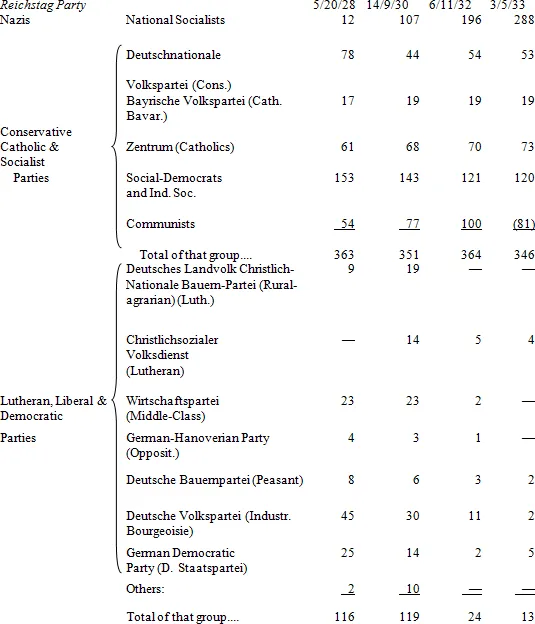
This tabulation makes it quite evident that the large bulk of the democratic and liberal voters became successively National Socialists while the other non-Nazi parties were able to preserve the loyalty of their voters as late as March, 1933. The downfall of German parties was prophesied by Constantin Frantz in his Die Quelle alles Übels (1863).
186 For description of Munich, see Thomas Wolfe’s The Web and the Rock.
187 “Both emotional nationalism and emotional internationalism go back to Rousseau, but in his final emphasis he is an emotional nationalist; and that is because he saw that patriotic ‘virtue’ is a more potent intoxicant than the love of humanity. The demonstration came in the French Revolution which began as a great international movement and ended in imperialism and Napoleon Bonaparte. It is here that the terrible peril of a science that is pursued as an end in itself becomes manifest. It disciplines man and makes him efficient on the naturalistic level, but leaves him ethically undisciplined. Now in the absence of ethical discipline the lust for knowledge and the lust for feeling count very little, at least practically, compared with the third main lust of human nature — the lust for power. Hence the emergence of that most sinister of all types — the efficient megalomaniac. The final use of a science that has thus become a tool of the lust for power is in Burke’s phrase to ‘improve the mystery of murder.’”—Irving Babbitt, Rousseau and Romanticism.
188 Guglielmo Ferrerò in his article “La Vague Dictatoriale” (Illustration, Jan. 20, 1923), says explicitly: “Even a dictator, if he does not intend to copy the Russian model, has nowadays to appear as a representative of the people’s will. We have seen it in Italy. How did the recent revolution attempt to justify itself? By declaring that it represented the true will of the nation which had been falsified by parliament. Now even the revolution dared pronounce that sheer force could violate the will of the nation and that a legitimate power exists outside of this will.
“The kings of old felt their responsible power to have been received from God, whereas the modern plebiscitarian dictator rules by the grace of the people. Their responsibility is toward the people which one has to treat alternatively with sugar and whip, with shrewdness and brutality. The ‘contract’ with God is of another nature.”
189 “Napoleon III, in 1868, when he discovered that his rights to rule were being vigorously contested, had a book written, or wrote it himself, Les Titres de la Dynastie Napoléonienne. The motto prefixed to the book is Vox Populi, Vox Dei. Here it is shown historically that the French constitution of 1799, which called General Bonaparte as First Consul to the head of the French Government, was adopted with more than 3,000,000 votes against 1500. The vote was repeated in 1848 when the Consul had himself proclaimed Emperor, and the result was 4,500,000 “ayes” to 2500 “nays.” On December 10, 1848, Napoleon III was elected President with 5,430,000 votes against Cavaignac, who had 1,448,000 votes. On December 2, 1851, he was elected President for 10 years with 7,500,000 against 6,500,000; on December 2, 1852, when he was chosen as Emperor, the ‘nays’ had sunk to 253,000. Has history, and more especially democratic history, recognized here the expression of the will of the French people, which as such must be respected? On the contrary, the reign of both Napoleons has not been regarded in the least as the expression of popular will, but as despotism, ‘sword rule,’ ‘tyranny.’”—Hans Delbrück, Government and Witt of the People, trans, by Roy S. McElwee, New York, 1923, pp. 7–8.
190 Years before the outbreak of the Spanish Civil War, Miguel de Unamuno, disgusted with the compromising spirit of some Spaniards, wrote in his Vida de Don Quijote y Sancho: “Yes, that is what we need: a new civil war. It is urgent to declare that the basins are and ought to be helmets, and to start a row like that which occurred at the inn; a new civil war. Can you not hear those poor fellows of dry and shrivelled heart insisting that there are certain topics that ought to be avoided, saying over and over that these and other disputes lead to nothing practical? What do they mean by ‘practical’?
“Pusillanimous whiners and howlers! Avoid religious questions! Give first attention to getting rich and powerful! The cowards cannot see that if we do not solve our more intimate problems, we are not powerful and rich and cannot become so. I repeat it: our country will have no agriculture, no industries, no commerce, no roads that would lead whither it were well to go, until we attain and hold to our own Christianity, our quixotic kind of Christianity. We shall not have a rich exterior life, until we kindle in the hearts of our people the fires of eternal disquietudes. It is impossible to be rich while living a lie, and the lie is, for our spirit, our daily bread.” — Miguel de Unamuno, The Life of Don Quixote and Sancho, trans, by Homer P. Earle (New York: Alfred A. Knopf, 1927), p. 293.
191 Walter Lippmann writes in the Good Society: “It would require another Erasmus to depict the confusion engendered by this disorientation of the human mind. With man degraded to a bundle of conditioned reflexes, there was no measure of anything in human affairs: all the landmarks of judgment were gone and there remained only an aimless and turbulent moral relativity. Thus our contemporary culture has vacillated between a doctrine of human providence, holding at one moment that man’s destiny is inexorably fixed and at another that it can be planned and managed. Such is the moral bewilderment that the historical determinists, who have nothing but scorn for the idea of free will, have become the protagonists of a consciously planned society in Russia, and the mystical collectivists who announced the manifest destiny of nations and tribes as corporate Leviathans have become the exponents of arbitrary personal leadership in Italy and Germany. Yet they are unabashed by their contradictions. For the denial of the human soul was the perfect preparation for these rivals of tyranny. Materialistic determinism is nothing but a secularization of religious determinism brought into the Occident by the sinister Genevan. Yet determinism permits different practical attitudes; it either leads to a shallow humanitarianism or to brutal terror. The former attitude is due to the denial of personal guilt, the latter is the result of the will to extermination which is the only way to deal with obnoxious and untractable animals.”
192 Leftists naturally hate ideological explanations. Thus in the New Republic, Oct. 28, 1940, Sidney Hook wrote: “I am acquainted with no scientific historian who has asserted that the rise of Hitlerism is due to a philosophic doctrine rather than to the conjunctions of economic depression, the consequences of the Treaty of Versailles, the errors in policy of the democratic parties within Germany and of the democratic governments without.” — Reply to Mortimer Adler’s paper against the “professors.”
193 Totalitarianism can retain the terms “freedom” and “democracy” and give them its own meaning.
See T. S. Eliot in “The Idea of a Christian Society.” New York, 1940, p. 69.
194 Jacob Burckhardt saw the coming menace which in his opinion would evolve from democracy and republicanism. He wrote in a letter to his friend Fredrich von Preen: “But it is as you say; the people are to be educated for mass meetings in good time. We shall get to the point where people will begin to howl if there are not at least 100 of them together.”
And on April 13 he wrote to Preen: “It has for some time been clear to me that the world is driving toward an alternative between complete democracy and absolute, lawless despotism; the latter, of course, would not be exercised by dynasties which are much too soft-hearted but by professedly republican military commands. But one does not yet like to picture a world whose rulers entirely disregard law, comfort, enriching labor and industry, credit, etc., and therefore can rule brutally.”
195 A few high lights from Lord Vansittart’s Black Record:
“The German is often a moral creature, the Germans never; and it is the Germans who count.”
“Within a short while from the time of Tacitus two further facts about the Germans became notorious, and have never varied since. The first was that they were out for ever more and more living space — the unlimited Lebensraum that they claim today For example, seventeen hundred years ago they were busy occupying Rumania (sic).
“These fierce characteristics showed themselves to the full in the Thirty Years’ war of the seventeenth century in the first phase of which Bohemia was overrun, and the Czech population subjected to a persecution almost equal to that of 1939. In this war the German commander Tilly distinguished himself by the sack of Magdeburg in which 30,000 people were butchered, rather less than were butchered at Rotterdam this year.”
(Czechs and Germans alike were persecuted. Victors were Austrians. Tilly never ordered the sack of Magdeburg. Tilly was Fleming. Tilly’s army was largely non-German. Magdeburgians were all Germans.)
Catherine the Great was a Prussian.
There are frequent citations of Latin authors. His Lordship always forgets that the Saxons and Angles left the Germanies 600 years after Caesar and Tacitus, in quest of more Lebensraum. The comic aspect of the booklet lies in the fact that Lord Vansittart (von Sittart) is of German origin. (See Burke’s Landed Gentry.)
196 “The fact is that for one hundred and fifty years these people have been a cancer in the world, and it is time they were removed. . . . The only decent reason for fighting is that there is something in the world you hate so much you can no longer live with it.” — H. M. Harwood, “Playwright and Producer,” in London Front, 1941.
197 Hitler characterizes the soul of the masses (he had so efficiently misled) as “female”: “Similar to women . . . the mass wants to be mastered and not implored and in its innermost is gratified by a teaching which does not suffer any other beside it more than by the granting of liberal freedom; the mass does not know how to use that freedom and feels slightly abandoned. It feels the unabashed spiritual terror no more than it senses the revolting violation of its human liberty.”— Mein Kampf.
Further reference material:
On the modern Lutheran, etatistic mentality:
Friedrich Gogarten, Wider die Ächtung der Autorität, Jena, 1931.
On the “democratic” character of National Socialism:
Père Ducatillon, O.P., La guerre, cette revolution, New York, 1941, pp. 32–33. There this author cites in support of this view an article by J. T. Delos in La vie intellectuelle, Oct. 10, 1938.
On the implications of the fact that the National Socialists won through the ballot:
J. P. Mayer, Alexis de Tocqueville, New York, 1940, p. 203.
On National Socialism in general:
Rohan d’O. Butler, The Roots of National-Socialism, New York, 1942. The author belongs to the “ethnological” school which deducts N.S. from the German character. In his appendix, p. 300 ff., he brings a bibliography which he acknowledges to be rather limited. Of all the authors he quotes (the total number is 58) there are only six Catholics of whom two are French analysts. Yet the total percentage of Catholics of the German Nation is almost fifty. It shows clearly where the roots of National Socialism are to be found.
On the independence of freedom from parliaments:
Ernst Troeltsch, Die Bedeutung des Protestantismus für die Entstehung der modernen Welt, München, 1911, p. 102.
On the participation of school teachers in the National-Socialist movement:
Franz Neumann, Behemoth, New York, 1942, pp. 377, 379. On the class structure of the N. S. Party: p. 399. (Workers, 35 per cent; Lower Middle Class, 51 per cent; peasants, 7 per cent; higher middle class and aristocracy, 7 per cent.) On the identification of the “Nation” with the “Leader,” Ibidem, p. 469. Quoting Gottfried Neesse, Führergewalt, Tübingen, 1940.
On Max Weber’s prophecy of Nazism:
Max Weber, Grundriss der Sozialökonomik III, Tübingen, 1922, p. 156.
On National Socialism and Prussiandom:
Carl Dyrssen, Die Botschaft des Ostens, Breslau, 1932, p. 186. (“Der National-sozialismus 1st die Urform des Preussentums.”)
Rosenberg and the “Syllabus” of Pope Pius IX:
Alfred Rosenberg. Mythus des XX. Jahrhunderts, München, 1932, p. 467. (“Die entehrendste Urkunde aller Zeiten.”)
On National Socialism and Scientism:
See: the great attack of Martin Bormann (the successor of Hess as deputy leader against Christianity as an unscientific superstition, recorded by the (London) Tablet, February 28, 1942, p. 110.
On the impossibility of a sound, modern parliamentarian life:
Carl Schmitt, Die geistesgeschichtliche Lage des heutigen Parlamentarismus, 1926, p. 9.
On the menace of a coming totalitarian terror:
Jacob Burckhardt, Weltgeschichtliche Betrachtungen, Berlin, 1905, pp. 171, 181.
On the evolution of “liberalism” to totalitarianism:
Styepan Trophimovitch, the old “liberal” reading a nihilistic book:
“It’s true that the author’s basic idea is correct, but that only makes the situation worse. It’s our own idea, no doubt; we were those who first sowed the seed and watched over it; indeed, they could have hardly said something new, after we had spoken. But, good Lord! Just look how they express themselves, how they distort and mutilate the truth! Were these really the final conclusions we were striving for? One can hardly recognize the original idea in that stuff!” (F. M. Dostoyevski, The Possessed.)
III
MATER AMERICAE
198 Modern historians, however, are not convinced that Magna Charta meant much to the mass of the English people of 1215 or since. The tradition seems to have begun rather more than four centuries later. Professor A. F. Pollard, the historian, appears to have little sympathy with the customary ideas on the subject. The liberty which the barons extracted from the king, was, he says “liberty to every lord of the manor to try suits relating to property and possession in his own manorial court or to be punished by his fellow barons instead of by the judges of the king’s court.
“This is what the barons meant by their famous demand in Magna Charta for every man to be judged by his peers. They insisted that the royal judges were not their peers but only servants of the crown, and their demands in this respect were reactionary proposals which might have been fatal to liberty as we conceive it.
“There is nothing about trial by jury or no taxation without representation in Magna Charta. Legally, the villeins, who were the bulk of the nation, remained after Magna Charta as before in the position of a man’s ox or his horse, except that there was no law for the prevention of cruelty to animals.”
It would appear from this that the case for Magna Charta as the basis of democracy breaks down. — Gideon Clark, Democracy in the Dock.
199 “Who are these Tories and Whigs? Essentially they both belong to the same social layer, that today is agreed upon; the ones are aristocrats as much as the others.” — Hans Delbrück, Historische und Politische Aufsätze, Berlin, 1907.
200 Burke said in his Appeal From the New to the Old Whigs: “As in the abstract it is perfectly clear, that, out of a state of civil society, majority and minority are relations, which can have no existence, and that, in civil society, its own specific conventions in each corporation determine what it is that constitutes the people, so as to make their act the signification of the general will — to come to particulars it is equally clear that neither in France nor in England has the original or any subsequent compact of the state, expressed or implied, constituted a majority of men, told by the head, to be acting people of their several communities. And I see little of policy or utility as there is of right, in laying down on principle that a majority of men told by the head are to be considered as the people, and that as such their will is to be law.”
201 “Strange as it may seem, England, monarchistic and conservative to the marrow at home, has in her foreign relations always acted as the protector of the most demagogical tendencies, invariably encouraging all popular movements aiming at the weakening of the monarchical principle.” — Durnovo’s Memorandum, February, 1914. From Documents of Russian History, by F. A. Golder, Stanford University Press, 1927.
Durnovo, an ultraconservative, was hostile to the panslavist, herdist war party. The Russian Conservatives did not in the least cherish the idea of a holy war in favor of the Karagjorgjevićs and the French democracy.
202 It is grimly amusing to read the decision of the Conference of Ambassadors, February, 1920, and April, 1921:
“The Principal Allied Powers consider that the restoration of a dynasty which represented in the eyes of its subjects a system of oppression and domination over other races, in alliance with Germany, would be incompatible with the achievements of the war in liberating peoples hitherto enslaved, as well with the principle for which the war was engaged.” — From C. A. Macartney’s Hungary.
The same illiterate crowd reversed its whole policy one hour before the Anschluss; too late, of course, to influence the inexorable flux of events. The Progressivists had then the privilege to wage another war in order to create a Europe either resembling their fatal error of 1919 or even to “undo” all treaties of 1919 and to go back to 1914.
203 Even the vision of Catholic historians becomes clouded if they once look beyond the Rhine into “darkest” Europe. Mr. Hilaire Belloc’s repetition of the old accusation embodied in article 231 of the Versailles Treaty in his Short English History makes painful reading. His treatment of the Austro-Serbian conflict is perfectly ridiculous. The words of Kaunitz come to one’s mind: “It is prodigious how much the English do not know of Europe.” — (Cited by Seton-Watson in his Britain and the Dictators.)
204 It is well to remember here the words of Edmund Burke in his “Appeal from the New to the Old Whig.” One sees here clearly that even traditional Whiggism and modern party liberalism were not one and the same and that the monarchical principle used to be stronger among the old Whigs than among the Neo-Conservatives today. Burke wrote (about himself): “He has studied the form and spirit of republics — but the result in his mind from that investigation has been and is, that neither England nor France, without infinite detriment to them, as well in the event as in the experiment, could be brought into a republican form; but that everything republican which can be introduced with safety, into either of them, must be built upon a monarchy — built upon a real, not a nominal monarchy, as its essential basis.” (Italics ours.)
Yet as we see the republican-aristocratic-plutocratic principles carried the more conservative whigs further than they intended. Hilaire Belloc sees in monarchy a bulwark against plutocracy and that theme is well presented by Robert MacNair Wilson in his Monarchy or Money-Power.
205 It is not only probable but even certain that the present war will have a lasting effect upon the plutocratic structure of the moneyed part of the British aristocracy. Yet the current indignation about the pluto-aristocratic leadership in the past has always been exaggerated by foreigners.
206 G. M. Turnell’s statement that St. Thomas More and St. John Fisher were the last Europeans in England was somehow premature. His criticisms are somehow justified for the immediate past but hardly for the present and future. He wrote: “When we come to consider life in concrete, we cannot help being struck by the divergencies between the English way and the Catholic way. Fisher and More are far less representative of English life than Hobbes and Locke, or in the practical sphere than pirates and colonists like Drake and Clive, or record breakers like Sir Malcolm Campbell or Mrs. Mollison. To turn the two saints into national heroes, or rather champions of English nationalism, is tantamount to make them the spiritual forefathers of empire builders and record breakers when in fact they stood for a way of life that was finally destroyed by imperialism and record breaking. It is, of course, a fundamental misunderstanding of their true significance. The significance of Fisher and More was that they were almost the last two great Europeans produced by these islands. They lost their heads because they stood for a faith which transcended boundaries of nationalism, because they would not let it degenerate into a national faith. In other words, they refused categorically to accept all that we understand by the English way. They were great because they were Europeans, not because they were Englishmen. Rather in spite of it. In the case of Drake and Clive, the fault lies precisely in the fact that they were English without being anything besides.” — “The Real English Way,” Colosseum.
207 So, too, republicanism is untraditional in Ireland in the sense that for the first hundred years or so of the modern Irish democracy — 1800 to 1916, when the Irish Republican Brotherhood stole Sinn Fein — the sole expressed and supported idea of the vast mass of the Irish people was for a hierarchical form of society, based on the status quo; for the fullest freedom of action and opinion; and for a native government of that order in peaceful union with Great Britain under the symbol of the Crown. — Seán O’Faoláin, King of the Beggars (The Life of Daniel O’Connell) (New York, 1938), p. 107.
208 Britishers speak actually about “Europe,” when they mean the Continent. John Maynard Keynes in his Economic Consequences of the Peace 1919 describes very aptly the differences between the continental and the British atmosphere twenty-two years ago:
“For one who spent in Paris the greater part of his six months which succeeded the armistice an occasional visit to London was a strange experience. England still stands outside Europe. Europe’s voiceless tremors do not reach her. Europe is apart and England is not of her flesh and body. But Europe is solid with herself. France, Germany, Italy, Austria, and Holland, Rumania and Russia and Poland throb together, they have rocked together in a war, which we, in spite of our enormous contributions and sacrifices (like though in a less degree than America), economically stood outside, and they may fall together.
209 Gideon Clark in his Democracy in the Dock, takes a very pessimistic attitude toward his own nation by saying: “The British . . . have a profound and never-failing gift of being deceived by specious humbug. . . . A recent Prime Minister accounted a great success in his day, worked steadily against their interests throughout his period of power, made the most amazing errors of judgment, was proved wrong by events again and again, yet remained with most of them trusted and liked because he seldom made a speech without telling them he was just a common Englishman like themselves, a hater of frills, pomp, and pretense, one who would infinitely rather spend his life in the fields of his native Worcestershire than in the seat of the mighty. The trick never failed; is there any reason to suppose it will fail the next time it is played? Are other nations so simple, so easily beguiled? It is difficult to know. Certain it is that healthy skepticism has no root in the English mind.”
IV
THE AMERICAN SCENE
210 “The social forces behind the American movement were aristocratic and mercantile. The merchants of New England joined hands with the landed proprietors of the South, both confident there was room for each in a world new and unscarred by European traditions. Both were oblivious of the coming manufacturing caste that was to make them implacable enemies. Nothing can be less true than the popular idea that the American Republic was the product of men longing for radical democracy.” — James N Wood, Democracy and the Will to Power, New York, 1921, pp. 50–51.
211 “This feeling remained so strong through the early part of the Revolution that the President of Princeton University (John Witherspoon) believed the common hatred of Popery caused by the Quebec Act the only thing which cemented the divergent religious groups in the colonies together sufficiently to allow them to make war, an opinion which was shared by English observers.” — Ray Allen Billington, quoting Daniel Barber’s History of My Own Times (Washington, 1827) in his The Protestant Crusade, 1800–1860 (New York: Macmillan, 1938).
On page 17 of this work are the following lines, sung during the Revolution:
If Gallic Papists have the right
To worship their own way
Then farewell to the liberties
Of poor America.
Also a part of John Trumbull’s “McFingal” is quoted where George III is accused in the following terms:
Struck bargains with the Romish churches
Infallibility to purchase.
Set wide for Popery the door.
Made friends with Babel’s scarlet whore.
212 One hears sometimes in American Catholic circles the cryptic remark that the American Constitution is finally based on St. Robert Bellarmine’s “democratic” ideology. In support of this theory, the fact is mentioned that one found the collected works of the Great Saint in Jefferson’s library. Yet the truth boils down to the fact that one discovered merely a volume of Sir Robert Filmer’s Patriarcha or the Natural Power of Kings, an apology of absolute monarchy containing slighting remarks on Bellarmine (on pp. 8, 9). There is practically no evidence that Jefferson read this book with great attention, except a pencil stroke. (See also David S. Schaff, The Bellarmine-Jefferson Legend and the Declaration of Independence.)
St. Robert Bellarmine’s political thought differs strongly from modern or classic democratic ideas. His attack against the absolutistic tendencies of James I do not make him a “democrat.” He concedes that a people without government has the right to choose a government: the best form of government in his eyes is nevertheless a monarchy with certain checks. The people has surrendered its sovereignty and transferred it to the king. (Potestas populi . . . donec eam in regem aliquem transtulit.) See also his Apologia 13, op. t, XII. The monarchy is thus for him “the best and outstanding form of government (Optimum et praestantisimum regimen). Democracy on the other hand is deterrimum regimen. He attacked Calvin bitterly for his republican tendencies. The check on a monarch he considered merely utilius (more expedient). The ideal monarch for him was a person qui omnibus imperat ac nulli subiiciatur.
See also Père Joseph de la Servière, S.J., “Les idées politiques du Cardinal Bellarmin.” Revue des questions historiques. Tôme xxxvii–xxxviii, who calls St. Robert Bellarmine: “résolumment Monarchiste.”
St. Robert Bellarmine said very clearly in De Ecclesiastica Monarchia I, that:
Propter naturae humanae corruptionem utilius esse censemus hominibus hoc tempore (!) monarchiam temperatam ex aristocratia et democratia.
Hoc tempore clearly means the period in which he lived and which still stood under the deep impression of the reformation and its caesaropapism. When the saint extolls the “democratic” element in the election of crowned heads he cites immediately the modus of election of the Holy Roman Emperors by the princely electors, a process which can hardly be called “democratic” (in Recognitio Libri Tertii de Laicis). He also says explicitly in De Laicis VII:
“To be ruled by a superior is not contrary however to human liberty, dignity and equality. Only the despot offends thus . . . even in the state of innocence there would have been political subjection, there would have been a difference of sexes, faculties and power; therefore an order of precedence and subjection. Among the angels there is a hierarchy of order with precedence and succession; why not among men? Therefore it is not contrary to liberty, nor humiliating to the dignity of man to be ruled by his legitimate superiors. . . . There is a difference between political subjection and servile subjection.
St. Robert Bellarmine’s Apologia was finally dedicated to the Emperor Rudolf II. and the idea expressed in Chapter XIII of his De Potestate Papae in Rebus Temporalibus, that the Pope might depose a Catholic “prince” (Emperor, King, President) for grave reasons and order the people to elect somebody else would surely not gain the full admiration of, let us say, Mexican, Peruvian, or Chilean progressive democrats.
Thomas Jefferson had furthermore nothing but bitter contempt for the Society of Jesus as such, of which Bellarmine was a member. In a letter to John Adams, replying to his predecessor’s charges against the Society (“If there ever was a body of men who merited eternal damnation on earth and in hell, it is this Society of Loyola’s”), he wrote: “Like you I disapprove of the restauration of the Jesuits, for it means a step backwards from light into darkness.” (Quot. by René Fülöp-Miller, The Power and Secret of the Jesuits.)
Thus we can hardly expect Jefferson to have willfully copied the basis of the American Constitution from one of the representants of Darkness. The efforts to prove the contrary remind one of the painful impression which the copy of the Magna Charta at the New York World’s Fair left in one’s mind. According to eyewitnesses it was exhibited under a transparent inscription “Democracy.”
213 “The basis of the American system is a written constitution, a paper formulated by men of an extreme conservativism and plainly distrustful of the people. This is shown by the carefully developed checks to spontaneous action; the method of balancing one branch against another.” — James N. Wood, Democracy and the Will Power, New York, 1921, pp. 48, 49.
214 “Now the basis upon which the Puritan political system was founded was that the Church members alone could have political rights. This ensured that the Puritan commonwealth could be nothing but an oligarchy. As wealth was one of the criteria (though by no means the only one) on the basis of which it was determined whether one belonged to the ‘elect,’ the commonwealth was necessarily controlled by the wealthy. Puritan rule was the rule of an economic and religious elite. This explains why typical Puritans in America, such as Winthrop and Cotton, denounced democracy. Winthrop declared that democracy was ‘the meanest and worst of all forms of government,’ inasmuch as there was ‘no such government in Israel,’ and he objected to ‘referring matter of council and judiciature to the body of the people, quia the best part is always the least, and of that best part the wiser part is always the lesser.’ Since the ‘elect,’ the ‘saints’ were necessarily a minority, it was obvious to Puritans that political rights could be exercised only by a minority.” — P. Kecskeméti, Political Thought in America, in J. P. Mayer’s, Political Thought, New York, 1940.
215 “I know no country where public esteem is so attached to worth, regardless of wealth, as it is in America.” — Jefferson to Mrs. Church, 1793.
216 “Throughout the Union property qualifications were required for the suffrage as well as for holding office. In New York, in a population of about 30,000, according to the census of 1790, there were only 1209 freemen valued at $100 or more, 1221 valued at $20, and 2661 ‘Forty Shilling Freeholders.’” — P. Kecskeméti, Political Thought in Ameriça.
217 “Democracy has never been and never can be so desirable as aristocracy or monarchy, but while it lasts it is more bloody than either. Remember, democracy never lasts long. It soon wastes, exhausts and murders itself. There never was a democracy that did not commit suicide.” — John Adams, quoted by W. E. Woodward, A New American History,” p. 253.
218 Both Rousseau and Jefferson are more clearly Republicans, or constitutionalists, than they are democrats; although it might be argued from Rousseau’s attack on slavery that he might have urged the justice of universal suffrage; and there is some positive evidence, both from Jefferson’s opposition to negro slavery and to his remarks on suffrage, that Jefferson was much more of a democrat than was John Adams and the New England aristocrats on the one hand, or Hamilton, Madison and Jay, the protectors of the propertied minority, on the other. But the dawn of American democracy really begins with Jackson.” — Mortimer Adler, “In Terms of What Moral Principle Is Democracy the Best Government?” in Philosophy of the State. Reprinted, by permission, from the Fifteenth Annual Proceedings of the American Catholic Philosophical Association, Washington, D. C, December 28 and 29, 1939, page 163.
219 “. . . But the great thing about it is equality. To begin with, the level of education, science and talent is lowered. A high level of education and science is only possible for great intellects, and they are not wanted. The great intellects have always seized the power and been despots. Great intellects can not help being despots and they’ve always done more harm than good. They will be banished or put to death. Cicero will have his tongue cut out, Copernicus will have his eyes put out, Shakespeare will be stoned — that’s Shigalovism. Hahaha! Do you think it’s strange? I am for Shigalovism.” — F. M. Dostoyevski, The Possessed, trans, by Constance Garnett, Modern Library, 1936, New York.
220 Rigorous in his condemnation of the educational system is Dr. Caspar Kraemer, Professor of New York University, as quoted in the New York Times, Mar. 12, 1939:
“We spend more money than any other nation in the world to get an inferior product. The democracy of our education consists of the regimentation of all students, no matter what their degree of proficiency, upon a single level, which must of necessity be low if it concerns itself only with those needs of the best students which are common to the worst.”
Professor Virginius Dabney (University of Virginia) in an essay on “Spurious Democracy” states:
“The malady is doubtless due to numerous causes. But perhaps a certain conception of ‘democracy’ underlies more than one of them. The notion that one man is just as good as another and perhaps a little better has something to do with it. . . . One curse of American life is the subordination of quality to quantity. Our educational system would be much better if there were fewer but better schools and colleges, fewer but better paid teachers in the schools, fewer but better paid professors in the universities with only half the number of students.”
Not less outspoken is President Robert Maynard Hutchins of the University of Chicago who wrote the following cruel words:
“Since our students have lived up to our expectations, we have succeeded in postponing maturity to a date undreamed of in the Middle Ages, or ever in Europe today. The American college senior is two or three years less grown up than his French or British contemporary. In ability to use his mother tongue and the other instruments of intellectual operation he does not at all compare with them. — “Education for Freedom,” Harpers Magazine, October, 1941. On the educational crisis in the modern world see P. Sorokin, Social and Cultural Dynamics, IV, pp. 259 ff.
221 Cf. James N. Wood, Democracy and the Will to Power, New York, 1921, pp. 175, 176.
222 Professor Willard Waller has called this the “rating and dating complex” and describes how it works in one college. Every student should read this article.
“The students in many colleges, such as the one described by Waller, are motivated by a strong desire to rise in their social status. That is the only reason some of them are in college. It is therefore important to ‘date’ with students of the opposite sex who stand as high as possible in the social scale. Fraternities and sororities add explicitness to this scale and intensity to the struggle. Students near the ‘top’ have more invitations and social opportunities than they can handle. Those near the ‘bottom’ are often deprived of companionship, because, if they still have hopes of climbing, they dare not too often or openly admit their low status by dating with someone recognized as inferior. The misfits, the unattractive, the unpopular do not pair off as easily or frequently as do the attractive and popular.” — Plan for Marriage, by Joseph Kirk Folsom, Editor.
See also: Willard Waller, “The Rating and Dating Complex,” American Sociological Review, 22:727–734 (1937).
223 “In Spain — and this is another paradox about Spain — the national holiday called fiesta de la raza is really a fiesta de la non-raza, a celebration of the international mixture of races among Hispanic nations in the best Spanish, antiracial tradition. It considers the distinction between races a sin. This tradition is essentially Christian. It is a genius of fraternal enthusiasm. The Spaniard of old had no inhibition toward marriage with colored women and the procreation of mestizos.
“For the Spaniards the Jewish problem has never been a racial one and will never be. It is an exclusively religious question.” — Ernesto Ximenez Caballero, in an article in Anti-Europea, specially devoted to the race question.
224 “The American mob’s grim reputation for sheer anthropoid savagery is equaled only by that of the revolutionary mobs of Paris. At the outset of the German Government’s movement against the Jews, an American visitor asked Herr Hitler why he was making it so ruthless. The Reichskanzler replied that he had got the idea from us. Americans, he said, are the great rope and lamppost artists of the world, known of all men as such. He was using the same methods against the Jews that we used against the loyalists of ’76, the Indians, the Chinese on the Western coast, the Negroes, the Mexicans, the Filipinos — every helpless people in fact whom we had ever chanced to find underfoot.” — A. J. Nock, “The Jewish Problem in America,” Atlantic Monthly, June, 1941.
225 Cf. Henry Belcher, The First American Civil War, London, 1911. I, p. 56.
226 A nice little sketch about the iniquities of Negro life by a correspondent, “V.S.Y.,” can be found in The New Republic, January 13, 1941.
A fuller account about the history of lynching can be found in Frank Shay’s excellent book: Judge Lynch, his first 100 years (New York, 1938). The unspeakable horror these pages conjure bear hardly the printer’s ink. The details of the lynching are of an obscenity which surpass human imagination (pp. 96, pp. 104–116). Three cases deserve special mentioning; the expectant Negro mother who was “carved up,” Dan Davis the Texan Negro who shouted from the stake: “I wish some of you gentlemen would be Christian enough to cut my throat” (p. 118) and the attorney of Colorado County (Texas) who declared: “I don’t call the citizens who executed the Negroes (aged 15 and 16) a mob. I consider their act an expression of the will of the people.” Ochlocratic sentiments are seldom expressed so neatly!
227 About the lack of anti-Jewish sentiment in the young American Republic see: Dixon Wecter, The Saga of American Society (A Record of Social Aspiration, 1607–1937) (New York: Charles Scribner’s Sons, 1937), pp. 152, 153.
228 “Business is religion and religion is business” preached the Reverend Maltbie D. Babcock of the Brick Presbyterian Church in New York in 1900.” — Dixon Wecter, The Saga of American Society, New York, 1937, p. 481.
229 Professor A. Peers once was addressed by a beggar in Madrid in the following words: “An aim, for the love of God, who in the bloom of my youth deprived me of the love for work.” (“Una limosna por el amor de Dios, que en la plenitud de mi juventud me ha quitado la gana de trabajar.”) — From A. Peers, Spain.
This could certainly not happen in a progressive, Calvinistic country.
230 “Turn now to Germany, a country lately delivered from despotism by the arms of altruistic heroes. The social legislation of that country for more than half a century, afforded a model to all other countries. All the workingmen’s insurance, minimum wage, child labor and other such acts of the United States are bald imitations of it, and in England before the war, the mountebank Lloyd George borrowed his whole bag of tricks from it. Well, Dr. Hans Delbrück, in his Regierung und Volkswille, tells us that this legislation was fought step by step at home, and with the utmost ferocity, by the beneficiaries of it. When Bismarck formulated it and essayed to get it through the Reichstag he was opposed by every mob-master in the Empire, save only his kept Socialist, Ferdinand Lasalle. The common people were so heavily against him for several years that he had to carry on the government without the consent of the Reichstag — that is, unconstitutionally, and at the rick of his head.” — H. L. Mencken, Notes on Democracy.
231 Herbert Spencer in his essay: “The Coming Slavery” has aptly described the viciousness of “popular” representation in Germany in its quest for “popularity.”
232 “In the world of politics, the chances of getting imbecile leaders under an elective system could be considerably reduced by applying to politicians a few of those tests for intellectual, physical and moral fitness which we apply to the candidates for almost every other kind of job. Imagine the outcry if hotelkeepers were to engage servants without demanding a ‘character’ from their previous employers; or if sea-captains were chosen from homes for inebriates; or if railway companies entrusted their trains to locomotive engineers with arterio-sclerosis and prostrate trouble; or if civil servants were appointed and doctors allowed to practice without passing an examination! And yet, where the destinies of whole nations are at stake, we do not hesitate to entrust the direction affairs to men of notoriously bad character; to men sodden with alcohol; to men so old and infirm that they can’t do their work or even understand what it is about; to men without ability or even education.” — Aldous Huxley, Ends and Means, Chatto and Windus (London), 1937, p. 174.
233 Cf. Georg Simmel, Soziologie, Leipzig, 1908, p. 138.
234 Cf. Moises Yakovlevitch Ostrogorski, Democracy and the Organization of Political Parties, trans, by F. Clarke, New York, 1902.
235“Espèce de depute was the last word of abuse which a French cabdriver could find from a vocabulary of invective unrivaled in any language except American.” — Douglas Jerrold, Britain and Europe: 1900–1940 (London: Collins, 1941), p. 25.
236 In St. Thomas Aquinas, Summa Contra Gentiles, Bk. I, Ch. IV, we find an excellent account of why man endowed with an intelligent reason seldom makes full use of it. He cites lack of interest, lack of time and lack of energy as main reasons for this inertia.
237 “What we need in every executive department in Washington is a solid body of permanent undersecretaries, clerks, and other employees, well and broadly trained and irremovable, except for cause — and change in administration is not an adequate cause. We want ‘careermen’ not alone in the diplomatic and consular service, but in every department of Government.” — Ralph Adams Cram, The End of Democracy (Boston: Marshall Jones Co., 1937), pp. 216–217.
Cf. also Letters from a Chinese Official, Anonymous, New York, 1912, p. 45.
238 “The experience of thousands of years teaches that the overwhelming majority of peoples does not take sufficient interest in the state to be able to form well-founded opinions concerning either persons or bills to cast its vote accordingly. . . . In most elections, except those of rare popular interests, the party that succeeds through some means or other in hauling a crowd of absolutely indifferent men to the polls is the party that wins. Is it then the people’s will that has become manifest through this election? We find ourselves in an evident dilemma. If no parties existed, the vote would be so small that there could be no question of an action of the people. If we have parties, it is true, they drag the people onto the stage, but the verdict is pronounced by the powers, who understand how to induce those who have no opinion of their own to vote in the way desired.” — Hans Delbrück, Government and Will of the People, trans, by Roy S. MacElwee (New York: Oxford University Press, 1923), p. 14.
239 About the type of bureaucratic “manager” and his increasing importance see James Burnham, The Managerial Revolution, New York, 1941, pp. 254, 255.
240 About the thirst for “Success” and the competitive spirit in their relation to crime see: Morris Ploscowe, “Crime in a Competitive Society,” The Annals of the American Academy of Political and Social Science, September, 1941.
241 A record in preaching was established eight years ago by the Reverend S. Brown of Mount Zion Baptist Church in Washington, D. C. The learned pastor spoke 88,794 words in 12 hours and 10 minutes. This record was beaten by the Reverend N. Lee in his little Emmanuel Temple in Los Angeles, who spoke over 200,000 words in 21 hours, 20 minutes.
242 There is naturally also another angle to this problem which has been well brought out by Professor John U. Nef, in “Civilization at the Crossroads, II,” The Review of Politics, October, 1941, p. 463.
V
THE AMERICAN TRAGEDY
243 “For the Liberal the spiritual center of gravity was in the individual, and the realm of private opinion and private interests was the ideal world. Hence, when the Liberal spoke of religion as a purely private matter it was in compliment rather than in derogation. To separate the Church from the State — to keep religion out of politics, was to elevate it to a higher sphere of spiritual values. But today in the democratic world, these values have been reversed. The individual life has lost its spiritual primacy, and it is social life which has now the higher prestige, so that to treat religion as a purely individual and personal matter is to deprive it of actuality and to degrade it to a lower level of value and potency. To keep religion out of public life is to shut it up in a stuffy Victorian back drawing room with the aspidistras and antimacassars, when the streets are full of life and youth. And the result is that the religion of the Church becomes increasingly alienated from real life while democratic society creates a new religion of the street and the forum to take its place.” — Christopher Dawson, Beyond Politics (New York: Sheed & Ward, 1938).
244 Paragraph VI, Thesis 55, Syllabus of Pope Pius IX, condemned the following assertion: “The Church ought to be separated from the State, and the State from the Church.”— (Allocution Acerbissimam of Sept. 27, 1852.)
245 “The curious Jansenist condition of modern Catholic Ireland” and the low-Church mentality of America is well discussed by Sean O’Faolain, in King of the Beggars (The Life of Daniel O’Connell), New York, 1938, p. 14.
Sigrid Undset, herself a Catholic convert is even more outspoken in her condemnation of Catholic Puritanism in America. Cf. her Men, Women and Places, New York, 1939, p. 108.
246 The American version or application of that culture [i.e., Catholic culture] has set the novelist an almost impossible task. This can be seen, I think, if we turn to an examination of the attitude of Catholic readers. That attitude has reflected all too often a Catholic social consciousness that is tinged with excessive touchiness, with readiness to see offense and insults everywhere, with puritanism, which all spring, I fear, from an inferiority complex. Willy-nilly, our authors have bent to these cramping winds, to the detriment of their art. — Harold C. Gardiner, S.J., in “Reader-Hazard,” America, Vol. LXV, No. 22.
A valid criticism of Catholic-American étroitesse has been made by Father Victor Dillard, S.J., in “Jeunesse Catholique en Amérique,” Études, April 5, 1940.
247 To give only a few names of leading British Catholics in the past 60 years (converts italicized):
| Cardinal Newman | Fr. W. Orchard | Alfred Noyes |
| Cardinal Wiseman | T. S. Gregory | A. J. Cronin |
| Cardinal Manning | Douglas Jerrold | Francis Thompson |
| Baron von Hügel | Bernard Wall | Coventry Patmore |
| Lord Acton | Christopher Dawson | D. B. Wyndham Lewis |
| G. K. Chesterton | Christopher Hollis | J. B. Morton |
| Maurice Baring | Douglas Woodruff | Bede Jarrett, O.P. |
| Evelyn Waugh | Eric Gill | Algernon Cecil |
| R. H. Benson | Arnold Lunn | Deathbed converts: |
| Sheila Kaye-Smith | Hilaire Belloc | Oscar Wilde |
| Compton Mackenzie | Wilfrid Ward | Frank Harris |
| Graham Greene | C. C. Martindale, S.J. | |
| E. I. Watkin | Ronald Knox |
248 The Reverend William Ayer, himself a Baptist, complained in a sermon (Mar. 21, 1937) about the attitude of liberal Protestantism which is organized within the framework of the Federal Council of Churches. He said: “Liberal Protestantism is in many instances taking on itself the cloak and spirit of a mild communism. And the Federal Council more often speaks the communist shibboleth than the Gospel one. Liberal Protestantism, or Modernism, is far from defenseless. It has not only the capable organization backing of the Federal Council and affiliated organizations and movements, but it has the financial backing of the Rockefeller millions and other wealth not to mention the extreme socialist group throughout the land.” (Cf. New York Times, March 22, 1937.)
A characteristic representative of this group is the bimonthly The Protestant (formerly Protestant Digest) which combines enthusiastic pro-Bolshevism with furious anti-Catholicism.
249 See the outstanding excerpts from “The Bible up to date” by Dr. William L. Bailey, Northwestern University professor, Newsweek, Dec. 4, 1939.
250 As late as the year 1777 the city of Birmingham refused to have a theater as it would encourage ‘laziness’ and therefore impede trade.” Max Weber, Die Protestantische Ethik und der Geist des Kapitalismus.
The hostility of the Puritans and Protestant extremists, all forerunners of our capitalistic system against phantasy and its products, was simply unbelievable. Not only did they view with mistrust the theater but also the novel and ‘fiction’ in general had to suffer. (There is still a fair amount of contempt for the writer and reader of ‘fiction,’ which the German calls Romane — implying the romantic element in that product of art.) The Reverend Richard Baxter (middle of the seventeenth century) wrote in his Christian Directory, Ch. VIII, Part 6, a passionate attack against novels.
Even Orestes Brownson was affected by his Protestant environment. See Works XIX, pp. 225, 226.
251 “The pride of caste is becoming the pride of taste; but, as before, it is averse to the mass of men; it consents to know them only in some conventionalized and artificial guise. It seeks to withdraw itself, to stand aloof; to be distinguished and not to be identified. Democracy in literature is the reverse of this all.” — William Dean Howells, Criticism and Fiction, New York, 1891, p. 180.
This tallies with Anatole France’s criticism of the aesthetic deficiencies of the Third Republic. (See J. J. Brousson, Anatole France en pantouffles, Paris, 1924, p. 67.)
252 “. . . All the great things on this Earth begin with a dream. ‘Woe to him who has never dreamt,’ it has been written. One does not rise to heaven without passing through the clouds.” — Gustave Thibon, Études Carmélitaines.
253 “To romanticise is to give a higher sense to the common, to give the dignity of the unknown to the known, to touch with a ray of eternity all that is limited in time.” — Novalis.
254 Cf. Just Havelaar, Democratie, Arnhem, 1920.
255 “Our unemployed millions are endemic. Our cities strictly built for a profit of a minority have for the majority banished relaxation and peace. Our mechanized and commercialized pleasures have shrunk the individual human being and created a mass mind as dangerously prone to demagogic doctrine in our terms as the oppressed Italians and Germans. Does anyone believe that the American millions think straighter than Europe’s millions — or are being taught to think straight on a regimen of movies, radios, and popular novels — with the schools and universities taking their cues from the columnists?” — Waldo Frank, Chart for Rough Water, New York, 1940.
256 Similar phenomena can be witnessed in England where the speaker of the Con gregationalist Convention declared in October, 1935, in the presence of Bishop Barnes of the Church of England that he expects to see the day when “His Majesty’s Communist Government” will be established in the British Isles. One of the most active members of the “Friends of the Soviet Union,” the Dean of Canterbury, declared solemnly that the Soviet Union is the greatest Christian experiment of all times.
257 The infantilism of the American masses is well analyzed by John U. Nef’s, “On the Future of American Civilization,” The Review of Politics, Vol. II, No. 3.
258 Cf. Lewis Mumford, “The Passive Barbarian,” in Atlantic Monthly, September, 1940.
259 Peter Viereck sees the danger in America very clearly. “Germany was historically ahead of us,” he writes in his Metapolitics (New York, 1941), “in being ripe for Fascism. We in America can expect similar developments from similar causes. These causes are more basic and world-wide than Versailles; an overmechanized and overspecialized industrial society is spawning mass men, instead of responsible, self-disciplined individuals rooted in the universal moral values.”
Cf. Alain Locke from Howard University in a lecture: “Pluralism and Intellectual Democracy” at the Conference on Science, Philosophy, and Religion, September, 1941.
260 I am not concerned with the problem of Christians as a persecuted minority. When the Christian is treated as an enemy of the State, his course is very much harder, but it is simpler. I am concerned with the dangers to the tolerated minority; and in the modern world it may turn out that the most intolerable thing for Christians is to be tolerated. — T. S. Eliot, The Idea of a Christian Society.
261 Aristotle, like Plato, has clearly foreseen the dangerous developments from democracy as well as the ultimate danger itself. Cf. Aristotle, Politics, V, vii, 18; also V, ix.
PART IV
THE ISSUE
I
COMMUNISM
262Socialists and Communists of middle-class or Plutocratic background:
Karl Marx |
Karl Radek |
Largo Caballero |
Lasalle |
Krassin |
I. Prieto |
Robert Blum |
Zinovyev |
Engels |
Léon Blum |
Kamyenev |
Romain Rolland |
Plyekhanov |
Litvinov |
Sir Stafford Cripps |
Lenin |
Molotov |
Yoffe |
Trotzki |
Dovgalyevski |
Karl Liebknecht |
Earl Browder |
Otto Bauer |
Rakovsky |
Bukharin |
Karl Seitz |
Naomi Mitchison |
Rykov |
Julius Deutsch |
Stephen Spender |
Béla Kún |
Willi Münzenberg |
Charles Fourier |
Kurt Eisner |
Barbusse |
Corliss Lamont |
Léviné |
Malraux |
|
Socialists and Communists of the nobility: (Gentry). | ||
John Strachey |
Tukhatchevsky |
Bakunin (Anarchist) |
Dzerzyński |
Chicherin |
St. Simon |
263 Cf. Analysis of Work in Christian and bourgeois perspectives by P. Lafargue in L’Origine ed evoluzione della proprietà, Palermo, 1896.
264 Bolshevism actually promises to make everybody a state employee and thus to assure the maximum of social security. That tendency was always strong in the European bourgeoisie. Even Herbert Spencer complained about it in his essay “The Coming Slavery.” Yet he made the mistake of considering this craving for government jobs as a desire for an increased dignity. Primarily it was something else — the nostalgia for security; the added dignity of a state priesthood was of secondary value. Spencer writes: “And in Russia where that universality of State-regulation which characterizes the militant type of society has been carried furthest, we see this ambition pushed to its extreme. Says Mr. Wallace, quoting a passage from a play: ‘All men, even shopkeepers and cobblers, aim at becoming officers, and the man who has passed his whole life without official rank seems to be not a human being.’”
To be financially secure, to wear the uniform and to have a safe position; this bourgeois idea of the West grew on eastern soil in tropical richness and splendor. A similar evolution could be observed in Hungary where the biztos kis állás (the secure little position) is valued by the bourgeoisie beyond anything else. Count Keyserling in his Europe overrates the aristocratic essence of modern East Central Europe considerably.
265 Dr. Waldemar Gurian is therefore entirely correct when he writes: “Bolshevism is at once the product of the bourgeois society and the judgment upon it. It reveals the goal to which the secret philosophy of that society leads, if accepted with unflinching logic,” Bolshevism — Theory and Practice (New York: Macmillan, 1932), pp. 237–238.
This statement is also well illustrated by E. v. Kuehnelt-Leddihn in an article “We’re All Marxists Now,” Colosseum, April–June, 1939.
Christopher Dawson describes the interrelationship of the modern bourgeois ochlocratic world in his Enquiries Into Religion and Culture with the following unmistakable words: “The Bolshevik philosophy is simply the reductio ad absurdum of the principles implicit in bourgeois culture and consequently it provides no real answer to the weaknesses and deficiencies of the latter. It takes the nadir of the European spiritual development for the zenith of the new order.”
266 “If one walks through the streets of St. Petersburg and scrutinizes the faces it is easy to guess who is a communist. These faces are not characterized by lecherous satisfaction or animalistic callousness but by boredom, the truly transcendental boredom of the “Paradise on Earth,” of the “Empire of the Antichrist.” — Dimitri Myerezhkovsky, The Realm of the Antichrist.
267 “For men love one another with a spiritual love only when they have suffered the same sorrow together, when through long days they have ploughed the stony ground bowed beneath the common yoke of a common grief. It is then that they know one another and feel one another, and feel with one another. In their common anguish, they pity one another and they love one another. For to love goes with pity and if bodies are united by pleasure, souls are united by pain.” — Miguel de Unamuno, Tragic Sense of Life, trans, by Crawford Fitch, London, 1921.
268 “If any one requires to be convinced that speculative thought is one of the chief elements of social power, let him bethink himself of the age in which there was scarcely a throne in Europe which was not filled by a liberal and reforming king, a liberal and reforming Emperor, or, strangest of all, a liberal and reforming pope; the age of Frederick the Great, of Catherine II, of Joseph II, of Peter Leopold, of Benedict XIV, of Ganganelli, of Pombal, of d’Aranda; when the very Bourbons of Naples were liberals and reformers, and all the active minds among the noblesse of France were filled with the ideas which were soon after to cost them so dear. Surely a conclusive example how far mere physical and economic power is not being the whole of social power.” — John Stuart Mill, Considerations on Representative Government (New York, 1882), p. 24. (This is a good refutation of environmentalism and the marxist overestimation of self-interest.)
II
WORLD WAR II
269 Genuine German conservatism abhorred the idea of the domination of one nation over the other. Cf. Eugen Diesel, Vom Verhängnis der Völker, 1934, p. 113.
270 “Burkhardt in his first great historical work, devoted to the period of Constantine the Great (1852), saw this coming era of terribles simplificateurs as one in which some ‘great handsome fellow with the talents of a subordinate officer’ would introduce barbarism. Then naked power alone would rule and the whole culture of Europe — religion, morals, education — would be overwhelmed in its mighty waves.” — J. P. Mayer, Political Thought.
271 Cf. Robert Michels, Zur Soziologie des Parteiwesens in der modernen Demokratie, Leipzig, 1911, pp. 67, 68.
272 “For Tocqueville was a liberal of the purest breed — a Liberal and nothing else, deeply suspicious of democracy and its kindred, equality, centralization and utilitarianism.” — Lord Acton, Lectures on the French Revolution (London: Macmillan, 1910), p. 357.
Views similar to those expressed by de Tocqueville can be found in Donoso Cortès famous “Discurso” (Jan. 4, 1849, in Oeuvres, I, Paris, 1858).
273 “The proposition that the people are the best keepers of their own liberties is not true. They are the worst conceivable, they are not keepers at all; they can neither judge, act, think, or will, as a political body. Individuals have conquered themselves; nations and large bodies never.” — John Adams, “Defence of the Constitution,” etc., as well as Vol. IV of Works.
274 The present Third Reich (June, 1941, minus Alsace and the “General Government,” South Styria and Slovakia) has a population of 96 millions of whom 45 millions are Protestants, 48 million Catholics and 3 million non-Christian. If we add the above mentioned territories we have 45 million Protestants against 60 million Catholics. Protestant to Catholic birth rate is in the relation of 10 to 18.
275 We find a good case for a German monarchy in the successful book of one of the collaborators of the liberal Manchester Guardian, He wrote in 1934: “By fastening the main responsibility for war on the Kaiser, the Allied and Associated Powers instilled into the German people the belief that if this brilliant but irascible and flighty person (who with different advisers, might have been a very good monarch) were eliminated, they would obtain more tolerable peace terms, and that reconciliation between victors and vanquished would be made much easier. The Kaiser was chiefly dethroned by Anglo-American propaganda, and, his son being depicted as only second to himself as a monster of wickedness by that same propaganda, the succession was also made difficult. . . . By promoting the overthrow of the monarchy, the Allied and Associated Powers helped to destroy the political form that was most suited to the genius of the German people. A constitutional monarchy, with the color and ceremonial that are as dear to the Germans as to the English, would have given the German State a certain majesty and fascination that was denied to the Republic, largely by reason of the complete aridity of the Marxian Myth (dialectical materialism does not lend itself to picturesquely, symbolical representation). . . . The solution for Germany’s internal dissentions might have been found in a popular monarchy, a Volkskaisertum. Besides, as we shall see later on, the monarchic principle was conducive to decentralization and favorable to that federal spirit which has added such variety, richness, and freedom to German life. The monarchy contained the menace of reaction, but no reaction and no despotism under a restored monarch would have been as tyrannical as the dictatorship established by the National Socialist revolution of 1933.” — F. A. Voigt, Unto Caesar.
When the National Socialist danger increased beyond proportion in 1931 and 1932, Dr. Heinrich Brüning himself thought about winning the Left and the Conservatives (who were unfortunately under the leadership of an uncapable industrialist — Dr. Hugenberg) to forestall their victory by a monarchical restoration. The Left with the exception of the Nazis and Communists was quite willing to follow him, but Hindenburg, the great Cunctator hesitated. An excellent account of these intrigues and negotiations can be found in J. Wheeler-Bennett’s Hindenburg, the Wooden Titan, London, 1936, pp. 339, 353–368.
276 “In a republic and in a parliamentary monarchy on English lines, it is almost impossible for any outstanding genius to seize the reigns of government, for the mediocrity of the people from whom power has to be derived will always bar his way.” — Guglielmo Ferrero, Peace and War, 1933.
277a Mr. Walter Lippmann contests in his Good Society the statement of Mr. Lewis Mumford that “as industry advances in mechanization a greater weight of political authority must develop outside than was necessary in the past” (Technics and Civilization). Unfortunately we cannot share Mr. Lippmann’s optimism. He is convinced that the changes in techniques are so rapid that a rigid control and planning are out of place. The reply is that the control must be as flexible as its object. The difficulty is to have a well-adapted economical control without an increase in political control and a further destruction of civil liberties. This will not be altogether easy to achieve yet we gain a better perspective of our task if we regard industrial development as an “evil” which has to be policed.
277b Here, so many Anglo-Saxons, make a basic mistake in judgment. It must be borne in mind that the plan for peace and the war effort are intrinsically interconnected. It depends upon the peace proposals (of the United Nations not yet made) how long the Axis resistance is going to last. Professor Harold Laski of the London School of Economics thinks that the European Continent will only rise if it sees that England and America go sincerely “left,” i.e., that private capitalism be supplanted by state capitalism. (See his letter to the New York Times, Sept. 30, 1942.) Howard Smith, who has written an otherwise excellent book on Germany (Last Train from Berlin) believes the same nonsense. It is depressing that an American who has lived for years in Nazi Germany still believes that there is any enthusiasm left in Europe for State omnipotency. He argues that if England would have kept her promise to nationalize the Welsh mines, things would be different in Germany (!). The German public would become restless if the armament factories and the ammunition industry of the United States would be nationalized (!). This would be the way to revolutionize the masses (!) in the sign of Total Democracy, which should become the slogan.
All that is a dangerous walking in circles. The Europeans inside and outside of Germany are fed up with State and Statism, with any manifestation of colossalism and Pan-ism, with private or state capitalism. If German workers hear that the Welsh mines have been nationalized they visualize merely a mining manager in uniform and police support instead of a mining manager in a business suit and a police “connection.” Total nationalization is communism. One wonders whether there is really a group of professors in the London School of Economics which thinks that Dutch saboteurs die with the name of one of the Gollancz books on their lips, whether the Chetniks of General Mihajlović make shrines with pictures of Miss Naomi Mitchison or of Mr. Stephen Spender. I can assure Mr. Smith and Professor Laski that Europeans are not going to die on barricades for 10 per cent increases in salary, for the aggravated evil of State capitalism, for birth control clinics, cheap gadgets or election campaigns. The only form of leftism which will be popular in Europe after the war is Anarchism, total liberty, not a spurious “Total Democracy” which is halfway to total communism. (Cf. “A Conservative’s Reflections on the Future of Europe” by F. S. Campbell, Thought, September, 1942.) These proposals all stem from the same psychological source; the basically erroneous interpretation of Fascism and Nazism by Marxists and Crypto-Marxists deeming it to be a capitalistic, semimedieval aristocratic-clerical conspiracy by non-Marxists ochlocrats. All remedies proposed on the basis of this wrong diagnosis are bound to fail and are going to cost oceans of blood. (See also Professor Laski’s article in the London Observer, July 5, 1942, p. 3.)
278 “Then, after the destruction of the Roman Empire and the French Revolution, began the third great crisis of western civilization. The fundamental reason was the same for all three: in the case of Rome, the downfall of the imperial government; in that of the Revolution, the downfall of the French monarchy; and today, the downfall of the monarchic system in Europe during 1918 and 1919. The war which began on September 1, 1939, was not born of a conflict of political interests between the great powers, as was the first World War; it was born, like all the wars of the French Revolution, of the intellectual, moral, and political disorder to which Europe after 1919 was subjected by the collapse of the monarchic system, by the universal cult of revolution, and by the phrenetic subversion of all the laws.” — Guglielmo Ferrero, The Reconstruction of Europe (Talleyrand and the Congress of Vienna, 1814–1815), trans, by Theodore R. Jaeckel (New York: G. P. Putnam’s Sons, 1941), pp. 347–348.
279 “Contemporary Europe is dominated by two fears; fear of Germany, and fear of anarchy as a consequence of social revolution. As a logical consequence, Europe will return, as she always returned, to her traditional civilization, which is neither urban democratic nor dictatorial, but agricultural and hierarchical; neither theocratic nor atheist, but Christian, yet rendering to Caesar the things that are Caesar’s.” — Douglas Jerrold, Britain and Europe, 1900–1940 (London: Collins, 1941).
280 Cf. Armand de Caulaincourt, With Napoleon in Russia, trans, and edited by George Libaire (New York: 1935), p. 391.
281 As an illustration of an inhuman humanitarianism, here is a sampling of some of the “finest” passages from the City of Man (New York: The Viking Press, 1941), issued by Herbert Agar, Frank Aydelotte, G. A. Borgese, Hermann Broch, Van Wyck Brooks, Ada L. Comstock, William Yandell Elliott, Dorothy Canfield Fisher, Christian Gauss, Oscar Jászi, Alvin Johnson, Hans Kohn, Thomas Mann, Lewis Mumford, William Allan Neilson, Reinhold Niebuhr, and Gaetano Salvemini.
“Democracy is nothing more and nothing less than humanism in theocracy and rational theocracy in universal humanism” (p. 33).
“Democracy teaches that everything must be within humanity, nothing against humanity, nothing outside humanity” (p. 34).
“But the fundamental principle is that the democratic concept of freedom can never include the freedom to destroy democracy and freedom. . . . This is — in an interpretation suited to the modern mind —the spirit which Christ called the Holy Ghost” (pp. 34–35).
“The Protestant insurrection overrode all obstacles to the direct communication of the individual with God, thus fundamentally asserting the freedom of man’s spirit” (p. 37) — (within the framework of predestination . . .).
“Jesus, highest of Jewish prophets” (p. 40).
“Democracy, in the catholicity of its language, interprets and justifies the separate creeds as its own vernaculars.”
“It follows then, that none of these vernaculars, however venerable and lovable, and whatever their right to citizenship, can take the place of the universal language which expresses the common belief of man. The latter explains and annexes all dogmas as symbols; the churches, in the fetters of literalism, anathemize as heresy and error the symbolical meaning that is the dogma’s innermost truth” (p. 45).
“A constitutional reform of democracy cannot be founded but on the spirit of a new religion” (p. 80).
“An inquiry into the religious heritage of the western world should try to discover which of its elements are more apt to co-operate with the democratic community and consequently more deserving of protection and help by it, and whether other elements, conversely, are by nature and content so committed to the support of Fascist and other autocratic philosophies and intrinsically so inimical to democracy, or at least so ambiguous, as to become the source of additional danger in the hour of peril” (pp. 81–82).
“Colleges and universities have even developed, almost spontaneously, in their chapel services and exercises a provisional model for an unsectarian liturgy — virtually adequate to a new religion outside the literal fences of each separate faith and embracing the spiritual substance of all” (p. 85).
Walter Farrell, O.P., summed this book up in his extensive review in the Thomist (October, 1941) with the following phrase: “This book represents one of the earliest and most concrete conquests of Hitlerism in America.”
282 “A further reason (for the disastrous results of the modern treaties) — of which the full effects are seen for the first time in history in the Treaty of Versailles — was the purely democratic organisation of the more prominent victorious States. In the earlier and more absolutistic world that had been responsible for the great peace settlements of the past few centuries, monarchs, and ministers, who often saw further than the public opinion of their time, could take account of future possibilities, and, out of regard for political considerations, place a check on any immoderate demands. The terrible suffering which a modern war of long duration inflicts on the population, the exhausting sacrifices for which it calls, makes it imperiously necessary to inflame the nation to a white heat of fury so that it may hold out. All the arts of the subtlest propaganda were for the first time, in this war, directed to the achievement of that end. When the end came, it was obvious that the terrible momentum of an enraged public opinion could not be switched off by the twist of a lever. Much, therefore, that figures in the treaty of peace was inserted against the better judgment of the leading statesmen, to satisfy an excited public.” — Richard von Kühlmann, Thoughts on Germany, trans, by Eric Sutton (New York: Macmillan), 1932, pp. 89–90.
283 Compare the attitude of the Allies at the end of World War I with the words of Frederic William III, addressing the Mayor of Berlin on the day of the victorious return of the troops in 1814: “The reception-festivities are exquisitely arranged and I honour them as expressions of good intention; but they are too pompous. I am displeased with the accumulation of trophies, canons, and banners in front of the armory and directly opposite my lodgings. One does not have to and indeed one must never jeer at the vanquished enemy. That is despicable boasting and don’t let us continue in our good luck the arrogance which brought us misery. It is against all manners to hurt the feelings of peoples with whom one has just concluded a peace, by frivolously exhibiting cannons and banners. . . . The magnificent victory-columns, the showy trophies in the windows of the arsenal must be removed, tomorrow’s feast shall be one of Christian gratitude and humbleness before God. It is He who has done great things for Prussia; to Him alone all the honor is due.” — Quoted by Fr. Eylert, Charakterzüge und Historische Fragmente aus dem Leben des Königs von Preussen, Friedrich Wilhelm III,” Magdeburg, 1846, Verlag der Heinrichshofen’schen Buchhandlung.
284 Godoy, the much maligned minister of Charles IV, said 120 years ago: “Yo soy uno de los pocos hombres de Europa que, a través de vicisitudes tan violentes y frecuentes como han sufrido los gobiernos y los naciones, no han prestado más que un juramento, uno solo: el que hice a mi rey y he mantenido hasta su muerte y despues de ella.” How many officials in central Europe can show today a similar record? The decay of morality after a century of materialistic tradition in Europe is best characterized by the exclamations of an Austrian National Socialist leader during the Schuschnigg-regime which imposed a special oath of allegiance upon the government officials. He said: “Na gut, so schwör’n mer halt a bisserl!” (O.K., then let’s have a little oath giving!) Neither can I forget a German gentleman who emphasized his promise by the remark: “I give you my pre-war word of honor” (Vorkriegsehrenwort).
Further reference material:
On the origins of World War I and II:
Professor Sidney Fay, in Events, Vol. 6, No. 34, October, 1939, p. 241.
III
ODDS AND ENDS
285Étatisme (statism) first of all manifests itself in a scholarly form, in the establishment of gratuitous and obligatory education with the aim of the liberation of the individual; next it appears in the social form, in measures destined to protect health and to shelter it from the risqués of life: insurances against accidents, illness, old age, invalidity, and protection of survivors. Finally it exerts itself in the economic field through the creation of a national bank, equipped with the monopoly on issues. — Louis Rougier, Les Mystiques Economiques, 1938.
286 Cf. Louis Rougier, Les Mystique Economiques, 1938.
287 “And that race which has once lost the seed of aristocracy can never again recover it. For that seed is produced only in the garden of God, and when God purposes the destruction of a nation He destroys its Lords, and does not renew the sacred stock. Thus the nation deprived of leaders may not progress. It cannot even stay where it is, but must sink back to the marsh and the forest whence it has painfully and under guidance emerged.” —A. Carthill.
288 Cf. Wilhelm Hasbach, Die Moderne Demokratie, Jena, 1921, p. 200. See also Orestes Brownson’s judgment on this subject quoted by Doran Whalen Granite for God’s House (New York: Sheed and Ward, 1941), p. 161.
289 “As opposed to the ancient authoritarian state (Obrigkeitsstaat) however, the people are not despised, but highly honored in the new Führerstaat. If I were the ‘People’ I should protest that I prefer contempt and disregard to having my will absorbed and my feelings prescribed for me. I would rather be despised as a social inferior than be robbed of my ego as an infra-personal being.” — Aurél Kolnai, The War Against the West.
290 “The typical leader by no means influences the masses in one direction, he finds the undercurrent and is himself a possessed among the possessed. The typical mass-leader is not a ‘demagogue,’ he does not consciously and with a cool brain direct the masses in one way, he most of all is gripped by the ecstasy of mass-experience, he is himself among the most unconscious of all.” — Theodor Geiger, Die Masse und Ihre Action.
291 The ideal monarch is certainly not an aristocrat. This is the deeper reason why, for instance, the laws of the House of Habsburg do not consider ladies of even the oldest aristocratic families as fit to be the wives of future emperors. The humiliating attitude of Francis Joseph toward his nephew Francis Ferdinand who married the Countess Chotek is explainable by the tendency to keep the dynasty aloof from any class connection. It is truly essential for the sake of the very functions of the Christian monarchical system in Europe that rulers have: (a) international connections and (b) no class affiliations.
292 “. . . He is the petit bourgeois, the man of bourgeois liberalism. How from our point of view is he to be characterized? He is seen to be the pharisaic and decadent product born of the spirit of Puritanism or Jansenism and that of rationalism. He prefers juridical fictions to love (as Sombart says, he is not ‘erotic’); and he prefers psychological figments to being (which is why one can say that he has no ontological being).” — Jacques Maritain, L’Humanisme integral (True Humanism).
293 cf The demoniacal representation of Hitler as Oberförster in Ernst Jünger’s courageous symbolical tale Auf den Marmorklippen (Hamburg, 1939).
294 Cf. Aristotle, Politics, III, vi.
295 “In the sphere of economics, covering nine-tenths of man’s daily life, the test of every activity, increasingly came to be not ‘Is it just?’ but ‘Does it pay?’ There was only one check on that rule — the human conscience. With the gradual concentration of business in the hands of limited liability companies, even that check was removed. A limited liability company has no conscience. A priesthood of figures cannot consider claims of morality and justice that conflict with its mathematical formulas: it must live by its own rules. Man, who had once tried to model his life on the divine, came to take his orders from the lender of money and the chartered accountant acting in their purely professional capacity. That has been the story of the last century of civilization. The age of enlightened selfishness begot plutocracy, and plutocracy begot the monstrous materialistic and pagan tyrannies we are now fighting to destroy. It was England that first unconsciously led the world in this morass. It is England — wisest and gentlest of the nations — that has now to discover the way out.” — Arthur Bryant, Pageant of England 1840–1940 (New York and London: Harper and Bros., 1941), pp. 323, 324.
296 Cf. J. H. Wood, Democracy and the Will to Power, p. 221.
Further reading material:
On “democracy’s” hopeless antitotalitarianism:
Georges Bernanos, Lettre aux Anglais, Rio de Janeiro, 1942, specially, pp. 234, 299–300. On Europe’s anti-bourgeois character, pp. 210 ff.
On the “democratic” persecution of the Catholic Church:
Ronald Knox, Nazi and Nazarene, London, 1940, p. 7.
On the factual background of totalitarianism (1) communications and (2) “democratization of the masses”:
Karl Mannheim, Man and Society in an Age of Reconstruction, New York, 1940, p. 108.
A conservative criticism of National Socialism:
Hermann Rauschning, Make and Break With the Nazis, London, 1941.
On the prospects of “democracy” in the United States:
A letter from Lord Macauley to Henry S. Randall, Esq., dated Kensington, London, May 23, 1857.
On the “democratic” aspects of totalitarian “leaders”:
Sigmund Neumann, Permanent Revolution, New York, 1942, pp. 3–4, 45.
The Menace of the Herd, or Procrustes at Large
Read the whole book online · Book details
Free to read online and to download from this archive.