
Chapter 20 of 27 · The Menace of the Herd, or Procrustes at Large by Erik von Kuehnelt-Leddihn
I. Communism
Politics is like the legendary sphinx who devoured all those who could not solve her riddles.— Rivarol.
IT IS not a mere coincidence that almost all prominent Socialists and Communists were of middle-class descent.262 The basic problem of middle-class life is security — in the national as well as in the personal sense.263 The two classes which have the greatest inner affinities and likeness, the working class and the middle class, both live in the cities and the vast majorities of both classes are employees and not free men. There is a difference in income which is nevertheless not so startling as one is wont to believe. The middle classes are forced to spend relatively large sums for the sake of appearances (clothes, furniture, higher rents for “better neighborhood”), which makes it often more difficult for the white-collar class to save and to enjoy personal luxuries (as, for instance, holidays, good food, etc.). It is merely the haute bourgeoisie and the small enterpriser who belong sociologically (or rather typologically) to a different “class” or “group.”
But if we compare the worker and the petty bourgeois we must say that the former has many bourgeois and the latter many “proletarian” traits. Of all salaried professions the officials and army men have the greatest security and there has always been in Europe a curious trend in all bourgeois groups for careers in the bureaucracy. He who had the greatest security was the most admired of all. The worker shares this admiration in all bourgeois civilizations and thus he is not immune against the terrible, bourgeois promise of bolshevism: “Ye shall all be state employees! Ye shall all get insurance and pensions!”264
This promise of a millennium of absolute security had little effect in those countries which lacked a middle class or the bourgeois spirit,* as, for instance, Albania, Lappland, Persia, Afghanistan, or Ethiopia. Socialism and bolshevism had a strong appeal in some countries on account of their promises to the national cause (Bulgaria and partly Mexico), in others again it was the revolutionary appeal (Spain, Greece, Italy, Chile). In the latter case bolshevism is essentially “Revolution in Permanence,” but not a new, bourgeois order bent on promoting material security.
In the technical-capitalistic-bourgeois world communism is even in the lowest ranks of the working or proletarian classes entirely unproletarian. This is true of communism in England, the United States, Scandinavia, and perhaps in France. In these countries communism or communist propaganda never even made a pretense to increase human liberty or to liberate the individual from the dreadful collective slavery of the factory or the office; all the party promised was to change the management, i.e., to put state officials instead of private enterprisers behind the leather doors, and to make every plant or office a branch of the gigantic machinery of the total as well as totalitarian state, thus giving the sacral dignity of a “state employee” even to the last night watchman. Imperial Russia had two million of Činovniki — state officials who have been so well portrayed by Nicholas Gogol — but thanks to the technocratic evolution of the Soviet Union we have now six and a half million of these high priests of government (who have been equally well portrayed by Katayev); the total number of all state employees, direct and indirect, must be somewhere in the vicinity of sixty and seventy millions.
Bolshevism has frequently acted as the trail blazer of bourgeois civilization and the pioneer of the middle-class mind in countries with a feudal, agrarian, or nomadic culture. Russia today is far more bourgeois than it used to be twenty-five years ago and the havoc wrought by bolshevism in central Asia can hardly be estimated. It is pretty certain that an average New York white-collar worker would feel today far more “at home” in Moscow than forty years ago. He would find that people speak his “language.” The materialistic philosophy of Lenin would be more comprehensible to him than the ideas of Vladimir Soloviev.
The impressions many travelers received in the USSR culminate in the observation that this gigantic country, with a mystical Christian past, transforms itself into an immense suburbia extending from the White to the Black Sea, a suburbia inhabited by an antlike, commuting population of straphangers and bourgeois. There is nothing more unproletarian than these dull “bourgeois” (grazhdanini) with their “Americanized” tastes, their enthusiasm for skyscrapers and the other manifestations of “progress,” these Babbits with their nostalgia for two-room apartments, a quarter share of a motor car and improved club buildings.
It is nevertheless true that continental communism is “proletarian” inasmuch as it considers the proletariat to be the savior class and an aristocracy for the transitional stage (when there will be only one class). Yet in spite of this program it is very unlikely that an “extreme” class (the Fourth not less than the First Estate) can ever become a “common denominator.” Bourgeois standards and ideas influence, on account of their teletic magnetism, the proletarian world of the USSR, and the result is the terrifying suburbanization of Russia. Communism in Great Britain and the United States immediately made the short cut to integral “bourgeoisism”; the worker in the Anglo-Saxon world would hardly be pleased to be called a proletarian or to remain one. Communism in the United States and England is indeed essentially and substantially a movement of the semi-intellectual middle class with a good sprinkling of the quarter intellectual upper class. Communism in the United States would hardly be identified with the slums of lower Manhattan, the dust bowlers of Kansas, or the miners of Pennsylvania. . . . The word communism rather evokes associations like professors of state colleges with thick lenses in their spectacles, parlor pinks with Harvard accents, bored Park Avenue hostesses, anemic little East Europeans in public libraries, “progressive” and “advanced” psychologists specialized in sexual disorders, and unbearably conceited “foreign” correspondents.
The gospel of the Bolsheviks has for our middle class with its materialistic outlook, its Rentnerseele, a truly apocalyptic strength and a satanical power of temptation. Our materialistic society can theoretically not be saved from bolshevism by itself (or from the more “national” form of socialism) because these political and economical theories are nothing else but the last iron consequences of their own herdist ideologies. With a little more honesty and a little less liberal inhibitions (and these fizzle out slowly) they should have surrendered a long time ago. After the rejection of the Cross by the homo oeconomicus all his interest became centered around the problem of increased income. Instead of the beatific vision, insurance and pensions became the axis of human longing. For pensions and increased salaries the Bolsheviks slaughtered three million people and exposed twenty million people to the bitter death of starvation. The National Socialists are now on the best way to commit similar atrocities for the benefit of another millennium with superhighways and an economical Lebensraum. Thus we see geocentrism and the brutal craving for material welfare leading to madness, mass slaughter, and the demoniacal construction of Babylonic Towers. And one must fear that we are now only at the very beginning of a series of catastrophes. The gates of hell are wide open and the reason for the cataclysmic character of this age has never been better characterized than by Vassili Rozanov in his Apocalypsis of Our Time where he says:
The deeper reason for everything now happening lies in the fact that owing to the withering away of Christianity enormous cavities have originated in the European World. Everything tumbles down now into these cavernous hollows.*
Russian bolshevism has many aspects which can only be understood properly if we bring them into correlation with the Russian scene. This would require a book of its own and we must rather limit ourselves to the communist sentiment as we find it at large in the Occidental world.
It is, of course, only too natural that a young man, brought up in the bourgeois spirit which culminates in the cognition that material issues are the most important ones, finally finds his way to Communism. If the production and distribution of goods is the problem of humanity it is difficult to see how a sincere, altruistic, and logical thinker, accepting the preceding statement as axiomatic, can under present circumstances come to any other solution than that offered by Moscow. The egoist, on the other hand, finally lands in Manchester. An education based on £.s.d. or on dollars and cents, inspired by the awe for technical “progress,” i.e., a modern, ochlocratic education, can hardly establish other aims of existence.265
It is exactly this eagerness and unhesitating acceptance of bourgeois values which characterizes the Communist. What he usually accuses as being typically “bourgeois” is nothing else than the survival of Catholic-Christian tradition, and not the views conceived as true and ideal by the nineteenth-century godless, progressive, and progressing bourgeois. The intellectual exponents of the agnostic middle classes in the later part of the past century had already established norms, ideas, and ideals which the timid city dweller did not dare to accept straight away. It is true that these materialistic creeds were final, logical conclusions of ideas and trends already in existence for the past hundred years but the urban tradition of compromise and of the tame “fifty-fifty” prevailed for a long time. The urbanites act in masses and masses move slowly. There were a few men who braved the old Christian morals and traditions and plunged headlong into the realization of 100 per cent modernism, but the large bulk of the middle class “citoyens” looked with misgiving upon these people whom they considered partly as dissolute bohémiens, partly as “radicals.” Yet the “radical” of the fin-de-siècle was no revolutionary whatsoever but simply a person — or rather an individual — who seriously believed in the gospels of Thomas Huxley, Haeckel, Nietzsche, Büchner, Fechner, Virchow, and Ibsen, and acted accordingly. Neither are the progressivists, in present-day America, revolutionaries or enemies of the order. Being “radical” or “progressive” they merely want to continue with greater speed and determination along the established, wrong trail.
One cannot repeat it often enough that the only true revolutionary in this world is the Church with her basic opposition to the very spirit of our modern times. The same is true, to a certain extent, of every genuine, freedom-loving tradition which is based upon the Catholic notion of human responsibility and the free will, for whose philosophical and theological defense the Society of Jesus has earned everlasting merits.*
Though bourgeois in spirit, communism (like any other ideology) can transcend its class limitations, but it will always betray its origin.266 W. H. Auden, for instance, in his enthusiasm for Red Spain, could not refrain from seeing the future of that country molded and shaped by the spirit of Welwyn Garden City or Bronxville in preference to that of Cervantes, Goya, or Calderón.
Yet the great consolation for the enemies of state capitalism — we are referring here to the private capitalists — is the illusion that Communism is not feasible at all because it is “against human nature.” Such an argument is nothing else but Rousseauan optimism; as if “progress” has not succeeded in producing hundreds of items which are “contrary to human nature,” and which nevertheless were generally accepted. But the mere allusion that communism might be successful (as successful as equally inhuman superbombs) makes our private capitalists furious beyond measure. The materialistic bourgeois world is fed with success stories, success talks, phrases like “nothing succeeds like success,” and success attracts them as light attracts the moths.* In such a culture all those who have cash are beloved and the beggars are treated with suspicion.
Communism was very clever in playing up the success story, and the bulging eyes of miserable straphangers devouring pictures of gigantic tractors, barge canals, and power plants reflect the mystical attraction of massed material on the minds of the urban simpletons.
The National Socialists put forth similar propaganda, and we must not forget that the history of Leftism is one of almost endless victories, the history of Rightism one of almost endless defeats. The Stuarts, the Carlist Pretenders, the Habsburgs, the Church in Northern Europe, Austria as against Prussia, the Sonderbund as against Swiss centralism, the White Armies in Russia, the Bourbons in France — they all lost, were beaten, defeated, and rendered powerless. They may be ultimately victorious — in the sense that Christ was after the crucifixion. Yet it is always the defeat, the “Lost Cause” which attracts the noble man who is a loving man and whose heart turns instinctively toward those who suffer and not toward those who triumph.267
Rightist ideas on the other hand are only truly magnetic if they are absolutely pure; Leftist ideas, on account of their materialistic and heretic essence, never demand perfection. Mediocrity is the death of every Rightist movement, but it is the very air in which Leftism thrives. A totalitarian leader who betrays practically every point of his party program hardly shakes the faith of his fanatical followers, but mediocre monarchs, Popes, and prelates have destroyed the old order.
The success of National Socialism had also an effect on many a money-bag in the City, an effect which can only be compared with the impression a boa constrictor makes on a rabbit. With the materialists, success becomes an argument in itself and immediately disarms the opponent. A fully successful communism in Russia would have the most devastating effect on the whole democratic-materialistic bourgeoisie, and almost nothing would stem the determination of the masses to sacrifice the little liberty they have for greater comfort and security. One is almost inclined to say that two cinema shows a day would render the Church (as “opium for the people”) superfluous.
Yet Russian communism is a reaction against religious and political forms prevailing in Russia prior to 1917, and is in many respects a “complementary heresy” to the Eastern Schism.* Occidental communism on the other hand (and we will include here National Socialism) is ideologically a direct and straight result of modern mentality, based on the French and the Industrial Revolutions. The parlor pink and the SS man did not arrive at their philosophy through an antinomistic revulsion but through logical conclusions from the wrong axiomatic premises of the nineteenth century.
Russian bolshevism, replacing eastern Christendom by the grim religiosity of Marx, produced a caricature of the evangelical counsels with many a diabolical aspect. There is a good deal of “communism” in monasteries and convents, yet this is based upon a voluntary renunciation of perfect human rights. On account of our free will we can make supreme sacrifices which ennobles our very existence. Bolshevism on the other hand forces us brutally into a parody of monastic life amidst fellow monks and fellow nuns who hate their habit and sigh under the ferocious tyranny of their pseudo-abbot. This evil distortion of an otherwise Christian ideal is more satanic** than wanton, a thoroughly pagan and diabolic opposition to Christian existence. This explains also the reason why the Vatican has found stronger words against “altruistic” bolshevism than against egoistic capitalism.
Before closing the chapter on communism we shall make a short résumé of the main characteristics of “democracy,” National Socialism, and communism (in its dogmatic form regardless of temporary Russian practices). Democratism, it is understood, will be treated here in its undiluted (continental) form, free of all alien (liberal Anglo-Saxon) influences.*
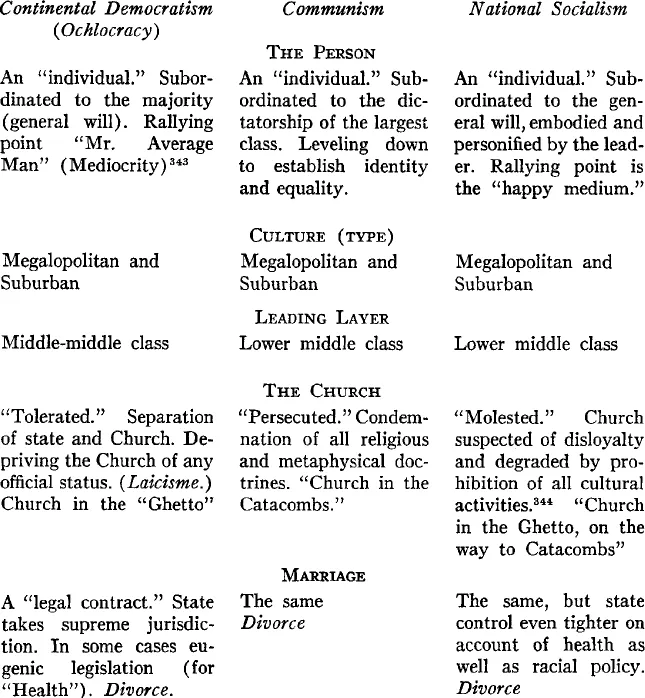
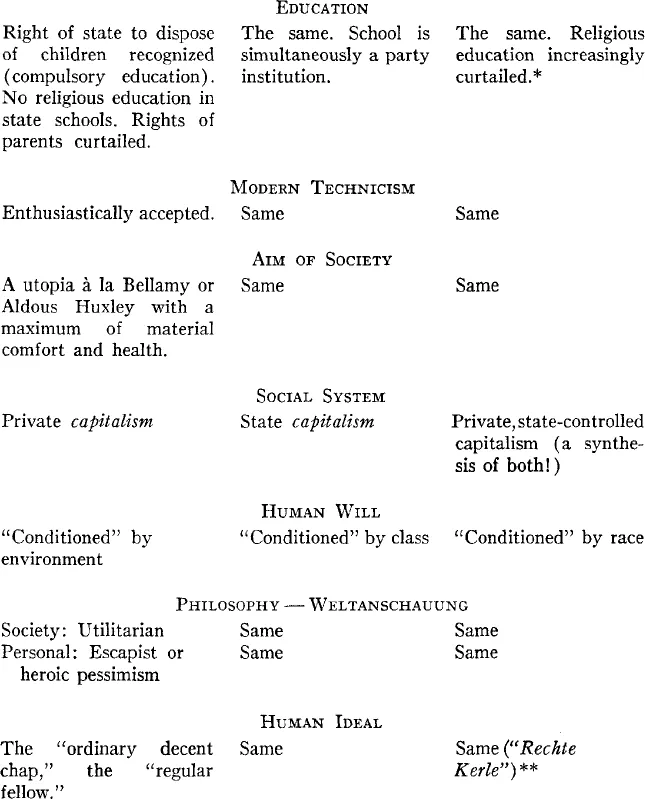
* The idea that the children belong to the State and not to the parents was first expressed by the Protestant minister Wolfgang Capito in his Responsio de miisa, matrimonio et iure magistratus in religionem, Strassburg, 1707. But the most furious advocate of State rights over children was the notorious Marquis de Sade, member of the Convention.
** Cf. Dr. Erich Kühn, Schafft anständige Kerle (Berlin, 1939).
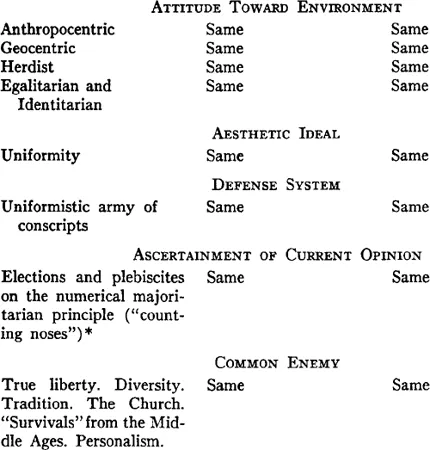
* This is clearly not the Anglo-American principle which denies proportional representation. The President in the United States can actually be elected by a minority of votes provided he has a majority of electors.
(If we take into consideration that these three ideologies “grew,” practically together, it is surprising that there is so much difference between them still left. Socialism is only about forty to fifty years younger than democratism, and nationalism assumed its racial character only another twenty or thirty years later. It must be conceded that ochlocratic democratism as the oldest of the three is undoubtedly the mildest.)
* The reader is reminded that German aggression against the Soviet Union does not make her our ideological ally although we are bound to her militarily. To give military help to the Soviet Union is not only a matter of prudence; it is also morally justifiable because we help her to get rid of the domination of a foreign power which has its own system of the suppression of personal liberties.
* Russia had a comparatively numerous lower middle class which became an easy prey of communism. We find a series of thumbnail sketches depicting the representatives of this quickly bolshevized class in E. v. Kuehnelt-Leddihn’s Gates of Hell. The agrarian peasant bolshevism was of the anarchical type in the best tradition of Pugatshev; the suffering of the peasantry began with the introduction of collectivization imposed by the urban Communists.
*Apokalipsis našego vremeni, Paris, 1926.
* There is hardly a better description of a totalitarian state based upon (religious) determinism than in Stefan Zweig’s admirably written book Castellio Against Calvin (New York, 1936). The parallels between Calvin’s Geneva and the “Germany” of the racial determinists are obvious and the paradoxical brutality against a population allegedly without free will the same. (Yet the very brutality, even if itself senseless, can be excused by “Divine predestination,” “Racial urge,” and similar confusions.)
* The “interventionists” who got busy after every British victory and the isolationist who was riding high and mighty after every Allied defeat belong to the same category.
* See E. v. Kuehnelt-Leddihn, Jesuiten, Spiesser, Bolschewiken, Salzburg, 1933, pp. 53–54.
** National socialism has no less satanic background. The deplorable lies spread by the Allies in 1914–18 against imperial Germany were largely trumped up or faked. An image of Germany was shown to the horrified Allied citizens as it never existed in reality. An old Austrian proverb says: “Never paint the devil on the wall.” It dates back to a Viennese saga about a very humorous painter whose exhuberance and fearlessness astonished everybody. One day, having had a little too much new wine — the famous Heurigen — he boasted that he could paint a portrait of the devil on the wall of the inn. His frightened companions tried to dissuade him from this plan, but in vain. Hardly had the unfortunate artist finished the portrait when it came to life and Satan, leaping from the wall, throttled the terrified painter to death.
Something similar happened to the Allies. The Third Reich is the propaganda picture of the Second Reich come to life.
* Democratism is here the phenomenon Christopher Dawson would call continental or Rousseauan democracy of the 1792 brand.
The Menace of the Herd, or Procrustes at Large
Read the whole book online · Book details
Free to read online and to download from this archive.