
Chapter 22 of 44 · The Case for Legalizing Capitalism by Kel Kelly
Chapter 10: Socialist / Government Economic Policies
Socialist/Government Economic Policies
It was asserted in Chapter 8 that politicians have very little interest in or knowledge of how an economy works. It was also explained that they have no incentive to do the right thing even if they knew what that was. Still, they make decisions and pass laws every day that affect our economic lives. This chapter will highlight popular and formal economic actions undertaken by our rulers, based on advice from their “advisors,” in order to try and manage and control the economy, and, it will analyze the economic merit of these so-called macroeconomic policies. It will also attempt to explain why these policies are so popular and why better policies are not implemented instead. Most importantly, it will show that though these policies of economic manipulation are believed by government economists to arrive at a better outcome than can the free market, they in fact cannot. The importance of this chapter is that in disproving socialist macroeconomic theory, I will make null and void the rationale for why government must manipulate the broader economy instead of allowing the free market to work.
In order to fully examine these advanced economic theories and dismiss them as not having merit, I must go into some quite technical detail. The intended outcome is to show that government bureaucrats not only cannot improve our state of affairs, but 1) the free market can, and 2) government bureaucrats can only make things worse.
Planning Our Economy
A majority of the theories of economic cause and effect explained thus far in this book were standard theories accepted by most economists before the Great Depression. However, there were some flaws and weaknesses in the theories, particularly with respect to work and wages, and the possibility of labor exploitation, which gave way to the acceptance of Marxism.394 In the late 1930s, John Maynard Keynes published his famous book, The General Theory of Employment, Interest and Money. With its arrival, sound economics was thrown out the window and replaced with anti-capitalist theories which seem plausible on the surface, but could not withstand strong scrutiny. Yet few seemed to care.
Several years earlier, Keynes had presented a completely different theory of the workings of the economy, in his A Treatise on Money; but it, along with many other of Keynes’ notions of how an economy really works, was shown to be incorrect by F.A. Hayek. When the General Theory came out, Hayek had grown tired of putting the time and energy into disproving Keynes, only to see him scrap his theories and start again with new ones. In the absence of a rebuttal, the General Theory caught on rapidly, and soon became the dominant economic theory in the world. Why did it catch on so fast? Because 1) it is in accordance with the common belief — and supposedly proves — that a free market cannot work without government control, and 2) it therefore gives government planners permission to intervene in the economy.
Today, Keynesian and other economic policies involving market manipulation are used by government central planners to try and control the economy. Were it not for this government control, the study of economics would be largely academic. For knowledge of economics is not needed for businessmen to carry on about their business of creating profits and wealth, or for workers and consumers to perform their jobs and live their lives. In a government-controlled world, economics — the study of human action — becomes a study of cause and effect of government intervention in the economy. It should be helpful to take a look at these tools of economic manipulation, focusing on Keynesianism, to understand its cause and effects in light of what we now know about how free markets operate.
The Meaninglessness of GDP as an Economic Indicator
A premier tool and indicator of government economists is that of Gross Domestic Product (GDP). While GDP is universally regarded as the prime measurement of economic growth and rising standards of living, in reality, this mathematical calculation is, first, mostly a measure of inflation and, second, a measure of spending on consumption of goods as opposed to spending on the production of goods.
GDP is held to reflect the value of national income and output simultaneously, or, more generally, the value of what a country produces. My intention is to show, in contrast, that it reflects primarily the amount of money, and therefore the amount of inflation, in the economy. As more money is created by the central bank and inserted into the economy, prices rise. Higher prices necessarily mean that the value of goods and services, corporate revenues, profits, wages, investments, and expenditures included in the calculation of GDP rise as well (as demonstrated in Chapter 3). Thus, GDP largely reflects inflation.
By way of illustration, if the quantity of money in the economy did not increase, neither could nominal nor real GDP. We have seen that there are only two ways that prices can rise: the supply of goods and services must fall or the supply of money must increase. Clearly, our volume of goods is not declining — at least not rapidly enough to cause price increases of 3–6 percent per year — but the quantity of money is increasing.
Prices in the GDP calculation are “deflated” with a price index in order to adjust for inflation, but they are only partially deflated because price indices significantly understate the actual inflation rate, as we learned in Chapter 3.
As evidence that creating money lifts GDP, consider the following scenario. If the money supply of the economy were static, i.e., if the central bank neither added to nor subtracted from the amount of paper bills and bank credit in the economy, GDP would be the same each and every year, because the fixed quantity of money would have to be distributed across an increasing amount of goods (and velocity, or the number of times we spent those same dollars, would also necessarily remain essentially unchanged each year395). In other words, no matter how many goods exist in the economy, the value of the amount of total spending and incomes in the economy would be the same every year because the quantity of money would be the same — an increased number of goods, each selling at lower prices, would leave the total sales value (price × quantity) constant. With a fixed money supply, our real economic prosperity would be measured by the extent to which prices of goods and services fell relative to our static incomes, since with the same amount of dollars chasing more goods, the price of each good would necessarily fall. This analysis demonstrates that prices and wages cannot rise without an increasing supply of money (likewise, having more money does not help to produce more goods), and that an increased production of goods would actually reduce prices. Thus, GDP measures inflation, not production.396
What GDP is ideally trying to measure is the physical volume of goods and services at our disposal. But since we can’t add up oranges, trucks, movies and airplane tickets, and since there is not a stable and reliable monetary benchmark with which to measure all such items, we must accept that we can’t fully count our domestic product in monetary terms (but we can calculate the rate of increase of units produced of individual products and services).
The second major problem with using GDP as an economic indicator is that it counts mostly consumer spending and consumption, not the production of goods and services. Indeed, consumer spending is generally held to account for approximately 70 percent of GDP. However, since the production of goods, and not the consumption of goods, is what constitutes real wealth, an increase in GDP signifies mostly an increase in spending and consumption, not an increase in real economic prosperity.
As Reisman has shown, an increase in GDP in fact correlates with a decrease in economic progress because most business spending — productive spending — is subtracted from the calculation of GDP in order to avoid so-called double-counting (which will be explained below).397 The greater the amount of productive spending in the economy, the greater is the corresponding number that is subtracted from the GDP calculation. As a result, the stated GDP is lower than would otherwise be the case. This is significant because productive spending, as I have shown, is virtually the sole means of wealth production.
Most business costs are subtracted from GDP in order to prevent “double counting,” because it is thought that the value of most goods associated with business spending is reflected in the value of the final product, and should be counted as such. Therefore, GDP counts the final product as representing both the final product and all the products that went into it. It says that if we produced bolts, screws, and automobiles, in sum, we produced only automobiles. This is wrong because the screws and bolts were in fact produced, in addition to automobiles, and they have their own separate values, even if they are eventually used to create the composite automobile.
Since, then, most business spending is excluded from GDP, the resulting calculation over-represents the contribution of consumer spending to total expenditures, and under-represents total productive spending, which far exceeds consumer spending and pays most wages — business spending is what is likely 70 percent or so of the economy. GDP, therefore, leads people to believe that prosperity comes about by means of spending and consuming our wealth. Wall Street and government officials, in turn, tell us to go and spend in order to “help” the economy. But it is savings, i.e., abstaining from consumption, which pays for the production of goods — real wealth — and increases our ultimate amount of consumption. Contrary to popular belief, savings do not usually sit under a mattress being hoarded, but are actively invested and financing production. All the assets companies possess are owned by capitalists (individuals), via their invested savings.
After all, if we spent all our savings on consumer goods, what money would finance factories, tools, and machines (and home mortgages and credit cards)? What money would pay the wages of workers producing products that have yet to be sold? As a reminder, machines and workers are paid for the products they make before consumers buy them. When we purchase a house, the hammer and the construction worker have already been paid for and have moved on to building the next house. Food, groceries, and CDs, as well as the tools and people that make them, have all been paid for before the consumer compensates (by purchasing these goods) the companies/employers who have paid to have the products created. Similarly, an automobile factory is paid for many decades prior to the complete reimbursement of the investors’ capital (when the last cars are produced). Almost all workers and machines are paid in advance with savings, not with sales revenues from consumers.
In sum, economic progress consists of increased productive capabilities, not production-sacrificing consumption. Therefore, GDP does not measure our wealth-producing capabilities. It can give us an idea of the relative wealth between countries (assuming exchange rates can freely adjust to the relative quantity of money, production, and capital flows across countries). And it shows us an approximate rate of inflation and how much we are consuming. But it should not be understood as an indicator of economic progress or standard of living.
Additionally, GDP merely counts the monetary value of things produced; but what’s produced may not be what really adds value to a society. For example, leftwing government economists such as John Kenneth Galbraith used to cite the Soviet Union’s strong GDP growth as an example of successful socialist policies (similarly, Latin America had GDP growth rates as high as developed countries for many decades in the twentieth century, but its real standard of living did not grow comparably). The truth is that the Soviets created little of value. They had tons of screws, but not enough screwdrivers; they had scores of bricks, but not enough mortar with which to assemble the bricks into a building. According to the mathematics of calculating GDP, the Soviets could have produced nothing but screws, and seen their GDP rise. If they produced more screws each year, or even the same amount of screws while the quantity of money increased, they could have shown a rising GDP. To Galbraith this would represent wealth; but to the Soviet citizens, having tons of screws, but no new clothes, food, or houses, would mean death and poverty. Given the assumptions and methodology of GDP calculations, a nation could really increase its GDP by having each citizen simply pay their friends and neighbors to scratch their backs while the government simultaneously printed a lot of money. The more backs that were scratched, and the faster the government printed money, the faster GDP would rise. It should be clear from this that simply having an increase (or decrease) in GDP, like simply having jobs, does not necessarily mean anything. For real wealth to be created, both jobs and GDP must entail the creation of goods and services society needs.
The Keynesian Multiplier398
One of the tools Keynesians are most proud of is their so-called “multiplier,” which they seem to think is equivalent to magic. The idea is that new additional spending of money creates new incomes. Keynesians believe that the formation of any additional spending in the economy, that is in turn spent by its receivers and re-spent in successive rounds, will create additional incomes at a multiple of the original amount of spending. They consequently propose that government should engage in deficit spending during recessionary periods when businesses will supposedly not spend, so as to pump up the economy. They are so convinced of this magic multiplier that they even claim that if government invests in building such things as Egyptian pyramids, the spending on the pyramids would create subsequent additional incomes and create prosperity. Paul Samuelson, a leading Keynesian theorist, wrote in his textbooks that if the government printed money to pay for a million dollars worth of goods to be thrown in the ocean, the spending and re-spending of the million dollars which created those goods would create additional employment and production. Under that logic, if we threw every new thing we created in the ocean, we would somehow become really wealthy.
Indeed, the mathematics of the multiplier theory is sound, but the assumptions are not.399 Since it is only productive expenditure, not consumption expenditure, which pays wages, the multiplier could only result in additional profit income, not wage income (the Keynesians specifically state that the multiplier works if incomes are spent, not saved and invested). To understand this concept better, suppose you spent $100 at the bookstore. Then the bookstore owner, instead of re-investing in his business, spent the money at the grocery store. The grocery store owner then takes the $100 out of the cash register and spends it on a new appliance. The appliance store owner spends it on movies, carnival rides, or whatever. The spending goes on and on in this fashion. In this case, the money was never not spent. If it were not spent, it would instead be saved.
If people spent all their incomes, there would be no funds available with which to invest and to pay wages. It is saving, i.e., not spending, that pays for additional capital goods and labor. Had any of the above businesses saved the $100 and invested it in their business, they could buy new machines or hire more workers. Had they saved the $100 in a bank, other businessmen, in borrowing these funds, could have expanded their operations or started new ones.
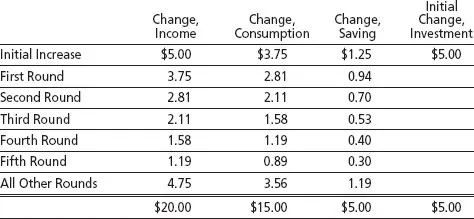
Figure 10.1: The multiplier process.
If all monies were spent and not saved, we would soon consume all existing goods. Since we would not have produced any new goods to replace those consumed, we would soon have literally no goods of any kind, including food or housing (after our food was eaten and our houses deteriorated).
In sum, the only effect from any additional spending is to raise the rate of profit: business costs remain the same, but the additional spending increases sales revenues. But nothing new is created, no investments are made, and no wages are paid.
Keynes stated that if people were careful not to save too much, there could be full employment with interest rates of zero. But this is illogical thinking. For if people saved nothing, there would be no productive expenditure, thus there would be no employment (only self-producing for profit). In this scenario of not saving at all, profits would be equal to the entire amount of sales revenues, and the rate of profit would thus be infinite.
But the Keynesian multiplier has even deeper problems than assumed thus far. Any additional spending cannot create real additional wage income even if the spending was in fact saved. This is because increased real incomes can only come about from new and additional production; workers can’t consume more goods if there have not been any additional goods created for them to consume.
The multiplier’s math (Figure 10.1400) shows us that a single $5 million of “investment” expenditures by the government can create $20 million of new national income, if people spent 75 percent of their incomes and saved 25 percent. With a portion saved each round, the amount of money being spent eventually completely diminishes to zero. But, according to the Keynesian’s own model, if people spent everything they earned, saving nothing, the amount spent each round would never diminish. In this case, each time the $5 million is spent it would create another $5 million in national income. This means that as long as the same money is spent and re-spent it will perpetually create an infinite amount of national income, forever. Obviously, this does not happen.
Now, a less important fact is that companies and businesses only receive so much income each year, and can only spend it once. And we know from studying how many times the same dollar is spent in the economy each year (velocity) that the same dollar is spent only several times in an economy on average — people don’t just take the same dollar and pass it around faster and faster.
The more important insight to consider is that it is not just passing around dollar bills that creates new wealth. If it did, why would we need to pass around bills in order to encourage us to begin making things? It is not for lack of thought or incentive that we don’t make more things; it’s for lack of savings and real capital goods. If you think back to the desert island example in Chapter 1 where a barter economy existed, you will recall that money is a “receipt” or “claim” that represents ownership of real goods already produced. It’s the real goods that are being exchanged, and once they are consumed they’re gone. And adding more paper bills to the economy for people to pass around simply changes the money price of the goods, but does not create new goods. Can we imagine five people on a desert island creating goods faster by passing around paper bills than they would by not doing so? With or without the bills they need to find resources, to build things, and to have real, unconsumed and stored previously-created food and materials (i.e., savings) to sustain themselves while they produce more wealth. If we look at the Keynesian multiplier in the context of a barter economy the assumptions behind its mathematics break down and its façade disappears.
Lastly, if new spending comes from newly printed money, it does in fact result in increased incomes, but as incomes are spent, consumer prices rise in proportion (or even in disproportion, as consumer goods are used up), and no new wealth is created. Printing money is therefore not a realistic way to increase real incomes. Also, spending taken on by government necessarily reduces the ability to spend by others, because it either depletes savings via taxes or reduces purchasing power via inflation.
Still, since most of the government’s economic advisors believe in the multiplier effect, the government continues to spend and spend, on any and everything, believing it will somehow bring prosperity. This is the basis behind our “stimulus” programs. Japan, too, has tried unsuccessfully to spend its way out of economic recession for the last 19 years; the Keynesian economist’s only explanation is that Japan did not spend enough. The only thing the spending in Japan has created is the greatest amount of debt a country has ever had in history. But politicians don’t have to worry about profits and losses, as it’s not their money.
The Supposed Failure of Lower Wage Rates to Create Full Employment
A cornerstone of Keynesian theory is that it denies that allowing prices and wages to fall in the depths of a recession when unemployment is high — high because of the very fact that businesses are suffering profit and revenue reductions and need lower costs in order to invest and hire more workers — will result in the purchase of more workers or goods. Indeed, say Keynesians, if wage rates were lower, employers would not be able to take on any more workers (think back to our discussion in Chapter 1 where we showed that an employer would hire 10 people at $10 each instead of only nine people at $11.11, since his total monetary outlay is the same either way). They believe there is only a finite amount of work to be done. This argument is the same as saying that there are no more goods and services people want in their lives (i.e. as consumers we would have no more demand for the additional things we would make as workers). Keynesians believe that, given a static quantity of money, we only have so much we want to buy in physical terms and no more. No matter how cheap things are, we will not purchase any additional amounts of the things we buy because we always have enough of them. Keynesians therefore believe that we are capable of producing more than we can consume (the overproduction doctrine). But if one imagines a world in which everything is free it becomes clear that in fact we would all consume more of the things we want, given the ability to.
But for most of us living in the real world, if the price of most food, jewelry, or clothes, or anything that we need or want, was simply less expensive, most of us would consume more of these things. The same applies to employers “consuming” workers: if employers have a set amount of money they can spend on labor — which they do — with lower wages, more workers would be employed with that same amount of money (each earning less money). This is elementary to even most non-economists. All goods eventually get sold at some price. A purse that originally cost $300 at Macy’s might end up being sold at outlet malls for $30, but it gets sold at the price people are willing to pay for it. The same applies to workers; if the government would cease its support of labor unions and minimum wage laws — laws that keep wages above the “market-clearing” price — employers would hire more workers since they could pay lower wages. In this case — a free market in labor — all those who wanted a job would have one, no matter what their skill level. And workers would be paid the value of the revenues they bring in (though salaries would be discounted enough to provide for the going rate of profit). The truth is that the Keynesian position is simply one refusing to recognize that their own socialist policies keep people out of work.401 Wages are “sticky” in falling, as Keynesians claim, mainly because government policies prevent them from falling.
The Keynesian Explanation for Why There Cannot Be Full Employment
Most arguments by mainstream economists for why the free market will not work and how it needs to be manipulated are based on ill-conceived theories that are woven into mathematical and geometrical equations and graphs. The Keynesian argument that there cannot be full employment is enshrouded in the so-called IS curve (don’t let these technical terms scare you away; they mean nothing), which is largely derived from a thing called the Marginal Efficiency of Capital (MEC). The MEC, which is essentially the rate of aggregate profits in the economy, is believed by Keynesians to be downward sloping, which simply means that the relationship between the rate of profit and the level of business investment is negative. Put another way, the more companies invest, the lower will be the going rate of profit. Thus, Keynesians therefore contend that if businesses invest too much money — which would come from too much savings arising from too much employment — the economy-wide rate of profit will be too low and companies will thus stop investing. This lack of investment due to a too-low rate of profit, in turn, causes “disinvestment” or, the hoarding of savings, and, therefore, unemployment.
The Keynesian assertion that increased investment leads to unprofitability (i.e., the downward-sloping IS curve and MEC) has three main components, all of which are wrong. The first is the claim that as more investment takes place as a result of falling prices and wages, the price of capital assets — the plant, machinery, and equipment needed for production — would rise from the increased demand arising from the additional investment. The theory is that a higher price of capital assets would lower the rate of return because it increases the initial investment, lowering profits. The reality is that, since falling prices and wages lead to lower unit costs, as well as increased production and supply, the price of capital assets would fall, not rise. Here the Keynesians are forgetting what they preach, which is not to confuse an increase in the supply demanded based on lower prices with an overall increase in demand for a product when the prices are unchanged. Additional investment that would take place due to falling prices and wages would be wholly based on lower prices of labor and capital assets, and would exist only in that case.
The Keynesian’s second argument for why too much investment will cause the rate of profit to be too low and thus unemployment too high is that with more investment and therefore more capacity, the selling prices of products will fall relative to costs, thus squeezing profit margins. But this claim makes no sense: business costs would fall along with selling prices, thus keeping profitability intact. In fact, declining prices, under normal economic conditions, is caused by a fall in the cost of production (business costs). Keynesians assume that with additional investment, selling prices would fall but that the cost of producing them would not. Since costs in fact fall as fast or faster than revenues, profits would remain at least the same under this scenario where prices are falling due to an increase in production. For reasons explained below, increased investment and lower business costs and selling prices actually cause profits to rise.
The third main argument for why too much investment leads to lower profits and unemployment is the claim that with additional investment, businesses would experience diminishing returns on the same amount of capital that exists. The reality is that, in the context of the Keynesian argument — in the depths of a recession where there is mass unemployment — there is already unused capacity, and the rate of increased employment of the many unemployed would outpace the rate of increase in the supply of new capital goods. This increase of the ratio of labor to capital means increasing, not diminishing, rates of returns on capital. Even in the context of ongoing, non-recessionary periods, there are not diminishing returns because technology tends to increase along with production and supply so that fewer workers per unit of production are needed.
While the Keynesian’s overall argument is that lower prices cannot lead to profitable investments and full employment, the Keynesians switch the context in the middle of their convoluted argument and do not specifically address the idea of lower prices resulting in increased demand for labor and production. Instead of discussing falling prices and lower costs of capital and production, they explain what would happen if there were instead, theoretically, rising prices and constant or higher costs of production. They basically state that if things were not as they are, they would be different. In fact, Keynes himself acknowledged that he knows of no actual case where his “unemployment doctrine” has existed.402
By arguing that mass unemployment during recessions cannot be alleviated with lower wages and prices and increased investment, the Keynesians are in essence claiming that recessionary periods are as good as things can get, that recoveries cannot exist in free markets without government assistance (which begs the question as to how things used to be better before the onset of recession). The reality is the opposite: profits are lower in recession than in recovery, and investment is weakest precisely during a recession, not during a recovery.
Liquidity Preference
Keynesians cite something called “liquidity preference” as the particular thing that explains why investors will not invest below a particular rate of interest (usually 2 percent). They argue that if the rate of return is lower than this rather arbitrary too-low level, lenders would choose instead to “hoard” cash. Keynesians also claim that, when interest rates are high, if these investors hoard too much cash, the rate of interest could not fall low enough to stimulate investment sufficiently to raise the economy out of the depression.403 A primary assumption, therefore, is that liquidity preference (demand for money) — along with the quantity of money in the economy — determines the rate of interest. Thus, they propose that when investors won’t invest due to expected low returns, the government should increase the quantity of money to lower interest rates enough to make investment spending profitable (which will actually set up a new boom and bust sequence, causing future losses and lack of investment).
But it is not true that the rate of interest will be too low or that holding cash determines the rate of interest. The actual fact is that the “hoarding” of cash, which would reduce the available supply of loanable funds, would act to raise the rate of return in a free market where the government did not keep interest rates artificially suppressed. With higher rates of return, people would thus be induced to invest more.
Second, the relationship between the demand for holding money and the rate of interest Keynesians propose is backward, which reveals that the rate of interest is thus not determined by liquidity preference. Proof of this can be had by observing the levels of liquidity preference, or the demand to hold money, in actual cases of hyperinflation: when inflation and thus interest rates are high, people don’t want to hold money; they want to trade it for real assets that don’t lose their purchasing power. And when inflation and interest rates are lower, people do tend to hold money.
The lesson from these facts is that it is not true that investors might want to hold so much cash that it prevents business investment from taking place during recessions. The real story, once again, is that investors don’t invest during recessions due to 1) the anticipation that prices will fall further due to a money supply collapse, 2) losses they already have from the central bank’s boom and bust prevents them from investing more for the time being, and mostly 3) that the government will not allow wages and prices to fall so that investment will be profitable and equilibrium restored.
Lastly, not only does liquidity preference not determine the rate of interest, but neither does the quantity of money. The rate of interest is predominately determined by the (nominal) rate of profit (not vice versa): there would be no interest paid if companies did not already achieve a particular rate of profit with which to pay the interest.
Profits Rise, Not Fall, With More Investment
Contrary to the Keynesian claims of an inverse relationship between the “marginal efficiency of capital” (i.e., the rate of profit) and business investment, more aggregate, economy-wide investment means higher, not lower, profits. Net investment and profits move together almost in lock step, as was explained in Chapter 1. As new investment is undertaken the increased business spending results in increased revenues. The aggregate value of the corresponding costs associated with the revenues lags behind the aggregate value of the investment spending because much of the productive expenditures consists of purchases of capital equipment and inventory, whose appearance on financial statements are delayed due to common depreciation and cost of goods sold accounting principles, and thus do not show up immediately on profit and loss statements. The results of these facts are that when investment takes place, sales revenues outpace their corresponding costs; the revenue/cost gap widens, increasing the rate of profit.404
The opposite scenario takes place during recessions. As revenues fall, depreciation and inventory costs remain higher, and fall more slowly and in a delayed fashion. This is a primary reason profits sink so quickly and harshly during recessions (and again, falling spending and falling profits result from the fact that new money from the central bank stopped flowing into the marketplace).
Any net investment on the part of businesses by definition means an increase in profits. The fact that profits rise with increased net investment and fall with disinvestment completely obliterates the notion of the Keynesian’s so-called MEC and IS curves. They are simply figments of the imagination, literally just made up. The overall point to understand is that the Keynesian argument that there must be government intervention because businesses will not invest and “jump-start” the economy because it will be unprofitable for them to do so is a complete fallacy. They will do so as soon as they can overcome the results of the previously-enacted government policies — to do so any sooner would be injurious to all.
Keynesian Self-Contradiction on Profits
With their Marginal Efficiency of Capital concept, Keynesians claim that more net investment reduces the rate of profit. But with their multiplier concept, they (implicitly) claim that more net investment raises the rate of profit. It is implicit because with an increase in aggregate demand that their multiplier would bring about, it would be expected that profits would necessarily rise. This is the case even if the increase in profits and demand were in proportion, which, in reality, they could not be (profits increase faster than demand due to aforementioned lag in costs based on depreciation and costs of goods sold).
The Accusation that Savings is Destructive
Keynesians assert that since it is saving which funds investment (at least they admit this fact, sometimes), too much savings can cause too much investment, thus causing low profits and unemployment, as discussed above, and proven to be incorrect. The arguments behind this “Paradox of Thrift” theory have already been shown to be fallacious. But additionally, it should be remembered that there could never be such a thing as having too much saving because there is always more need for investment than there could ever be enough savings for (we can always use more and lower-priced things in our lives). But the Keynesian’s false belief that too much savings causes unemployment is the basis for calling for the government to be the entity that acquires and uses these supposed “excess” savings — the additional amount of savings constituting “too much,” and the amount which supposedly causes investment losses — since the government alone will invest in unprofitable ventures. The government, in their view, is supposed to run deficits (i.e., employ a “fiscal policy”) as a means to sop up the excess savings. This is the crazy logic that is supposed to justify our current government policies of increased deficit spending during our current recession. The Keynesians believe this spending will somehow help the economy, but the truth is that it will serve only to take the equivalent amount of capital away from businesses producing wealth and squander it on unproductive activities.
In my Keynesian-dominated program in economics, I was taught that the need for savings is imaginary, and that instead paper bills can finance real production (and, as the Figure 10.1 shows, that having the government spend savings actually somehow creates savings). But even Keynes himself said that savings were indeed needed. The problem was that he proposed both saving and the spending of savings simultaneously, stating, “There is room, therefore, for both policies to operate together: to promote investment and, at the same time, to promote consumption.”405 Since Keynes understood his own contradiction, he alternated terms so that when he referred to supposed harmful savings, he called it “hoarding,” and when he referred to helpful savings, he called it as such. Nonetheless, Keynes’ own formal definitions state that saving equals investment.406
Government Spending of our Savings
The Obama administration, with support from both aisles of Congress, is spending trillions in order to “get the economy going” by “investing” in it. But as we have learned, the government is not making real (profitable) investments, it is just spending money that produces very few real goods and services, if any. True, we need improved infrastructure, but that had already been budgeted for previously; and the infrastructure should already have been improved with those previous monies, but were instead used for redistribution. Now, the government is taking money from the productive private sector where it would otherwise be used to produce real wealth, and wasting it on government works projects. It is destroying capital, reducing our productive abilities, and making the economy worse.
Why Recessions Remain Recessions
As we saw in Chapter 3, a recessionary economy suffers from malinvestment caused by previously enacted government “policies,” namely those creating fake money and tampering with market interest rates. Due to malinvestment, labor and capital have been allocated to places which the workings of the free market would have disallowed, but where they were placed by artificially low government-manipulated interest rates and fake money masquerading as real money. As a consequence, there has been too much production in some areas of the economy (i.e., dot-coms, financial services, housing, etc.) and too little in other areas (i.e., consumer goods industries). Once the money spigot stopped and these malinvestments were recognized as such, the market naturally acted to move capital and labor to where free market prices would dictate they be. But “stimulus” packages and the pumping of new money keeps these malinvestments in place, preventing the economy from righting itself by restoring its natural equilibrium.
Most economists erroneously think that the economy stays in recession because individuals and businesses will not spend; they say that there is a lack of demand. But these economists confuse artificial monetary demand arising from printing paper bills with real demand arising from having created something of value in the marketplace (which can then be exchanged for money and then other goods).407 They don’t understand that lack of demand means that there is a lack of spending in money terms due to the fact that the money that was created out of thin air by the banks has diminished or evaporated into thin air — in reverse fashion to how it was created — due to the ceasing of the previous credit creation and the ensuing business and bank losses which resulted (the reverse of the money creation process we saw in Chapter 3), in addition to the fact that people are hesitant to spend until the economy seems once again stable, since they are experiencing financial losses as a result of the crisis. Spenders, just like the banks, first want to get their financial situation improved, and they want to wait until the economy has settled down — has found its new “equilibrium.”
Keynesians — who engage in statistical studies as a substitute for understanding real cause and effect — measure demand in terms of the calculated GDP number, not in terms of real goods and services created, as they should. They think that if monetary demand is restored, and that enough money is pumped into the economy to raise GDP, a mere number, to a higher level, that everything is fixed and that the economy is once again in good shape. They have no concept of the fact that what’s wrong with the real economy is a misallocation of capital and an artificial, tenuous production structure. Artificially increasing a superficial indicator called GDP so as to read a higher number does not fix everything. This is analogous to having a plastic surgeon create an artificial smile on a depressed person and then calling that happiness.
The process of truly fixing the economy — allowing it to find its new equilibrium — involves allowing prices (and balance sheet values) to fall, businesses and individuals (such as homeowners) to incur losses, and allowing the movement of capital and labor to the places market prices would dictate. But just when the economy begins to do this, our Keynesian central bank, supported by the president and congress, disallows this adjustment and keeps printing more money in order to increase monetary demand; they thus keep in place the malinvestments and the artificial production structure. These pro-government economists don’t even take into consideration the ramifications that creating fake money has on the production structure; they believe there is no real cause and effect. They think that if we simply print more money people will magically have more “demand” and spend, and the economy will once again take off. But we know now that real “demand” consists only of real goods, not paper bills, and that spending makes an economy worse, not better. Indeed, the economy might take off in monetary terms, but that does not mean that things are really fixed and that we are increasing our real wealth.
Printing Our Way Out of Recessions
Printing money is a core Keynesian tool also because this additional money is used to finance government expenditures that are supposed to create their multiplier effect and cause additional “demand.” Starting the printing presses again can in fact work to raise GDP and get spending going as the economy receives more printed money at exponentially increasing proportions. However, this ultimately leads to either hyperinflation and a destruction of the monetary system, or a larger economic recession or depression (when the money stops flowing), causing even more unemployment and a larger-scale destruction of capital and wealth than existed before. Our most recent recession is so intense precisely because of the very fact that the economy was not allowed to adjust in 2001-2002, and trillions of dollars of new money were thrown at the problem.
Though these cycles of massive inflation and economic collapses have appeared over and over in various countries, socialists still stick to printing money as a means of trying to achieve economic improvement, since government economists believe printing paper bills or creating checking deposits on a computer screen can result in the creation of new physical goods. But surely, if printing money really created wealth, we would no longer have unemployment and scarcity — all a country would need in order to go from dirt poor to wealthy would be a central bank and a printing press. Unfortunately, the truth is that only physical production and the adequate devotion of savings to creating capital goods brings about economic improvements.408
Even if you do not understand an inkling of economics, doesn’t it seem intuitively obvious that constantly manipulating an entire economy, pumping it up and then cooling it down, instead of letting it function normally on its own accord would result in a negative outcome? It’s analogous to how Elvis and Michael Jackson both used artificial drugs to pump them up in the morning and keep them going through the day, and to calm them down so that they could sleep at night, instead of allowing their bodies to get the natural sleep, nutrients, and exercise they needed. The result in both cases was death.
Government spending, along with creating fake money, not only does not work, it makes the economy worse off in multiple ways, and prolongs the recession. These policies, along with all the other government economic manipulations not only cause the very depressions Keynesians think they can prevent, they result in less economic growth even in good times, prior to their causing the ensuing recessions. Keynesianism, its numerous variants, and all other socialist economics effectively consist of theories which state that prosperity can be created through the systematic destruction of wealth.
Why are Keynesianism and other Socialist Policies So Popular?
Why do government economists promote such anti-capitalistic policies? Because it gives a salvific role to the government. Keynesianism is an ideal economic philosophy — as opposed to economic science — for government officials since it suggests that government should intervene in and manage the economy. Compare this to the boring free-market proposal of doing absolutely nothing. Which do you think politicians will choose?
But why do most economists in general support government intervention economics? There are three likely reasons. One is that no matter what logic or reason would tell them, they want to support socialist ideologies (e.g., Krugman), particularly because the ideologies seem moral and enlightened. So they stick their heads in the sand and pray only to socialist gods. The second reason is that they simply don’t understand how the marketplace works if left on its own. If they understood free markets and were honest with themselves, they would naturally support capitalism because it’s the path to greater prosperity for all. The third reason is that they have incentives to support government economics because they can often benefit from being hired to propose more optimal means of government intervention, as mentioned before.
But having the government sanction Keynesian and other pro-government economics means that most economists are likely to be pro-government economists. Since government controls our school systems and influences our universities (even private colleges usually receive some government funding), the government, or political groups, make sure that public schools and universities teach government (Keynesian) economics.409 Also, the government funds most economic research; and when the government funds research it usually insists on the research revealing the story it wants told. I’ve heard way too many accounts supporting this assertion, from both academia and from business consulting firms.
Therefore, most government funded or partially funded institutions are overwhelmingly comprised of government economists who prosper by producing pro-government research. This also, of course, includes actual government economists such as those at the Bureau of Labor Statistics, Treasury Department, Congressional Budget Office, FDIC, etc. It similarly includes economists at the World Bank, the IMF, USAID, WTO, OECD, etc.
Even most “private” financial institutions can be expected to largely have pro-government economists. Why? Because aside from the fact that they are taught Keynesian economics from government-issued textbooks in either left-wing universities, such as Ivy League schools (most universities are actually left-wing), or in government-funded schools, financial institutions make their living almost entirely off of government economics, primarily that of the Federal Reserve’s printing press. If the government’s central bank did not create money from nothing and provide the inflation for asset markets to rise and rise, financial institutions would simply make money by safekeeping funds or borrowing real savings from one group and lending them out to another, making money on the spread only (in addition to the other basic services such firms offer). Financial institutions in general, therefore, have every incentive to support socialist economics. They don’t care about the real economy — they care about what will send the stock market higher again.410 A majority of professional economists fall under one of these above categories; it should be clear now why most economists support left wing policies.
Another reason that most economists fail to understand that the marketplace works better without government intervention is that the very crucial details of the workings of capitalism are obscure and very difficult to understand. The intricacies can take many years to fully comprehend. Anti-capitalist economics, on the other hand, usually simply give a one-dimensional view of how virtually everything will go wrong if the marketplace is left to its own devices, and the logic makes sense on the surface. But any scrutiny of Marxism and Keynesianism will quickly reveal its fatal flaws. There are tens, if not hundreds of free market books explaining, in gory detail, the flaws of Marxism and Keynesianism. Yet to my knowledge, no books have ever been written explaining, in detail, topic-by-topic, the systematic flaws of free-market economics. There are no developed and precise rebuttals to Mises, Hayek, Rothbard, Hazlitt, or Reisman. There are, however, many books which simply state that free markets don’t work and others that attempt hit and run attacks on certain sub-topics. Most tellingly, none of the big works by Keynes, Marx, and other anti-capitalists explain how wealth and standards of living would improve under their regulated, socialist economies. They don’t explain how labor laws can create higher wages or how stifling production creates increased production. They simply explain with half-cocked theories how capitalism must fail. This point is so important it’s worth stating positively: Socialists have not and cannot explain how taxing, inflating, and regulating an economy can produce increased wealth for all of society. They have no viable, feasible, operable system of economic progress!411 Nor can they point to any society wherein socialism or communism has brought about more wealth for more people.
When they will actually listen to and consider free-market explanations, socialists will say that capitalism sounds plausible in theory, but there is no proof that it would work in reality. First, evidence such as what I’ve presented here in this book should suffice as showing that it works where and to the extent it’s allowed. But the fact is, it is socialism that cannot be proved. All evidence empirical and circumstantial points to its failure. Even socialists propose marching full speed in the direction of communism, which they admit doesn’t work, but pretend that no matter how hard or fast they approach it, they’ll never get past that imaginary wall that is supposed to somehow separate socialism from communism.
No matter that capitalism seems to work and socialism doesn’t, socialists want the government to enact their policies without any proof whatever that they work, steering us away from capitalism. They want us to take actions that will cause unemployment and a reduction in standards of living when they can’t explain economically how these policies will truly help laborers and help create more goods and services. Thus, the onus should be on socialists to prove that what they propose will help us all before they are allowed to take away our freedoms and our prosperity.
Free Market Fantasy
Meanwhile, as the economic problems drag on, left-wing media such as the New York Times constantly question, ironically, why anyone still believes in a free market, as though we have one. They fully believe all of our problems were caused by utter freedom. As Jeffrey Tucker states:412
So you can take a market and beat it, tax it, regulate it, subsidize it, flood it with fake money, punish its performers and reward its losers, hobble its capital sector, strangle consumers, nationalize stuff at will, and erect every barrier to trade and cooperation, and STILL call it a market. When the scheme fails, it’s the free market that failed, so clearly we need the totalitarian state to sweep into action.
Similarly, in March of 2009, Harvard University sponsored an audacious conference called “The Free Market Mindset: History, Psychology, and Consequences,”413 where “professional” economists and academics pondered why anyone would believe in the free market since we all know that it causes all our problems. To my knowledge, this group did not bother to invite an actual free-market economist or advocate to the conference to explain how the conference holders arrived at their confused state.
It would be a dream to have a type of courtroom battle where each side presents its economic arguments and counter arguments in full detail, where a societal jury would judge which system is likely to work and which isn’t. If society had the time and patience to learn and understand in detail how markets work, there is no way that they would not choose capitalism if they were honest with themselves.
We have seen the results of Keynesian policies for the last 80 years. We have seen the results of similar types of policies of government intervention before Keynesianism came along (i.e., the economic crises of 1873, 1896, 1907, 1921, 1929, etc.). These policies have harmed our economy. Yes, we are still alive and relatively prosperous, but at great costs. We would have much higher standards of living without inflation, unemployment, and recessions if we had had a true free-market economy all these decades.
It is often argued that free markets are fantasies, that they are a theoretical, idealistic world. This argument could not be further from the truth. Were it not for laws specifically preventing free markets from functioning, free markets would exist today. Saying free markets are theoretical is like saying that grass can’t grow in a plot of land where a parking lot exists. Were it not for the asphalt, grass would be there instead. And grass does spring up through the cracks in parking lots unless it is prevented from doing so by cars driving on the asphalt, by chemicals, or by more asphalt being poured on top of it. Like the grass, the free market finds a way to try and operate daily, but they are constantly being suppressed. Fantasy? Abolish the central bank tomorrow, leaving only the dollars which currently exist. Watch and see if inflation and recessions continue to occur.414 Idealistic only? Try allowing private companies to provide water and electricity and see whether we continue to have water shortages and power outages. Utopia? Just take away labor laws and see if unemployment persists. Just permit these things long enough to try them, I dare you.
Only YOU Can Prevent Socialism and Economic Regression
YOU, as a voter, are preventing free markets and prosperity from happening by continuing to vote for anti-capitalistic policies just because you are scared to see what would happen. I implore you: let’s just try it for 10 or 20 years in one area of the country. Not a government-sponsored and regulated “free market” with a thousand pages of rules — but a true free market. Let’s have a real free market in say, eastern Oregon, or northern Nevada, places where there aren’t many people living who might object to a lack of government domination. Instead of continuing to say it won’t work, let’s just give it a chance and see what happens. No true free market has ever existed in the history of the world. Our political leaders will never go for it on their own because if it is successful, people will no longer want the politicians to rule them. So this must be championed by the voters. Demand from your government a free-market experiment! As Mises stated, “What determines the course of a nation’s economic policies is always the economic ideas held by public opinion. No government, whether democratic or dictatorial, can free itself from the sway of the generally accepted ideology.”415
Otherwise, demand more free market legislation — which means demand to un-do previous legislation — on more and more issues. Instead of letting your politicians know that you want energy independence, let them know that you simply want free trade and a repeal of environmental legislation preventing the production of oil. Instead of demanding “change” in the way of more minimum wage laws or more union support, let your politicians know that you want the marketplace to determine wages. Instead of blaming free markets for financial crises and recessions and asking for yet more regulation, demand from your politicians that they quit printing money and quit attempting to manage and regulate the economy.
We can have increased safety and security. We can have more and higher-paying jobs. We can have prices falling daily. We can have a cleaner environment. We can have an absence of wars. We can have a higher quality of life every single month, no matter our age, skin color, or religious belief. We can have prosperity and freedom — but only if you will understand how it works and then vote for it. Let’s give peace, freedom, and prosperity a chance.
The Case for Legalizing Capitalism
Read the whole book online · Book details
This work is published under a Creative Commons licence. You may copy, share, and re-host it with attribution.