
Chapter 20 of 44 · The Case for Legalizing Capitalism by Kel Kelly
Chapter 8: War And Patriotism
War and Patriotism
War is anti-capitalistic. Indeed, it threatens to destroy capitalism. When nations engage in war, liberties are dismantled and government control of the economy increases; standards of living decline as resources are redirected from the production of goods and services to the production of guns, bullets, and tanks; and the possibility of losing a war threatens the very existence of the nation. Not to mention that engaging in foreign conflicts for any reason besides immediate and urgent self-defense impoverishes other nations, creates enemies, manipulates for the worse the various economic engines of the world, and weakens our own defenses here at home. All of these factors undermine capitalism. Most important, wars claim the lives and property of mostly innocent people.
This chapter will reveal that war is politically and economically unnecessary, that there is usually not a legitimate reason for war. Since most people believe our politicians’ claims that we are constantly threatened by evil forces lurking outside our borders, this chapter will show, in contrast, that most wars are intentionally created by politicians who invent threats, because they benefit from war or because they believe that a nation needs war in order to succeed.
180 million people were killed in wars during the twentieth century, far more than in any previous century.272 This is equivalent to almost 5,000 people killed per day. Most of the dead were civilians, often women and children.273 This number does not include those merely wounded, tortured, mutilated, dislocated, raped, diseased, or impoverished. Between the moment “peace” was declared after WWII in 1945 and the time of the Israel/Palestine “Peace Accord” in 1993, more than 150 wars were fought throughout the world.274 These wars were not started by individuals or businesses, but by “legitimate” government forces — or by “revolutionary forces” seeking government power. Thus the root cause of war is almost always the nation state system, or those attempting to control the nation state. We should, therefore, discourage state control and consolidation of power.
Socialists often claim that capitalists start wars in order to further their interests and make higher profits. But it is rather the nation state, pursuing the interests of its leaders, that starts wars. It is common, though, that powerful businessmen, essentially in collusion with politicians, use the government to gain at the expense of all those victims of wars. To the extent that war is driven by businesses (by way of influencing politicians), the problem stems from the ability of the government to 1) have the power to centrally control all economic activity and intervene in industry and to 2) have unlimited power to tax, especially to create money (i.e., steal money) in order to fund as many wars as desired. Without these powers, the government could only engage in conflicts for which the people voluntarily, or at least by direct voting, allowed it to collect taxes; citizens would decide how much and how often they needed protection (and would probably agree to pay 80+ percent tax rates if needed to fund an immediate threat to their property). Under this structure, government would have to fully organize its wars as a customer or trading partner of industry, not as a controller of industry.
Under capitalism, partnerships between the government and military suppliers — including banks — would be both prohibited and impossible. Under mostly free markets in a system of a limited government restricted to 1) providing only basic infrastructure services, 2) upholding laws to fully protect private property and individual freedom, and 3) defending interests at home, there would be no opportunities for politicians to engage in military actions for economic reasons. Government would not be intertwined with businesses as it is in today’s political structure, since it could not intervene in the economy. Any supposed economic problem would be solved by the marketplace.
In fact, under true capitalism, wars would exist only when the capitalist country was attacked by an outside force. Any “anticipatory reaction strikes,” “defensive” actions on behalf of other states being attacked, or the carrying out of foreign “regime changes” for the purpose of imposing supposed democracy, such as the U.S. engages in today, would constitute aggression and be illegal.
Though our school history books and most of our historians tell us that America’s wars have been fought for the high and necessary goal of defending our country and our freedom, the truth is otherwise. The real causes of wars are rarely what we are told by official sources. As is commonly noted, truth is the first casualty of war. Since most citizens instinctively oppose war and death, their leaders often have to develop propaganda that instills a hatred for the enemy and reveals a supposed threat to the people that justifies the sacrifices they want the people to make. Historians of the winning side then write accounts substantially relaying the official story leaders tell.
Many important facts and circumstances surrounding the onset of wars are not shared with individual citizens, who usually do not bother digging into publicly available reports to piece together the real story, either at the time or after the event. Americans in particular are usually led to believe that an evil force — communism, terrorists, religious fanatics, a new Hitler (every run of the mill dictator is labeled the next Hitler), etc. — is lurking on the horizon, poised to strike at any moment. Therefore, it’s necessary to strike first. We are also told that it is only those dangerous foreigners who are provocative, that we ourselves do nothing to stoke the fire — we are as innocent as can be. In fact, however, we often push our way to the front of the line to get on the stage of war.
Since this book is focused primarily on American leaders and their management of the nation, it will be instructive to look briefly at some past wars and smaller conflicts America has been involved in so as to understand the difference between the official stories and reality. This will be done using particular (true) information that is rarely revealed to the public,275 enabling readers/voters to better understand real history. A review of several instances of America’s foreign policy will show that the U.S. doesn’t simply play the role of kind protectorate for others’ countries — or even our own.
Obviously, the United States — one of the freest countries in the history of the world — is not the sole bad actor. Our enemies are surely as bad or worse than we are, and other countries in our position would no doubt carry out the same or worse actions. Nevertheless, there is in our case a disparity between the high morality of our claimed purposes and the reality of our undertakings.
While the goal of this chapter is to present this hard-to-find but nevertheless public information, there will not be space to fully support the claims, other than referencing sources. Much of the information below will be shocking and may strike readers as incredible. Readers are therefore encouraged to consult the sources listed in the footnotes on their own, and to do other research. Local bookstores are probably not the best places to seek this information: many vested interests with an incentive to maintain the current system would prefer that the information not become common knowledge. Indeed, much of the information in this chapter would not have surfaced were it not for the Freedom of Information Act. There are, in any case, numerous sources of documentation about the following topics released from the U.S. and other world governments.276
The Civil War277
To kick off our set of brief examples of the real details of actual wars showing that conflicts do not take place exactly as we are told, and that they need not have taken place, let’s start with the Civil War. Although many assume that the Civil War in the U.S. was fought for the high moral purpose of freeing the slaves, the truth is otherwise. Government power, economics, and ideology were the driving factors.278 Slavery played into these issues, inasmuch as how slaves being counted as citizens in terms of the census would affect control of the government and the balance of power between the North and South. Had slavery alone been the issue, it could have been abolished in the same way as in every other country in the Western hemisphere, namely by compensating slaveholders.
The South wanted to secede from the Union mainly because of economic exploitation by the North, particularly as it related to punitive import tariffs: 75 percent of the tariffs were imposed on the South’s ports, but the overwhelming bulk of tariff revenues were spent in the North. In essence, money was being redistributed from the South to the North. The South wanted free trade with no tariffs and consequently felt compelled to secede in order to control its own economic future.
Though slavery is clearly morally reprehensible, we should remember that it was in fact legal in the US at the beginning of the Civil War.279 The only formal question regarding slavery at the time was whether the North should return escaped slaves, and whether the newly created states should hold slaves. Nor were secessionist movements restricted to the southern states. Many northern states, such as Maryland, Connecticut, and most New England States, had themselves tried to secede, as did New York City during the war. 280
Indeed even Lincoln’s Republicans and many northern states opposed emancipation due to the labor competition freedom would create.281 Republicans protested the expansion of slavery, not for moral reasons, but because of the change in balance of government power that would represent.282 And Lincoln’s eventual Emancipation Proclamation issued during the war did not free all slaves — only ones in the states the North did not control. Slavery still existed in “loyal” border states and in Washington, D.C., itself.
Lincoln had previously declared, as indeed had our nation’s founders, that the right to shake off an existing government and to form one that better suits a people is a most “valuable” and “sacred” right.283 Therefore if America’s war of independence from Britain was just, so was the South’s. Further, Lincoln had denied any intention to interfere with the South’s slavery and had no legal right to do so.
The South wanted only secession, but Lincoln, in calling for a blockade of southern ports,284 in fact initiated the war, maneuvering the South into firing first (killing no one), so that he could engage in war against it. Even some Northern newspapers saw though this charade and questioned Lincoln’s intentions. Besides wanting the South to fund most of his budget, for ideological and religious reasons, Lincoln sought a centralized government with increased power.
Over 600,000 people died during the Civil War. Many of those wounded or killed were civilians targeted by Lincoln’s forces285 — both black and white women and children were robbed, brutalized, tortured, raped, and left homeless. Southern blacks were regularly beaten, tortured, or killed by their northern liberators.286
Others merely lost their freedoms during the war: Lincoln suspended habeas corpus, arrested judges who declared his actions illegal, suspended state legislatures on the suspicion that they might vote for secession, confiscated railroads and “disloyal” newspapers,287 and arrested thirteen thousand people without cause or warrants for protesting his war. He also used American soldiers to slaughter Indians who were in the path of his friends’ desired railroad tracks.
The United States Supreme Court later stated that the war had two starting points before the firing at Fort Sumter, both initiated by President Lincoln in calling for a blockade of Southern ports.288 Thus, through the use of force, Lincoln transformed America from a confederation of states to a consolidated warfare-welfare state, thereby creating American nationalism, which, like all nationalism is both jingoistic and fascistic.
Is Secession A Bad Thing?289
We saw above that the Civil War would not have taken place had Lincoln allowed the South to secede. And secession is seen by most as a terrible thing that tears countries apart; whenever the possibility of secession is mentioned in today’s world, the concept is viewed as something only lunatics would support. “How could anyone dare promote changing the borders of these United States of America!” But there is nothing sacred about national borders as they stand. They are arbitrary lines, imposed by centralized governments, separating people. Plus, no borders are permanent; the U.S. did not have its current borders 100 — and especially 150 — years ago and will likely have different ones 100 years from now.
Minority secession movements are seen as violating democratic majority rule. But the crucial and always unanswered question is: democratic rule over what geographical area? Most people assert that there should be a single, overriding government agency with a monopoly force to settle disputes by coercion. Fine, but if that’s the case, then by the very same logic, shouldn’t all nation-states be replaced by a one-world monopoly government? After all, don’t we currently have “international anarchy” (“anarchy” is defined as a lack of overall government control, not a state of chaos)? Most people rightly protest a one world government for fear that world taxation, socialization, control, and a lack of local freedom would totally and irreversibly suppress the liberty and property of Americans. Even American Democrats hate the idea of a one-world government (unless they can be assured of controlling it).
In the U.S. and Europe, the individual geographical regions that were consolidated into today’s nation states used to consist of individual monarchies (in Europe) and of smaller autonomous cities and states (in the United States), where people lived much more prosperously and safely (there was no income tax, no inflation, low crime, strong economic growth). Though a centralized world government is not promoted by most people, the historical trend, as far as government action is concerned, has been to combine smaller regions into larger centralized areas, but not the reverse.
Yet individual groups of the world in some of these larger regions often want self-rule, such as the Kurds in Turkey, the Basques of Northern Spain, French Canadians, the Chiapas in Mexico, the lower Saxons and Bavarians of Germany, the Padania region of Italy, Northern Ireland, etc. If we’ve combined ourselves into larger centrally-planned nation-states, what’s wrong with undoing that and reverting to smaller autonomous regions, for those who want them?
Exactly what should national boundaries be based upon? What national boundaries are considered as just? In the first place, it must be recognized that there are no just national boundaries per se. Real justice can be founded only on the property rights of individuals. If fifty people decided voluntarily to set up an organization for common services or self-defense of their properties and themselves in a certain geographical area (as happened in California in the 1800s before the state government took over), then the boundaries of that area, based on the just property rights of the members, would also be just.
National boundaries are just only when based on voluntary consent and the property rights of their members or citizens. The only way to have national boundaries as just as possible is to preserve and cherish the right of secession, the right of different regions, groups, or ethnic nationalities to leave the larger entity and set up their own independent nation. If the natural right of secession is not permitted, if people cannot live how they please, there is no true freedom. As Murray Rothbard said:
There is no nation; there are only individuals. The nation is a collectivist and therefore pernicious concept. The concept of ‘national self-determination’ is fallacious, since only the individual has a ‘self.’ Since the nation and the State are both collective concepts, both are pernicious and should be combated.290
Given that nation-states do exist, they should (a) never exercise their power beyond their territorial area (a foreign policy of “isolationism”), and (b) maintain the right of secession of groups or entities within their territorial area. The right of secession, if strongly upheld, implies also the right of one or more villages to secede even from its own ethnic nation, or, even the right of a single individual to secede.
Respecting the Borders of Other Countries
It is the fact that nation-states exercise power beyond their borders and fail to allow “self-determination” in countries in which they interfere that many of the problems of the 20th century developed. This was the case particularly with respect to British, French, and American foreign policy, where these countries carved up pieces of Europe and the Middle East, arbitrarily assigning borders in order to break countries apart (Germany, Poland, Austria-Hungary, Palestine, etc.) or to assemble them by force (Czechoslovakia, Syria, Iraq, Jordan etc.).291 The Allied forces, due to politics, recognized and protected existing borders when it benefited them (saving Poland and Hungary from the Nazis and the Soviets in 1939), and refused to recognize existing borders when it did not (failing to save Czechoslovakia from the Nazis in 1938 or the Baltic States from the Soviets in 1940). In creating countries in the name of “self-determination,” the Allies made some ethnicities more equal than others, by forcing the “bad” ethnic groups to be ruled by our friends, the “good” ethnic groups.
Due to politicians seeking power and alliances in 20th century Europe, border changes created minorities and international conflicts, regional and civil wars, and were often accompanied by violence and ethnic cleansing. People were not free to live as they wished, but only as rulers, although democratically elected, physically forced them to.
Our democratic, freedom-seeking leaders also intervene or don’t intervene in domestic affairs within other nation’s borders, such as when the U.S., paying “allies” to join them, invaded Iraq to save its people — particularly its gassed Kurdish minority — from a ruthless thug and to stop the Iraqis from accessing the same weapons that we have and use. Yet, when it came to the on-going genocide in Rwanda (resulting from one group trying to force another to live a particular way within defined borders), the U.S. apparently decided that those people were not worth saving, or that there were no strategic reasons for doing so. So much for saving human lives being a primary objective.
The inconsistencies are clear to those who take time to think about them. As Newsweek stated with respect to foreign policy in 1991:
What is sacrosanct about existing borders, given that many ethnic groups have plausible claims to their traditional land? Bush seems to agree in the case of the Palestinians — but not the Kurds, or Yugoslavia’s Croats and Slovenes. And some threats to international order stem from violence or political repression within the borders of a single country. Doesn’t “order” depend to some extent on the spread of democracy? Bush seems to think so in Cuba, but not in China. The president sometimes professes ambivalence about interfering in other countries’ internal matters (the clash between Moscow and Lithuania, for example). But he has plunged into the affairs of Kuwait, Iraq and Panama.292
(Panama, incidentally, is a prime example of how the U.S. does not practice what it preaches concerning democracy. After we invaded that sovereign country to depose Noriega merely because he quit taking orders from the U.S. government, Panamanian citizens cried for free elections. Instead, the U.S. swore in its hand-picked Endara regime on a U.S. military base hours after the invasion.)
Sanctifying status quo boundaries has been the basis of U.S. foreign policy since the establishment of the League of Nations and its successor the United Nations, all based on the incoherent and disastrous concept of “collective security against aggression.”
This logic underlay U.S. intervention in World Wars I and II, and in the Korean War: first we determine (often incorrectly) which is the “aggressor state,” and then all nation-states are supposed to band together to combat, repel, and punish the aggressor.
A major flaw in this concept, as hinted at in the Newsweek quote above, is that when an individual aggresses upon another person, there is usually clarity, based on property rights, as to who is the aggressor and who is the victim. But what happens when nation-state A aggresses against the border of nation-state B, often claiming that the border is unjust and the result of a previous aggression against State A decades before? How can we be certain that State A is the aggressor and that we must dismiss its claims out of hand?
When nation-states arbitrarily claim individual property as belonging to their borders, and other nation-states want the land instead, or, those who rightfully own the land want to unshackle themselves from the current nation-state who holds them, troubles necessarily arise.
World War I293
Turning now to the first World War, we find that there was no need for America to enter the war, and above all, that there was no need for war, period. The Great War started as a narrowly European conflict begun by Serbia, in which America had no reason to engage.
Due to the Europeans’ complicated web of alliances and need to fight multiple countries in multiple places, the Germans, once their borders were threatened, chose to pass through neutral Belgium in order to quickly prevent France from attacking first. The British, incorrectly interpreting these actions as an economic threat to their own empire, though it had no legal responsibility to assist Belgium, stepped in to fight Germany, thereby turning a regional conflict into a world war. Though most British cabinet ministers were initially hesitant to wage war, Britain’s foreign minister, Edward Grey, the country’s primary proponent of war, succeeded in persuading the majority of the people to support the move, just as George W. Bush somehow persuaded American politicians and citizens into war against all odds in 2003.
Ironically, not only did Germany’s military actions not endanger Britain, but Germany’s Kaiser would likely have honored his commitment (on the eve of the war) to guarantee French and Belgian territorial integrity in exchange for Britain’s neutrality. The Bolsheviks, upon taking power in Russia, released documents proving that Germany went to great lengths to avoid the war. All countries were guilty, but had Britain left the warring countries to fight amongst themselves, millions of deaths and the destruction of hundreds of cities would have been prevented.
German and British soldiers spent Christmas Eve 1914 together under a voluntary cease-fire, helping each other bury their dead, playing soccer, exchanging chocolates and cigarettes, celebrating Christmas, and discussing the various pieces of war propaganda appearing in their respective country’s newspapers.294 One of the British soldiers, years later as a Cabinet Minister, explained to the House of Commons that “if we had been left by ourselves there would never have been another shot fired... it was only the fact that we were being controlled by others that made it necessary for us to start trying to shoot one another again.”295 The soldiers from each side realized they had no idea what they were fighting about, which was mostly for their politicians’ careers.
Had Britain, who pulled America into the war, stayed out of the war, there likely would have been a quick and easy German victory, with some territorial changes in Eastern Europe, but probably no mass destruction and death. Russia would not have been destroyed and seen its government collapse. Therefore, there would have been no Bolshevik Revolution, no Lenin, and no Stalin (and possibly no Mao in China). Had the small German victories been the extent of the war, there would have been no Versailles Treaty, and therefore no Hitler (see below), and therefore no World War II and Cold War. Overwhelming evidence suggests that the Germans had no plans for massive expansion in Europe.
In this latter scenario, not only would most of the 20 million deaths of WWI have been avoided, but also the 50 million deaths of WWII — mostly civilians — not to mention the hundreds of millions killed under the communist regimes that sprang up on the back of Russia’s WWI collapse. Additionally, without the weakened and impoverished immune systems of the people of the world during WWI, the Spanish Flu, which killed more than 20 million worldwide starting in the last year of the war, would likely not have been able to spread like wildfire as it did.
Other nations can be belligerent if they must; but there is no need for America to get involved.
The Politicians’ Need for War
Today, politicians go to war largely to increase their power, but this power is achieved at the expense of the power and freedom of the people. Since war is an instrument used to aggrandize state power, most of the losses of individual freedoms occur during times of war.
During WWI for example, the Sabotage and Seditions act was passed, allowing the federal government to punish anyone with an opinion that was “disloyal, profane, scurrilous, or abusive.”296 This act prevented the post office at one point from delivering mail that was “antiwar.” And we have all seen the freedoms taken from us by the Patriot Act. Wilson and the war also gave America the Federal Reserve and the (permanent) income tax, along with the Federal Trade Commission, the League of Nations, and the Versailles Treaty, which directly led to World War II. The German language was made illegal, and in some states only English was legal. Citizens were asked to report those selling goods for less than the government-stated price. The injustices were numerous, and many last to this day.
There are, however, many advantages for politicians who go to war. They gain substantially increased “wartime” powers; they unite a country which comes together to support the glorious “war effort”; they gain fame and admiration for “heroically” leading a country through the difficult challenge of “defending freedom.” But only governments go to war, not people. The people of various countries usually get along fine and would never fight were it not for their government’s telling them to or putting them in positions where they feel compelled, and, were it not for their thinking that they somehow need politicians to “lead them.”
It might be argued that the soldiers of the Christmas truce of WWI who would not have continued fighting on their own might grow up into businessmen who would want to fight for each other’s profits. But without a national government to do their fighting for them, they would have been constrained to stick with business, i.e., merely exchanging money for resources, and competing with their products and their prices instead of with machine guns and bombs.
I’ve traveled to many countries which do not like the United States. But the people are very warm to me. This is because, as they state, they dislike my government, not the people (even though it’s the people, in democracies, who support the government by voting for it).
Democratic House member Charlie Rangel proposed in 2007 that the U.S. force all young men to serve in the military so that politicians would be less likely to start wars, since their own sons might have to fight. A more humane option would be a law requiring the president, his staff, and all members of congress to go to the front lines and fight during war instead of allowing them to stay at a safe distance in their leather chairs and marble buildings.
The Economic “Need” for War
In absence of politicians managing an economy, what would be left would be individuals living, working, and trading with each other all around the world. There would be little need to fight for land or resources; what resources were needed could be obtained through free exchange. One could buy all the land and oil they need; there are millions of entities willing to sell these items. (Often, though, resources in today’s government-run economy can be unavailable because government misuses, hoards or controls them to a degree that they are not available for exchange on the market. An example would be African countries whose dictators don’t allow the economic investments needed to take their natural resources out of the ground. Or the nationalized steel and oil companies, whose assets are not for sale at any price.) After all, Japan became much more successful economically by laboring and buying resources after World War II than it was in stealing them from Korea and China before that.
There is also no need to “find a distant market.” It would be ideal if other countries were involved in world production and exchange, but if they are not, so be it; they should be left alone. If a country can’t find export markets because there are no trading countries, it can exchange and consume all of its production in the home country, since there could never be a satiation of goods at home. But since ignorant government officials and businessmen who fund their campaigns feel a need to somehow find foreign markets, wars ensue. Industry can find foreign markets by itself; governments usually intervene to try and force foreign markets into becoming “democracies” and trading partners. This is unneeded and immoral.
We don’t need to impose democracy. Even if countries want to become full communists, let them; they won’t survive anyway. As we learned from Chapter 6, communism cannot survive on its own. Had the Soviet Union taken over Europe, America, or the world, it wouldn’t have lasted long. Communism was no real threat, but hundreds of millions of people in hundreds of countries suffered under brutal regimes or died in the name of keeping communism at a distance. They would probably have been better off under communism.
We don’t need the world to be democratic or even capitalistic in order to prosper. It’s true, we will prosper much more with capitalism existing in more countries, but it’s not a necessity. And it should be clear by now that Democracy is usually mutually exclusive from Capitalism and freedom. The last century has been filled with democracies starting wars, suppressing citizens, and preventing economic progress. And we have seen already that wars themselves do not help grow an economy.
There is also no need to be economically or militarily “powerful.” There certainly is no need for power in order to progress economically — quite the opposite. There also cannot be such thing as a country being an economic “power”297 under capitalism, because private enterprises produce and exchange goods — they do not physically compete. Under capitalism, a strong economy can only come about due to voluntary and peaceful exchange, not by force.
There is no need for any type of “economic control,” nationally or internationally, especially at the cost of millions of lives and the loss of freedom, which is what has been the result of democratic socialist countries seeking this control. We should heed the words of George Washington:
The Great rule of conduct for us, in regard to foreign Nations is in extending our commercial relations to have with them as little political connection as possible... ’Tis our true policy to steer clear of permanent Alliances, with any portion of the foreign world.298
World War II299
As in the Civil War and World War I, we find more evidence of unnecessary belligerence and deceit leading to WWII. After WWI ended, the British continued their naval blockade of Germany, thereby causing 800,000 civilian deaths through starvation and, driving Germany to agree to sign the vindictive and punitive Versailles Treaty.300 This treaty not only imposed reparations beyond what the German economy could endure, but also distributed portions of the country to Poland (which was set up by the U.S. as a client state in order to keep Germany and Russia in check), Czechoslovakia, and Austria, denying self-determination to millions of Germans, despite President Wilson’s assurances to the contrary. Hitler, later, was democratically voted into power on the promise to fight communism and end the Versailles Treaty. After the Allies rejected numerous offers of renegotiations from Hitler — except for an approval for Germany to reclaim some of Czechoslovakia — including a 25-year non-aggression pact301 and returning to the Allies’ originally-promised treaty terms, and after the allies essentially canceled Poland and Germany’s 1934 non-aggression pact, Germany, in cooperation with the Soviet Union, invaded Czechoslovakia, Austria and Poland in order to reclaim their land and people (and probably to acquire additional land). Hitler had not expected the Allies to fight over a treaty they themselves declared unfair. The Allies claimed to have entered the war specifically to defend Poland, but they mostly refused to help Poland in any real way. In fact, Poland was ultimately “saved” by being carved up by Roosevelt, Churchill, and their ally Stalin to suffer yet more death and torture under the Soviet Union.
After the war started, though British citizens did not want war, Churchill engaged in bombing raids on German cities, contrary to the usual story that Hitler — who wanted no fight with Britain, and allowed allied forces to escape Dunkirk — bombed first. And though American citizens also wanted to stay out of the war, Roosevelt did everything possible to get them in, by trying to have the “enemy” fire the first shot. He had destroyers chase and provoke Nazi subs and taunt Japanese war ships in hopes that they would fire back (with the approval of “losing one or two cruisers”), sent 50 destroyers to aid Britain, cut off the Japanese oil supply, etc. After one German sub finally shot back, Roosevelt declared: “In the long run...all that will matter is who fired the last shot. America has been attacked.”
When the Japanese tried to negotiate, Roosevelt refused, as he did with Hitler. Knowing they would be attacked, the Japanese — who were guilty of invading and slaughtering the Chinese at the time — decided to strike first (protective reaction strike), at Pearl Harbor. Roosevelt knew of the impending attack both from the Peruvian ambassador302 and from intercepted radio transmissions from Japanese carriers and battleships en route to Hawaii (though the usual story is that the Japanese maintained radio silence).303 Except for reporting the ambassador’s information as rumors, Roosevelt withheld most intelligence from Pearl Harbor commanders,304 but he did direct commanders to leave their oldest ships in Pearl Harbor and to send twenty-one of the newest and most modern ships away from the path of the oncoming Japanese fleet.305 In 1999, the U.S. Senate concluded that the previous scapegoats, Pearl Harbor officers, “were not provided necessary and critical intelligence that was available, that foretold of war with Japan, that warned of imminent attack, and that would have alerted them to prepare for the attack.”306
The War ended with atomic bombs being dropped on Japanese citizens, even though the Japanese had been trying to surrender for months, and though its army was on its last leg. Roosevelt would not allow them to because their one condition was that they keep their emperor. But once the war ended, America insisted that Japan keep its emperor anyway, even shielding the imperial family from charges of war crimes, though they were surely guilty of such.
America’s World Dominance
We often hear that America is the “world police” or that it is “imperialistic,” but do we really know what this means? Have most people really looked into the facts? Probably not. So let’s take a brief look at the role the United States plays in affecting people throughout the world.
For well over 50 years now, the U.S. government has attempted to, and been largely successful at, controlling much of the world.307 It has attempted, and usually accomplished, the overthrow of over 40 foreign governments and the smashing of more than 30 rebellion movements fighting against oppressive regimes.308 It spends hundreds of billions of dollars a year of our tax money maintaining its overseas operations: over 325,000 military personnel and more than 700 military bases in over 130 countries. These operations are not in place to protect us from aggressors; they are there to make sure other countries do exactly what the U.S. wants them to, for the U.S. to maintain dominance.
In addition to using tools such as the United Nations and NATO to control other countries, the U.S. has very often, and continues to, either directly or indirectly engage in torture, murder, genocide, use of chemical and biological weapons, terrorism, famine, starvation, bombing, ethnic cleansing, drug trafficking, invasions, sanctions, embargoes, assassinations, perverting elections, deposing democratically elected leaders, propaganda, blackmail, and extortion (yet today, people are obsessed over “mere” water-boarding, and water-boarding only). These actions take place largely through policies carried out by dictators that America sets up in countries throughout the world. William Blum, in his book Rogue State: A Guide to the World’s Only Superpower, compiles a list (which is far from complete) of many of these interventions. They are listed in Figure 8.1.
Let’s look at a few brief examples of these foreign interventions to get the idea of America’s actions. Many of the following descriptions are from Blum’s book.
Indonesia, 1965
The U.S. helped oust Sukarno, who had communist leanings, and replaced him with General Suharto and the Indonesian military. Suharto oversaw a purge of all people who were or might possibly be suspected of communist ties or sympathies. The New York Times called it “one of the most savage mass slayings in modern political history.”309 It is estimated that within a few years between a half million and a million or more people were killed. The Clinton administration later called Suharto “our kind of guy.”310
It was learned afterward that the U.S. embassy had compiled lists of names it turned over to the Indonesian army so that these individuals could be hunted down and killed. One U.S. diplomat stated, “They probably killed a lot of people, and I probably have a lot of blood on my hands. But that’s not all bad. There’s a time when you have to strike hard at a decisive moment.”311
Cambodia, 1970s
Notorious general Pol Pot and his Khmer Rouge, after ousting the U.S.-supported regime of Lon Nol, engaged in mass murders reminiscent of Nazi genocide. Four years later, Vietnam overthrew Pol Pot. But since the U.S. hated the Vietnamese government, it secretly financed Pol Pot and coordinated with him. The American funds helped to support Pol Pot’s killing of villagers and would undoubtedly have led to many more mass murders, tortures, and continued communism had the Khmer Rouge returned to power.
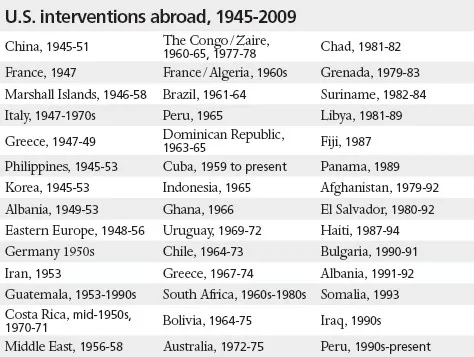
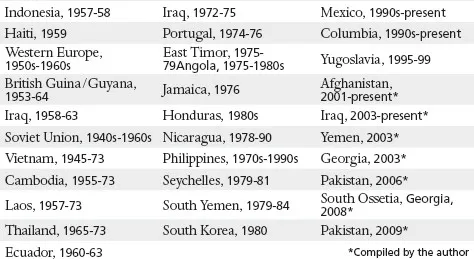
Source: William Blum, Rogue State: A Guide to the World’s Only Superpower
Figure 8.1
Europe, post WWII
The CIA created secret civilian armies that it controlled all over Europe, especially in Germany, after WWII. The operations were rolled into NATO after its creation. The civilian armies engaged in random acts of terrorism which were orchestrated so as to appear to have been carried out by leftists; the goal was to make people fearful of the Soviets and disinclined to vote for leftist communist parties. An example of the terrorist acts was the bombing of the Bologna railway station in 1980, claiming 86 lives.312
Afghanistan, 1979-92
Since the country had a Marxist president supported by the Soviet Union, the U.S. wanted to oust it. It teamed up with the Taliban Islamic fundamentalists to intentionally induce the Soviets to respond. President Carter’s national security advisor Zbigniew Brzezinski stated that “the secret operation was an excellent idea... it had the idea of drawing the Russians into a trap... giving the U.S.S.R. its Vietnam war.” America’s guys, the Mujadeen, engaged in torture that even U.S. government officials called “indescribable horror.”313 Half of the population was horribly affected: 1 million died, 3 million became disabled, 5 million became refuges.
Yugoslavia
The U.S. government supports breakaway provinces (such as Taiwan) when it’s in the U.S.’s interests, but opposes them when they’re not. President Clinton, in reference to Chechnya’s attempted secession from Russia, stated, “we once had a Civil War in our country... over the proposition that Abraham Lincoln gave his life for, that no State had a right to withdraw from our Union.”314 Three years later, President Clinton opposed Serbian president Slobodan Milosevic preventing Kosovo from withdrawing from the Federal Republic of Yugoslavia. Clinton, who promised to be an anti-war president, breaking international law, and under the guise of NATO, bombed Yugoslavia for 40 days, destroying much of the country.
Clinton cited a “moral imperative” for his bombings; but at the same time, America’s ally, Turkey, had for fifteen years been carrying out many of the same abuses against the Kurds as Serbia was against Kosovo. Nor did Clinton spy a moral imperative to stop the genocide in Rwanda a few years earlier. NATO bombings gave rise to most of the deaths in Yugoslavia, provoked most of the Serbian atrocities, created an environmental disaster, and left numerous unexploded uranium and cluster bombs. This bombing, like most, involved the firm expectation by American military planners that many innocent civilians would be killed. Additionally, several hundred thousand were left homeless.315
Palestine
The British promised Palestine to Arabs while simultaneously promising it to Jews for their “National Home.” It allowed Jewish settlers to acquire land (often by bribing government officials) from Britain which it and Turkey had taken from Arab peasants who had traditionally occupied the land, and threw the Palestinians off their land.
Disgusted with trying to manage the conflicting desires of both Jews and Arabs, the British finally withdrew from the region after WWII and left the mess up to the United Nations, where the U.S. exerted a tremendous amount of pressure to partition Palestine, which the U.N. reluctantly acted on. The Partition granted the Jews almost half of Palestine, even though they represented a very small fraction of the population. Afterward, the conditions of this partition were ignored and largely disregarded by Israel, and it began forcefully to acquire much of the rest of Palestine, instigating violence against those in its path. Most of the original Palestinians were eventually driven from their homes and bank accounts. Now they fight to get them back.
Jews and Arabs lived peacefully in the Middle East for hundreds of years. Today, they are constantly at war. The United States helps fund the forces of both Israel and Palestine, but gives Israel over 20 times more.316 It is commonly explained by politicians and the media that Israel is simply defending itself from unfair attacks, and that the Palestinians are no-good terrorists. When Iran (and Arab states) says that Israel has no right to exist and that it should be wiped off the earth, the media and politicians portray these words as nuclear threats (knowing the public will fall for it), when actual translations reveal that Iran is primarily saying that Israel is an illegitimate state illegally occupying Palestinian land, and should therefore cease to exist, at least in that spot.
It is very true and very sad that Jews have been unfairly persecuted for centuries. It would be nice for them to have a safe place of their own (although many ethnic and religious groups are persecuted and do not have the luxury of their own homeland), and I would personally help them to defend themselves from any aggressors. But regardless of the agonizing unfair abuse they’ve endured through the centuries, their homeland should have been acquired fairly. Jews could have acquired the land legitimately through purchase from the rightful owners. In this way, they would be entitled to all the land they could afford, even if they bought all of Palestine and changed the name to Israel! Additionally, if the U.S. was going to give away land, instead of giving others’ land, it would have been better to give away its own uninhabited (and geographically comparable) land in the western United States.
The Middle East Today
This friction between Israel and the Arab world is the root issue of many, if not most, of the problems in the Middle East today (and many of our terrorist threats). And the U.S. constantly intervenes to keep an artificially structured middle east artificial. But almost everything it does simply causes more problems. For example, our current problems in Iraq are of our own doings. The CIA helped bring Saddam Hussein to power, and we funded his war against Iran. He then used those weapons to invade Kuwait, only after the U.S. explicitly gave him the green light to do so. He gassed his people with chemical and biological weapons supplied by the U.S. After helping him, we then felt compelled to attack him because he was a supposed threat to us.
Likewise, we intervened in Iran for years, we knocked off their elected leaders and inserted our own, we bombed their ships, and shot down their passenger planes. Iranians finally overthrew the Shah America imposed on them, and kidnapped its embassy workers.
Iran recently celebrated its 30th anniversary of the ouster of their American imposed Shah. It was also the anniversary of the seizure of the American embassy in Tehran. On that anniversary Iran’s supreme leader Ayatollah Ali Khamenei proclaimed that “hatred towards the US government is deep-seated because of its plots against the Iranian people over the past 50 years...[b]esides, they have not apologised yet and rather keep on their arrogant attitude.”317 He proposed to the new Obama administration that “If you change your attitude, we will change our attitude.”318
Hugo Chavez indicated similar sentiments to Obama at the Summit of the Americas by giving him a book, “The Open Veins of Latin America: Five Centuries of the Pillage of a Continent,” which chronicles western economic and political intervention on his continent (though their own leaders have done far more damage in the last century).
Now that we have ravaged Afghanistan and killed more than a million Iraqis (of course the media, and Americans in general, only care about the body count of U.S. soldiers, as though Iraqis are not real human beings who are just as valuable), we need a new war. So Iran is now once again being made the new poster child for the supposed threat to the world. We have screwed with them for decades, but we call them the ones who are threatening harm.
They are no threat; we are the threat, and they are rightly scared of us. But the U.S. intentionally makes them out to be the menace because it needs a new war, a new reason for the public to “come together” and support our benevolent government who wants to bomb the world in order to keep us safe — perpetual war for perpetual peace. Even though, surprisingly, the American public retrospectively saw that the invasion of Iraq was a sham, they shockingly returned their head to the sand once George W. Bush moved to his next desired war, the one against Iran. Had he stayed in office long enough he probably would have been allowed by the American people to get away with attacking Iran. But what’s also scary is that President Obama and Secretary of State Hillary Clinton are now continuing the fake tough talk and are implying that Iran is somehow a threat.
With respect to foreign countries and terrorists, we have to ask: If we didn’t bother them, what possible beef could they have with a country keeping to itself half-way around the world? Would they want to invade us and take our buildings and homes and ship them to their own country? Do they want to steal our bank accounts (in which case massive amounts of dollar bills flowing into Iran would only raise prices, and dilute the effects of their new wealth)? Do they want to reside in Virginia and Oklahoma instead of their native lands? What do they actually gain? They really don’t have a reason to bother us except for the fact that we make their lives difficult. Moreover, in case a country did attack, doesn’t it make sense that our country would be safer with our forces at home instead of abroad?
President Obama has already decided to send tens of thousands of troops back to Afghanistan. Since almost every president, Democrat or Republican, eventually goes down the war-mongering path, it would not be surprising of Obama to eventually deliver his (contrived) case to the American public, stating how Iran is now the new threat to world safety and must be dealt with immediately... in the name of freedom and security, of course. Oh yeah, and “patriotism” too.
How to Start a War
The politician’s best excuse to get a country into war is an imminent threat of attack by a madman dictator holding “weapons of mass destruction.” This worked quite easily to get America into Iraq in 2003. It is America’s best chance to start a war with Iran or North Korea. Of course, there are currently 29 nations holding weapons of mass destruction.
There are no military threats 99 percent of the time. “Threats” usually consist of either 1) a country building up arms simply because the other is doing so and because each side is afraid the first side will attack or 2) a country being fearful of a military attack only because of the fact that their previous hostile actions have either intentionally or unintentionally brought the threat about. Both of these cases applied to countries on both sides of the Iron curtain during the cold war (after all, the U.S. and its allies did invade Russia in 1918),319 and the former case specifically applies to current U.S. fears of a military buildup in China, and vice versa. Neither case should be a reality to countries which remained neutral and isolationist. As should be apparent from the information in this chapter, isolationism saves many more lives than does “defending” other countries that are aggressed upon.
A solid general tool politicians apply is that of “national interest,” which is simply and cunningly defined to cover every ill and grievance under the sun. Any two groups fighting, anyone starving or anyone with a hate thought anywhere in the world, and especially, any nation not a “democracy” as we define it is a threat to our “national interest.”
Aggression usually starts with sanctions. This allows a step-by-step escalation of intervention, since immediate bombing or invasion does not go over well for most Americans. Our government first needs to cut off supplies to a country, starving its citizens.320 Then, we impose “unconditional” surrender or “unconditional” compliance with our demands. Knowing our extreme and outrageous demands will not be met, we can then claim that they are not being peace-making and are still a threat. Then, we can bomb and invade. Troops are usually sent first as “humanitarian aid, with a gun in one hand and a food packet in another.” When the locals reject our benevolent help and start firing at us, then we go in with orders to kill. When there is no need to make an affair public, funding an opposing group or taking out the current leaders of the country in question via secret operations can do the trick.
Since most countries don’t measure up to America’s high moral demands upon them, there are usually plenty of dirty countries for us to clean up. With bombs and tanks we can impose “human rights,” “multiculturalism,” “freedom,” “free trade,” and “democracy.”
The Need for War and the Terrorist Threat
Once the cold war ended in 1990, our massive defense program, which consumes one-fourth of all government spending, needed a new excuse in order to retain its unbelievably bloated size. The defense department needs a justification to exist. It needs a reason to “protect” citizens and to keep its extraordinary power. Allowing peace to exist would mean that many of our politicians and military personnel, all of whom are simply government workers, would have to be workers in the real world producing wealth instead of destroying it.
For well over 40 years, the U.S. was always fighting the supposed communist threat. Now, the excuses are terrorists, a Hitler-like madman (or even just a really offensive guy), or the war on drugs (ignoring our partners’ own drug trafficking).
A common excuse for military buildup is the likelihood of an imminent attack from North Korea. This supposed threat has been trumped up for decades, and its heightened intensity usually corresponds with either the annual Congressional debates on defense appropriations or talks between the secretary of defense and South Korean defense officials. We sometimes hear that troops are amassing on the border just north of Seoul. But more than 75 percent of North Korean troops have been “massed” on the border of South Korea since the late 1970s, in response to new and threatening U.S. nuclear strategies.
Terrorism is the best excuse, because it can be pointed to anywhere and everywhere: secessionists are fighting with the only tools they have with which to gain independence — with car bombs and the like — against a massive, highly-armed state? Terrorism! Nationals are fighting to stop the U.S. from overthrowing their government? Terrorism! A government official was murdered as a protest to a CIA assassination or an arrest of a rebel leader fighting to end U.S.-backed suppression? Terrorism! When Middle Easterners attack the West as revenge or protest for U.S. government actions, we call it terrorism. When the CIA operatives or its client states terrorize others, or when America bombs a country for days on end, it’s called fighting for freedom or fighting the war on terror. Blum shows in his book that most well known terrorist attacks can be traced back to the groups the U.S. trained in Afghanistan against the Russians.
Osama bin Laden himself has stated that his beef with America and the West is based on our previous actions in trying to manipulate the world. He even suggested reading Blum’s book. Similarly, six of eight Muslim men found guilty in 2008 of plotting to bomb multiple airliners claimed in video tapes that their attacks served as revenge for Western actions. One bomber said, “This is revenge for the actions of the USA in the Muslim lands and their accomplices such as the British and the Jews.”321 Another said that “Osama [Bin Laden] has warned you many times to leave our lands or you will be destroyed, and now the time has come for you to be destroyed.”322 A third one stated, “If you want to kill our women and children then the same thing will happen to you. This is not a joke. If you think you can go into our land and do what you are doing in Iraq, Afghanistan and Palestine and keep on supporting those that are fighting against the Muslims and think it will not come back on to your doorstep then you have another thing coming.”323 It does appear as though Al Qaeda doesn’t seem to attack countries or peoples who do not appear to aggress upon them: Switzerland and Norway, for example almost completely stay out of international political and especially military efforts, and are not targets for terrorists.
Blum also shows that America itself literally harbors terrorists. Many of those involved in terrorist acts in Latin America, under the direction of the CIA, now live safely in America, protected by America. Blum particularly cites Cuban exiles in Florida who regularly engage in terrorist attacks in and around Cuba.
Why Not Stop Our Part of the Terrorism?
In the mean time, the West and the terrorists continue to play the silly game of attacking each other because the other attacked them. Why don’t we just stop playing and see what happens? The best thing President Obama could do is to bring home our troops from around the world, apologize for any unfairness or wrongdoings (I know: that doesn’t sound tough enough, and we have to save face for some reason), and strongly state that the U.S. will engage in absolutely no military operations unless the U.S. is attacked after this point. If there’s an attack after that, we can tear apart those responsible. But why not see if much of the world violence, and threats against the U.S., might stop if we quit perpetuating the cyclical game of tag?
It is interesting that right-wingers hold Germany to be the sole guilty party of WWI, when it did not start the war, and when it was compelled to attack — after its southern border had already been threatened by Serbia — before it was itself attacked. They do not consider the imminent threats that forced Germany into action. Yet, these same people call daily for the U.S. to take action against soon-to-be-aggressors, namely terrorists. They refuse to recognize that Germany’s actions were linked to a pending threat, but constantly use threats to justify America’s military actions around the world. And just as these people refuse to acknowledge any political or military actions that could have caused Germany to become engaged in either of the world wars, they refuse to recognize any previous political or military actions by America that could cause terrorists to hate the U.S. and want to attack us today. We must come to grips with the fact that actions have consequences; that cause has effect.
There do appear to be a group of Muslim fundamentalists who are just nuts and want to do harm to those who aren’t of their religious persuasion or don’t share their ideological beliefs. But I think we can handle them if we’re attacked, and they will likely be less aggressive if they are not aggressed upon by the West. The notion that we’ve got to go get them before they get us, while it sounds all macho and even almost logical, does not consider the laws of unintended consequences. Just as protecting (supposed) neutral and innocent countries such as Poland and Belgium caused those countries (and ours) to suffer more drastically than they would have otherwise, attacking those we think (usually knowingly falsely) will attack us, will likely lead to much more death and destruction, on both sides, than we anticipate ahead of time. And just as throwing money at social and economic problems does not and cannot bring about improvements, so the United States government cannot cure all the ills of mankind.
This chapter (and author) is not intended to be anti-American, anti-Semite, pro-Nazi, or pro-terrorism. It is not desired that these statements express support for any side, as all sides are highly guilty in multiple ways. It’s just to say that we have to call a spade a spade and be honest with ourselves regarding our own role in having created the current world (dis)order. We have to understand that we bring most of our national security troubles on ourselves, just as we do with our economic problems.
There are many who defend most of the numerous conflicts America has been involved in, claiming that in each of these cases, we really did need to get involved with the private affairs of other countries. They claim that many countries would have been taken over and millions would have been killed. But thanks to warmongers and rulers — many of whom America creates — who don’t respect property rights, countries are constantly taken over and millions are killed — even though we do police the world. My argument has been that America actively makes things worse by getting involved, causing many conflicts and more deaths than would occur otherwise. Before confidently refuting my assertions, one should ask themselves whether 180 million deaths last century, and hundreds of millions more physically injured or dislocated, was really the optimal outcome? Do we really believe that had America not intervened in the world wars and private conflicts that there would have instead been 250 million, 500 million, or 1 billion people killed? Was 180 million dead really, truly the best we could have hoped for?
As H.L. Mencken wrote:
When after many battles past,
Both, tired with blows, make peace at last,
What is it, after all, the people get?
Why, taxes, widows, wooden legs, and debt.
Patriotism
Having learned that the government acts in ways detrimental to its citizens economically, and by causing wars, we should ask exactly why we support our politicians, why we support most of our military operations, and why we support our very national identity. In short, we should ask ourselves why we are patriotic.
What is patriotism? What exactly are we supporting when we are patriotic? If the answer is “our country,” does that mean a geographical region which our government has artificially and arbitrarily identified as its own? If so, does our patriotism change when the boundaries change? Should we not have been patriotic toward the southwestern states before we stole them from Mexico? Should the residents there have been patriotic towards the U.S. once they were forced to be citizens? Should the citizens of the various countries of the Soviet Republic have been patriotic to the U.S.S.R after they were forced at gunpoint to be countrymen? Should the citizens of Czechoslovakia — who were forced together by Wilson — have been patriotic towards the Czech Republic or to Slovakia after the nation split up? Geographical borders are only imaginary, temporary, lines.
Is patriotism instead the act of being loyal to the land itself, specifically the land upon which one grew up? If so, should someone who grows up in Nevada but moves to Connecticut for their career be patriotic towards Nevada or Connecticut? One might reply that the answer is both, since one lived in and identified with both regions. If that’s the case, what if one grew up in the U.S., but had a career overseas in South Korea teaching school or working for a multinational corporation? Is it bad if such a person is also patriotic towards South Korea? What if I have lived in France and learned to love the people and the land and actually prefer France to the U.S.? To whom should I be patriotic, to France or to the U.S.? Am I unpatriotic to favor France? If so, were our forefathers unpatriotic to want independence from their native Britain and make America their new home? We Americans don’t seem to think so now. But if the Latinos of Miami wanted to make Miami their own new Cuba by seceding, or if the southwestern states wanted to secede from the nation as a separate country or once again become part of Mexico, we would call them traitors.
Or is patriotism based on a connection to the people of a nation, to our fellow citizens? If so, should I be loyal to Americans because they are my compatriots? Why should I? It is my very patriotic neighbors who democratically vote to take my property and give it to someone else against my will. It is my neighbors who vote for regulation and government intervention that makes my life worse. It is my fellow citizens who vote for politicians that create wars and send millions of their own citizens to die.
Naturally, our government leaders call stealing from our neighbors patriotic. In 2008, Joe Biden said, “it’s time [for the rich] to be patriotic... time to jump in... time to be part of the deal... time to get America out of the rut.”324 Many people in fact do believe that the rich need to pitch in and help us innocent workers who are in this rut — a rut created by Biden and other government officials by their policies of printing money, spending more than they can steal from citizens, and in many other ways destroying our wealth and bringing on economic crises. It is a rut which was created because we voted yet again for the same bad policies of the last 100 years. Biden implicitly says the wealthy are using too much of their money to provide us with goods and jobs. They should instead turn their assets into cash and give it to us to consume. Thus, according to Biden, it’s unpatriotic to provide the things which improve our lives. Conversely, it’s patriotic to squander all our wealth. If this is patriotism, we should all be anti-American. Most Americans support these terrible ideas and support terrible politicians like Biden who cause this harm. The same applies to politicians and citizens in every country. Why should one be loyal to such people?
The people of Argentina — and other Latin American countries — face massive economic crises caused by their thieving politicians every decade, crises that involve hyperinflation that wipes out their life’s savings, creates banking crises, mass unemployment, massive national debt, and general suffering. They have endured human rights abuses, political persecution, subservient judiciaries, lack of accountability, widespread corruption, virulent demagoguery, social upheaval, and the absence of individual economic rights for centuries. Yet Argentineans are incredibly patriotic and proud of their nation. Citizens of Mexico and Cuba risk life and limb to escape to the United States in order to find work and survival, since their fellow citizens and government offer them few opportunities at home for prosperity. Yet both of these peoples proudly display their native flags while in exile. Citizens of Germany and Austria have been led into war over and over with millions of fathers and brothers killed, yet they are historically always patriotic and ready for the next war (though since WWII they have been largely antiwar). Why should any of these people be patriotic? Exactly what are they supporting by being devoted to their country?
Patriotism is an abstract notion with no real substance. It means nothing; it’s just a façade, a fake, imaginary glue that keeps a people naively devoted to causes, countries, governments, and neighbors who usually bring them harm (the phrase “come together” is similarly ambiguous and empty). National borders mean nothing. They would not exist without government force, and they are usually laid out for reasons of politics and power, not in accordance with the religions, identities, culture, or preferences of individuals. Time and again, decade after decade, borders change. The people on each side of a new border are supposed to be loyal to people within their new border, and to the new government forced upon them. They often resist and want their previous identities back. It is for this reason, and for reasons of freedom and self-rule, that regions such as Chechnya, Georgia, Palestine, Quebec, Northern Tibet, Taiwan, Sri Lanka and Kosovo, among many others, often fight for independence. More often than not, those who fight for freedom (and for socialism, incidentally) are called freedom fighters, but they are labeled terrorists by those who oppose their separation. In today’s America, patriotism, effectively, is the act of aggressing upon other nations; it is the act of stealing from our fellow man in the name of furthering our prosperity, while in fact destroying our prosperity. It is under the name of patriotism and supposed freedom that it is justifiable for the U.S. to attack citizens of any country, including its own.
Patriotism is usually the cause of many of our problems, not the solution to them. And as time passes, we become more obsessed with it. Now, a government official, or even football players and referees, cannot appear in public without an American flag on their lapel or jersey. Soon, it will be required that each of our cars have the yellow or red, white, and blue ribbon sticker plastered on it (for the few that don’t already) — and such things have certainly happened in this country previously. We must all show that we are, as Biden said, “part of the deal.” It is reminiscent of Nazism, where all citizens swore allegiance to their ruler and proudly saluted and waved the Nazi flag in the name of nationalism; they lived and died for the glorious fatherland (Figure 8.2). We are only several steps behind them.
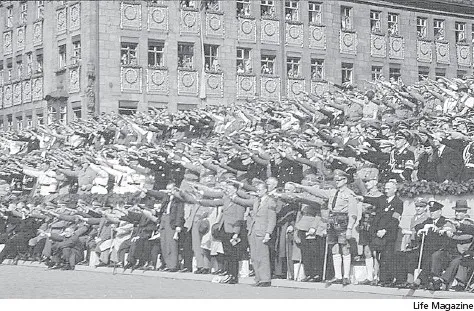
Figure 8.2: German Citizens Supporting Adolf Hitler and his national cause.
The right-wing radio hosts further this cause by obsessing about why we need to protect ourselves from aggressors and terrorists and fight for our freedom. In truth, there would be little to no protection needed if we would just leave the rest of the world alone. And not only do Republicans not offer us freedom through the economic and social policies they propose, but they cause us to lose freedom at rapid rates during times of the wars they sucker us into. The patriotism charade is now at the point that these talk show hosts tell each caller (that they agree with) that they “are great Americans,” and each caller, in return, tells the host that he, too, “is a great American.” One wonders how they don’t feel just a bit silly with such melodramatic antics.
And when all of “our boys,” our “heroes,” are at war, willingly taking money to go and kill other people around the world, many of us blindly “support our troops.” It does not matter whether our troops are actually helping or harming us, or saving people or destroying them: since they are American troops, we should support them... just as the German people blindly supported their Nazi troops simply because they were German.
Patriotism leads people in each country to think that their country is superior to others, and that their country must survive and prosper at all costs — even if it means death to people in other countries. Patriotism breeds an “us versus them” attitude. Without the notion of patriotism and national borders, people would live wherever and however they prefer, practice religions they want, marry whomever they desire, and produce, exchange, and prosper in whatever way they see fit. (There does need to be, and there would be, a governing body, just not a single one with monopoly powers of enforcement and control.) We would not see ourselves so much as members of particular groups (nationalities), but as various people of the world. And yet we are forced by law to “celebrate” diversity in our government-controlled world. In absence of government borders, people would more easily mix and mingle in the world and not look at each other as “those other people” but instead naturally look at them as their neighbors. Those who wanted to be racist or simply to keep to their own kind would be able to do that, too, on as much property as they could peacefully acquire through exchange.
People could quickly rush to judge me as unthankful. They could say that I should be grateful that my country has permitted me the level of freedom that it has, which is in fact far in excess of most countries, even if it diminishes by the month. Indeed, I am grateful to be lucky enough to live in a place that offers relative freedom. But this is not a reason to be loyal. If it were, we could also argue that a wife who gets beaten up periodically by her husband who threatens to bring much greater harm to her if she tries to leave him, but is otherwise treated well and quasi-lovingly by him, should also be loyal to him. She should in this case be thankful that he allows her a relatively normal life, even if he threatens to use force against her and periodically does. This thinking is wrong. No one should be loyal and patriotic to someone who allows them to be mostly free but still treats them unfairly. Freedom from harm and coercion should be a natural right, not something granted by those good enough not to kill us or keep us as slaves. This is why, for example, it is still illegal and unacceptable to forcefully hold women against their will or to strike a fellow man as an initiating aggressive act. Aggression is aggression, even in a free society.
The Ills of Democracy and Political Parties
Political parties in every country have their “schticks,” and each one usually entails some form of socialism. In the U.S., the Republicans’ agenda consists of imposing their hypocritical and extreme religious beliefs on our country and causing wars, killing, and setting up dictators in other countries. The Democrats’ agenda involves deliberately trying to destroy our means of increasing our standards of living, and trying to equalize everyone by dragging us all down to the lowest economic common denominator. These issues are the things each party merely focuses on; but, in fact, both parties promote most of the same policies. Both of these groups, along with every other form of government, engage in the use of force to make people live and act differently from what they would otherwise choose, and to make them hand over much of their personal property once it’s been fairly earned. Regardless of the fact that Republicans (and Democrats to a lesser degree) claim to be about free markets and capitalism, they are not. Republicans are socialist and totalitarian just like the Democrats. Individuals fervently support their respective Republican and Democratic parties, and see the other party, which they detest, as supporting reprehensible views. In the bigger picture, Republicans and Democrats are virtually side by side on the political spectrum that runs from Communism (full socialism) on one side, to free market capitalism (complete freedom) on the other. Both parties, for example, recently had their respective plans for government bailouts, and for nationalizing our healthcare system.
Our society is always proud to support “democracy” as though it automatically equates to freedom. But freedom is not necessarily related to democracy and may or may not coincide with it. A dictator, such as Pinochet in Chile, can create largely free markets, and a democracy can create near or complete totalitarianism, as was the case with the democratic election of Adolf Hitler and more recently with that of Hugo Chavez. Democracy can really be reduced simply to a method of voting, one which allows the expropriation of the property of others — “the tyranny of the majority.”
Though it is socialists of one stripe or another, be they Fascists, dictators, Communists, or Democrats who have begun every war in the last century, killing hundreds of millions, who have strictly and often violently controlled and directed individuals in their respective countries, and who have caused starvation, unemployment, and suffering of millions for decades, it is socialism that most people in the world cling to as something that will help them. Mild socialists (your average Democrat or environmentalist), curiously, think that extreme socialists (communists) are bad, even though communism is just an advanced state of the policies socialists adamantly support.
After World War II our economists and government officials were impressed with the socialist system that destroyed Germany’s economy, and they wanted to replicate it for the economy of the new West Germany. Thankfully, West German leaders, aware of this, and aware of the destruction that Nazi economic policies had caused, through twists and turns, set up a system of relatively free markets which brought dramatic economic growth for the next thirty years (overcoming the negative effects of the Marshall Plan325). People support the evil of socialism because, ironically, they fear that individual companies — which have rarely, if ever, had anyone killed, and which, absent government regulation, have never taken anything forcefully from anyone, and could not only not bring harm, but provide improvements for our lives — can somehow hurt them. All because they don’t understand what capitalism is and how it works.
The Patriotism of Politicians
While politicians claim to be patriotic and to do what’s best for America, they do the opposite. How could they know what would truly help or hurt American citizens? Have they spent years studying economic cause and effect? Have they learned production techniques that could result in greater output? Have they read numerous books on organizational behavior, so that they can “plan” the economy? Of course not! They have spent their days kissing babies, polling to find out what voters want, learning to be actors, and making emotional, passionate speeches that appeal to the masses who will be suckered into such antics. In short, politicians are equivalent to game show hosts. If they were really patriotic, they would spend their time figuring out how truly to help people, instead of simply figuring out how to win votes.
We naively believe politicians are there to “lead us.” We believe that the president, in “running the country,” has the toughest job on earth. This is partly because people who do not understand economics believe that a country cannot “run” on its own. But it can. It is the individual people and businesses that progress our lives. The president does not get up in the morning and turn on the factory lights or start the machines. He does not determine how much should be produced that day. He does not decide who should work where. Individuals, capital, and market prices run the country. President Obama is not “leading” us through this crisis — he’s simply manipulating the economy further than it was already manipulated. Had he not done so, the market (i.e., individuals) could have already fixed itself.
We have seen that the government’s planning does not help an economy. We have seen that regulation does not protect citizens from companies, and that military actions do not protect citizens from foreign aggressors (except in special circumstances). Of course, some of the actions the president engages in involve setting or adjusting laws pertaining to protecting our legal rights and our legal property. But most of his actions involve just the opposite — taking our property or preventing our free will choices. For example, there are laws that prevent gangs from barging into our homes and kicking us out of them; but, at the same time, there are many more laws linked to how our homes will be taken from us by the government if we fail to pay one of the myriad taxes forced upon us — taxes that legally allow our property, our paychecks, to be given to others, including these very gangs, via wealth redistribution.
The same type of “work on behalf of the people” is done by all members of Congress and the Senate, and to a lesser degree by state and local government. The country would get along quite fine any given year if congress and the president ignored all of the “work” it would otherwise do, except for focusing on the 1 percent or so of the decisions that involve truly protecting citizens and providing basic services that we want and need. Most of the other 99 percent of their work involves imposing implied or actual government force for the purpose of benefiting one group at the expense of another. The government is simply an institution — an instrument — that is used to bring about these iniquitous actions.
Politicians’ “work” involves doing what is needed to please their constituents. Their constituents, in turn, usually want government subsidies, regulation, wealth transfers, or some other government force imposed, so that they can benefit from the suppression of others when they otherwise could not. Almost everything we see government doing today consists of this: bankers, car companies, airlines, and steel companies are subsidized at the expense of taxpayers so that they don’t have to go out of business; workers are protected from having to receive market wages; poor workers are protected with a minimum wage; companies are regulated so that they don’t harm consumers; government forces the negation of contracts such that borrowers can benefit at the expense of lenders; inflation is generated so that more money can be taken from taxpayers and given to others; environmental legislation is imposed in order to let environmentalists “protect our environment” at the expense of the rest of us; one industry is prevented from producing a particular product so that another industry’s profits will not be affected. The list literally goes on and on for tens of thousands of pages (in the national register).
Though all of these actions are detrimental to society, politicians don’t care. What they care about is getting votes. They care about getting re-elected. They will therefore do what appears to help voters, even though their actions usually harm voters. The long-term health of the country is not in their interest; the short-term success of their career is. They do not know exactly what would help or what would harm, but they need not be concerned with such immaterial matters. This is why it is so vitally important for voters themselves to understand what helps and harms them. If voters would demand of politicians the things that would truly benefit them, politicians would give it to them, for they would pass or not pass whatever laws would get them votes.
If people demanded that government quit printing money, quit regulating businesses, quit taxing, and stopped stealing from the rich, the government would cease these operations. Then, all members of society would see a dramatic increase in their standards of living, with jobs available to everyone and prices falling by the day. But there is a catch: those of us who earn less than the average — those who are net beneficiaries of wealth redistribution — would have to clearly understand how they would benefit from refusing to vote for free money. They would have to understand that, instead of having money handed to them, they would instead earn money in the form of a salary. But this change in structure would result in significantly increased wealth for this group. This issue is likely the biggest challenge free markets face, for it is very difficult to convince someone that if they refuse free money they will be better off.
A Proposal to Divide Up a Nation
Since most Americans do not understand how prosperity is created, and since we have different views on how our rulers should rule us, we constantly group into political factions (Democrats, Republicans, Greens, Communists, Libertarians, etc.) and fight each other in order to get the kind of system each group wants by trying to take control of our one, single, monopoly government. The winning group gets much of what they want, but their gains are diluted because the winning politicians must keep in mind the wants of the opposing groups, since they consist of career-affecting voters. Politicians are constantly juggling the wants of these different groups.
This is, for example, why Iraq is in such a mess today. Saddam Hussein, for all his evils, was good at giving the different Iraqi interest groups many of the various things they wanted. Today, the U.S.-based regime leaves many of these groups alienated, causing them to rebel and terrorize. But like most countries, Iraq is one whose people are comprised of different religions, ethnicities, and desires, but currently forced to consolidate against their will under one umbrella. Therefore, Iraq should be allowed to be broken up into different provinces, leaving its people to join the regions that they would prefer.
Since the United States, too, is comprised of different interest groups fighting for the kind of government and rule each group desires, instead of competing, why shouldn’t we allow the United States to be divided into different provinces, where self-rule according to the desires of each province is permissible? It would really not be dissimilar from our original structure of having the individual states be mostly autonomous entities.
If we truly support freedom, why shouldn’t we be able to live as we choose? The current answer is that we can’t, because our neighbors would like to live differently from us. To solve this problem, why not let our neighbors live as they choose on their property (in their province), and let us live as we wish on our property (in our province)? The 50 states or even portions of states could be grouped into as many different provinces as needed, based on the number of different groups who wish to self-rule as they like. One region could be for communists, another for their cousins the socialists, and others for the greens and the free marketers. The overarching protocol would be absolute self-rule, free from any influence from a centralized federal government. The free market region, for example, would have its own monies that would be unrelated to the Federal Reserve’s U.S. dollar; it would have its own laws, with absolutely no control whatsoever by the government of any other region; there would be no central government connecting all provinces, unless a province chose to join with another for centralized control.
Since each political group thinks that its way is the best way to run a country and believes its system leads to people being better off than under other types of systems, such a simultaneous experiment testing different economic/political models, starting from an equal base, would be an objective way of proving which system truly creates a better world for its citizens (though the division of East and West Germany already proved this).
There would naturally be some concerns over what it means to divide up a nation. In the first instance, there would be concern over resources. This is not a problem. The free market region needs none; so those of us who would choose to live in that province would be happy taking the geographical area of fewest resources, and would even take the smallest piece of the pie. Give us the Arizona desert, for example! We will engage in trade for the resources we need, and within a few years, the Arizona desert will look like Beverly Hills. So that they can have better lives, we will also welcome the homeless, the poor, gays, minorities, the uneducated, Jews, Muslims, and, due to an open immigration policy, anyone else from anywhere in the world. The Communist region could try to be self-sufficient, as Communists would naturally choose. They could create scores of jobs by building automobile plants, steel mills, oil wells, mines, and power grids. The socialist region could have a mix of the free market and communist regions. The green region could take down the concrete and steel buildings and parking lots they often complain about and plant grass and trees and live off the land.
But what about the logistics of having millions uprooted and moving across the country to their desired region? Americans are already pretty mobile and rarely stay in the same place all their lives. Perhaps most would be very willing to move in order to live in the way in which they chose. Others could remain where they are and see how it goes (except that those in the communist region would not have a lot of time to decide, since the communist government would inevitably put up borders and take away passports to prevent people from leaving). There would still be people who would have to choose between moving against their will or living in a way they would otherwise reject. But acting and living in a way that is against their will is what most people have to do today under our current system. Otherwise, most details can likely be worked out.
The Case for Legalizing Capitalism
Read the whole book online · Book details
This work is published under a Creative Commons licence. You may copy, share, and re-host it with attribution.